Claude Didn't Solve Riemann. It Moved a 41% Wall.
An unreleased Claude model raised the proven share of zeta zeros on the critical line from 41.6% to 67.2%. What it is, how it was made, how far it's checked.
The most important sentence first: the Riemann hypothesis has not been solved. The Clay Mathematics Institute’s million dollars is still where it was.
When I wrote this story up in August, all I said was that the model “significantly raised the lower bound of solutions”. That isn’t wrong, and it says almost nothing. The lower bound of what, from how much to how much: the original didn’t say, because at the time I’d only read news coverage.
This time I read Anthropic’s own account and looked at the formal proof it put on GitHub. The result is much more specific than “raised a lower bound”, and much more interesting. There’s a number that mathematicians spent 46 years grinding from 33.3% up to 41.7%, and a Claude version that doesn’t have a name yet pushed it to 67.2% in a day and a half.
What does this result actually say?
The Riemann hypothesis is about something called the Riemann zeta function. That function has infinitely many “nontrivial zeros”, and the hypothesis says all of them lie on a single straight line in the complex plane, called the critical line.
Nobody can prove the “all”. So mathematicians settle for a weaker question: what proportion of the zeros can we at least prove are on that line?
The lower bound on that proportion has a long history:
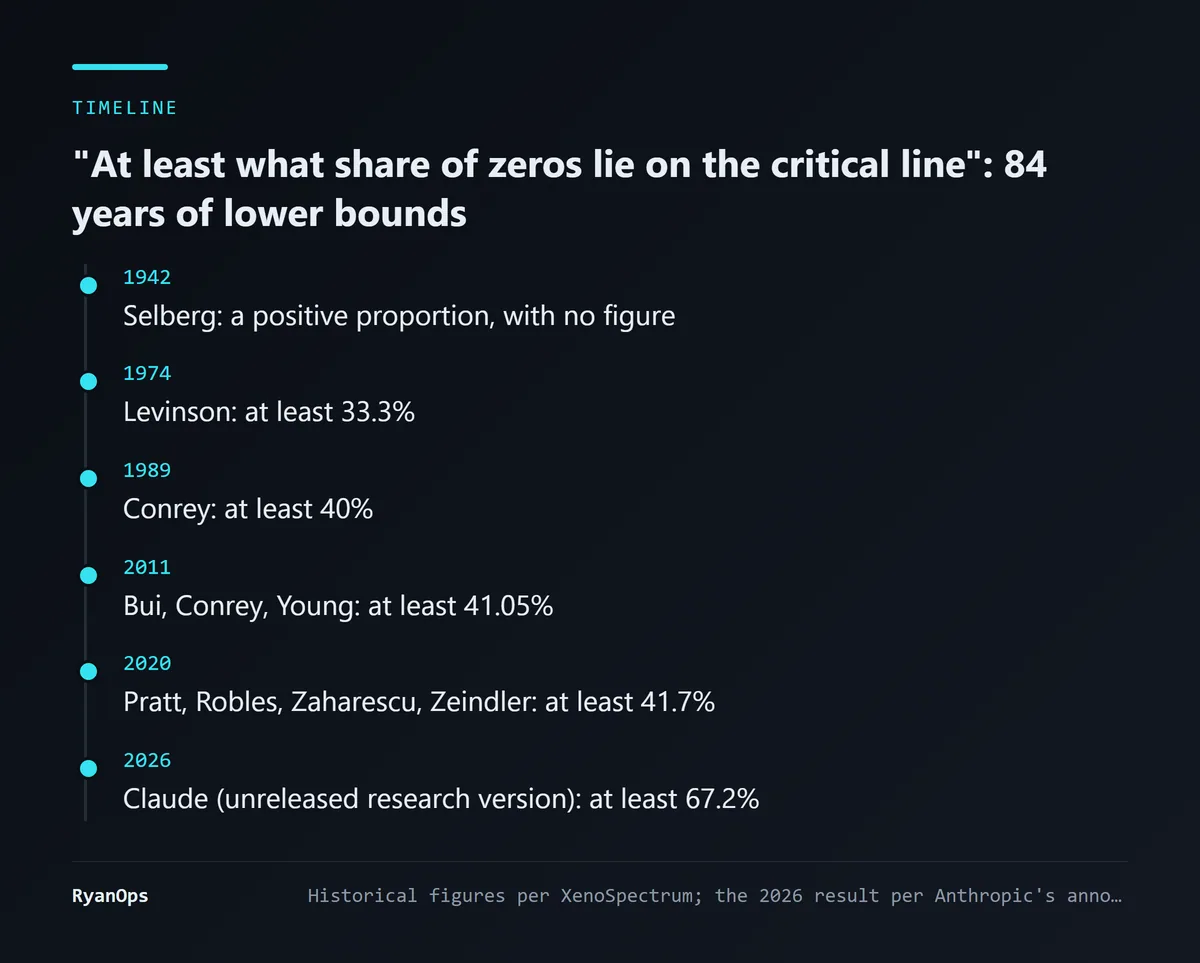 Figure: the history of the lower bound on zeros on the critical line (compiled for this article; historical figures per XenoSpectrum, the 2026 result per Anthropic’s announcement)
In 1942 Selberg proved the proportion is greater than zero. In 1974 Levinson pushed it to a third. In 1989 Conrey pushed it to 40%. Then it got very slow: 41.05% in 2011, 41.7% in 2020. XenoSpectrum’s report does the arithmetic: from 1974 to 2020 the bound rose by an average of 0.18 percentage points a year, and it describes the low-41% range as the ceiling of the existing approach (the mollifier method).
Anthropic’s announcement gives the previous lower bound as 41.6% and the new one as 67.2%. (The figure above shows 41.7% for 2020; the two numbers come from different sources and differ by 0.1. I’ve listed both as given.)
Note what the number means. 67.2% is “at least”, not “exactly”. It doesn’t say the other 32.8% are off the line, only that this is as much as can currently be proved. The Riemann hypothesis needs 100%.
Isn’t that a big step toward solving the hypothesis?
No, and Anthropic says so in plain words. The announcement’s own sentence: “We don’t expect that the techniques Claude used will lead to proving the Riemann hypothesis.”
I think that’s the sentence in the whole announcement most worth quoting. A company announcing a mathematical result from its own model volunteers that this road doesn’t reach the destination.
The reasoning goes like this. The methods that move the lower bound from 41% to 67% are, at bottom, estimating how many zeros are on the line. Push methods of this kind all the way to 99.9% and they still couldn’t prove that no zero lies off it. That requires an entirely different idea.
So the correct reading is this: it’s an independent, meaningful result in number theory that happens to be related to the Riemann hypothesis. It isn’t a progress bar for the big problem.
How was it made?
The process is the part I enjoyed most, and the August article got one thing wrong about it.
The person who started it isn’t a mathematician. Anthropic employee Jarred Sumner asked Claude to “take a real stab” at the Riemann hypothesis and left every mathematical choice to the model.
The first attempt failed. Claude generated and tried 650 ideas, and none of them worked. The August article wrote the “650 ideas” and the later success as one event; in fact 650 was the failed round.
The second attempt took a day and a half and used about 60 subagents. The division of labor:
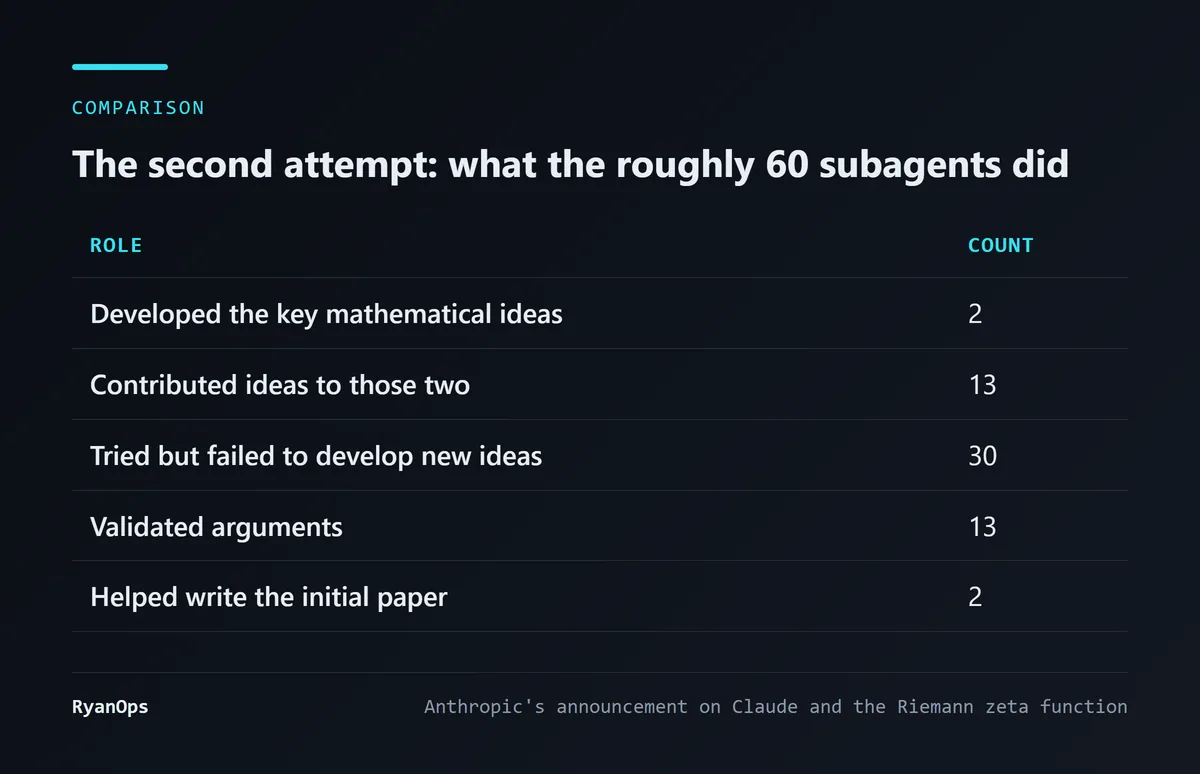 Figure: the division of subagents in the second attempt (per Anthropic’s announcement)
Two things in this table are worth a look.
First, only 2 actually produced the key ideas. Thirty came up empty, exactly half. That ratio is a lot like a human research team, where most attempts go nowhere.
Second, validation took 13, the same number as those contributing ideas. It spent no less effort on checking than on coming up with ideas.
The workload the announcement lists: about 2,400 shell commands, hundreds of Python scripts, and thousands of numerical checks against known zeros. The two Claude Code sessions together used about 31 million output tokens. The opening of the August article wrote that as “310 thousand”, off by a factor of a hundred, and it’s corrected here.
As for what it did mathematically, I can only relay it. It joined several existing lines of research: Montgomery’s 1973 techniques (which required assuming the Riemann hypothesis first), work by Aryan and by Baluyot, Goldston, Suriajaya and Turnage-Butterbaugh that made those techniques work without the assumption, plus a 2000 paper by Bombieri. Anthropic says the key step was treating the whole space together and allowing a non-diagonal quadratic form. I can follow the words of that sentence and not why it’s the key, so I won’t explain further.
What did the human contribute?
This is the best detail. The announcement says Sumner’s input was “mostly encouragement”, things like “keep going” and “believe in yourself”. Anthropic says this helped Claude overcome its initial skepticism.
In other words, the model didn’t believe at first that it could do it. One line in the announcement: “Even Claude was surprised by its own finding.” And another, a little self-mocking: perhaps Claude, like many of us, underestimates the rate of AI progress.
A footnote adds that the same kind of encouraging prompt was used for something else: getting Claude to attempt to disprove the Jacobian conjecture.
It’s a detail I’ll keep in mind. Two months later Anthropic published a report on models “working around restrictions” in evaluations, calling that behavior persistence. The same tendency not to give up is a virtue on a math problem and becomes a problem in front of a web page that’s blocking you.
Has this result been checked?
This is the part I most wanted to pin down. When an AI says it proved something, why believe it?
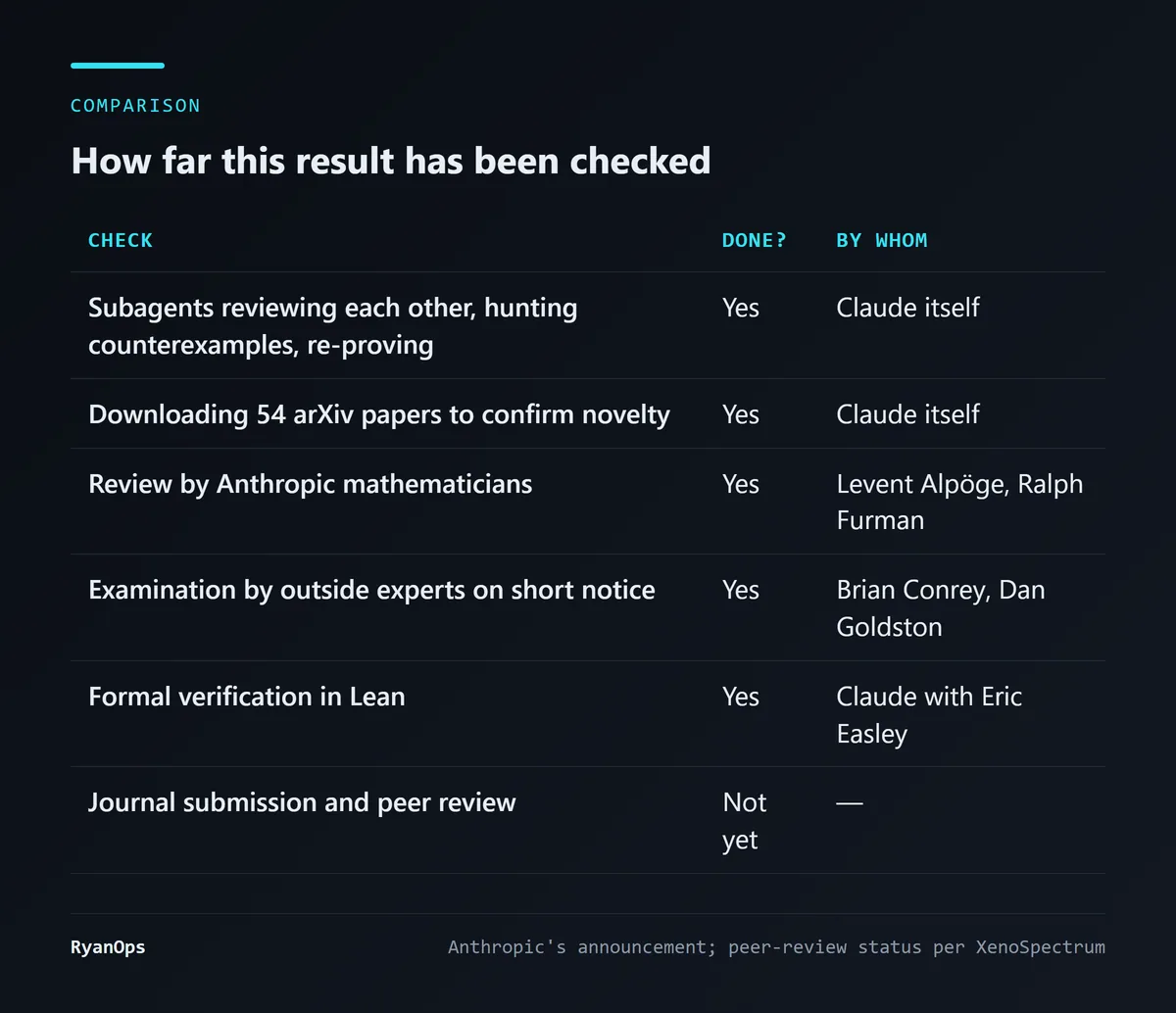 Figure: how far this result has been checked so far (compiled for this article from Anthropic’s announcement and XenoSpectrum’s report)
Layer by layer.
What the model did itself: subagents reviewed each other, searched for counterexamples, re-proved the result independently, and downloaded 54 arXiv papers to confirm it was new. Then it recommended that a human number theorist validate it.
Two mathematicians at Anthropic, Levent Alpöge and Ralph Furman, examined the work and wrote a short note for experts.
Outside, two specialists in this area, Brian Conrey and Dan Goldston, examined the paper “on short notice”. Conrey is the one in the history figure above who took the bound to 40% in 1989.
Last is formal verification. Claude, working with Anthropic’s Eric Easley, wrote a machine-checkable proof in Lean and put it on GitHub. I went and looked at that repository:
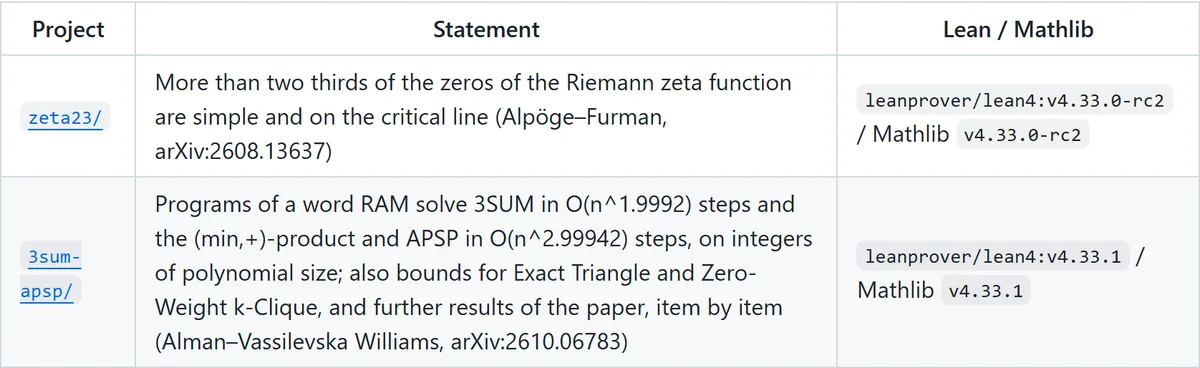 Figure: the description of Anthropic’s public Lean formalization repository (source: github.com/anthropics/zeta-23-lean)
The repository’s name, zeta-23, refers to two thirds. The statement in the table has one more word than the press coverage: more than two thirds of the zeros are “simple” and on the critical line. The table attributes the statement to Alpöge–Furman and gives an arXiv number.
The README spells out what counts as passing for this project: it builds on a pinned toolchain, there’s no sorry (Lean’s placeholder for “skipping this for now”) outside the trusted statement files, and it passes an independent check called comparator.
What Lean verification guarantees needs stating precisely. It guarantees that from the premises as written, by legal logical steps, the conclusion as written really does follow. It doesn’t guarantee that conclusion is the mathematical proposition everyone thinks it is. If the statement is written wrongly, Lean passes anyway. That layer of judgment still needs people, and it’s what the mathematicians above did.
What hasn’t been done is the traditional step. XenoSpectrum points out that the result has not been submitted to a journal or been through formal peer review. Two outside experts examining it on short notice is a different kind of thing from journal refereeing.
My judgment: for a mathematical result that has just appeared, this level of checking is high, higher than most preprints get. The formal proof is strong evidence. But “accepted by the mathematical community” can’t be said yet.
How do mathematicians see AI doing mathematics?
This isn’t the year’s only case. TechCrunch’s report mentions three others: a number of Erdős problems were solved by AI models this year, OpenAI released 10 major results proved by its internal Astra model, and a separate Anthropic effort disproved the long-standing Jacobian conjecture. I didn’t look into the details of each of these, and list them only as reported.
The reaction is split.
In June this year a group of prominent mathematicians signed the Leiden declaration. TechCrunch quotes its core claim: true proofs should be “attributable to specific authors who take credit for their discovery and assume responsibility for their correctness”.
Fields medalist Timothy Gowers, in a post responding to the declaration, is more open. He says that if theorems are one day no longer tied to particular mathematicians’ names, maybe that won’t be any more problematic than the fact that stars aren’t named after astronomers.
This result sits squarely in the middle of that argument. The model has no name and is an unreleased research version. The formalization repository files the result under the two human mathematicians who reviewed it. The person who posed the question doesn’t know the mathematics, and his contribution was saying “keep going” a few times.
So whose theorem is it?
My own view is that the “responsibility” the Leiden declaration worries about does have someone carrying it in this case: Alpöge and Furman put their names on it, which amounts to vouching for its correctness. That’s a workable arrangement, with human mathematicians reviewing, signing and taking responsibility, and what the AI did written down clearly. It isn’t elegant, but it answers “who do you go to if it’s wrong”.
Credit is the harder question. If a result’s key ideas came from 2 of 60 subagents, and those subagents ceased to exist once they were done, I don’t know whether the word “discoverer” still applies.
The limits of this article
- I can only relay the mathematical content and am not able to judge independently whether the proof is right.
- The historical lower bounds come from XenoSpectrum’s compilation, which itself gives both 41.6% and 41.7% for the 2020 figure.
- The process details (the division of subagents, token counts, the encouraging prompts) all come from Anthropic’s own announcement, with no independent source. The announcement was updated once on August 13 with a rewritten paper.
- The model is an unreleased research version, so nobody outside can rerun the experiment.
- For the other AI math results (Erdős problems, Astra’s 10 results, the Jacobian conjecture) I only quoted TechCrunch’s one-sentence descriptions.


