Gemini Hit 1 Billion Users. Counted How, Exactly?
Google says the Gemini app passed 1 billion monthly users. The growth curve, what the number counts and omits, and why another dataset shows ChatGPT at 80%.
On August 11, Google announced that the Gemini app has more than 1 billion monthly active users. Two months earlier, ChatGPT was reported to have crossed the same number.
News stories usually end right there: both passed a billion, the race is heating up.
When I rewrote this piece I checked one step further and found that these two “one billions” can hardly be set side by side. Different people said them, they’re calculated differently, and even the unit of time differs. Better still, in another firm’s September statistics ChatGPT holds about eighty percent and Gemini just over ten.
All three sets of numbers are real. They’re measuring different things.
What exactly did Google announce?
The news came from Google’s official account, quoting a post by CEO Sundar Pichai:
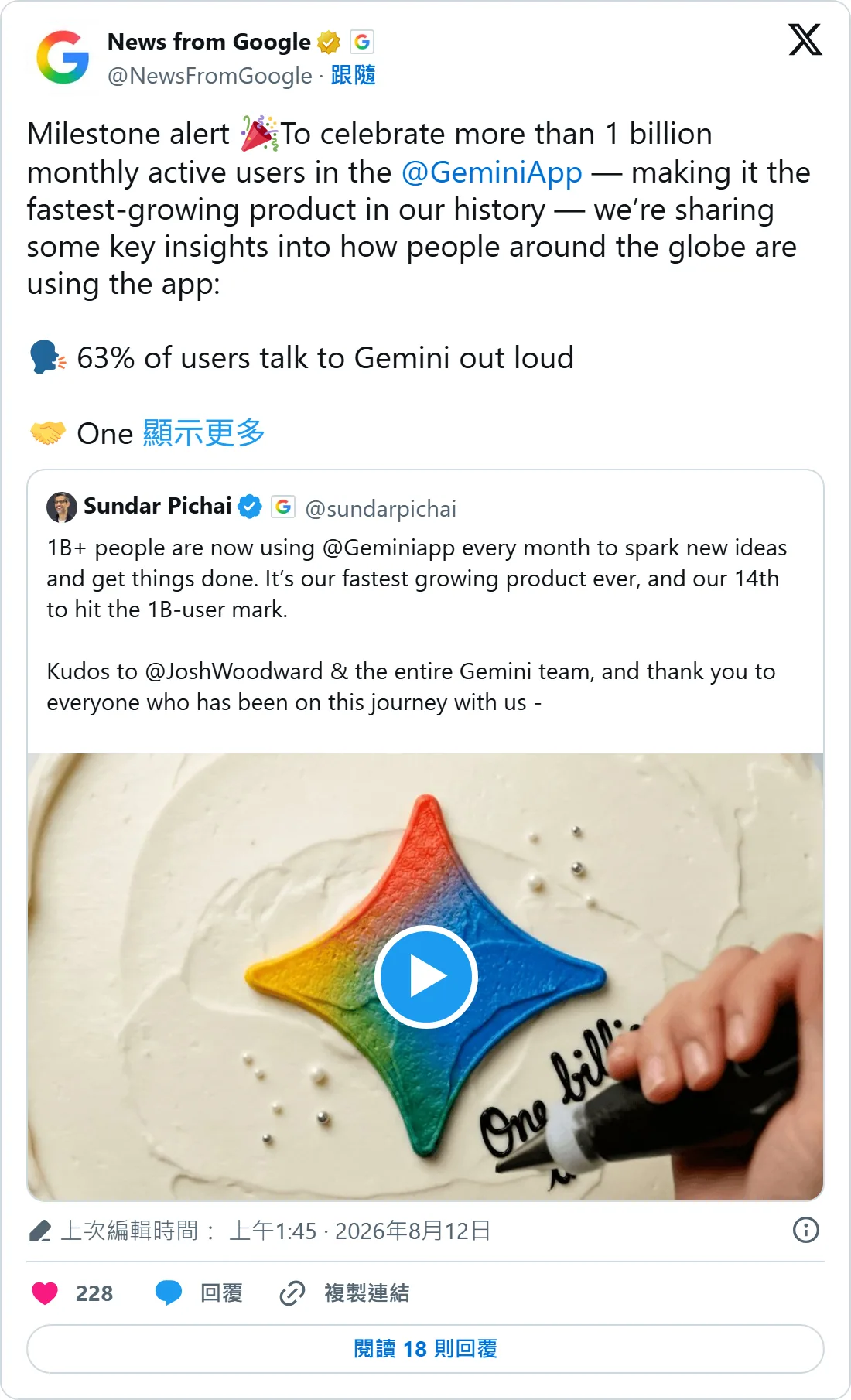 Figure: Google’s official account and Pichai announcing the Gemini app passed 1 billion (source: x.com)
Pichai’s words carry two points. First, this is Google’s “fastest growing product ever”. Second, it’s Google’s 14th product to reach 1 billion users.
The 14th part says more about what kind of company Google is than the billion does. 9to5Google’s report names seven of the others: Search, Gmail, Android, Maps, Chrome, Play and YouTube. Unite.AI cites Pichai at this year’s I/O saying 13 products each had more than a billion users, five of them above 3 billion. I didn’t find an official version of the full list of 14.
For a company that already holds 13 billion-user products, pushing a 14th to a billion is a completely different level of difficulty from a startup doing the same thing. I’ll come back to this.
How did it grow to a billion?
I lined up the figures Google has disclosed over time:
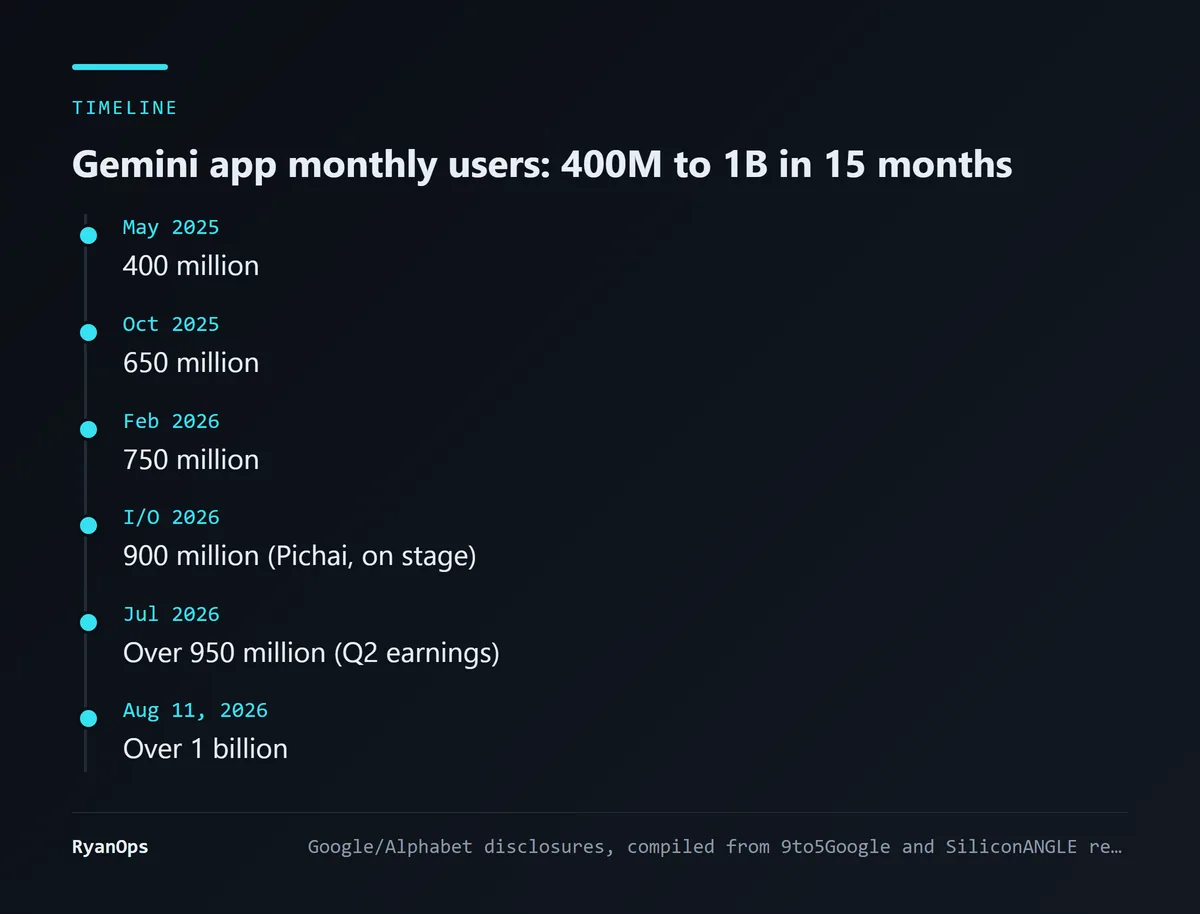 Figure: the Gemini app’s monthly-user growth curve (compiled for this article from Google’s disclosures as reported by 9to5Google and SiliconANGLE)
It was 400 million in May 2025 and 1 billion this August. Six hundred million more people in 15 months.
On its second-quarter earnings call Google gave another figure: daily active users tripled over the past year. Monthly active means “opened it at some point this month” and daily active means “opened it every day”, and the latter says more about whether a product is really in use. Unfortunately Google gave only the multiple, not the absolute number.
On usage, Google released a few numbers alongside, and I find them more interesting than the billion:
- 63% of users talk to Gemini out loud, and there are more voice-only users.
- In Gemini Live, one in five interactions goes beyond voice, with the camera on or the screen shared.
- More than 150 million images are generated every day.
- There are over 100 million active users on iOS. Power users on macOS prompt about twice as often as on other surfaces.
- Gemini can now take actions for you across more than 40 apps.
The 63% voice figure is worth a pause. It means most people use Gemini by speaking, which makes its competition more than another chat window: it includes the voice assistant that was already on your phone.
What does this billion count, and what does it leave out?
This is the part I think most needs sorting out.
TechCrunch’s report includes one specific sentence: the figure covers the Gemini app only and doesn’t include people who reach Google’s AI through other channels. So people who see AI summaries in Google Search or use AI Mode aren’t counted. Incidentally, the same report says AI Mode alone has over 1 billion monthly active users globally.
So this number is actually on the conservative side; Google didn’t pour every Gemini-touched surface into it.
But there are two things Google hasn’t said.
First, how “monthly active user” is defined. Does opening it once count? Does summoning it with a long press of the power button on Android count? SiliconANGLE’s report states plainly that Google hasn’t explained how it defines a monthly active user.
Second, how many of these people came by their own choice. Gemini is built into Android, Search and Workspace. One outlet points out as a result that a meaningful share of this billion arrived through a default, not a deliberate download. That doesn’t make the number fake; users who come through a default are still users. You just need to remember it when comparing against anyone else.
Why can’t it be compared directly with ChatGPT’s billion?
I laid the two out together:
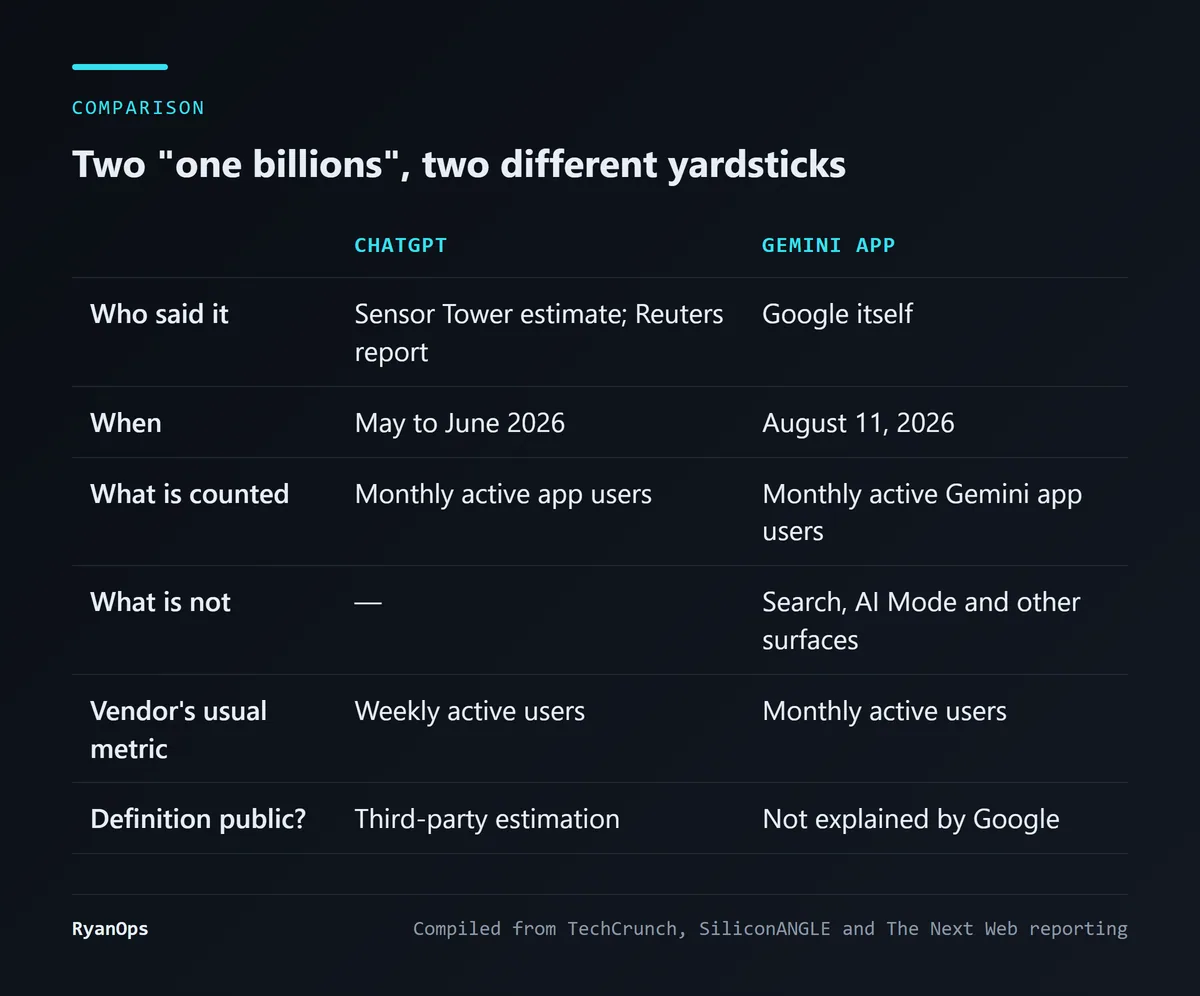 Figure: where each “one billion” comes from and how it’s counted (compiled for this article from TechCrunch, SiliconANGLE and The Next Web reporting)
There are at least three layers of difference.
Different speakers. Gemini’s billion was announced by Google itself. For ChatGPT’s billion monthly actives, TechCrunch cites a Reuters report from early June, and other outlets say the data source is Sensor Tower’s estimate of app usage, dated to May. One is the company’s own number and the other is a third-party estimate.
Different units of time. OpenAI itself is in the habit of talking about weekly active users. The Next Web’s August report cites OpenAI’s claim that its products reach more than a billion people every week. A billion people using something weekly and a billion using it monthly are very different things, and the former is a much higher bar.
The starting line can be drawn anywhere. The common line is that ChatGPT is the fastest app ever to a billion. Some outlets put it at about three years and others at three and a half, depending on which day you count from. The same goes for Gemini. Counting from February 8, 2024, when Bard was renamed Gemini and the app launched, it’s two and a half years to this August. Counting from March 2023, when Bard opened for early access, it’s three years and five months. Pichai says it’s the fastest-growing product in Google’s history, and I believe that; but whether it’s faster or slower than ChatGPT depends entirely on which starting point you pick.
So what’s that other 80% versus 11% statistic about?
At this point I went to look at Statcounter. It has an AI chatbot market share page, and the worldwide figures for September look like this:
 Figure: Statcounter’s worldwide AI chatbot market share for September 2026 (source: gs.statcounter.com)
ChatGPT 80.48%, Gemini 10.91%. Both claim a billion users, and in this dataset they’re more than seven times apart.
First, what I don’t know: the page doesn’t explain what this share actually measures, and I couldn’t find methodology text on it. Statcounter has always built its statistics from traffic received by partner websites, and if this metric follows the same approach, what it measures would be how much traffic clicks out from these chatbots, which is a separate matter from how many people use them. That’s my inference; please don’t take it as Statcounter’s official explanation.
If the inference is right, the gap is quite reasonable. Someone who asks Gemini about the weather by voice, has it set an alarm, or asks it to draw a picture never clicks an external link. As noted above, 63% of Gemini users speak to it. That kind of use counts as one person in monthly active users and as zero in traffic statistics.
Whatever it measures, the figure is at least a reminder of one thing: “a billion users” only answers how many people touched it, not what they use it for or how deeply.
So who won?
My view is that it’s the wrong question, or at least one that can’t be answered yet.
If you want a description closer to the facts: ChatGPT still clearly leads on people opening it on purpose to ask something, and both Statcounter’s numbers and OpenAI’s weekly-active figure point that way. Gemini’s advantage is distribution. It doesn’t need you to download it; it’s already in your phone, your inbox and your documents.
That’s also why the “14th billion-user product” line matters. Google’s playbook has never been to build something you make a special trip to use, but to place it inside the thirteen products you already use. What Google previewed as next goes the same direction: more than 60 regional dialects, study tools, and carrying out tasks across apps on Android.
What would change my mind? If Google one day publishes the Gemini app’s absolute daily actives, or a weekly-active number on the same basis as OpenAI’s, a real comparison becomes possible. Until then both sides will keep choosing whichever yardstick flatters them most.
What has Google done since?
In the two months after the billion announcement, Google has moved quickly. At the Made by Google event the next day, the new Pixels got a minor hardware revision and a $100 price increase, with the whole bet placed on Gemini. A few days later, Gemini 3.7 Flash arrived unannounced at half the price. On September 30, Argon, the first model of the Gemini 4 generation, appeared, but opened first only to cyber defenders.
Whether these user numbers have kept climbing since will have to wait for Alphabet’s next earnings report, when there’ll be new figures to check against.
Which numbers here deserve a discount
- Gemini’s billion, the 63% and the 150 million images are all Google’s own disclosures, with no third-party verification.
- The points on the growth curve come from statements made on different occasions, and the definition isn’t guaranteed to be consistent across them.
- ChatGPT’s billion monthly actives is a third-party estimate and media reporting, not an official OpenAI number.
- For Statcounter’s share, I’m not sure what it measures; the explanation in this article is my inference.
- I didn’t find an official version of the full list of 14 billion-user products.
- The original version of this article said Google “simultaneously launched Gemini 3.5 Flash”. That model wasn’t first announced on this occasion, and this rewrite removes the passage.


