Pixel 11: $100 More and 4GB Less RAM on the Pro
All three Pixel 11 models cost $100 more. Google's stated reason is memory, up sixfold in a year. The price, the missing 4GB and the AI small print.
Google announced the Pixel 11 series on August 12. Three phones, three prices: $899, $1,099 and $1,299.
My August piece said “the top model costs $100 more” and put the increase down to the manufacturing cost of the new chip. Both points were wrong.
All three models went up, each by $100. A Google executive gave the reason publicly before the launch, and it is memory. And along with the price rise, the entry version of the Pro models went from 16GB of RAM to 12GB.
In this rewrite I want to settle the account properly: where your extra $100 went, and what conditions are attached to each of the AI features Google is using to persuade you.
How does Google itself present the phone?
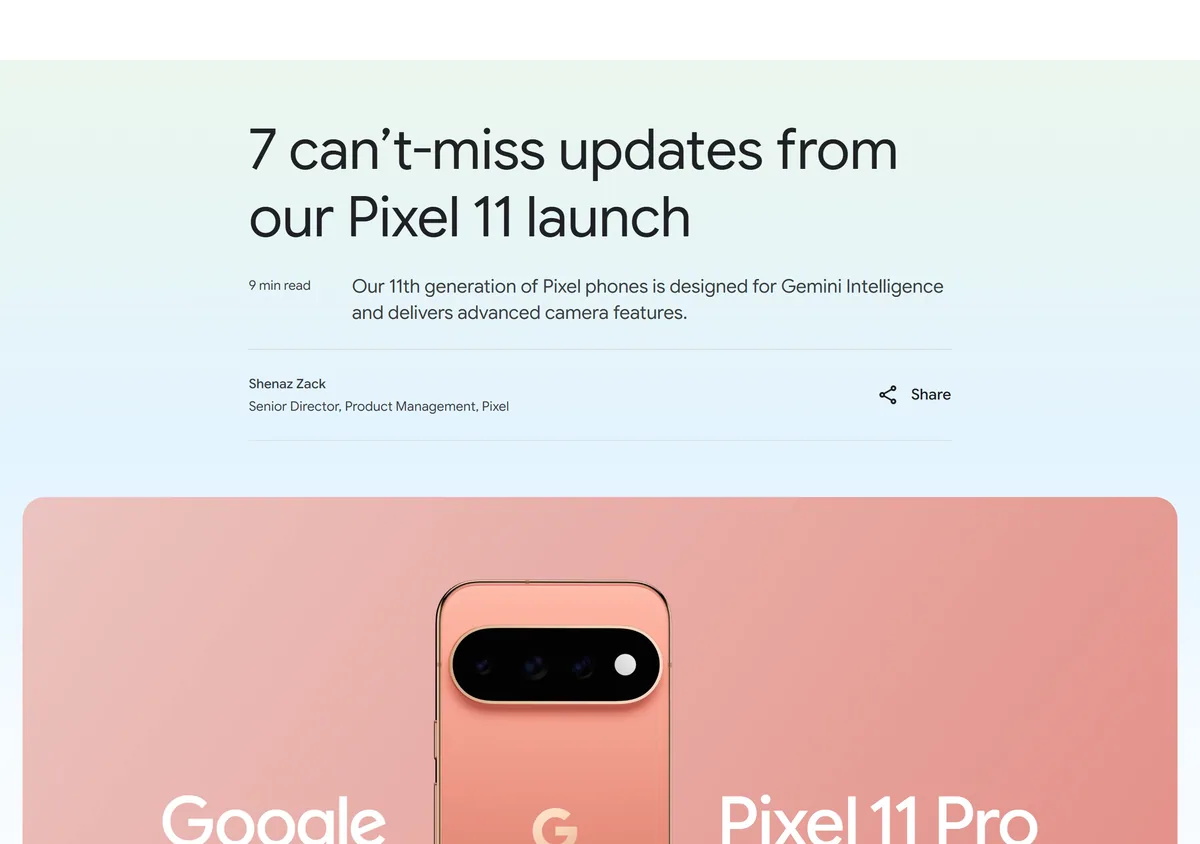 Figure: Google’s official post introducing the Pixel 11 (source: blog.google)
The subhead is the positioning: this generation of Pixel “is designed for Gemini Intelligence”, and only then come the cameras.
The post lists seven updates and says almost nothing about hardware specifications. The Tensor G6 processor is mentioned once, in the passage on Live Translate. There is not a single number for the display, the battery or the memory.
My August piece listed many specifications for the base model, such as screen size, battery capacity and charging speed, and said Tensor G6 was built on TSMC’s 2nm process. I could not find any of that in the official post this time, and none of the other sources I could open confirmed it, so I no longer list it. The hardware numbers below are only the ones I could trace to a source.
The basics the post confirms: preorder prices start at $899, $1,099 and $1,299, with sales from August 20.
How much did it go up?
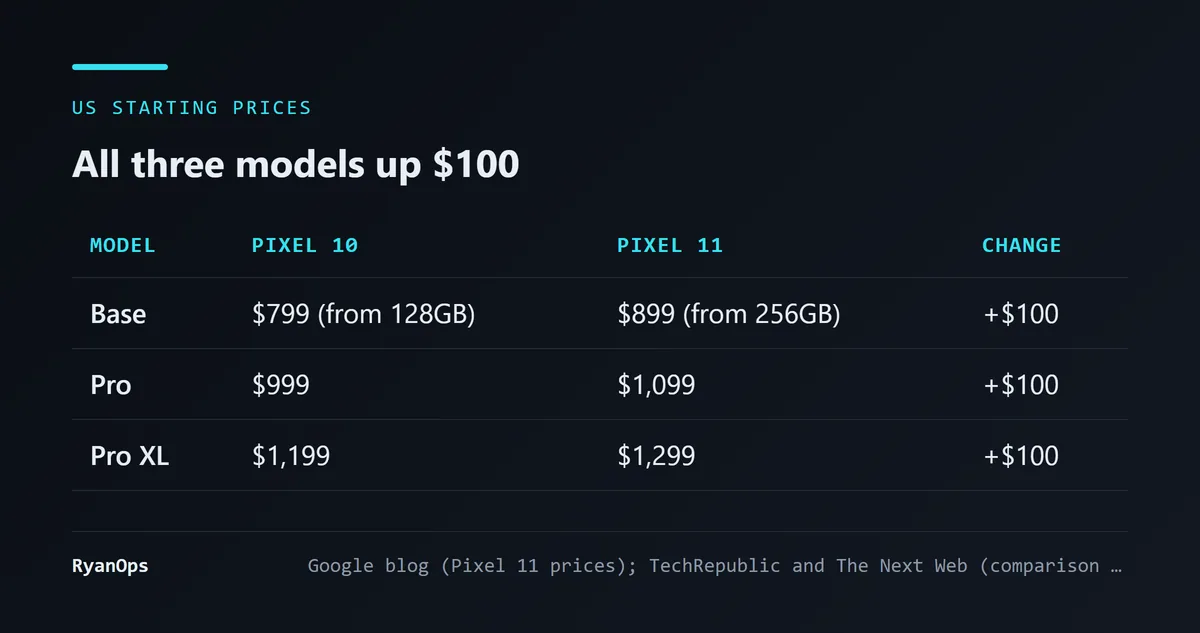 Figure: US starting prices for Pixel 10 and Pixel 11 (compiled for this article from Google’s blog, TechRepublic and The Next Web)
Each of the three went up $100.
The base model is a special case. The Pixel 10 started at 128GB. The Pixel 11 drops 128GB and starts at 256GB. So you can say it costs $100 more, or you can say the price at the same capacity is unchanged and only the cheapest option is gone.
Google did not invent the move. The Next Web points out that Samsung’s Galaxy S26 early this year also raised two of its three models by $100, likewise dropped 128GB, and presented it as a storage upgrade.
For a buyer the result is the same: the least you can pay for a Pixel is $100 higher.
What is the reason for the increase?
Google did not leave people guessing. Three weeks before the launch, Shakil Barkat, Google’s vice president of devices and services, told 9to5Google in an interview that the Pixel 11 would cost more. The Next Web summarized the interview on July 26.
His account is that Google had shielded consumers from supply fluctuations for as long as it could, but the economics had shifted. Prices across the whole Pixel family, watches included, would be adjusted dynamically to match “supply realities”.
The numbers he cited come from Morgan Stanley: one gigabyte of RAM cost about $2.80 in 2025 and costs $12 this year. Roughly sixfold.
The cause is that memory makers are redirecting capacity to the high-bandwidth memory (HBM) used in AI data centers, leaving ordinary memory for phones and computers short. What HBM is can be found in the glossary. In September I wrote about reports that the three big makers’ 2027 capacity is sold out, which is the upstream end of the same story.
There is an irony here. What made the phone dearer is AI itself. Data centers took the memory, phone makers pay more for what is left, and then you are told the phone is worth more because it has AI.
What about those 4GB?
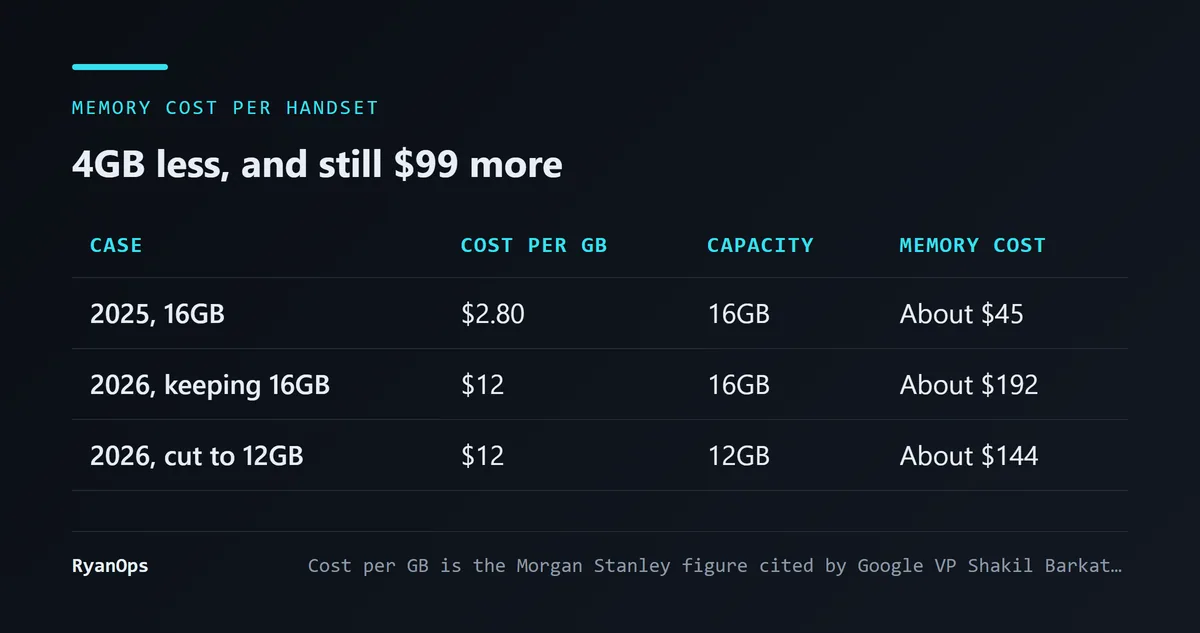 Figure: Memory cost estimate (cost per GB is the Morgan Stanley figure cited by Barkat; the 12GB row is calculated for this article)
Morgan Stanley’s analysis was done for a 16GB flagship: memory cost goes from about $45 per handset to about $192. That is $147 more.
The Pixel 11 Pro series did not stay at 16GB. According to EFTM’s review, the Pro XL comes with 12GB of RAM on the 256GB version, and only the 512GB and 1TB versions have 16GB. The previous generation’s 256GB version had 16GB.
I ran the same unit price for 12GB: 12 times 12 is $144. Against last year’s $45 for 16GB, that is $99 more.
Ninety-nine dollars. The price went up by $100.
I would not claim this coincidence is Google’s pricing formula, since memory is not the only cost in a phone. But it does show one thing: even after cutting 4GB, the extra cost of memory alone is about the size of the whole increase. Had it kept 16GB, Google would have had to raise the price by $150 or absorb the difference.
So two things actually happened together: plus $100 on the price, minus 4GB on the memory. It took both moves to offset the rise in memory prices.
Barkat mentioned another direction in the interview: Google has launched a dedicated effort to reduce the memory needs of Android and its apps, so that devices can keep the same experience on less RAM. He said that because Google makes the chip, the system and the on-device models itself, it can load and run models more efficiently than rivals using off-the-shelf parts.
Whether that holds up depends on real use. On-device AI models eat memory. A phone sold on AI with less memory is a slightly contradictory pairing to begin with.
What else went up or down?
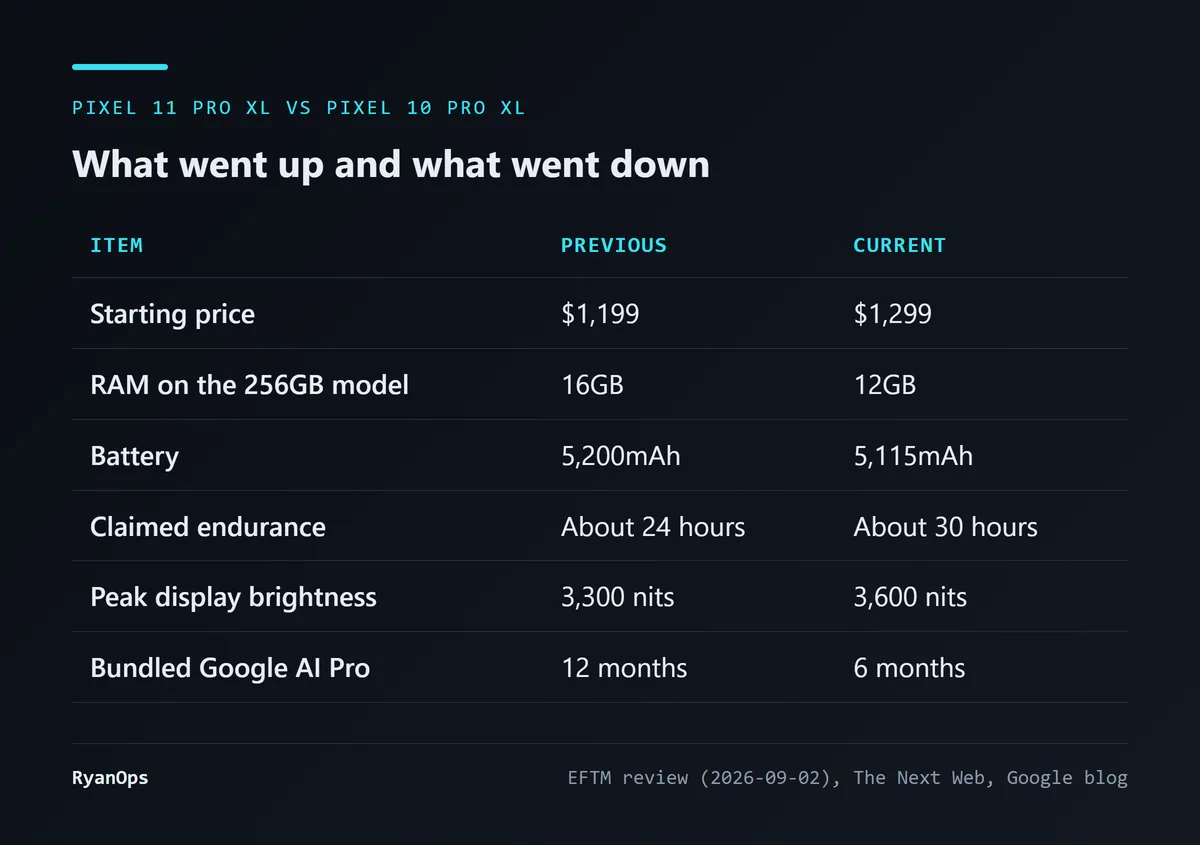 Figure: Some differences between the Pixel 11 Pro XL and the Pixel 10 Pro XL (compiled for this article from EFTM’s review of 2026-09-02, The Next Web and Google’s blog)
Most of this table comes from a review in early September by the Australian tech outlet EFTM.
Three things went down. Memory has been covered. The battery went from 5,200mAh to 5,115mAh, although Google’s claimed endurance rose from 24 hours to 30, and EFTM’s reviewer says it really does last longer in use than its predecessor, which usually needed charging around 6pm. The third is the Google AI Pro subscription bundled with the phone, cut from 12 months to 6.
That last item is easy to overlook, but it bears directly on what the phone is sold on. The official footnote on the Gemini features says usage limits or a subscription may apply. Halving the free period means you reach the question of whether to renew sooner.
What went up: peak display brightness from 3,300 to 3,600 nits, and Google’s claims that Tensor G6 makes web browsing 25% faster, app launches 15% faster and AI tasks 3.5 times faster. Those are Google’s statements.
On performance, I saw a search-result summary of Android Authority’s review saying Tensor G6 is behind the Snapdragon processor in the Galaxy S26 series on nearly every metric, while daily use is smooth. I could not open the original this time, so take it as a pointer only.
What does the small print behind the AI features say?
I went through the footnotes for each AI feature in Google’s post.
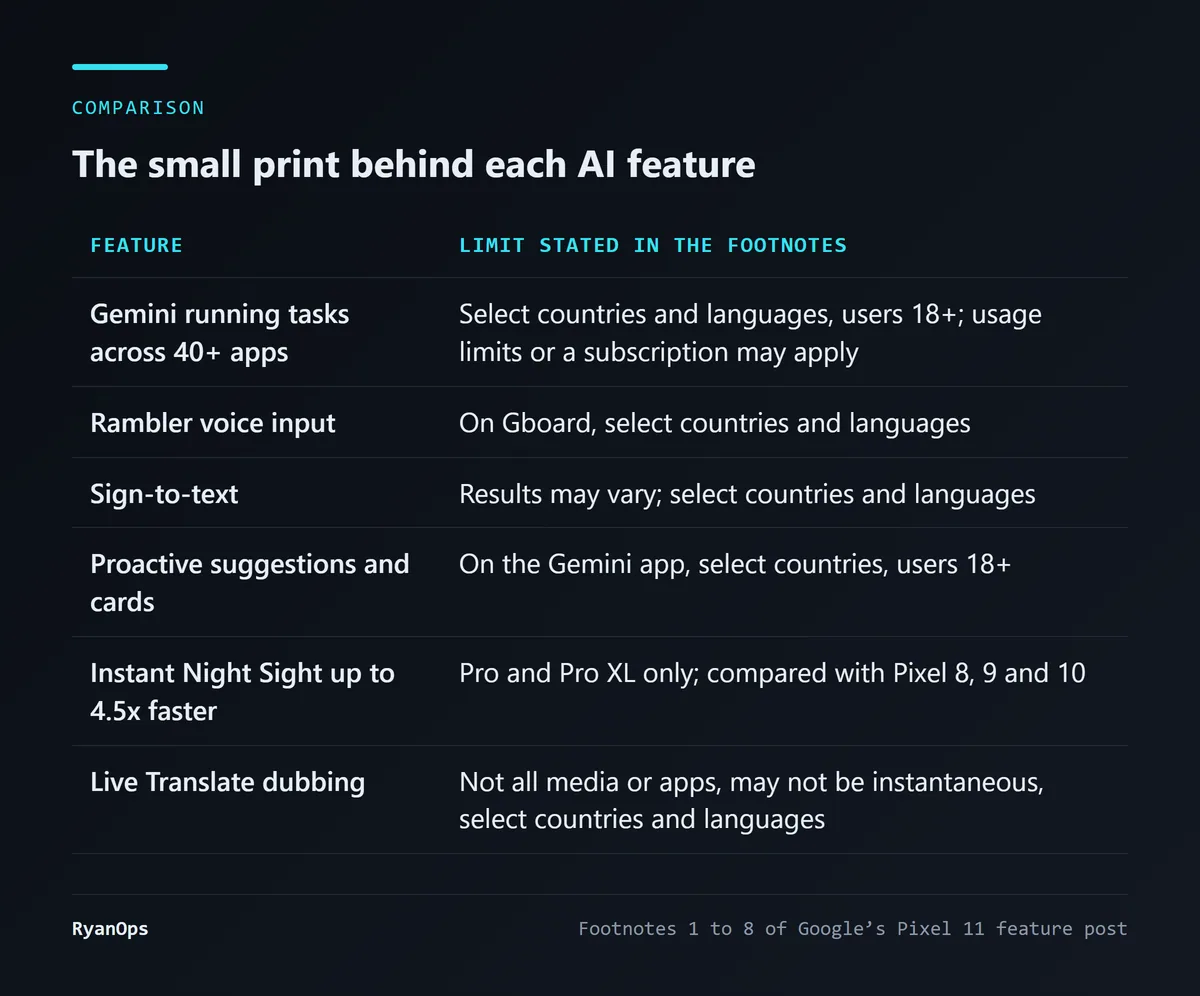 Figure: Official limits on the Pixel 11’s AI features (compiled for this article from footnotes 1 to 8 of Google’s post)
The features themselves are these:
- Gemini Intelligence: Gemini can carry out multistep tasks across more than 40 apps. This is the phone’s headline feature.
- Magic Capture: you press start and stop, and in between the phone analyzes about 400 frames, picks the best moments and outputs 12-megapixel photos, while also keeping a video.
- Rambler: voice input that tidies away your filler words.
- Sign-to-text: uses Google DeepMind’s sign language model to turn signing into text in Gboard.
- Live Translate: real-time speech-to-speech translation for video and audio, processed partly on the device by Tensor G6.
- Instant Night Sight: up to 4.5 times faster than Pixel 8, 9 and 10.
Now look at the table again. Six of the eight footnotes say select countries only, and four of those add select languages.
For readers in Taiwan, that sentence is the key. Google does not list which countries or which languages in the post. I cannot tell from it whether Traditional Chinese is included. Going by past Pixel features, English and the United States usually come first and other languages wait. If one particular AI feature is your reason to buy, confirm before ordering that it works in your region and your language.
My August piece had a passage saying press tests showed Gemini could already order groceries, book rides and phone restaurants to reserve tables for the user. I could not find a source for it this time. The examples in Google’s official post are more modest: prompting a reservation, saving an event to Calendar, adding a location to Maps. So that passage is gone.
The “4.5 times” item also deserves a second look. The comparison is with Pixel 8, 9 and 10, and only the Pro models have the feature. The base model does not. EFTM’s reviewer says Night Sight is now much faster, not quite “instant”, with processing time almost unnoticeable.
What do the reviews say?
The only review I could read in full is EFTM’s, which gave 93%.
On Gemini Intelligence the reviewer says it “shows some real promise”, citing cards for flights, availability and locations that appear proactively in the Messages app. He also notes that some people will be wary of giving it access to their data.
His favorite is Rambler, which he calls one of his favorite new features in Android 17. He has one complaint: it does not show you which words are being removed before you confirm.
HiLight, the new notification light in the camera bar, he calls “a mixed bag”: it lights only when the phone is face down, responds only to calls from favorite contacts and to Gemini activity, and offers little to adjust.
For other reviews I saw only the summaries in search results. Android Authority’s summary says Google’s bet on Proactive Assistance has yet to pay off, and PhoneArena’s says the Pro XL has less RAM and a higher price, now level with the Galaxy S26 Ultra. I did not read the originals of these, so please read the full reviews yourself before judging.
How do I see it?
The August piece concluded that Google has staked its bet on Gemini and that whether it pays off depends on how many people use these features every day. I still agree with that, but I want to add an angle I did not see then.
This price rise has no direct connection with Gemini. It is cost-driven. Memory went up sixfold, and without a price rise Google would have had to eat the difference. Gemini is the story Google uses to make the $100 easier to accept. It did not cause the increase.
Once the two are separated, the question changes. You are not deciding whether the AI features are worth $100 more, because you pay the $100 whether you use them or not. What you are deciding is whether to buy, now, a phone with less memory than last year at a higher price than last year.
If the phone in your hand still works, I would wait. Two reasons. Memory prices are cyclical, even if this round may last longer because of AI demand. And regional and language support for AI features usually fills in over the months after launch, by which time you will know better what you are buying.
If you must buy a Pro now, I would choose the 512GB version, because that is the one with 16GB of RAM. Google promises seven years of system updates, and on-device models will only grow. 12GB is enough today. In five years that is harder to say.
What would change my view? If a review measures the 12GB version running on-device AI features with no difference from the 16GB version, then Barkat’s “the same on less memory” is true, and my reservation about the 256GB version falls away.
I covered the scale of Gemini’s own usage in a separate piece.
What this rewrite corrected
- The original said the top model cost $100 more. In fact all three models went up by $100 each.
- The original put the increase down to the cost of the 2nm Tensor G6 chip and called this “the analysis of several tech outlets”. The reason a Google vice president gave publicly before launch is memory cost, which is corrected here with the numbers. I found no reliable source for Tensor G6’s process node this time and removed it.
- The original listed the base model’s display, battery, camera and charging specifications. I could not confirm them this time and removed them.
- The original did not mention that the 256GB Pro went from 16GB of RAM to 12GB. That is added.
- The original said press tests showed Gemini ordering groceries, booking rides and phoning in reservations. I found no source and removed it.
- The original did not mention the regional, language and model limits on the AI features. They are added from the official footnotes.


