Gemini 4 Argon Reaches AI Pro in Antigravity: Its Own Quota
Gemini 4 Argon now runs in Google Antigravity for paid AI Pro subscribers, with a separate weekly-only quota and no access on free trials.
Two days ago I wrote the piece on Argon arriving in Antigravity for AI Ultra only, and ended it with a line: if Antigravity opens Argon to Pro, everything I recommended there needs to change. I didn’t have to wait long. Early on October 16, Taiwan time, Google Antigravity’s official account posted that Gemini 4 Argon is rolling out to paying Google AI Pro subscribers.
So this piece is me making good on that line: what Pro actually gets, what it doesn’t, and how my earlier advice changes.
The short version first. AI Pro, at NT$650 a month, can now pick Argon in Antigravity, but it comes with its own quota that only has a weekly limit, trial accounts can’t use it, and Google hasn’t said how big that quota is. Going from Ultra-only to Pro took two days.
What did Google actually say?
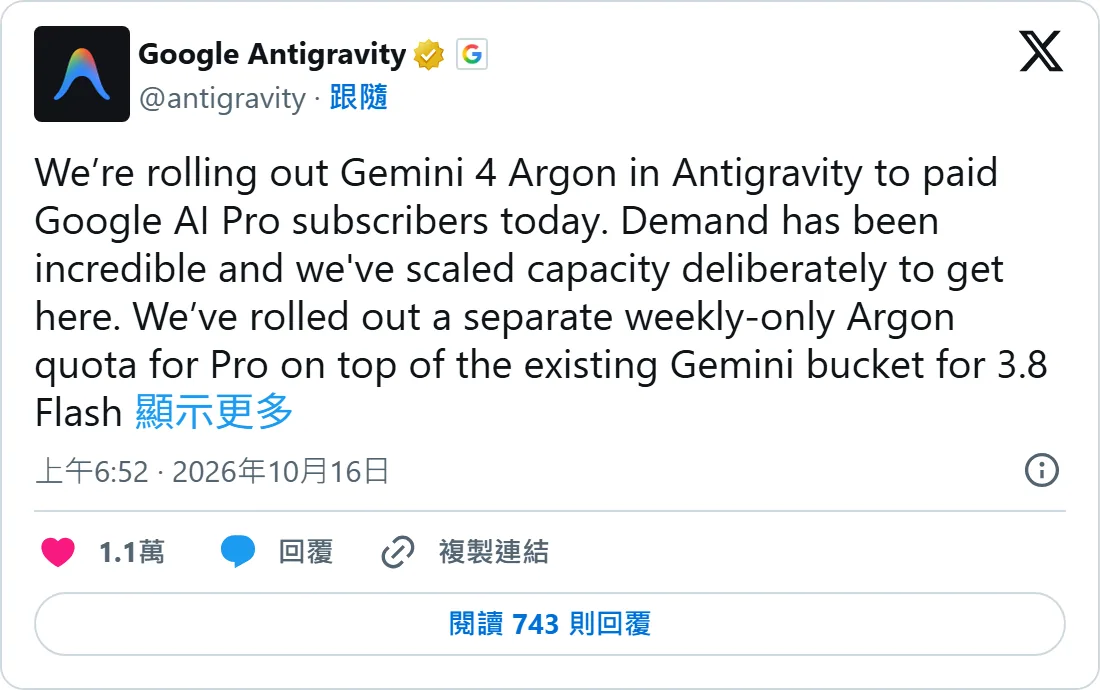 Figure 1: The @antigravity announcement; the embed shows 6:52 a.m. on October 16 Taiwan time, which is the afternoon of October 15 Pacific time (source: x.com)
The post breaks down into three parts: starting today, Argon is rolling out to paid Google AI Pro subscribers; demand has been incredible, so they scaled capacity deliberately to get here; and Pro gets a separate, “weekly-only” Argon quota sitting on top of the existing bucket used for Gemini 3.8 Flash.
The post keeps going, but the embed folds it into “Show more” right after “3.8 Flash,” and I couldn’t get the rest, so I won’t quote it below.
I then went back and reopened Antigravity’s official blog post. It’s still dated October 13, and there’s no “update” note anywhere, but the first paragraph has changed: two days ago it said Argon was opening to Google AI Ultra subscribers; now it says “Google AI Pro and Ultra subscribers.” In other words, Google edited the original text in place. If you read it two days ago, reading it now you’d assume it always said that.
The before and after, side by side
The most direct evidence is the model table in Antigravity’s docs. As it happens, I screenshotted that same table for my previous piece, so the two make a clean before-and-after.
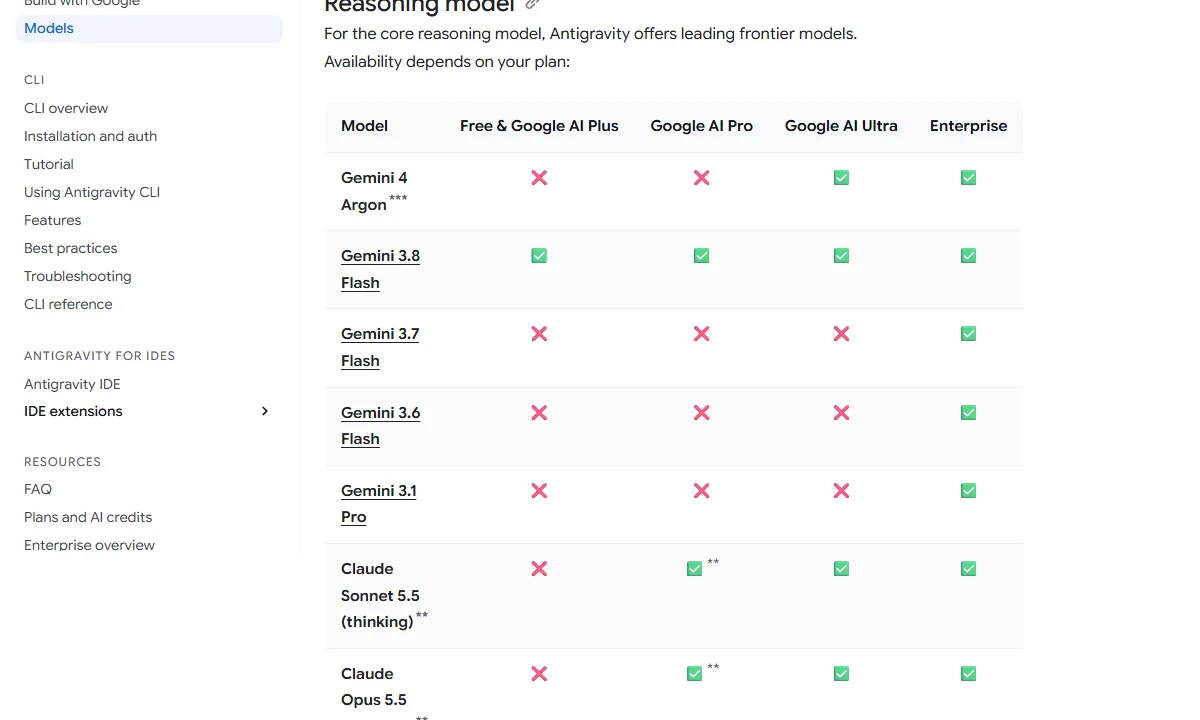 Figure 2: The model table on October 14, with a cross for Argon under Google AI Pro (source: Antigravity Docs, screenshot from this site’s previous article)
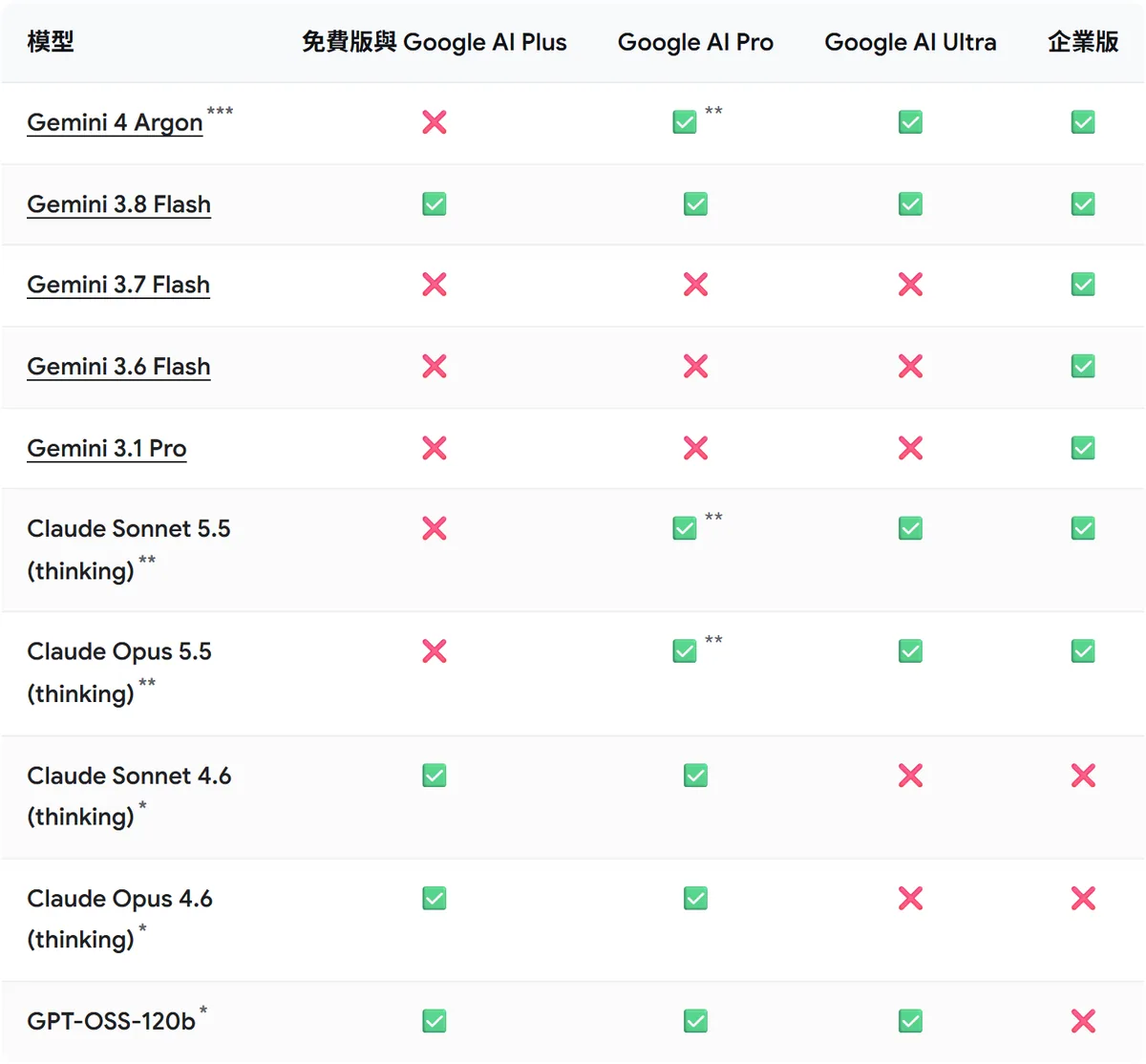 Figure 3: The same page reopened on October 16; Argon’s Pro column is now a check with two asterisks (source: Antigravity Docs)
Only one cell changed: in the Argon row, Google AI Pro went from a cross to a check. But there are now two asterisks next to that check, and that’s the part to read.
The double-asterisk footnote says “Available on Google AI Pro for non-trial subscriptions only.” That note was already attached to Claude Opus 5.5 and Sonnet 5.5; now Argon has it too. So if you’re trying out Antigravity on a Pro free trial, Argon still won’t show up in the model menu, and it only appears once the trial ends and you’re actually paying. When I opened Antigravity’s pricing page, the Pro card was labeled “free trial” right at the top, which is exactly the kind of gap newcomers trip over.
Argon’s own triple asterisk hasn’t changed: not available in Antigravity IDE, only in the Antigravity app, the CLI, and the IDE extensions. That was true for Ultra and it’s true for Pro.
What does that “separate bucket” quota mean?
I covered how Antigravity meters usage in the previous piece: Ultra gets a quota that refreshes every five hours, plus a weekly cap, and Google has published no numbers for either. The Argon quota Pro gets this time is described in the post as weekly-only, meaning a weekly cap with no five-hour layer.
Here’s my reading, and I’ll flag up front that it’s inferred from the wording: when a Pro user runs Argon, it draws from a dedicated weekly Argon allowance; when they run Gemini 3.8 Flash, it draws from the original bucket. The two are separate, so running out of Argon should still leave 3.8 Flash available. Conversely, with no five-hour layer, you could in theory burn through a whole week of Argon in a single afternoon and then have to wait for the weekly reset.
That has a practical effect on how you use it. Argon is the model Google itself describes as designed for the hardest problems, so the sensible move for Pro users is to save it for tasks that are genuinely stuck, and hand everyday small fixes to 3.8 Flash or Claude, rather than setting it as the default the moment you open the app.
How big is the quota? Google hasn’t said. On the pricing page, Pro says “More rate limits” and Ultra says “Even more rate limits,” with no numbers for either. 9to5Google’s report only quotes the “separate bucket” line, with no further detail. I couldn’t find this, so I won’t guess.
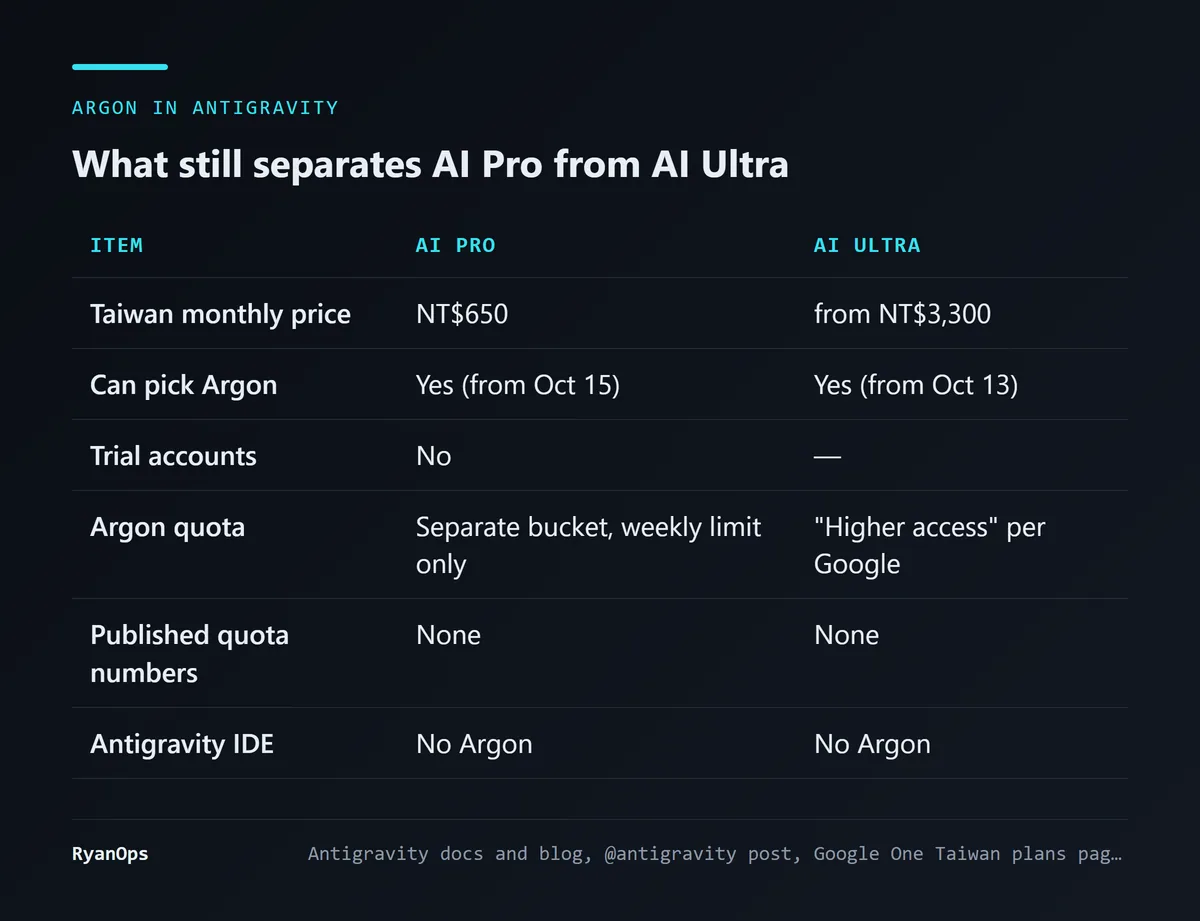 Figure 4: My summary of what the various pages say (data sources: Antigravity Docs, Antigravity blog, @antigravity, Google One plans page, checked 2026-10-16)
So what still separates Pro from Ultra?
Prices haven’t moved. I reopened the Taiwan version of the Google One plans page today: AI Plus is NT$165 a month, AI Pro NT$650, AI Ultra from NT$3,300, with another tier above that at NT$6,500. Ultra is still five times the price of Pro.
What’s left is the quota, and it’s a comparison with no numbers on either side. Ultra’s plan description includes a line saying it gets “higher access to Gemini 4 Argon in Google Antigravity,” and that line on its own tells you Pro now has access too, just a lower amount.
So when I wrote in the previous piece that “NT$3,300 is the price of admission for individual users,” that’s no longer true. Admission is now NT$650; Google just won’t tell you how many times the ticket gets you in.
How does my earlier advice change?
My advice to Pro users last time was that adding Argon in Antigravity wasn’t worth an extra NT$2,650 a month, because independent benchmarks put it in the same class as Claude Opus 5.5, which Pro could already pick. Artificial Analysis’s composite index has Argon at 53 and Opus 5.5 at 58.
That question is gone now, because you don’t pay extra at all. The new question is: as a Pro user in Antigravity, when should you pick Argon and when Opus 5.5?
I have three thoughts.
First, try both. This is something Pro users couldn’t do two days ago and can now. Last time I said only Ultra subscribers could run the same task through Argon and Opus 5.5 inside the same tool; now NT$650 gets you that comparison, and it’s more reliable than any leaderboard.
Second, note that the two have separate quotas. Argon uses its own weekly allowance, and Claude uses the original one. For a plan like Pro, where quota is tighter, that’s effectively an extra pool to draw from. I’d think of it as “one more top model to rotate in,” not “a replacement for Claude.”
Third, watch the conditions behind the benchmarks. A TechTimes report points out that Artificial Analysis tested Argon at its highest thinking level, while subscribers default to medium. I can’t verify that inside Antigravity myself, but if Argon underperforms what the benchmarks suggest, the thinking level is the first thing to check.
What would change my mind again? If Google publishes Pro’s weekly Argon quota and it’s so small it only covers a handful of tasks a week, then for Pro it’s just a sample. If instead it’s enough for daily use, Pro becomes vastly better value than Ultra.
What else changed over these two days?
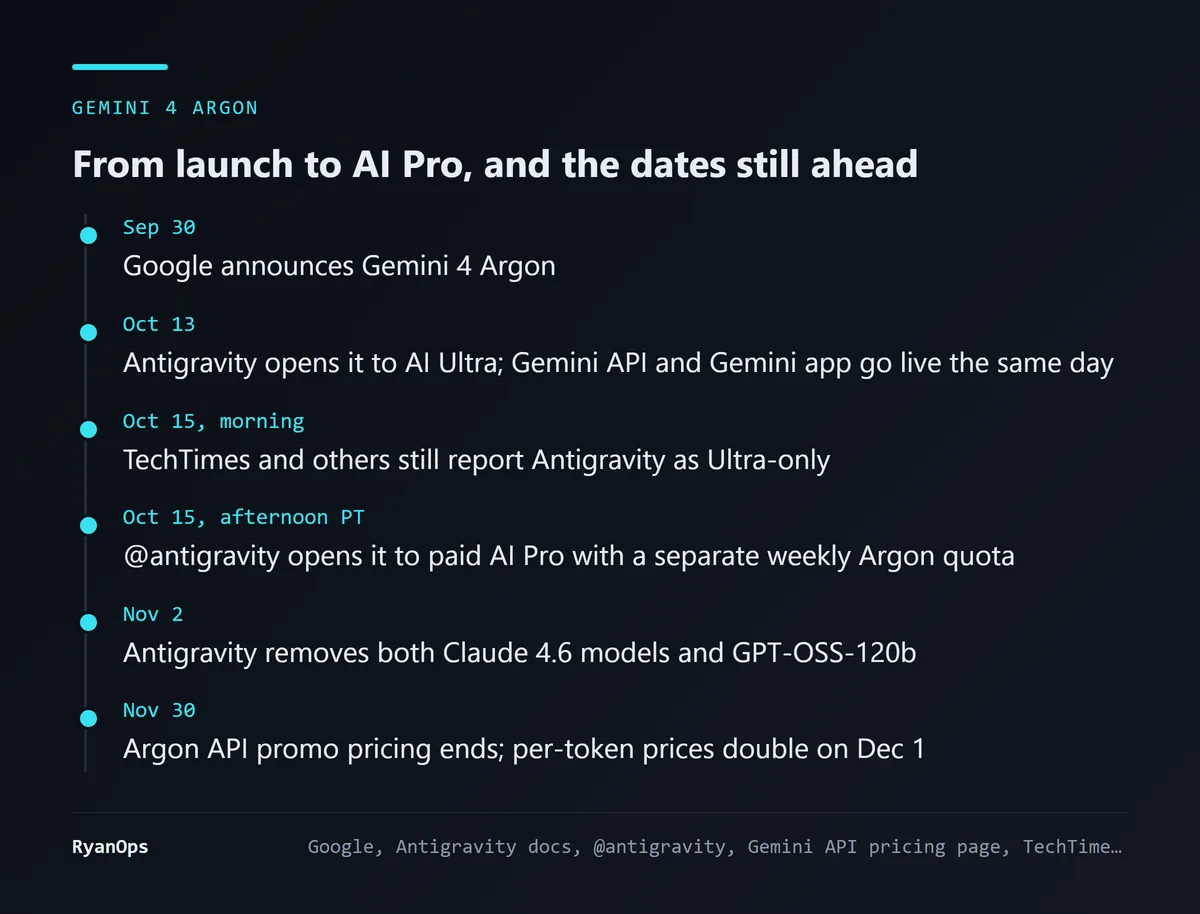 Figure 5: The dates from several sources, lined up (data sources: Google, Antigravity Docs, @antigravity, Gemini API pricing page, TechTimes, 9to5Google)
Three more things belong in the same picture.
One: reporting from that same morning was already out of date. TechTimes published at 6:54 a.m. Eastern on October 15 and still said Antigravity was Ultra-only; that afternoon Google announced Pro access. If you search “Argon Antigravity” today you’ll still find plenty of pages saying “Ultra only,” including my own previous piece. When you see that claim, check the date first.
Two: another asterisk on the model table takes effect November 2. The single-asterisk footnote reads “Will be removed on November 2, 2026,” and it’s attached to three rows: Claude Sonnet 4.6, Claude Opus 4.6, and GPT-OSS-120b. Reading across the columns, Free and AI Plus can currently use Gemini 3.8 Flash, the two Claude 4.6 models, and GPT-OSS-120b. After November 2, those two plans will have only Gemini 3.8 Flash in Antigravity. Pro also loses those three, but it still has Argon and the two Claude 5.5 models; if you’re still on a trial, though, all you’ll have left is 3.8 Flash.
Three: none of this is in the changelog. I went through Antigravity’s changelog; the October entries are all UI and CLI fixes, and the latest is CLI 1.3.6 on October 15, which lets people signing in with Application Default Credentials pick Claude Opus 5.5 and Sonnet 5.5. Argon opening to Pro only shows up in the banner at the top of the site and in that post. There’s no matching version in the changelog, though the official blog still recommends updating Antigravity to the latest version.
What should you do now?
If you’re a paying AI Pro subscriber: open the Antigravity app or CLI and check whether Argon is in the model menu. It’s a gradual rollout, so not seeing it today doesn’t mean you won’t get it. Once it’s there, pick a task you’re genuinely stuck on, run it through Argon and Opus 5.5 once each, then decide — and while you’re at it, get a feel for how many tasks Argon’s weekly quota actually covers.
If you’re on a Pro trial: not seeing Argon in the menu is expected; the footnote is clear that it requires a non-trial subscription. Also keep in mind that after November 2, the models a trial account can pick in Antigravity get very thin.
If you’re on Ultra: nothing much changes for you, but a big chunk of the case for upgrading from my previous piece is gone. If you moved up from Pro specifically for Argon, you could spend some time before your next billing date seeing whether Pro’s weekly quota would be enough for you.
If you use the API: this one doesn’t involve you. The line on the Gemini API pricing page saying Argon isn’t offered on the free tier or with a Google AI Pro plan refers to the API, and it’s still the case today; Antigravity also still doesn’t support bring-your-own keys. The half-price rate through November 30 is still in effect, and the numbers are in the previous piece. If you want to understand how usage limits work when no numbers are published, the glossary has an entry on it.
One last question I couldn’t answer: whether this “separate bucket” is temporary or long-term. Google’s post says capacity was scaled gradually, which usually means they’re still watching usage. I’d treat this quota as how things stand now, not as a promise.


