Argon lands in Antigravity: Ultra only, 53 vs 58
Google put Gemini 4 Argon into Antigravity on Oct 13, for AI Ultra only among personal plans. Artificial Analysis: 53 vs Opus 5.5's 58, at a third of the cost.
On October 13 Google put Gemini 4 Argon into Antigravity, its agent-first development tool. Most of the official post describes what Google did with it internally. The information that concerns you is in two paragraphs, one at the top and one at the end.
Here are the two main points first, with the details afterwards.
First, among personal plans only Google AI Ultra can select Argon in Antigravity. Free, AI Plus and AI Pro cannot. In Taiwan, Ultra starts at NT$3,300 a month.
Second, the benchmarks do not all point one way. On the software engineering test Google published itself, Argon leads. On the composite index from the independent firm Artificial Analysis, Argon scores 53 and Claude Opus 5.5 scores 58, so Argon is five points behind. The same data also shows that running the full suite costs $1.99 per task on Argon and $5.98 on Opus 5.5.
I opened every page behind this piece myself: Antigravity’s docs and pricing page, the Gemini API model and pricing pages, the Google One plans page for Taiwan, and two model pages on Artificial Analysis. I do not have Argon in Antigravity to test, so nothing below says “in my experience using it”.
Who can use it? Among personal plans, only AI Ultra
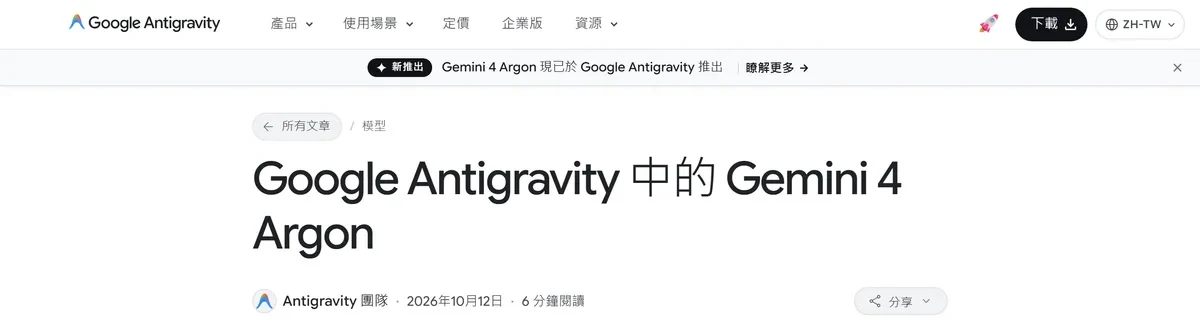 Figure 1: The announcement on the Antigravity blog. I was served the Traditional Chinese page, which shows October 12; the English page and the Gemini API changelog say October 13 (source: Google Antigravity)
In the announcement’s words, Argon is rolling out in the Antigravity desktop app and the Antigravity CLI for Google AI Ultra subscribers. Businesses have two routes: the API in the Gemini platform, and Antigravity itself on eligible Gemini Enterprise subscriptions.
The announcement does not say whether Pro qualifies. For that you have to look at the models table in the Antigravity docs.
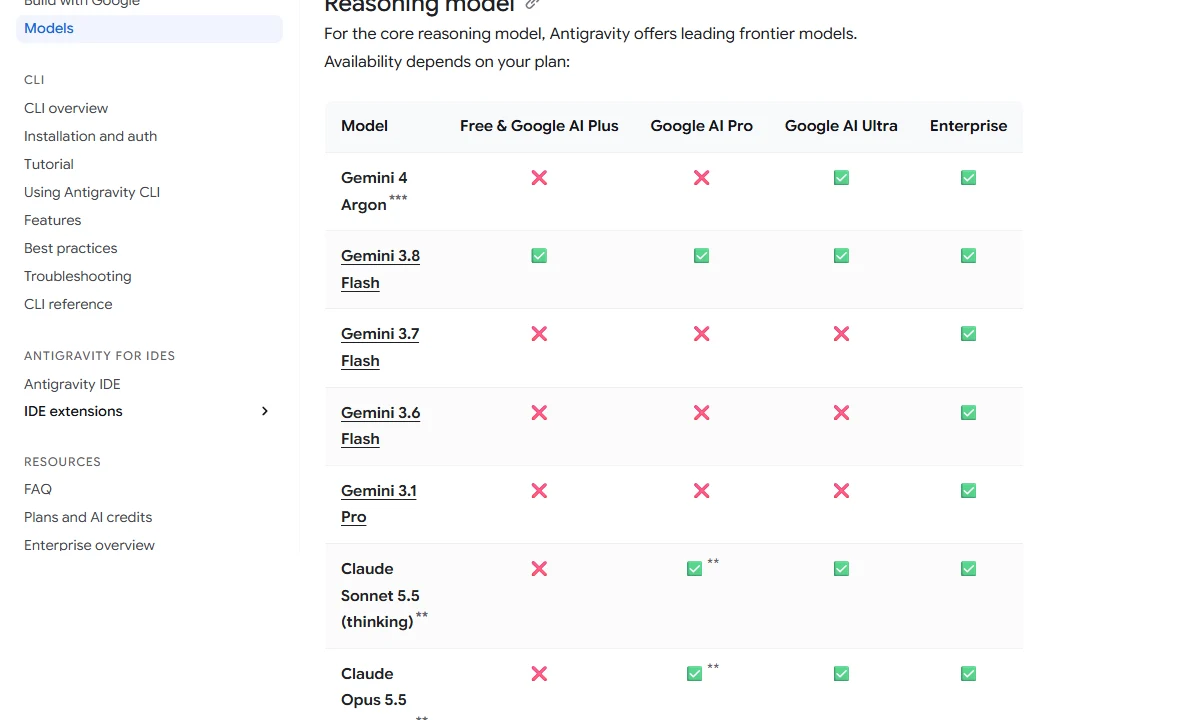 Figure 2: The reasoning models each plan can select, with Argon in the first row (source: Antigravity Docs)
The table is unambiguous. In Argon’s row, “Free & Google AI Plus” has a cross, “Google AI Pro” has a cross, and “Google AI Ultra” and “Enterprise” have ticks.
Three more details in this table deserve recording.
Argon carries a three-asterisk footnote: it is not available in Antigravity IDE, only in Antigravity 2.0, the CLI and the IDE extensions. If the standalone IDE is what you are used to, you cannot select it even on Ultra.
Ultra subscribers can also pick Claude Opus 5.5 and Sonnet 5.5 from the same menu. That means someone on Ultra can run Argon and Opus 5.5 on the same task, once each, inside Antigravity, which is more telling than any benchmark. Pro can select the two Claude models as well, on non-trial subscriptions.
The only Google model Pro currently gets in Antigravity is Gemini 3.8 Flash.
So what does Ultra cost? The Google One plans page I opened is the Taiwan version, and I combined it with the table above.
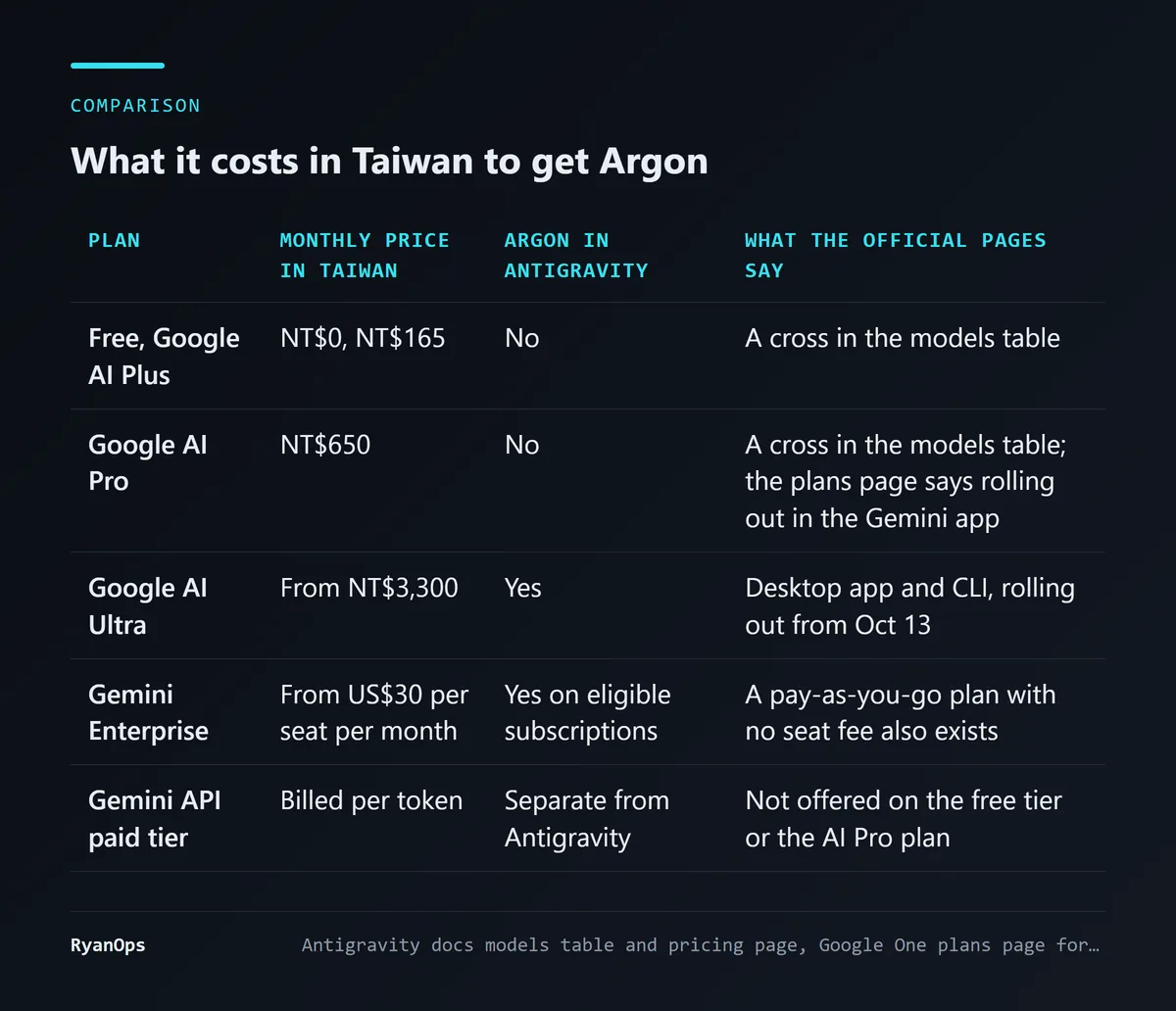 Figure 3: The price of each route and whether it gets you Argon in Antigravity (data: Antigravity Docs, Antigravity pricing, Google One plans, Gemini API pricing)
AI Plus is NT$165 a month, AI Pro NT$650, and AI Ultra from NT$3,300. The step from Pro to Ultra is a fivefold difference.
“Ultra only” needs two qualifications so that I do not mislead you.
One is that it refers to Antigravity. On the Google One plans page, the Pro column carries a “Gemini 4 Argon rolling out” label, and the note beneath says Argon is available to AI Ultra and rolling out to AI Pro subscribers in select countries. That is Argon in the Gemini app, which is a separate matter from Antigravity’s model menu. The page does not list the countries, and I am not sure whether Taiwan is among them.
The other is usage. Antigravity’s plans page gives no numbers. It says only that Ultra receives “the highest, most generous quota, refreshed every five hours” and the highest weekly rate limits, and explains that quota correlates with the amount of work the agent does, so complex tasks consume it faster. Once the quota is gone you can switch on overage paid with AI credits, charged at Gemini Enterprise consumption pricing. The page also states that bring-your-own-key is not supported. So how much work a month of Ultra lets Argon do is not something Google commits to, and you will only know by using it. The glossary explains the idea of usage limits.
Without Ultra, can you go through the API?
Yes, and it opened the same day. The Gemini API changelog has an entry on October 13: Gemini 4 Argon (gemini-4-argon) is generally available.
This needs reconciling with this site’s previous piece on Argon. That piece was rewritten on October 13, and when I checked the Gemini API models page then, Argon was not on it. Opening it again the next day, the top of the page had a new Gemini 4 section. From the announcement on September 30 to the API opening took 13 days.
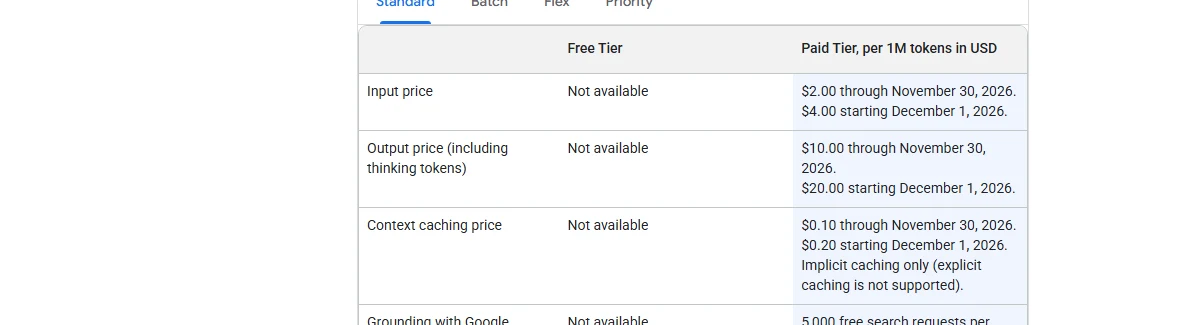 Figure 4: Argon’s API price and the end of the introductory period (source: Gemini API Pricing)
The pricing page answers something the launch left open: how long the introductory price lasts. The price of $2 per million input tokens and $10 per million output tokens runs through November 30, and from December 1 it becomes $4 and $20. The caching price doubles too, from $0.10 to $0.20.
The pricing page also has a line of small print: Argon is not available on the free tier, nor on the Google AI Pro plan. So the API route requires a paid billing account first.
If you are connecting Argon from your own code or another agent framework, the API is the more practical route. But it is separate from Antigravity. Antigravity does not support bringing your own key, so paying for the API does not add Argon to the menu in Antigravity.
Benchmarks: where does Argon win, and where does it lose?
For this section I drew on a third-party write-up, Kie.ai’s comparison of October 7. First, what kind of source it is: Kie.ai is a platform that sells API access to models, and the article promotes its own services. It was also written before Argon opened up, and several things it lists as “not yet published by Google” now have answers. So I treated it as a set of leads, and wherever a number could be traced back to an original page, I went and checked.
The most important set of numbers comes from Artificial Analysis, a firm that evaluates models independently.
 Figure 5: Artificial Analysis’s summary for Argon (source: Artificial Analysis)
Artificial Analysis’s Intelligence Index combines ten evaluations into one score. Argon, tested at High reasoning, scores 53. I then opened the page for Opus 5.5, tested at Max with a fallback model, which scores 58. Both are far above the median of 27 for comparable models.
Put the various numbers side by side and the winner depends on the test.
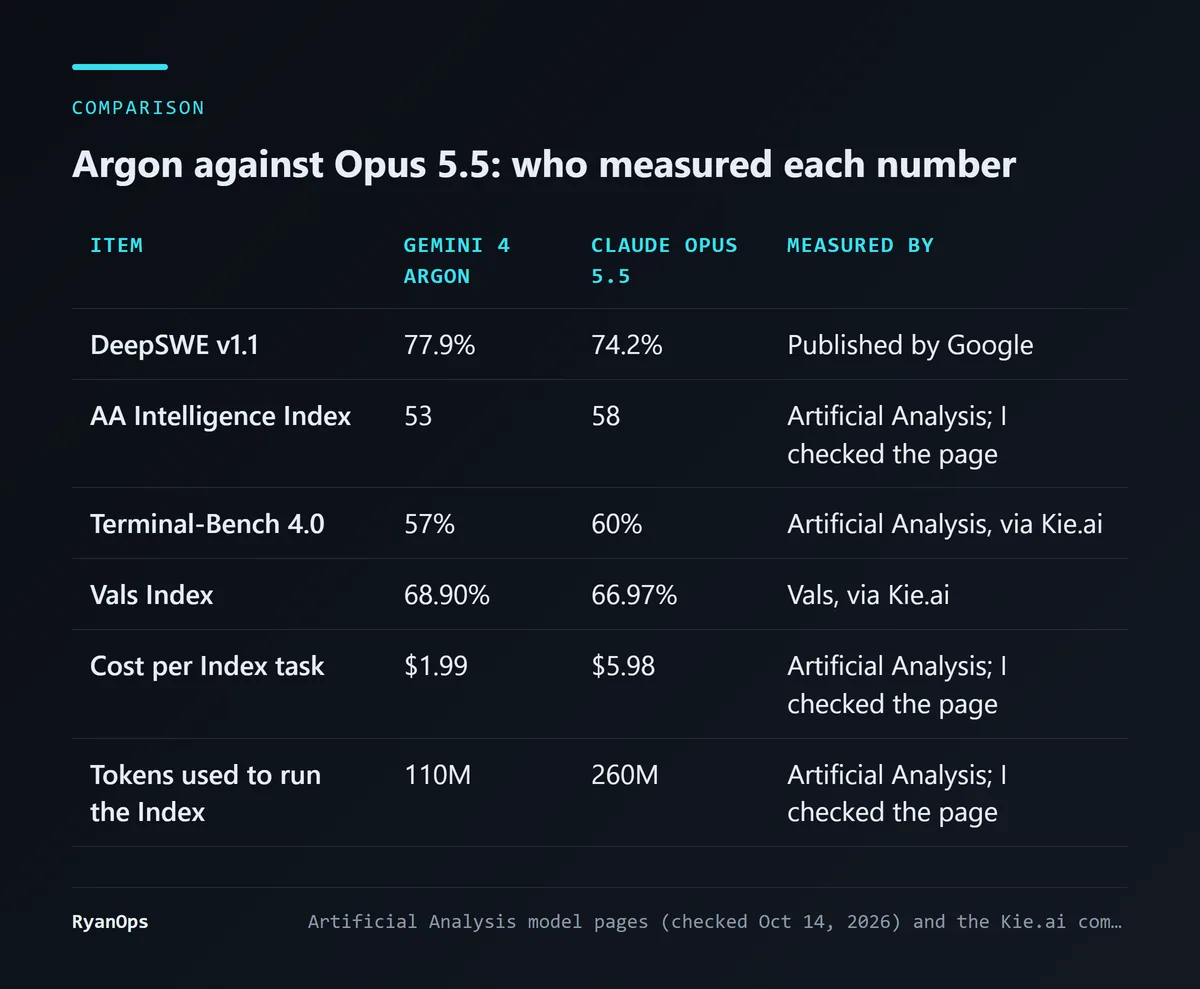 Figure 6: Who measured each number (data: Artificial Analysis, Kie.ai)
Where Argon leads. DeepSWE v1.1 is 77.9% against 74.2%, on a test of long-horizon software engineering tasks. The 77.9% is what Google published in its launch post. The 74.2%, according to Kie.ai, comes from the same Google comparison chart. I did not see it in the text of Google’s post, so I can only mark the rival’s figure as relayed. The Vals Index is 68.90% against 66.97%, also relayed by Kie.ai.
Where Opus 5.5 leads. The composite index, 58 against 53. Terminal-Bench 4.0 is 60% against 57%, which Kie.ai says Artificial Analysis measured. This test measures completing multi-step work in a terminal, the closest match to asking an agent to do things in the Antigravity CLI.
Kie.ai also compiles standings from several leaderboards: Argon first on Arena’s text board, and eighth on both the web development code board and the agent board. I did not go back to the original leaderboards to verify these.
Cost is Argon’s clearest advantage. I saw both of these numbers on Artificial Analysis’s pages: running the full index costs $1.99 per task on average for Argon and $5.98 for Opus 5.5, a threefold difference. There are two reasons. Argon’s unit price is currently half of Opus 5.5’s, and Argon uses far fewer tokens, 110 million against 260 million.
The arithmetic changes after December 1, though. I made my own estimate: assuming token use stays the same, once Argon’s unit price doubles the cost per task comes to about $3.98, still roughly a third cheaper than Opus 5.5. That is my projection, and it assumes Artificial Analysis’s test mix has not changed by then.
One caution in reading these numbers. The same test measured by different people can give very different scores. Anthropic’s own published figure for Opus 5.5 on Terminal-Bench 4.0 is 66.4%, as this site covered in its Opus 5.5 piece, while Artificial Analysis measured 60%. Reasoning level, harness, and whether safeguards are on all move the score. So a five-point gap such as 53 against 58 is something I read as “roughly the same tier, Opus slightly ahead”, and not as one model being clearly stronger. The glossary has an entry on how to read a benchmark.
Is “one million output tokens in one response” real?
It is real, but not quite what the phrase suggests. I read the Gemini API’s long decode guide, and three things were not made clear at launch.
For an ordinary request the output limit is still 65,536 tokens. Going beyond that means switching on background execution and raising the limit. The guide says a single model call generates up to 64K, and a longer response is produced by the server continuing hop after hop, each one picking up where the previous one stopped.
Input and output share one window of 1,048,576 tokens. The more you put in, the less can be written out.
The model will not write to the length you ask for. The guide’s counterexample is “write a 700,000-word book”, and it says outright that the model does not follow length targets. Long decode suits hard math, scientific proofs and the most difficult coding tasks, where the model needs room to think longer. Chat, summarization and classification have no use for it. The guide also says long decode can run for several minutes.
So a more accurate understanding is this: Argon lets the “thinking plus output” of a single response go past 64K, up to one million minus your input. That helps when running a large refactor in Antigravity, but it is no switch for producing a whole project in one go.
How does Google say it uses Argon internally?
The body of the announcement is Google’s own results. All of it is Google’s account and cannot be checked from outside. I list the numbers as given and then say how I read them.
The overall figures: more than 100,000 people across Alphabet use Argon each month inside an internal version of Antigravity. Over four weeks, agentic code rose 35% and post-submit rollbacks fell 30%.
There are six engineering examples. The CPU footprint of YouTube’s comments frontend was cut in half, after Argon found from production profile data that redundant emoji rendering alone accounted for nearly 45% of server overhead. Server comment-load latency dropped by 30 ms and client latency by 20 ms. Wing’s drone physics simulator received 18 proposed improvements. A queue of 134 bug reports had 97 stale or duplicate ones closed in under three hours, with the remaining 37 all assigned to owners. A Fortran codebase was rewritten in Rust with a 1.8x performance boost. A security audit of access-control changes found four critical bugs, where the announcement says two earlier frontier models auditing the same code both concluded there were none. Triage of on-call support tickets freed two to three hours per shift.
There are four examples outside engineering, and the finance one has the most specific number: a finance lead used Argon across 80 workflows, and over seven business days 15.5 hours of human direction produced about 335 human-equivalent hours of output. By my arithmetic that is 21.6 times. The announcement also says more than half of Google’s Cloud sales staff and almost half of its finance staff use Antigravity.
I have three reservations about these numbers. The internal version of Antigravity is not the same thing you download, and it is wired to Google’s internal codebases and tools. “A 35% increase in agentic code” does not say what the baseline is. And this is a product announcement, which lists only successes.
One easily skipped sentence in the announcement tells me more than those numbers do: Argon is designed to tackle the hardest problems, and Google is equally excited about future models that can be used as everyday drivers by a broader range of builders. Put plainly, Google itself does not think Argon should be used for every small job, and cheaper Gemini 4 models are still to come.
Should you upgrade to Ultra for it?
My view is that most people need not hurry.
If you are already on Ultra, there is nothing to deliberate. Update Antigravity and try it. Take a task you are really stuck on, run it once on Argon and once on Opus 5.5, and see which result you would be more willing to merge. Only Ultra subscribers can make this comparison, and it is more reliable than any leaderboard.
If you are on Pro now, paying NT$2,650 more a month just to add Argon to Antigravity does not seem justified to me. Independent evaluation puts it in the same tier as the Opus 5.5 you can already select on Pro, with a slightly lower composite score. Argon’s clear advantage is cost per task, but on a subscription you pay a flat monthly fee, so that advantage only shows once you hit usage limits often.
If you connect through the API yourself, it is the opposite, and now is a good time to try. It is half price until November 30, and the cost advantage is real.
What would change my view? If Google publishes concrete quotas for Ultra in Antigravity and they are clearly enough for a full day’s work by one person, the case for upgrading gets much stronger. If independent firms measure Argon overtaking Opus 5.5 on terminal and agent tests, or Antigravity opens Argon to Pro, the advice above would have to change. Conversely, if the cost-per-task advantage shrinks to very little after the December price rise, its appeal for API users falls too.
One thing I could not find: Google has not said when, or whether, Argon will come down to Pro in Antigravity. The announcement says only that this is the start of a rollout. Until then, NT$3,300 is the entry price for an individual.


