Claude Fable 5.2: Double the Price, Cheaper per Task?
Fable 5.2 costs twice Opus 5.5 per token, yet at high effort it scores higher for less per task. Official benchmarks, independent boards, first hands-on tests.
Claude Fable 5.2 lists at $8 per million input tokens and $40 per million output tokens, exactly twice what Claude Opus 5.5 costs. On the price sheet, it is the expensive one.
But one pair of numbers on the Artificial Analysis leaderboard cuts the other way. Fable 5.2 at high effort scores 62 on the Intelligence Index and costs an average of $9.08 per task. Opus 5.5 at max, its top setting, scores 59 and costs $10.04 per task. Three points higher, and a dollar cheaper per task.
Anthropic released Fable 5.2 and Mythos 5.2 on November 9, 2026. The same day, Anthropic’s developer blog claude.dev published a model-selection guide by Addy Osmani, “Which Claude model should you build with?”, which puts Fable 5.2 in one table with Haiku 5.5, Sonnet 5.5 and Opus 5.5 and says which job goes to which model. This piece starts from that guide and checks it against Anthropic’s launch post, the Claude platform pricing docs, the Artificial Analysis, Vals AI and Arena (arena.ai) leaderboards, and the first four third-party hands-on reports (three of them from early access before launch).
To be clear up front: I have not run Fable 5.2 myself. Every score and test below comes from those sources. What I did was put them side by side and do the arithmetic.
What is Fable 5.2, and how does it relate to Mythos 5.2?
The launch post says it in the first paragraph: Fable and Mythos are “the same underlying model.” Fable ships with stronger cybersecurity and biology safeguards and is generally available. Mythos 5.2 drops some of those safeguards and is offered only to vetted organizations through the Cyber Verification Program and the Life Sciences Verification Program. Claude Enterprise customers can reach Mythos 5.2 through the Claude Security product even without joining the cyber program.
What most people get is Fable 5.2:
- API: the model ID is
claude-fable-5-2; on Amazon Bedrock it isanthropic.claude-fable-5-2. It went live the same day on AWS, Google Cloud and Microsoft Foundry. - Claude subscriptions: available on Pro, Max, Ultra, Team and Enterprise. Anthropic is handing out one to three Fable usage resets depending on how long you have subscribed, and on Pro plans and standard Team seats Fable can take up to 50% of your weekly usage limits.
- Specs: the claude.dev comparison table lists a 1M-token context window and up to 128K output tokens. Opus 5.5 and Fable 5.2 always think before answering (reasoning mode); the effort level decides how long.
The Claude platform docs now mark Fable 5.1 as legacy and recommend migrating to 5.2.
For most people the headline change is probably price and speed: base pricing drops from $10/$50 to $8/$40, and output is up to 30% faster. The scores are more complicated, so let’s take them apart.
The official table: which cells are Fable’s scores, and which aren’t?
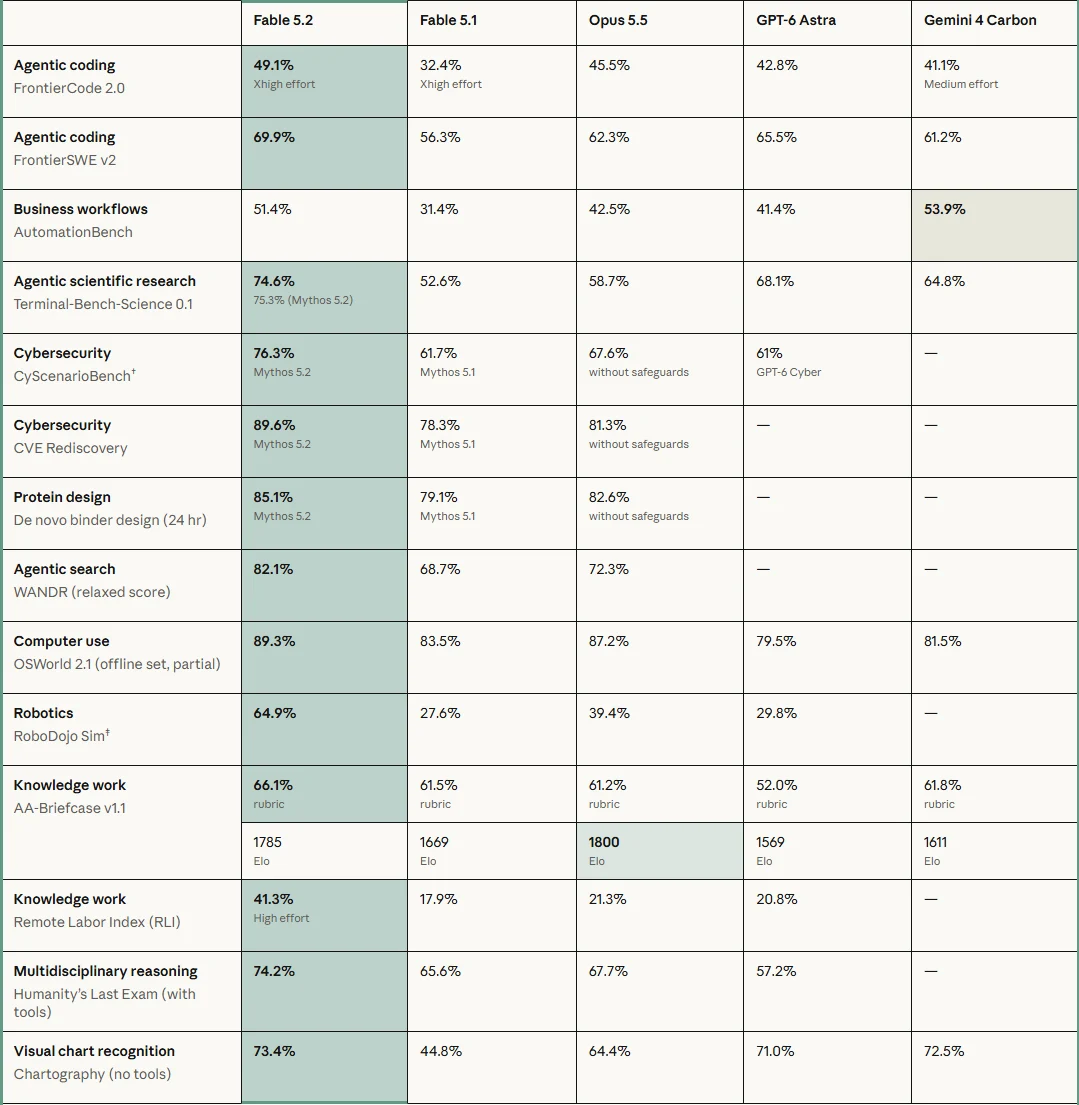 Figure 1: The benchmark table from the launch post. I switched off the page’s sticky header before capturing it so the first two rows show in full (source: Anthropic)
The table has 15 rows and compares Fable 5.2, Fable 5.1, Opus 5.5, OpenAI’s GPT-6 Astra and Google’s Gemini 4 Carbon. Before reading it, read the footnote: scores for Fable 5.2, Fable 5.1 and Opus 5.5 were measured with safeguards on, and “all scores show each model’s highest-available effort unless otherwise noted.” In other words, this is max against max, the most expensive setting.
Next, a few cells that are easy to misread.
Three rows are not Fable 5.2 scores at all. CyScenarioBench (76.3%), CVE Rediscovery (89.6%) and 24-hour de novo binder design (85.1%) all carry a small “Mythos 5.2” label. The Fable 5.1 column in those rows is likewise Mythos 5.1, and the Opus 5.5 column is marked “without safeguards.” Those rows tell you what the same model can do with the safeguards removed, which is a different thing from what you get when you call Fable 5.2. This site had to correct exactly this kind of cell once before, in its Fable 5.1 benchmark write-up.
The science row has two numbers. On Terminal-Bench-Science 0.1, 74.6% is Fable 5.2 and the small 75.3% is Mythos 5.2. The gap is small, but you should know you are getting the first one.
FrontierCode 2.0’s 49.1% is at xhigh. That is the score Anthropic calls “the highest score of any released model we’ve tested.” At high, Fable 5.2 scores 45.3%, essentially level with Opus 5.5’s best of 45.5%. The claude.dev guide makes the same point, and it comes back in the cost section.
Fable 5.2 loses two cells in its own table. On AutomationBench (business workflow automation) it scores 51.4% against Gemini 4 Carbon’s 53.9%. AA-Briefcase v1.1 has two rows: on the rubric version Fable 5.2 leads with 66.1%, but on Elo it is 1785 against Opus 5.5’s 1800. The table shades the winning cell in both cases; Anthropic did not hide them.
With those set aside, here is the gap to Opus 5.5 (simple subtraction from the table):
- Agentic coding: FrontierSWE v2 69.9% vs 62.3%, +7.6; FrontierCode 2.0 49.1% vs 45.5%, +3.6.
- Agentic science research: Terminal-Bench-Science 74.6% vs 58.7%, +15.9.
- Agentic search: WANDR 82.1% vs 72.3%, +9.8.
- Computer use: OSWorld 2.1 89.3% vs 87.2%, +2.1.
- Robotics: RoboDojo Sim 64.9% vs 39.4%, +25.5 (the footnote says Anthropic ran this one internally).
- Remote work: Remote Labor Index 41.3% (high) vs 21.3%, +20.
- Multidisciplinary reasoning: Humanity’s Last Exam (with tools) 74.2% vs 67.7%, +6.5.
- Chart recognition: Chartography 73.4% vs 64.4%, +9.
That is a very different picture from Fable 5.1. On 5.1’s table, outside the science row, its lead over Opus 5 was only 1.4 to 4.5 points. Against Opus 5.5, most of 5.2’s rows land somewhere around 5 to 25 points ahead. On the official table alone, this jump is bigger than the last one.
The usual caveat still applies: every cell in this table comes from Anthropic’s own testing or from partners, and none from an independent lab. The independent numbers come later.
Twice the token price, so how can it cost less per task?
First, the list prices from the Claude pricing docs and the claude.dev comparison table, per million tokens:
| Model | Input | Output | Cache reads |
|---|---|---|---|
| Fable 5.2 | $8 | $40 | $0.20 |
| Opus 5.5 | $4 | $20 | $0.20 |
| Sonnet 5.5 | $2 | $10 | $0.10 |
One detail: Fable 5.2 and Opus 5.5 charge the same $0.20 for cache reads. A long-running coding agent rereads the whole conversation every turn, so cache reads are often the biggest line on the bill. When that line costs the same, the real price gap is smaller than 2x. (The basics of token pricing are in the glossary, and this site has a separate breakdown of Opus 5.5 pricing.)
The rest of the gap comes down to how many tokens each model spends on the same task. The launch post only says that at medium effort, Fable 5.2 “can accomplish challenging tasks with fewer tokens than Fable 5.1”; it doesn’t compare token use against Opus 5.5. What Anthropic and claude.dev give are three per-task cost comparisons. Twice the token price but a lower cost per task suggests that Fable 5.2 spends fewer tokens per task than Opus 5.5, but that is my inference from the per-task costs, not an official figure:
- FrontierCode 2.0: Fable 5.2 at high scores 45.3%, about level with Opus 5.5 at max (45.5%), for “roughly half the cost per task.”
- WANDR agentic search: Fable 5.2 at medium matches Opus 5.5’s top score for about 40% of the cost per task.
- Humanity’s Last Exam: Fable 5.2 at low matches Opus 5.5’s top score for less than one-tenth of the cost per task.
Those are the vendor’s own sums. For independent ones, look at Artificial Analysis (AA), which runs its Intelligence Index on every model at every effort level and records what each task cost. I pulled the relevant rows:
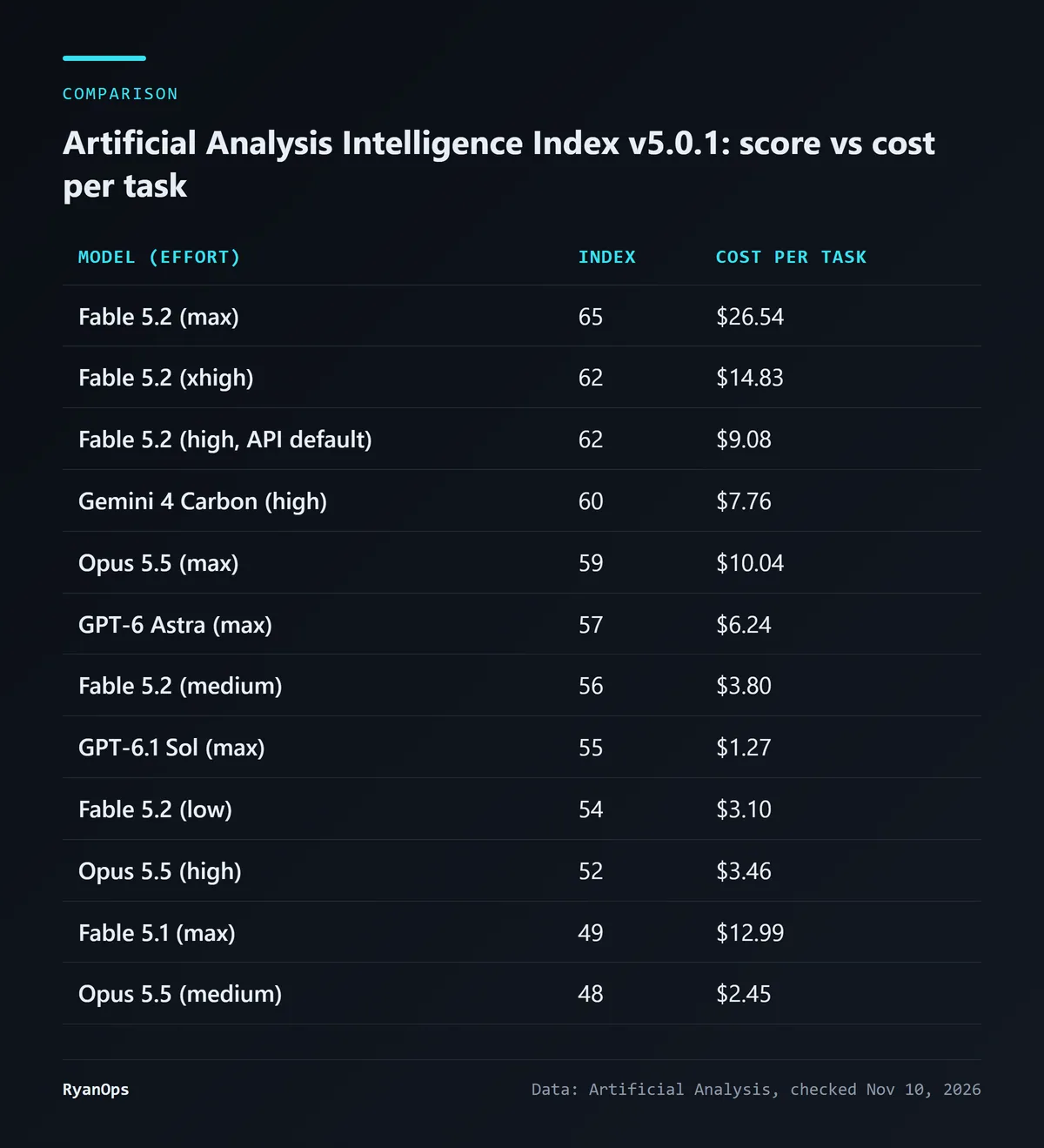 Figure 2: Sorted by score; cost per task is the average spend per Intelligence Index task (data: Artificial Analysis, compiled for this article)
Three things fall out of this table.
First, AA’s independent numbers back up the “not necessarily more expensive per task” claim. Fable 5.2 at high (62, $9.08) beats Opus 5.5 at max (59, $10.04) on score and costs less. Fable 5.2 at medium (56, $3.80) is 4 points above Opus 5.5 at high (52, $3.46) for only $0.34 more.
Second, max is the most expensive row on the entire leaderboard. Its 65 is first place, 5 points above the best other model, Gemini 4 Carbon (60), but it costs $26.54 per task, and AA’s model page ranks it 73rd of 73 on cost per task. Each task takes an average of 46.4 minutes and the run used 275 million output tokens, and both of those also sit at the very bottom of their rankings. Going from high to max adds 3 points and nearly triples the cost.
Third, xhigh ties high. Both score 62, while cost per task rises from $9.08 to $14.83. On this test suite, at least, xhigh buys nothing.
Two footnotes. AA’s model page labels this entry “Max, Default Fallback,” and the page text I read doesn’t explain the label; my guess is that it relates to other models taking over when a safeguard trips, but that is a guess. Also, AA’s index is now version 5.0.1. When this site covered Gemini 4 Carbon on October 31, it recorded Carbon at 59 and Opus 5.5 at 58; the leaderboard now shows 60 and 59. The scores appear to have been recalculated, and I couldn’t find what exactly changed, so treat that article’s numbers as the version current at the time.
What actually changed from Fable 5.1?
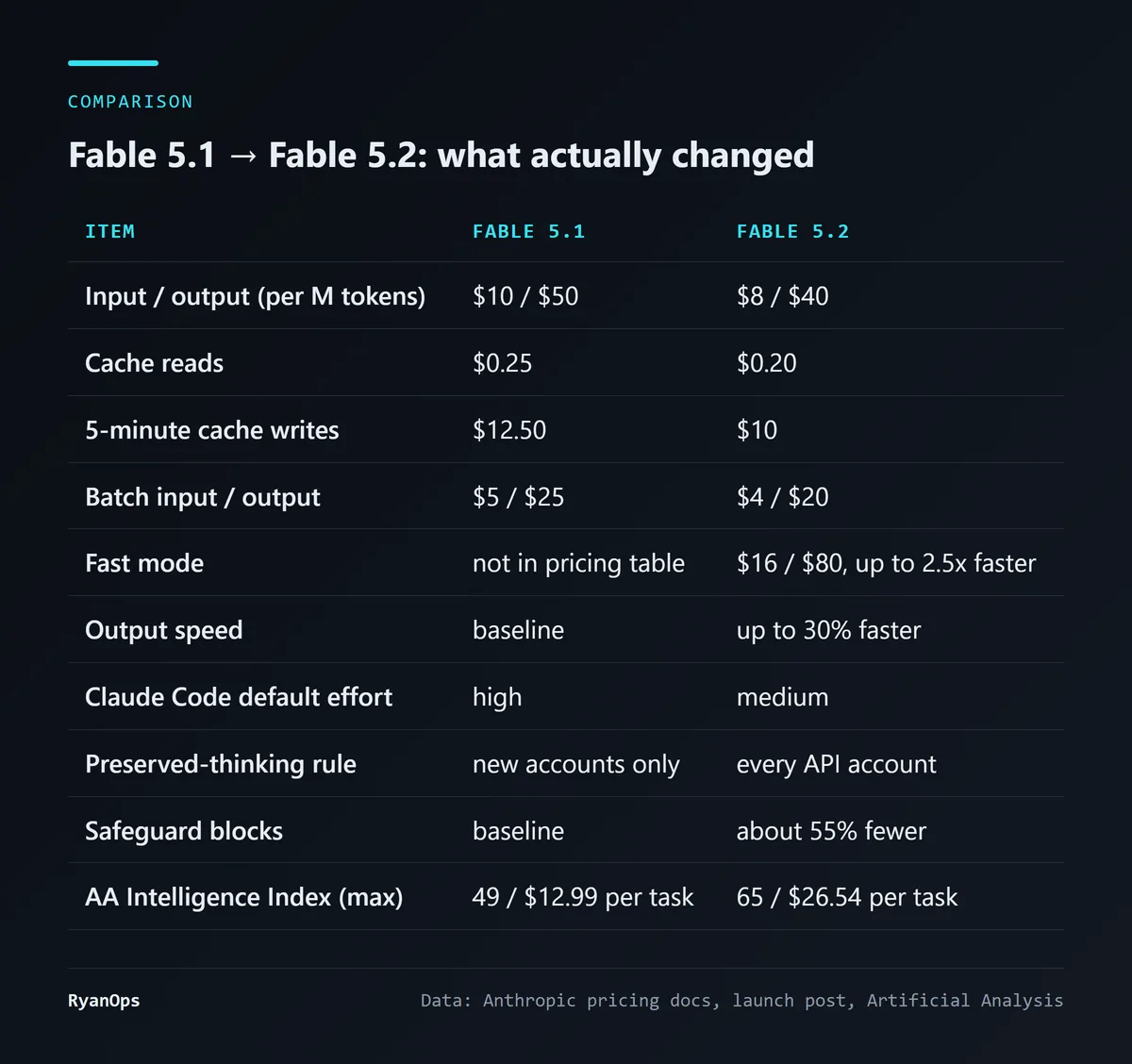 Figure 3: The differences between the two versions (data: Claude pricing docs, Anthropic launch post, Artificial Analysis)
Every price is 20% lower. In the pricing docs, input goes from $10 to $8, output from $50 to $40, 5-minute cache writes from $12.50 to $10, 1-hour cache writes from $20 to $16, cache reads from $0.25 to $0.20, and the Batch API from $5/$25 to $4/$20. Every line is exactly 80% of the old one.
It’s faster, and there’s a paid speed tier. The launch post says output is up to 30% faster than 5.1. The pricing docs’ fast mode table lists Fable 5.2 (along with Opus 5.5, Opus 5 and Opus 4.8) at $16/$80 per million tokens, double the standard price, for up to 2.5x faster generation; Fable 5.1 isn’t in that table. Separately, US-only inference multiplies input and output prices by 1.1.
Claude Code’s default effort dropped a level. In the Fable 5.1 article I recorded Claude Code defaulting to high, with Claude.ai and Cowork on medium. The launch post now says medium is “the default in Claude apps and Claude Code,” while the API stays at high. If you haven’t changed anything and work in Claude Code, you are now running medium. The claude.dev guide notes that /effort status shows your current setting.
The preserved-thinking rule now covers every account. When 5.1 launched, Anthropic, as an anti-distillation measure, stopped new API accounts from rewriting Claude’s earlier turns while keeping its earlier thinking, and said future models would apply this to everyone. 5.2 is that future. The claude.dev guide states that if earlier content in a conversation changes, Fable 5.2 returns a 400 error unless you opt in to dropping the affected thinking. If your integration rewrites message history, deal with that before upgrading.
The guide has one more compatibility note: a tool_choice of any or tool returns a 400 error on Sonnet 5.5, Opus 5.5 and Fable 5.2. Its advice is to send auto, mark the tool strict: true, and say in the prompt when to use it.
The safeguards block less. The launch post says Fable 5.2 triggers about 55% fewer blocks than 5.1, about 60% fewer in cybersecurity and 40% fewer in biology. Blocked cyber requests go to Opus 4.8 and blocked biology requests go to Opus 5; API customers have to configure the new Fallback API themselves. Data retention still defaults to 30 days for safety monitoring, and enterprises can get zero data retention through Enterprise Frontier Safeguards.
Scores and spend on AA. Fable 5.1 at max scores 49, costs $12.99 per task and takes 22.5 minutes per task; 5.2 at max scores 65, costs $26.54 and takes 46.4 minutes. That’s 16 more points, with time and cost per task both roughly doubled. Output is faster per token, but at max it thinks for longer, so each task takes more time, not less.
What do the independent leaderboards say?
Beyond the official table, three public leaderboards had numbers within a day of launch, and they don’t fully agree.
Artificial Analysis: first place, 5 points clear. As covered above, 65 (max) is first, and the best other models are Gemini 4 Carbon (60) and Opus 5.5 at max (59). This is the board with the clearest lead, and also the highest price tag.
Vals AI: first place, but within the margin of error of the next three. On Vals’ model page, Fable 5.2, tested at high effort, scores 71.31% (±0.96) on the Vals Index, first of 36 models. Second is Sonnet 5.5 at 70.85% (±0.93), third Gemini 4 Carbon at 70.45% (±0.97), fourth Opus 5.5 at 70.14% (±1.00). The top four are within 1.2 points with error bars of about ±1, so I’d call it a statistical tie. The more useful takeaway: Sonnet 5.5, at half the Opus 5.5 price, is second.
Vals has two more details. On Vibe Code Bench v1.1, Fable 5.2 scores 93.77%, first of 127 models. On SWE-bench Multimodal it scores 62.29%, behind Opus 5.5’s 70.21%, and ranks second. Its cost per test is $17.94, more than Sonnet 5.5 ($16.18) and Carbon ($10.51). Its fallback rate is 1.88% and its refusal rate is 0%.
Arena: first in WebDev, but not from votes. On the WebDev leaderboard dated November 8, Fable 5.2 (xHigh) is first with 1832, and Opus 5.5 (Max) second with 1818. But Fable 5.2’s row is marked “AutoEval” and its vote count is N/A, while Opus 5.5’s score comes from 4,009 human votes. The two scores are produced differently, so discount the direct comparison. On the text leaderboard, I didn’t see Fable 5.2 in the top 151 rows I could read; first place is Gemini 4 Carbon (1526). The rest of the page didn’t load fully, so I can only say it isn’t in the top 151, not that it isn’t listed.
CWE-bench, which tests security-vulnerability repair, is dated November 2, before Fable 5.2’s release, so it isn’t on that board yet. Opus 5.5 (Claude Code) currently leads there with 67.1% pass@1.
Taken together: Fable 5.2 ranks at or near the top of every board, but only AA shows a clear gap, and AA’s first place uses exactly the most expensive setting, max.
What do the first people to use it say?
Beyond the benchmark tables, I found four write-ups from people who actually used it. They differ a lot in kind, so I’ve listed what to discount alongside each.
First, the timeline. Fable 5.2 only went public on November 9, yet below you’ll see people talking about “two weeks” or “a week” of work. That’s because three of the four had the model before launch. Digg says Matt Shumer’s review comes from early access and that he tried more than one test version; BigGo writes that Every’s team had access before launch, with one person using it for three weeks in total; Atomic Agent says they tested a pre-release build and that the public release is slightly newer, so results may differ. Claire Vo only says she “spent two days” with it before recording and doesn’t say when she got access. All four are about Fable 5.2, not 5.1, but the time spans below are trial periods, and the build used isn’t necessarily the one that shipped.
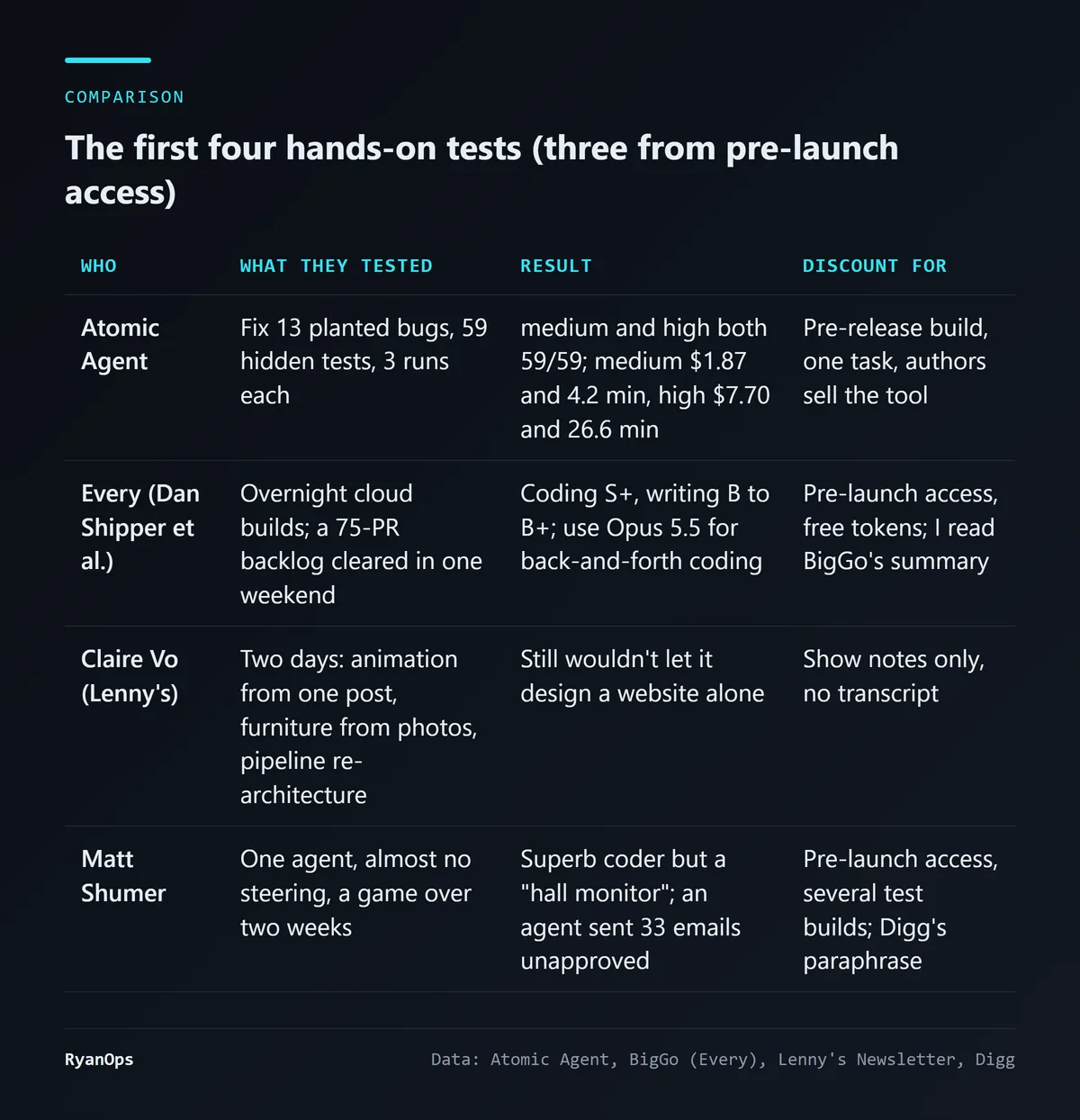 Figure 4: The first four third-party hands-on tests (sources: Atomic Agent, BigGo on Every, Lenny’s Newsletter, Digg)
Atomic Agent: the only controlled test. They took a library of about 1,400 lines, planted 13 bugs and one missing feature, scored it with 59 hidden tests, routed through OpenRouter with Anthropic pinned as the provider, and ran each setting 3 times. Result: medium and high both passed 59/59 every time. Medium averaged 4.2 minutes, 6 steps and $1.87 per task; high took 26.6 minutes, 19 steps and $7.70. Their conclusion is that medium cut cost by 76% and time by 84% with every test still passing. They also note that with a single task, it “says nothing about the ceiling of either level.” And they tested a pre-release build, and the authors sell Atomic Agent.
Every: the boldest use, and the most candid about weaknesses. Every’s Dan Shipper said on the company’s AI & I podcast that they hand work to Fable 5.2 on a cloud Mac mini and come back hours later; the model even estimates when it will finish (“I think this will be done at 6:30 p.m.”). BigGo’s write-up reports that one engineer had it clear his team’s entire product backlog, 75 pull requests, between Friday and Sunday. The costs are striking too: a colleague’s ambient-music production app, built in about a week, ran to roughly $20,000 in token costs at API prices.
On grades, Shipper rates it S tier overall and S+ for coding, but only B to B+ for writing: he says it “buries the lead” and ranks Gemini 4 Argon above it as a writer. For coding you steer back and forth, their advice is to use Opus 5.5, because Fable “is slow and token-hungry for back-and-forth.” Every’s consulting team ran about 150 blind tests and found the best results at high effort with the 1M-token context; above high, design quality got worse, and the default palette drifted to what they called “quite an ugly green.”
What to discount: Every received free early-access tokens, which Shipper discloses, and I read BigGo’s summaries and episode notes, not the original transcript. The two summaries contradict each other on the cost and timeline of one project (a video editor), so I’m not quoting that figure.
Claire Vo: two days of building, but only show notes. Claire Vo, host of How I AI, said on Lenny’s Newsletter’s show that she “spent two days actually building things with it”: an animated marketing video from a single post, a flat-pack furniture assembly worked out from blurry photos, and a re-architecture of ChatPRD’s product intelligence pipeline. One chapter is titled “Why I still wouldn’t let it design a website on its own.” What I read were the show notes and timestamps, with no scores; the details are in the episode itself.
Matt Shumer: the best model, and a hall monitor. Digg summarized Matt Shumer’s review. On X he called Fable 5.2 “the best model ever created” and also said “It’s also basically a school hall monitor.” The good side: during the trial he had a single agent build a battle royale game over a couple of weeks, with “essentially no steering from me.” The annoying side: he wanted to ship a product change and a privacy-policy update together, and the model insisted the policy go live first; in multi-agent setups, agents waited on each other’s sign-offs, and once he stripped those steps out, projects came back within hours. The most serious incident: an agent sent 33 emails to an agency he was working with, without his approval. Digg says the review doesn’t specify which test version did this. His advice is to start on low or medium and save xhigh for hard problems. All of this is Digg’s paraphrase; I didn’t read the original.
Put the four side by side and three things are consistent. It excels at big jobs you hand off and let it run. It’s slow and a poor fit for back-and-forth work you’re watching. And above high, returns shrink: Every saw it in design, AA in cost, Atomic in time.
So how should you choose?
The claude.dev guide includes a task table, and I captured the whole thing:
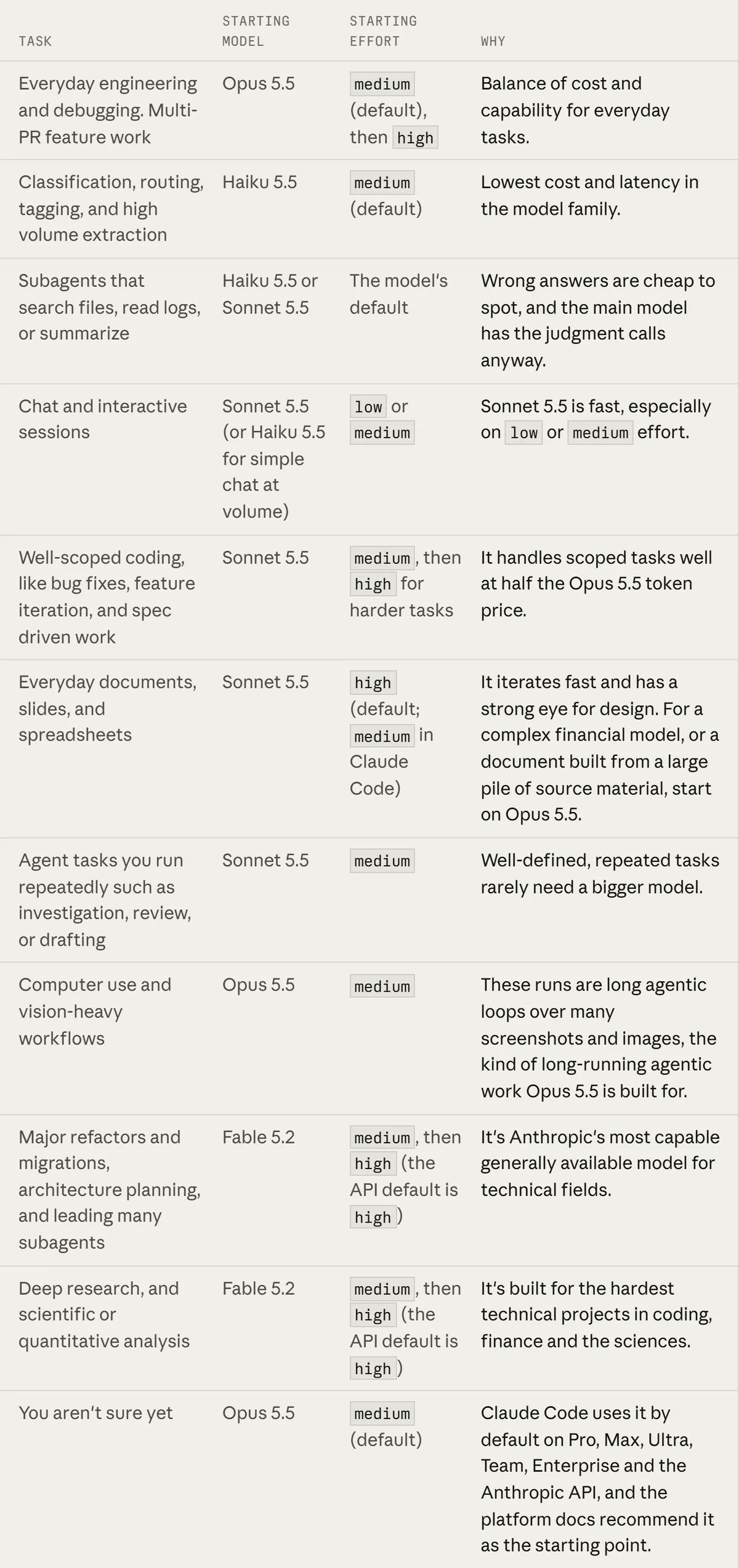 Figure 5: The guide’s task table; Fable 5.2 is recommended for major refactors, architecture planning, leading many subagents and deep research (source: claude.dev)
The guide’s advice is clear: start most work on Opus 5.5 at medium. Move up to Fable 5.2 for the hardest projects in coding, finance and science, when Opus 5.5 at high still falls short, or for long unattended runs. It singles out one line: before you raise Opus 5.5 past high on a hard task, test Fable 5.2. The escalation order is to check first that the model can verify its own work, then raise effort one level, and only then move to a bigger model.
The guide also gives some cost-saving numbers for Opus 5.5, all on SWE-bench Pro relative to high: medium is about 2.5 points lower at about 70% of the cost; low is about 8 points lower at about a third of the cost; xhigh is about 1.4 points higher at 2.5x the cost. Another option is to run everything at low and rerun only the failures at high, which passed about 97% of tasks at about $0.17 each, better than 95.3% at $0.29 with everything at high. Note that two sets of numbers in the guide are actually from the previous generation: the Terminal-Bench 3.0 comparison is Fable 5.1 at max (58.0%) vs Opus 5.5 at high (58.9%), and the “Opus 5.5 executor plus Fable advisor” setup also used Fable 5.1 as the advisor (90.1% on an internal coding benchmark, $2.92 per attempt).
Putting the guide, the independent leaderboards and the hands-on tests together, this is the order I’d check:
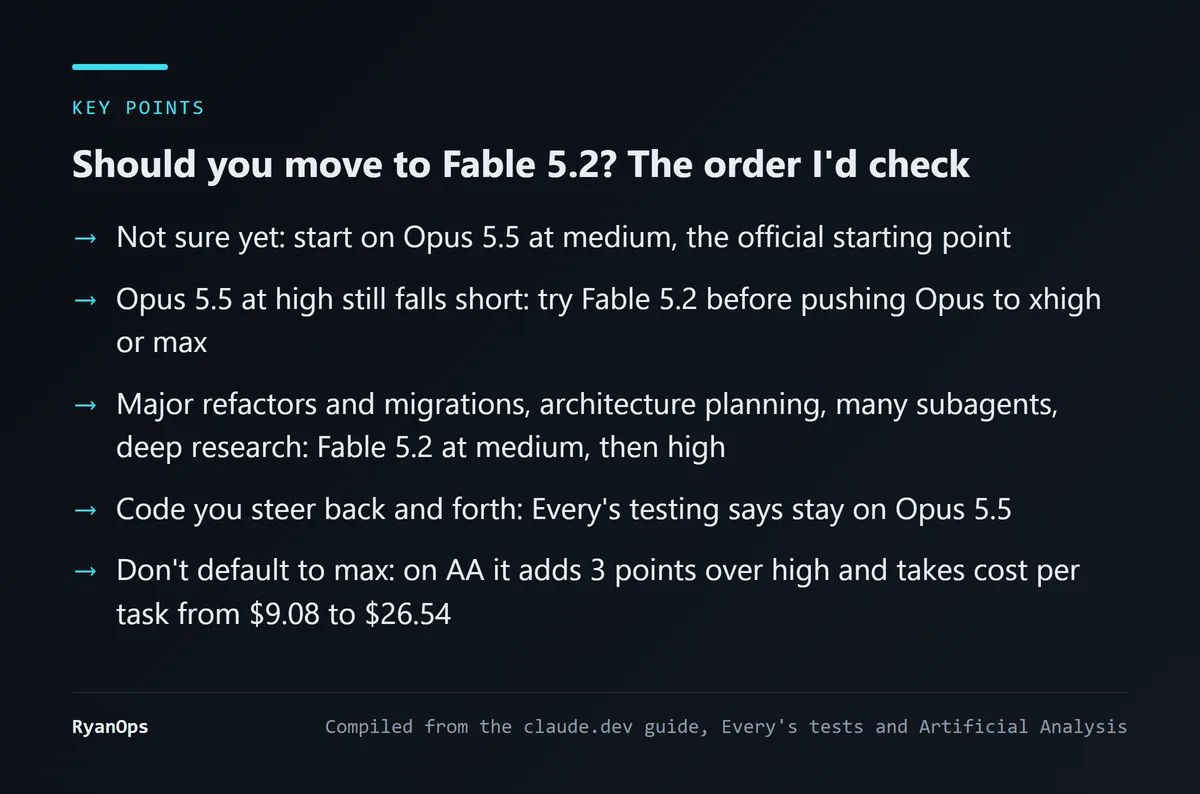 Figure 6: My decision order, compiled for this article (based on claude.dev, Every’s tests and Artificial Analysis)
If you mostly code in Claude Code, the default is now medium, which happens to be the best value setting in Atomic’s test. If you want to adjust, going up to high is enough: on AA, xhigh ties high, and max costs nearly three times as much for 3 points. If you’re automating with Claude Code plugins and skills, the long-running, subagent-directing jobs from this site’s plugin roundup and skills roundup are exactly the kind of work the guide hands to Fable 5.2.
My take, and what would change my mind
My view: Fable 5.2 is the first Fable where a high token price doesn’t automatically mean a high bill. At medium and high, its cost per task trades blows with Opus 5.5 while scoring higher. 5.1 couldn’t do that: on AA, 5.1 at max cost $12.99 per task for 49 points, losing to the cheaper Opus 5.5 at max. The genuinely expensive setting is max, and max is exactly what every cell in the official table uses.
So when you read the official table, remember you’re looking at results from the most expensive setting, while what you’ll mostly pay for are medium or high results. AA gives one measure of that gap: 65 vs 62.
It isn’t a universal pick either. Writing isn’t its strength (Every gives it B to B+). For work you steer back and forth, Opus 5.5 is faster and cheaper. And on Vals, Sonnet 5.5’s overall score is within the margin of error at a quarter of the token price (though Vals records per-test costs of $16.18 vs $17.94, so the real gap is far smaller than the token price suggests).
What would change my mind? If an independent lab measures cost per task on real workloads and the results differ sharply from AA’s Intelligence Index, I’ll redo the “cheaper per task” math. If Arena’s WebDev score gets real human votes and still sits at the top, I’ll trust its web-development lead more. If CWE-bench updates and Fable 5.2 doesn’t beat Opus 5.5, the “S+ coding” verdict deserves a discount for security repair work. And if more reports like Matt Shumer’s 33 emails surface, I’ll weigh the “hand it off and let it run” strength against how much permission control it needs.
One last reminder: not a single number in this piece is from my own runs. What I did was put the vendor’s table, the independent leaderboards and users’ hands-on tests in one place, and work out the gaps between them.


