Jev outputs no text: 68% accurate, 37x in 24 days
TypeSafe AI's Jev returns typed results with probabilities. From its site and docs: a $7.5B Series A on Oct 9, about 68% accuracy, nine failure modes.
On September 15, 2026, the San Francisco startup TypeSafe AI ended two years in stealth and introduced Jev, a model that does not generate text. You hand it some data and a few structured questions, and it returns typed results with probabilities: the probability for a yes/no question, an option picked from a list, or a score on a scale you define. The company positions it as AI for software to use.
This site wrote a version on September 22. At that point Jev was still on a waitlist, and I relied mainly on SiliconANGLE’s report and secondary write-ups. Three weeks later a good deal has changed. The site is open for sign-up, the documentation is fully public, and on October 9 the company announced an $870 million round. For this rewrite I read the site, the launch post and the technical docs, added what the old version lacked, and corrected two points that were wrong or that I can no longer find.
The conclusion first. The model’s design is interesting, and the company is more candid about its own numbers than most. But headline figures such as “444 times cheaper” only give the full picture when read next to the “roughly 68% accuracy” on the company’s own chart.
What happened to this company in three weeks?
TypeSafe AI was founded in 2024. Chief executive Diogo Almeida previously worked on RLHF, InstructGPT, ChatGPT and GPT-4 at OpenAI, and the two other co-founders are Erik Gafni and Sasha Sheng. When it came out of stealth on September 15 it also announced a $40 million seed round led by DCVC. SiliconANGLE relays a Forbes report that the round valued the company at about $200 million.
The old version stopped there. What follows is new this time.
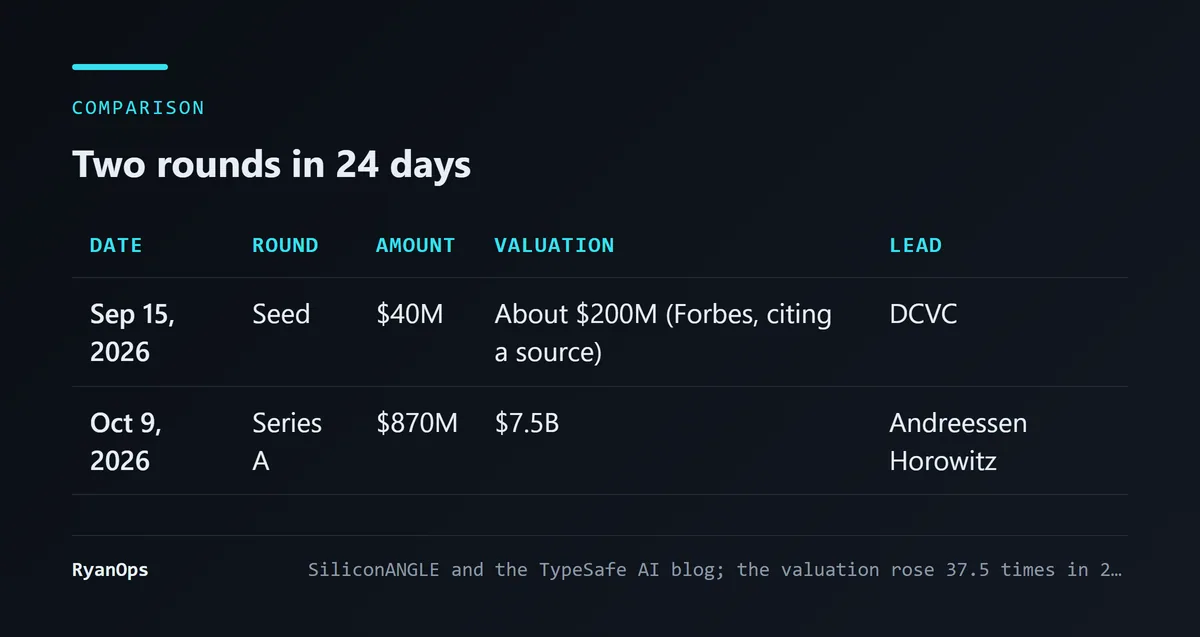 Figure 1: Two rounds in 24 days (data: SiliconANGLE, TypeSafe AI blog)
On October 9, TypeSafe announced a Series A on its company blog, led by Andreessen Horowitz with Sequoia Capital and existing investor DCVC participating. The body of the post deliberately gives no figures and says only “a really big series A”. The figures are in a footnote: $870 million at a $7.5 billion valuation, with a16z’s Martin Casado joining the board.
From $200 million to $7.5 billion in 24 days is 37.5 times. The seed valuation comes from a source cited by Forbes, so treat that multiple as an order of magnitude.
The same post makes two other claims: a third of the Fortune 500 are using Jev, and it has already saved customers millions of dollars in production. The company names no customers, and I cannot verify either claim.
How does Jev actually work?
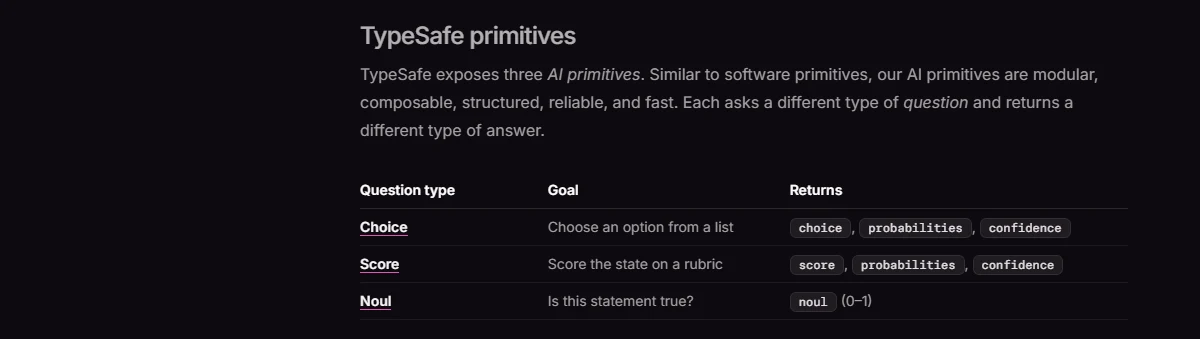 Figure 2: The three question types and what they return, from the official docs (source: docs.typesafe.ai)
Jev’s API accepts only three kinds of question, which the docs call primitives.
Choice selects one option from a list you supply and returns the selected option, a probability for each option, and a confidence value. The launch post says it supports up to 255 options and handles the larger sets in two stages.
Score places the data on ordered levels according to a rubric you write and returns a score, a probability for each level, and a confidence value.
Noul asks whether a statement is true and returns a probability between 0 and 1. It has no separate confidence field.
The three types can be mixed in one call. The docs say each question is evaluated in parallel and in isolation against the same data (which the docs call the state), so adding questions barely changes the response time.
This design brings a constraint, and the docs state it plainly. Each question should ask one specific thing, the kind of judgment “a highly knowledgeable person could make in a few seconds”. If what you want to ask needs extended reasoning or weighs several independent factors, break it up, ask each part separately, and combine the answers in your own code. The docs’ example: instead of asking “rate this startup pitch”, ask separately about market size, technical feasibility and differentiation, then weight them with your own formula.
Confidence is the heart of the design. The training method is called RLCD (Reinforcement Learning for Calibrated Decisions), and its aim is for the probabilities the model reports to line up with how often it is actually right. Once they do, you can set thresholds in code: proceed automatically when confidence is high, ask for more data in the middle, and hand the low ones to a person. An ordinary large language model asked “how sure are you” tends to be overconfident, which is why TypeSafe thinks such models are hard to use in automated flows.
The old version had the origin of the names right. System One comes from Kahneman’s Thinking, Fast and Slow, and Jev from the economist William Stanley Jevons.
How should “193 times faster, 444 times cheaper” be read?
Those two numbers sit in the most prominent spot on the home page. To its credit, TypeSafe spends a whole section of its launch post annotating its own figures, saying that extraordinary claims require extraordinary evidence. I collected those notes into one table.
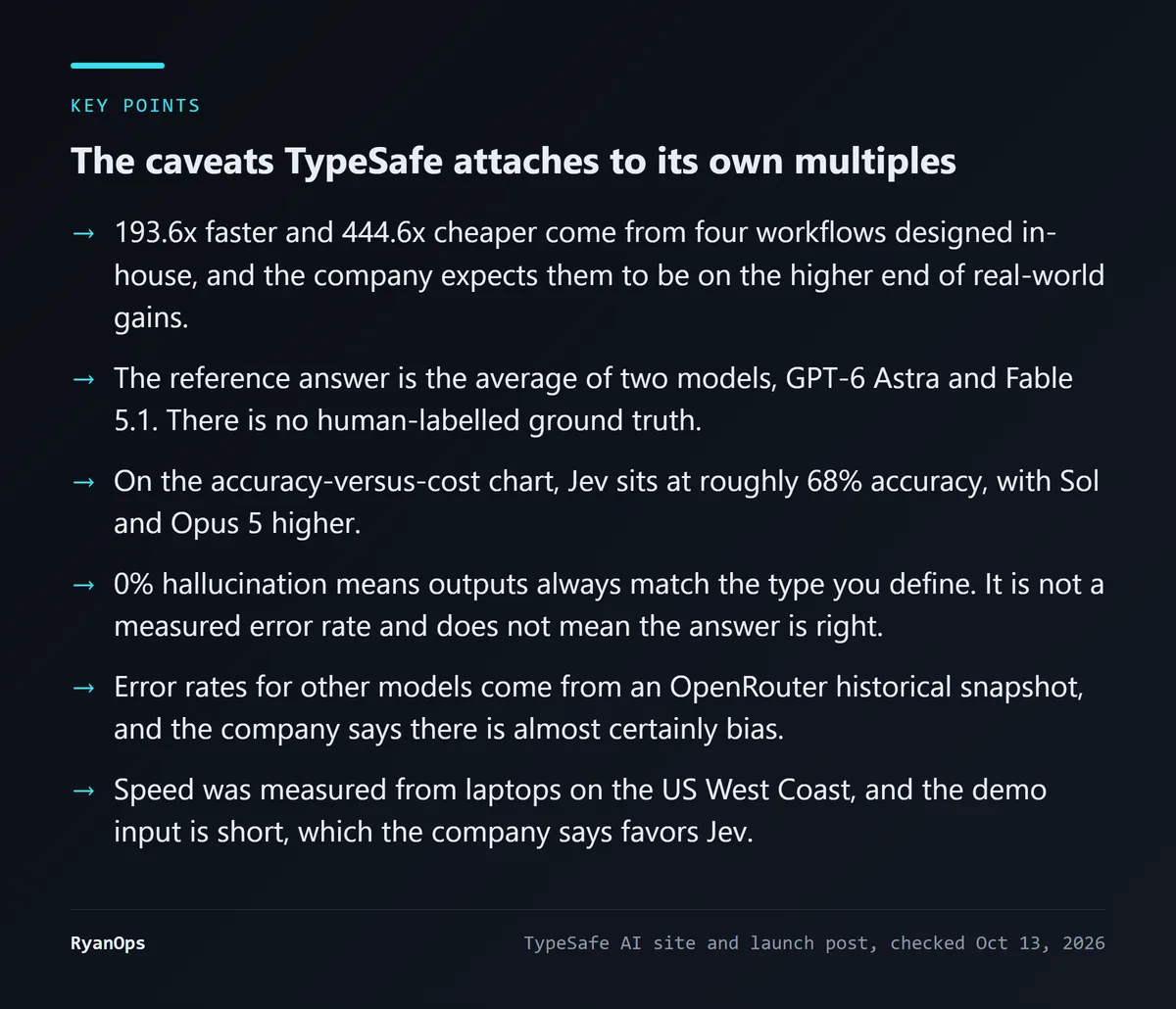 Figure 3: Limits written by the company itself (data: TypeSafe AI site and launch post)
The second and third matter most.
This evaluation has no human-labelled correct answers. The company’s approach is to assume there is a correct workflow and then use the predictions of “the largest, smartest, and most expensive external models” as the reference. In practice that is the average of GPT-6 Astra and Claude Fable 5.1. So the “accuracy” on the charts measures agreement with those two models. The company itself points out that this biases results towards OpenAI’s and Anthropic’s models.
Under that definition, the text description of the site’s accuracy-versus-cost chart says Jev is the lowest-cost model shown, at roughly 68% accuracy. GPT-5.6 Terra and Claude Sonnet 5 have similar accuracy at higher cost. GPT-5.6 Sol and Claude Opus 5 have higher accuracy and higher cost. One line below adds that these are workflow evaluation results and not a measure of accuracy on every task.
The old version did not give the 68% figure. It changes how the whole thing reads: Jev’s pitch is two orders of magnitude lower cost at mid-tier accuracy. The company does not claim to be more accurate than flagship models.
“Zero hallucination” also has to be read by the company’s definition. In the site’s own words, Jev’s 0% represents its guarantee that outputs match the defined schema. It is not an observed error rate from testing, and the charts concern output format and tool-call errors, not whether every answer is correct. An answer can still be wrong.
On price there is an inconsistency over time. The September launch post says: we can’t prove it isn’t subsidized, and we’ll need the long term to prove the sustainability of our pricing. The FAQ on the site as I saw it on October 13 says: we can serve Jev profitably at our current prices. Less than a month separates the two statements, with an $870 million round in between. Outsiders cannot tell which is closer to the truth.
Independent measurements are scarce so far. The closest I found is the Spring blog’s September 21 post introducing the Spring AI integration for TypeSafe, which reports a median latency of 275 ms for one question and 310 ms for three. That falls within the company’s stated range of 70 to 500 ms and supports “more questions barely slow it down”, but it does not measure accuracy.
What does the company say it is bad at?
The old version stopped at “tasks that need reasoning or generation are not a fit”. The docs in fact have a whole page called “Jev 1.13 jaggedness” that lists known flaws item by item, last reviewed on October 2.
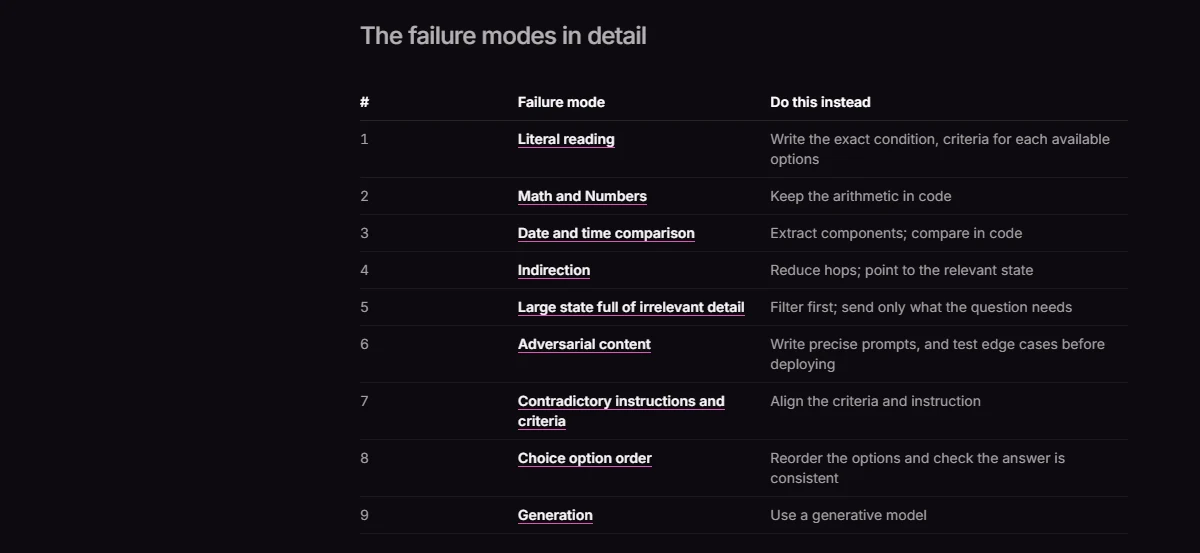 Figure 4: Nine known failure modes of jev-1.13 and the company’s advice (source: docs.typesafe.ai)
Several of them matter a great deal in practice.
It answers literally. The docs say it answers the question you wrote, not the one you meant. Scoping words, negations and implied conditions are read at face value.
It cannot do arithmetic. The docs say outright “Jev is not a calculator”. Counting the letters in a word, the occurrences of a term in a passage, or the items in a long list is unreliable. The advice is to keep counting and arithmetic in code.
It reads dates as text. Which of two dates comes first, how far apart they are, and whether one falls inside a window are all unreliable.
The order of options affects a Choice answer. The docs suggest reordering the options and asking again to see whether the answer is consistent. For a model whose selling point is consistency, this is a notable admission.
One more item sits on a different page and matters especially to people working in Chinese. The language support section of the models page says English is the primary training language and where accuracy is currently best. Other languages, including CJK scripts, are handled but not equally well, and the docs recommend testing on your own content and paying close attention to confidence when routing. I have not tested Jev on Chinese, and the company has published no figures for any language other than English.
How do you use it now, and what does it cost?
 Figure 5: Current model specifications, captured October 13, 2026 (source: docs.typesafe.ai/models)
The price is as the old version had it: $0.042 per million input tokens, with output free. On the site’s comparison table, Claude Haiku 4.5 is $1 for input and $5 for output, and GPT-5.6 Luna is $0.20 and $1.20.
Other specifications have been updated. The current version is jev-1.13.0. A request is capped at 64k tokens, within which the data plus the single longest question may not exceed 32k. Rate limits are 100K tokens or 80 requests per second, and the docs carry a warning that limits are adjusting dynamically with demand. Input is text only, so images, audio and video have to be converted to text first.
Customization also differs from ordinary models. The docs say Jev is not fine-tuned and not trained on customer data, and that the same weights serve every account. You can shape its behavior only through the data you put in the request and the way you write the questions.
Two points about access need correcting. The old version said the only route was a waitlist. The home page now has a sign-up button and an API console, with SDKs for Python and JavaScript. The old version also said Cloudflare Workers AI offers the model under the ID typesafe/jev. On October 13 I opened Cloudflare’s model catalog and could not find Jev, and the page responded that the model is “deprecated, removed, or not found”. I do not know whether it was once listed and later removed, or whether the information the old version cited was wrong to begin with, so that sentence is removed. The Spring AI integration does exist. It is a community project that wraps TypeSafe’s hosted API.
The model’s weights, parameter count and training data details are still not public, and there is no self-hosting option.
My read, and what would change it
I think the problem Jev is trying to solve is real. Calling a language model inside a program flow, then digging the JSON out, then dealing with its occasional malformed output or off-target answer is slow and brittle. A component that guarantees correct types, attaches calibrated probabilities and responds within a few hundred milliseconds is attractive for small, high-frequency judgments such as classification, routing and review.
I hold back on two points. First, every accuracy figure so far comes from an evaluation TypeSafe designed itself, in which “accurate” means agreeing with two large models. Calibration in particular needs independent verification, because the value of the whole design rests on the confidence value being trustworthy. Second, the $7.5 billion valuation rests on adoption figures the company states itself, without a single named customer.
One development since launch should be recorded. Checking the OpenAI API changelog on October 13, I saw that on October 6 OpenAI released a beta of a Decisions API with gpt-6-luna, described as “Turn text and images into typed answers 10x faster than the Responses API”. That is the same kind of thing Jev does, three weeks after Jev came out of stealth. I have not seen a comparison of the two yet, but from here on TypeSafe faces more than the argument that language models are ill-suited to this job. It also faces a product of the same kind from a large vendor.
What would change my view? If an independent team, using a human-labelled dataset, finds that Jev’s confidence does line up with accuracy, I would upgrade it from “an interesting design” to “a component you can put in a production flow”. If named large customers say publicly what they replaced with it and how much they saved, the claim about a third of the Fortune 500 gains support. Conversely, if prices rise in six months, or tests on non-English workloads such as Chinese come out clearly worse, I would advise teams working in Chinese to wait.
If you want to try it now, my advice is to do what the docs say. Take your own data, pick a simple classification or yes/no judgment, first measure whether the confidence lines up with your own human labels, and then set the threshold. Do not budget from the multiples on the home page.
What this rewrite corrected
- The Cloudflare listing was removed. The old version said Workers AI offers the model as
typesafe/jev. I could not find it in Cloudflare’s model catalog on October 13 and cannot confirm it was ever true. - Access was updated. The old version said waitlist only. The site now has open sign-up and an API console.
- Specifications were updated. The old version cited a context length of 32K. The official docs say 64k per request and 32k for the data plus the longest question.
- The 68% figure was added. The chart description on the site puts Jev’s accuracy at roughly 68%, and that accuracy is relative to the average of two large models. The old version did not say so.
- The Series A was added. Announced on October 9: $870 million at a $7.5 billion valuation, 24 days after the seed round.
- New material. The nine failure modes the company lists, its note that non-English languages perform less well, the two inconsistent statements on subsidy, the no-fine-tuning design, and the latency figures reported on the Spring blog.


