Fable 5.1: +23.6 on science, under 5 elsewhere
Anthropic shipped Fable 5.1 and Mythos 5.1 in September. Row by row, only science shows a big lead over Opus 5; the 75% cache-read cut matters more.
Anthropic released Claude Fable 5.1 and Claude Mythos 5.1 in September 2026. The launch page says at the top that the two are the same model with different levels of safeguards: Fable 5.1 is generally available, while Mythos 5.1 is offered only through trusted access programs to vetted cybersecurity and life sciences organizations.
This site’s September 9 version followed the launch page’s highlights: a hedge fund said the model caught a crash nobody had solved in four years, accuracy on science tasks doubled, and Mythos redrew the map of Venus. For this rewrite I read the launch page end to end and worked through every row of the table. The old version had one thing wrong (the Venus map was made by Fable 5.1), and it missed the most notable feature of this scorecard: outside the science benchmark, Fable 5.1 leads Anthropic’s own Opus 5 by only 1.4 to 4.5 percentage points.
How should you read the official table?
Start with the original. Anthropic compares Fable 5.1 with three others: its predecessor Fable 5, its own Opus 5, and OpenAI’s GPT-5.6 Sol.
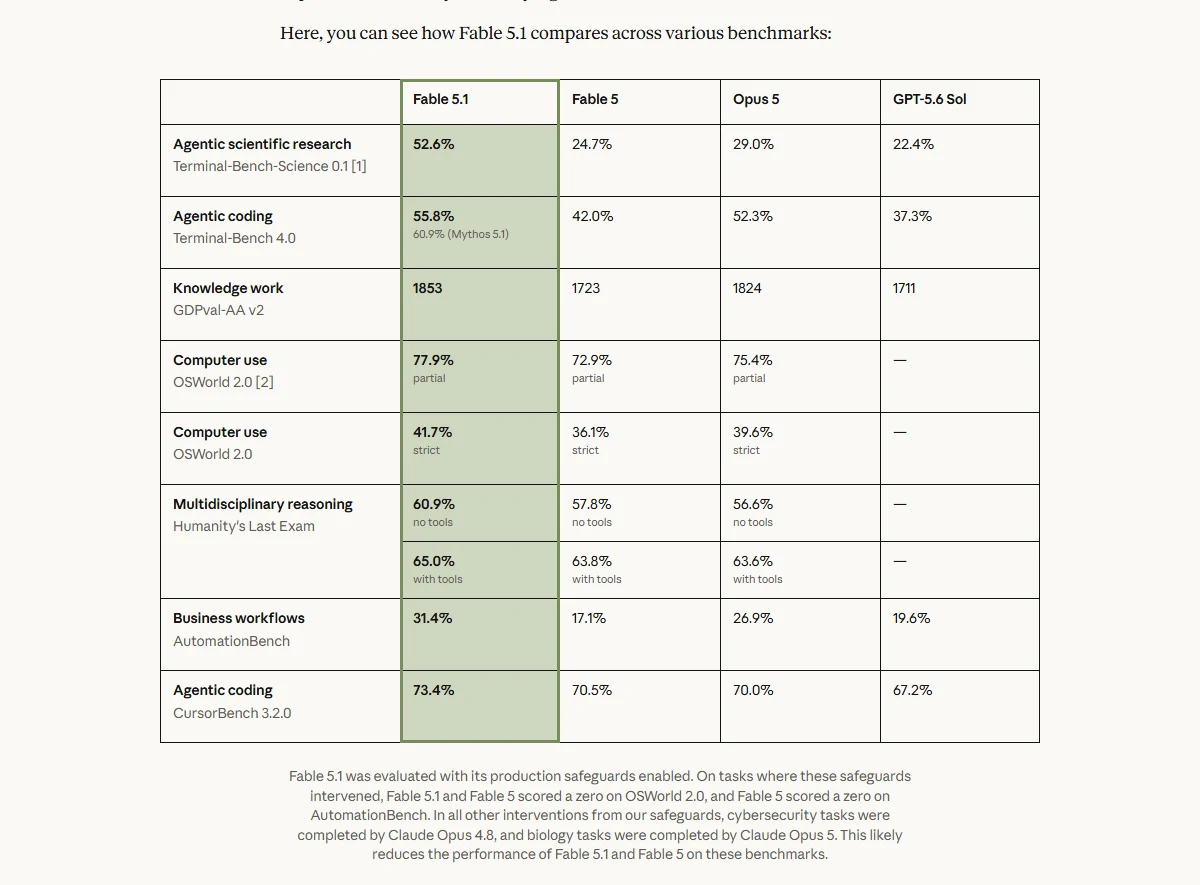 Figure 1: The table on the launch page; the small print below it describes how safeguards affect the scores (source: Anthropic)
Most coverage compares Fable 5.1 with Fable 5, because those numbers look best: Terminal-Bench-Science 0.1 goes from 24.7% to 52.6%, AutomationBench from 17.1% to 31.4%, and Terminal-Bench 4.0 from 42.0% to 55.8%.
The table also holds something more awkward. Fable 5 actually trailed the lower-positioned Opus 5 on several tests: 42.0% against 52.3% on Terminal-Bench 4.0, 17.1% against 26.9% on AutomationBench, 1723 against 1824 on GDPval-AA v2, and even 24.7% against 29.0% on the science benchmark. In other words, part of “much better than the last generation” is filling holes where the last generation was behind. To see how far Fable 5.1 moves the frontier, the more reasonable reference is Opus 5. I worked out that column.
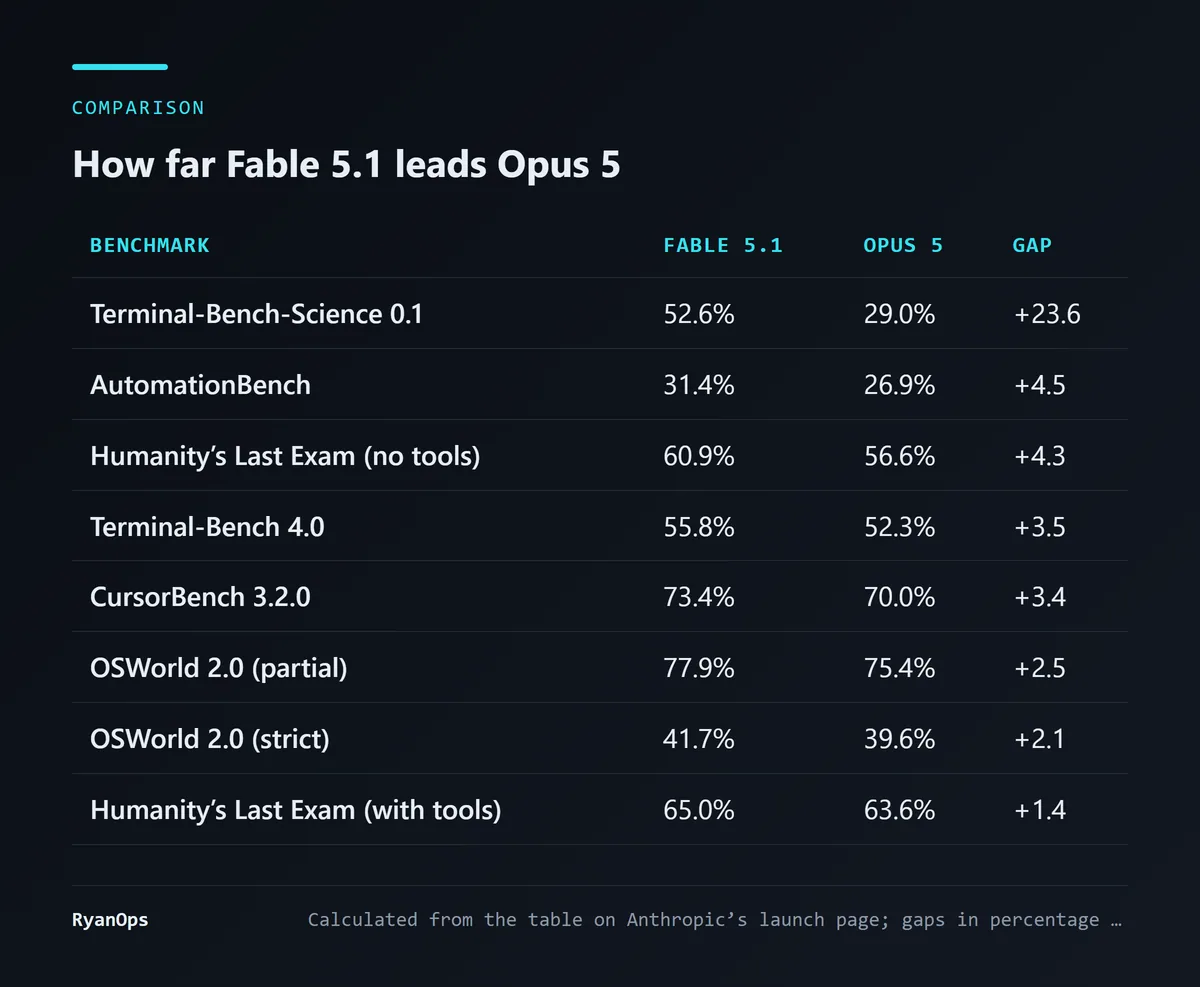 Figure 2: The lead with Opus 5 as the baseline (calculated for this article; underlying figures from the Anthropic launch page)
The result is clear-cut. The agentic scientific research row shows a lead of 23.6 percentage points, which is a real jump. The other seven rows all fall between 1.4 and 4.5. The knowledge work measure GDPval-AA v2 uses a rating scale, 1853 against 1824, a difference of 29 points; Vellum’s analysis converts that to about 1.6%.
One more thing is easy to misread. The Terminal-Bench 4.0 cell holds two numbers: 55.8% is Fable 5.1, and the 60.9% in small print below it is Mythos 5.1. The same model gains 5.1 points once the cybersecurity safeguards are removed. The old version gave only 60.9% and did not say it belongs to the version most people cannot use.
If the names of these benchmarks are unfamiliar, remember one thing: the numbers in this table come from Anthropic’s own tests or from results supplied by its partners. No row was measured by an independent organization.
What caveats come with these scores?
The launch page states three itself. I take them in order.
Safeguards eat into the scores. The small print below the table says Fable 5.1 was evaluated with its production safeguards enabled. Where safeguards intervened, the task scored zero on OSWorld 2.0. On the other tests, cybersecurity tasks were completed by Claude Opus 4.8 and biology tasks by Opus 5. Anthropic says this “likely reduces” the scores. Vellum’s advice is to treat the affected rows as floors. The same caveat cuts the other way in comparisons: the AutomationBench tasks on which Fable 5 was scored zero make the “nearly doubled” move from 17.1% to 31.4% look somewhat larger.
The standard error on the science benchmark is not small. A footnote says the standard error on Terminal-Bench-Science 0.1 is plus or minus 3.5 to 4.5 points per model. The public leaderboard has Opus 5 at 30.0% and Fable 5 at 21.4%; Anthropic’s own rerun got 29.0% and 24.7%, both within noise. A lead of 23.6 points is far larger than the error, so that conclusion holds. Gaps of 2 to 4 points are less solid under a similar error. Anthropic did not publish errors for the other tests, so I cannot tell which rows differ in a statistically meaningful way.
OSWorld 2.0 cannot be compared with older scores. A footnote says this run used the task release the benchmark authors published in August 2026, which differs from earlier releases, and that is why no competitor score appears.
I add a fourth that the launch page does not mention. As of October 13, when I rewrote this piece, I could not find a full independent evaluation of 5.1. That connects to what happened with the previous generation. As The Batch reported in June, when Fable 5 launched, Artificial Analysis recorded about 8% of tasks falling back to Opus 4.8, Vals AI reported nearly 100% refusals on biology and cybersecurity questions, and the ARC Prize Foundation declined to run its private test set because of the 30-day data retention requirement. Version 5.1 loosens the safeguards and offers a zero data retention option, so independent testing should be easier, but the results are not out yet.
What does the Millennium crash story actually say?
The line the old headline used comes from a senior portfolio manager at the investment firm Millennium, identified only as Damien. The full quote on the launch page goes like this. A particular piece of code had an extremely rare crash, about one in a million runs, that nobody on the team had explained in four to five years. Every model he tried missed it, including Fable 5. Fable 5.1 was the first to find it. It disassembled an external vendor library, matched it against the core dump, and traced the crash to a bug in that library.
The details are more interesting than “AI catches a four-year-old bug”. The problem was not in Millennium’s own code. It was in a third-party library with no source code available, visible only through disassembly. The last sentence of the quote is that the time such an analysis would have taken “is hard to justify”. That means people could have investigated before; it simply was not worth assigning someone for weeks to a one-in-a-million crash.
A reminder: this is a customer testimonial on a vendor’s launch page. The page carries 22 of them, all positive. I cannot verify this case, and I cannot see the negative feedback that was filtered out. The early user reports Vellum collected are less tidy: one tester asked for 1,000 words and got 1,288, and another said that at the highest effort setting the model sometimes kept working after being interrupted.
Base prices did not change, so where do savings of 25% to 45% come from?
Fable 5.1’s base price is the same as Fable 5’s: $10 per million input tokens and $50 per million output tokens. The only change is cache reads, the charge for when the model rereads content it has already processed and stored, which drops from $1 to $0.25 per million tokens, a 75% cut. The glossary covers the basics of token pricing.
Anthropic says typical workloads cost about 25% less and highly agentic work up to about 45% less, and it includes a chart.
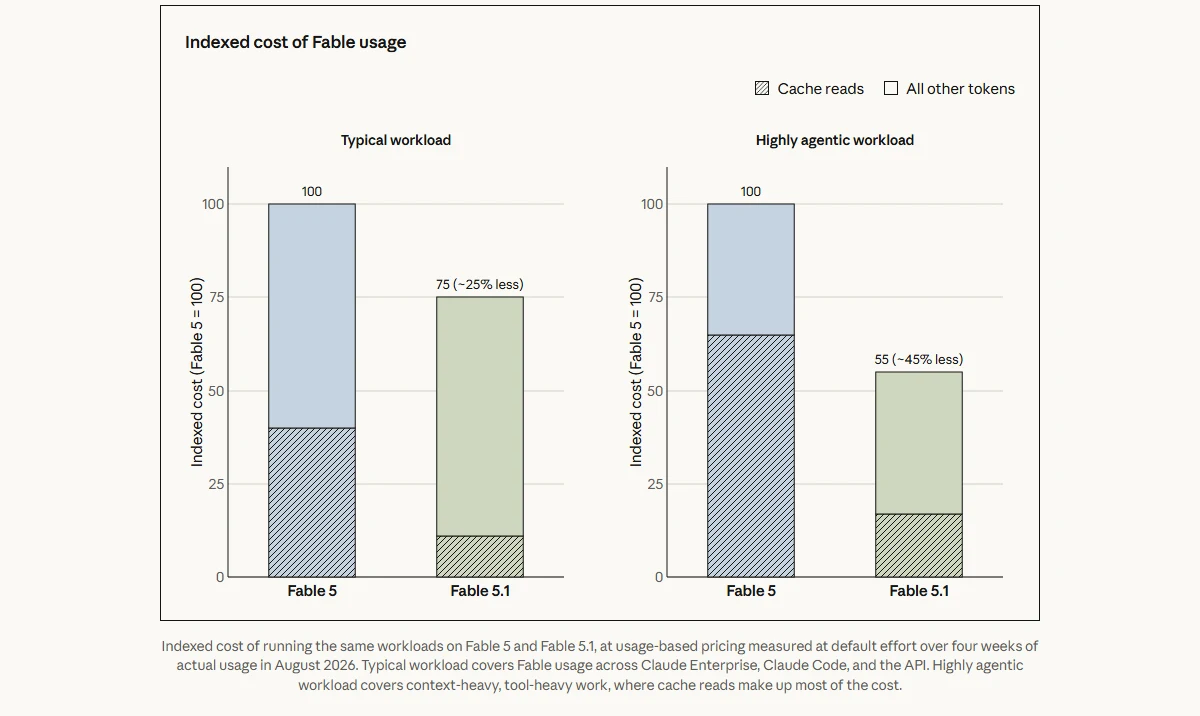 Figure 3: The hatched portion is spending on cache reads, based on four weeks of actual usage in August 2026 (source: Anthropic)
Both numbers can be worked backwards. If only cache reads fall by 75% and everything else stays the same, the share saved equals the share of the bill that cache reads make up, times 0.75. Saving 25% means cache reads were about 33% of the bill. Saving 45% means about 60%.
So to estimate your own savings you do not need to wait for an invoice. Look at how much of your current usage breakdown is cache reads. A coding agent that runs for a long time has to reread the whole conversation and its tool results on every turn, so cache reads dominate and the savings are large. If you mostly do single question-and-answer calls, you have almost no cache reads, and this price cut does nothing for you.
One thing does not line up for me. In the chart, the hatched portion of the Fable 5 bars looks like roughly 40% for the typical workload and 65% for the agentic one, higher than the 33% and 60% I derived. A possible explanation is that Fable 5.1 uses a different amount of other tokens than Fable 5, but the launch page does not give the underlying numbers, so I can only note the gap here.
The launch page points to one more way to save: set Fable 5.1 to Low or Medium effort and you get results similar to or better than Fable 5’s at a much lower cost. The default is High in Claude Code and Medium on Claude.ai and in Cowork. Cognition’s statement supports this. On launch day it moved the traffic in Devin that had been running on Opus 5 to Fable 5.1, on the grounds that the new cache price makes a Fable-class model “finally economical”, starting with code review. The old version wrote this as “switched everything over”. The original refers to Opus 5 traffic and to starting with a specific kind of work.
To compare with other vendors’ prices, this site has a piece on the price gap between DeepSeek V4 Pro and Fable 5. It uses Fable 5’s prices, so the cache read line should now be recalculated at $0.25.
Which model did each of the three science results?
The science section of the launch page lists three results, split between the two versions. The old headline said “its twin Mythos also redrew the map of Venus”. That is wrong.
 Figure 4: The original text; the subject is Claude Fable 5.1 (source: Anthropic)
The text is plain. Claude Fable 5.1 trained a neural network on radar images taken by NASA’s Magellan mission more than 30 years ago, together with an existing map covering one-fifth of Venus, and produced a new elevation map covering a third of the planet. Detail improves from 10 to 20 km down to 2 to 3 km, and heights are up to 25% more accurate. The map is released under a Creative Commons license ahead of NASA’s VERITAS and ESA’s EnVision missions, in the hope of helping those teams choose targets to observe.
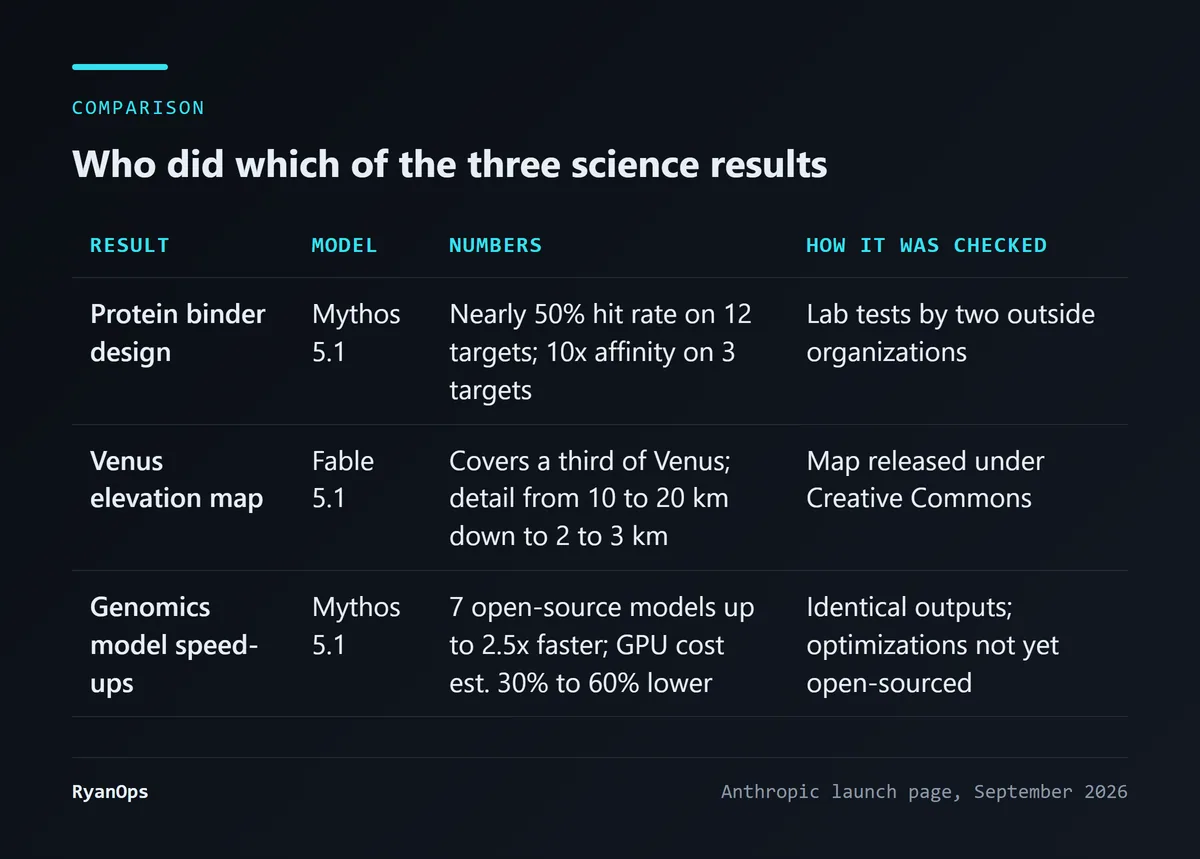 Figure 5: The three results, the model behind each and how each was checked (data: Anthropic)
The other two were done by Mythos 5.1. For molecular design, Anthropic gave the model open-source protein design and folding tools and sent its designs to two external organizations for experimental validation. The hit rate was nearly 50% across 12 targets, and the launch page says 10% to 15% is typical today. The old version said its binding strength was “10 times higher than competition rivals” and left out the qualifier: that applies to 3 of the 12 targets (EGFR, Nipah G, 15-PGDH), compared with the best designs submitted to Adaptyv Bio’s protein design competitions. A footnote adds, on Anthropic’s own initiative, that on Nipah G another entrant’s design aimed at a different region reached an affinity comparable to Anthropic’s best.
For computational biology, Mythos 5.1 wrote custom GPU kernels for seven open-source protein and genomics models and cached their intermediate results, making them up to 2.5 times faster on an NVIDIA H100 with identical outputs. The speed-ups across the seven models range from 1.4 to 2.5 times; only ProGen2 reaches 2.5, and most sit between 1.4 and 1.8. GPU costs for genome-wide analyses are “estimated” to fall by 30% to 60%. The launch page says these optimizations will be open-sourced “soon”. I could not find them when I wrote this.
Of the three, the Venus map is the one you can download and check today. The protein results are backed by outside experiments but I have not seen a paper. The model speed-ups cannot be reproduced until they are open-sourced.
What changed in safeguards and access?
The old version overstated several points in this section. Here they are one by one.
On cybersecurity safeguards, the old version said “the false positive rate fell 60%”. The launch page says Claude Code users can expect an average of around 60% fewer interventions per session from the cyber safeguards. One reason is that Fable 5.1 can now be used to find software vulnerabilities. It still cannot be used to develop exploits, and penetration testing, exploit generation and binary-based vulnerability scanning are still redirected to Opus models.
On biology safeguards, false blocks on elementary biology and medical questions are down 85% from when Fable 5 launched, but questions about life sciences research and development still go to Opus.
There are two routes to Mythos 5.1. The Cyber Verification Program (CVP) currently offers Opus- and Sonnet-class models with reduced safeguards, and Mythos-class models are to be added “in the near future”. The Life Sciences Verification Program (LSVP) has enrolled its first participants in partnership with the US government. Only a set of US organizations has access for now, and Anthropic says it is coordinating with the US government to expand to more domestic and international partners.
On enterprise data retention, Enterprise Frontier Safeguards (EFS) stores data in cloud infrastructure the customer controls, with human review done by the customer by default, and rolls out in phases starting this fall. Until then, eligible customers can use Fable 5.1 with zero data retention.
On distillation, API accounts created from launch day onwards can no longer manually edit Claude’s prior context in a multi-turn conversation while preserving the transcript of its prior thinking. Existing accounts are not affected for now, but the change will apply to everyone with future models. If your integration rewrites message history, this is worth checking against Anthropic’s help article now.
Last is the watermark. Anthropic signed the EU AI Act’s Code of Practice on Transparency of AI-Generated Content in July 2026, and text output from models released after August 2 carries a statistical watermark. The detection API is in private preview for regulators, law enforcement, media, fact-checkers, independent researchers and similar groups.
My read, and what would change it
My view of Fable 5.1 is that it is a solid reinforcement plus a real price cut, and it falls short of an across-the-board generational jump. The 23.6 points on agentic scientific research is a genuinely large lead. The other rows recover the ground where Fable 5 trailed Opus 5 and then push a few points further. For most developers, the 75% cut in cache reads is more direct than any row of scores.
What would change my view? If independent organizations such as Artificial Analysis or Vals AI, testing without safeguard interruptions, measure gaps similar to or larger than the official table, I would give those “few points of lead” more weight. If planetary scientists put the Venus map to use, or the protein results appear in a peer-reviewed paper, the science section becomes more than a vendor demonstration. Conversely, if independent tests show that safeguards still intervene often, or users widely report that their actual bills did not fall by 25%, I would revise my assessment downwards.
There is one thing I cannot judge for you: I did not test Fable 5.1 for this article. Every score and case above comes from Anthropic’s launch page and two third-party write-ups. None of them is something I ran myself.
What this rewrite corrected
- The subject of the Venus map was wrong. The old headline and body said Mythos 5.1 made it. The launch page says Claude Fable 5.1, covering a third of Venus.
- The Terminal-Bench 4.0 number did not say which version. 60.9% is Mythos 5.1; the generally available Fable 5.1 scores 55.8%.
- “10 times the binding strength” lacked its condition. It applies to 3 of 12 targets, against the best submissions to Adaptyv Bio’s competitions.
- “False positive rate fell 60%” was inaccurate. The original says around 60% fewer cyber safeguard interventions per Claude Code session on average.
- Cognition’s quote was inflated. The original is about moving Opus 5 traffic in Devin, starting with code review.
- The status of the CVP was wrong. Mythos-class models are not yet in the Cyber Verification Program; the launch page says in the near future.
- Material the old version lacked. The gap calculation against Opus 5, the effect of safeguards on scores, the standard error and leaderboard discrepancy, the back-calculation of cache share, the gap in independent evaluation, and the full context of the Millennium quote.


