Lovable Hits $13.3B After a Leak It First Denied
Lovable raised $400M at $13.3B, double its value of eight months ago. The revenue multiples, and how it answered April's data exposure.
On August 12, Swedish startup Lovable announced a $400 million Series C at a valuation of $13.3 billion. Its previous round was last December, at $6.6 billion. Eight months, exactly double.
What Lovable does fits in one sentence: you describe the app you want in plain language, and it writes the code and hosts it for you. The approach is called vibe coding.
My August piece spent a good deal of space on growth numbers and the founders’ story. Checking again, some of the numbers cannot be traced to a source, and one quotation has no original that I can find. The larger problem is the data exposure in April, which I wrote up as “the CEO apologized publicly and took full responsibility”. Set against the reporting from the time, the actual sequence was not that clean.
So this rewrite has two halves: first the money, worked through properly, then that day in April, told again.
What is in this round?
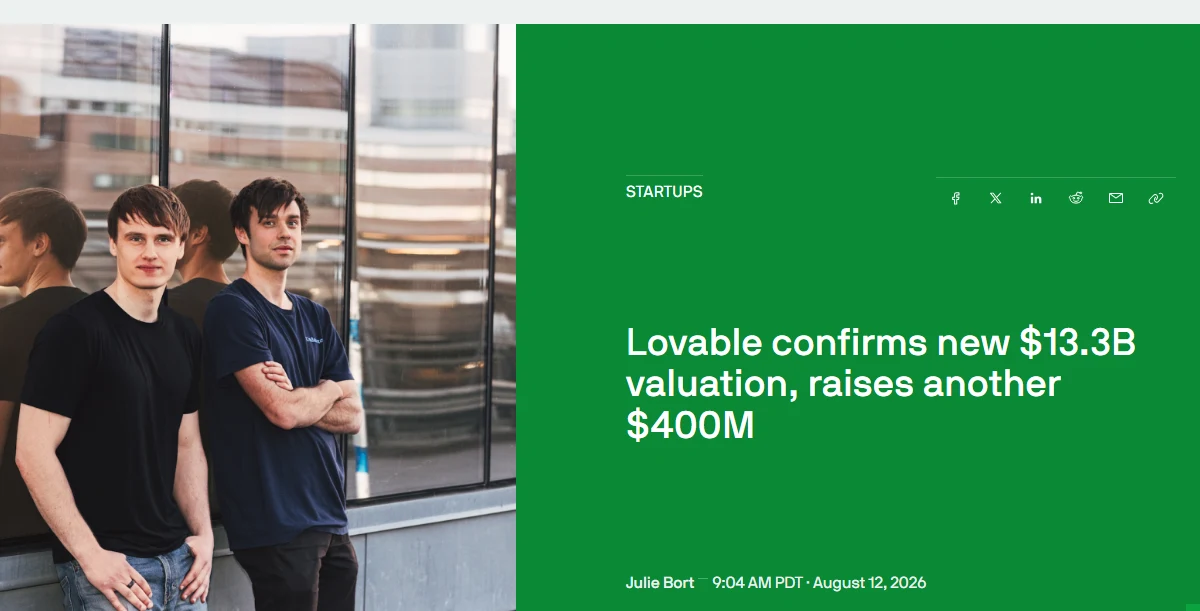 Figure: TechCrunch’s report on Lovable’s Series C, 2026-08-12 (source: techcrunch.com)
TechCrunch’s report confirms the following:
- $400 million, Series C, at a $13.3 billion valuation.
- Led by Menlo Ventures and the Scaleup Europe Fund, with more than a dozen other investors.
- The headline says “confirms” because TechCrunch had reported on July 8 that Lovable was in talks for a round that would double its valuation.
- The company told TechCrunch that annualized revenue reached $500 million in June.
- The platform hosts 60 million projects, which together attract 900 million visits a month.
One line of disclosure in the report is worth knowing: one of the new investors in this round, Regent, is also TechCrunch’s owner.
The August piece also named Tencent and Balderton Capital as investors and said the company expected annualized revenue to approach $600 million by the end of August. Neither point is in TechCrunch’s report, I found no other source, and both are removed. The figure of “1 million new projects a week” comes from the headline of a different TechCrunch report in June and is not in this one.
How did the valuation climb?
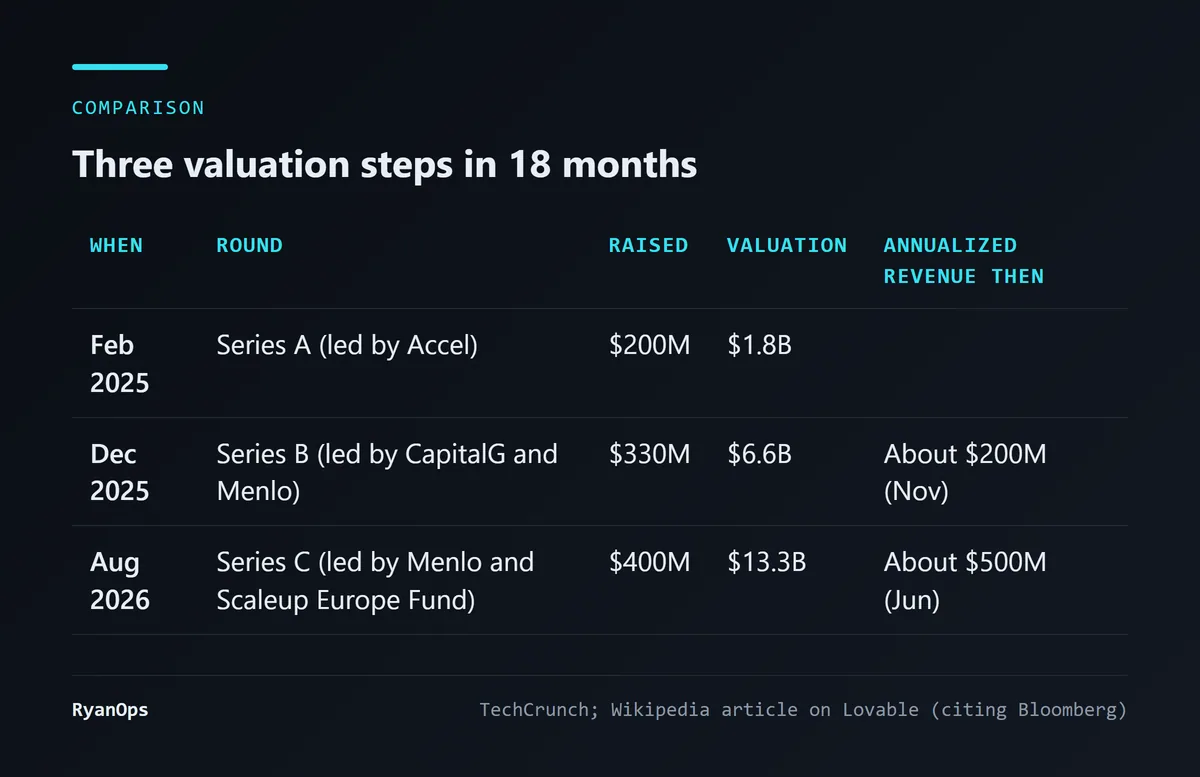 Figure: Lovable’s three funding rounds (compiled for this article from TechCrunch and the Wikipedia article on Lovable)
Over a longer span it looks more extreme.
February 2025, Series A, led by Accel: $200 million at a $1.8 billion valuation. December 2025, Series B, led by CapitalG and Menlo Ventures: $330 million at $6.6 billion. August 2026, Series C: $13.3 billion.
In 18 months the valuation multiplied 7.4 times.
The company’s history is short too. According to Wikipedia, founder Anton Osika first built an open-source project in 2023 called GPT Engineer, which used large language models to write applications. He and Fabian Hedin turned it into a commercial version, renamed it Lovable in December 2024 and opened it up. The company is in Stockholm.
In other words, from operating publicly under the Lovable name to the Series C took just 20 months. Osika has said the company reached $100 million in annualized revenue within eight months of launch.
The August piece said Osika had been a particle physicist at CERN and that the company made TIME’s annual list. I found no source for either this time and removed them.
Is a doubled valuation expensive or cheap?
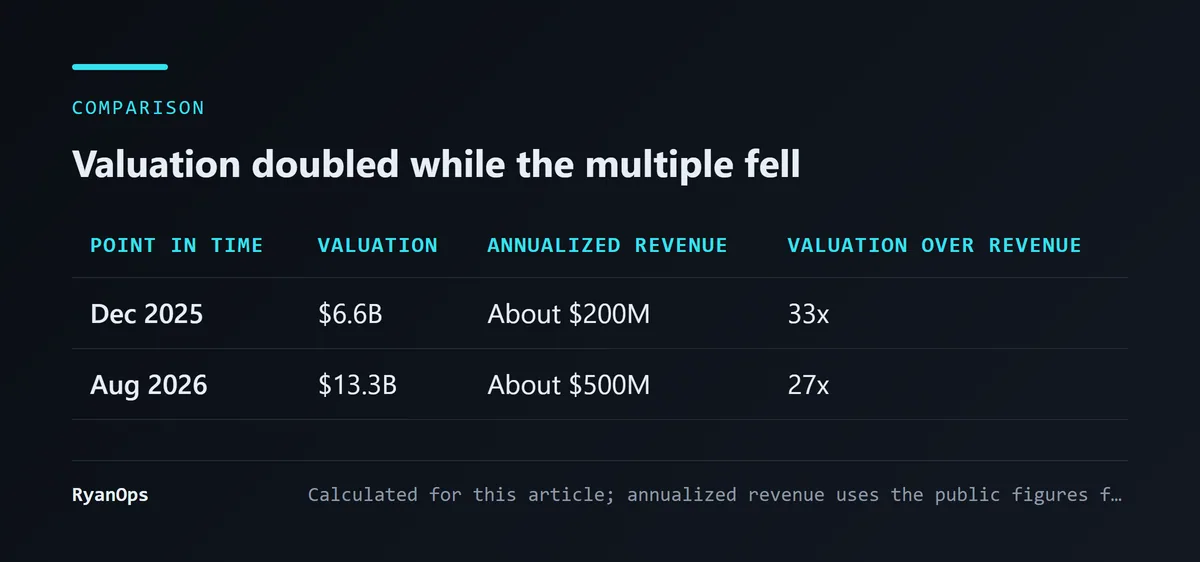 Figure: Valuation as a multiple of annualized revenue at the two rounds (calculated for this article, using the nearest public revenue figures)
“Valuation doubles” sounds as if investors have become wilder. Working out the multiple gives the opposite conclusion.
Last December: a $6.6 billion valuation, with annualized revenue reported the month before at $200 million. The valuation was 33 times revenue.
This August: $13.3 billion, with annualized revenue of $500 million in June. That is 27 times.
The valuation doubled and revenue rose 2.5 times. Measured by revenue multiple, this round is cheaper than the last.
The calculation has two limits that should be stated first. One, both revenue figures are a month or two away from the round dates, and at Lovable’s growth rate two months can make a big difference. Two, annualized revenue is the latest month’s revenue times 12, not the money actually received over the past 12 months. For a fast-growing company it sits well above actual annual revenue.
Twenty-seven times is still very high, of course. But the table shows at least that this doubling was carried mainly by revenue and not by investors paying a bigger premium. My first reaction to “doubled in eight months” was that it was a bubble. After doing the sums I think that needs adjusting.
The real question lies elsewhere: how much of that $500 million in annualized revenue will stay?
Building an app by talking suits a weekend project, an event page, or a prototype of an internal tool. Users of that kind pay for a month or two and leave once the thing is built. Sixty million projects is a large number, but TechCrunch’s report gives neither the number of paying users nor a retention rate. That is the figure I most want to know, and there is no public data on it at present.
Is it more than a wrapper around other people’s models?
Every vibe coding company gets asked this. Lovable’s answer comes in three moves.
Training its own model. TechCrunch writes that besides letting users choose frontier models, Lovable now offers a model trained in-house.
A long contract with Google Cloud. A multiyear deal signed in June, for five times its previous usage. The company’s explanation is that its back-end needs and sophistication have grown with its scale.
Investing in other startups. It has backed several European startups, one of them Denmark’s Atech, which builds vibe-coding software for designing hardware.
Taken together, the direction is to extend both downstream and upstream. Lovable does not only write the code for you. It hosts it too. Sixty million projects sit with it and 900 million visits pass through it. Its position looks more like a hosting platform, with the code-writing AI as the way in.
I have reservations about the in-house model. Training models is expensive, and Lovable’s rivals are labs spending tens of billions of dollars a year. A more plausible guess is that it trains small models for specific steps to cut costs, and is not trying to replace frontier models. But TechCrunch gives no details, and that is my speculation.
What happened on that day in April?
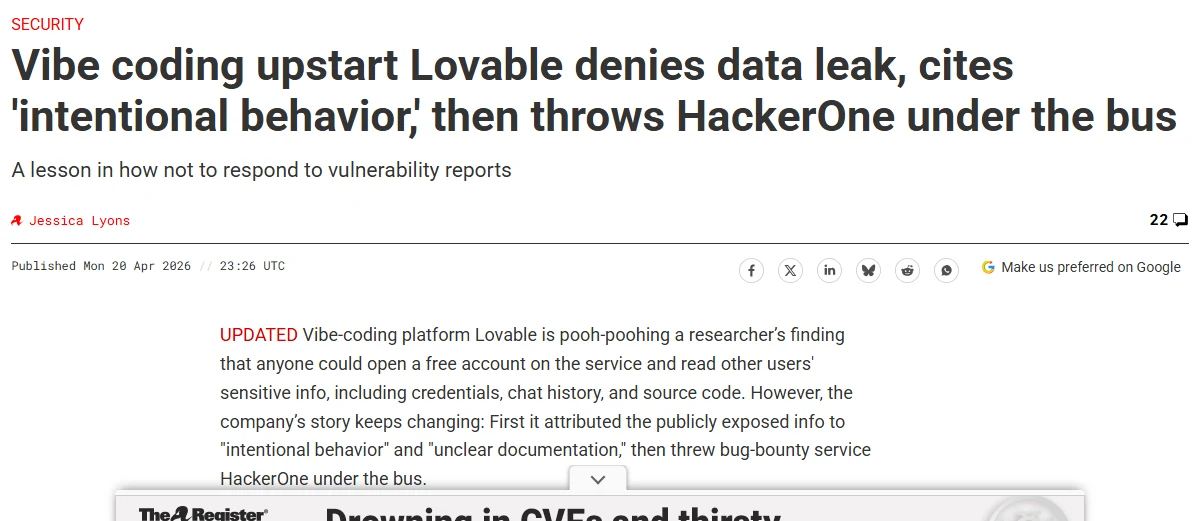 Figure: The Register’s report on the Lovable data exposure, 2026-04-20 (source: theregister.com)
The headline says it: the vibe coding upstart denies a data leak, cites “intentional behavior”, then throws HackerOne under the bus. The subhead: a lesson in how not to respond to vulnerability reports.
This is what happened. On April 20, a researcher known on X as @weezerOSINT said publicly that anyone with a free Lovable account could read other users’ data, including source code, database credentials and AI chat histories. The researcher said every project created before November 2025 was affected. The Register did not independently verify that scope.
No hacking skill was needed. By the researcher’s account, five API calls from a free account were enough to reach another user’s profile, public projects and source code, and then to pull database credentials out of the code. This kind of flaw has a formal name, BOLA: the API does not check whether you are the owner before returning data.
The researcher also said the problem had been reported 48 days earlier. Screenshots show a submission date of March 3, through the bug bounty platform HackerOne. It was labeled a “duplicate submission” and left there.
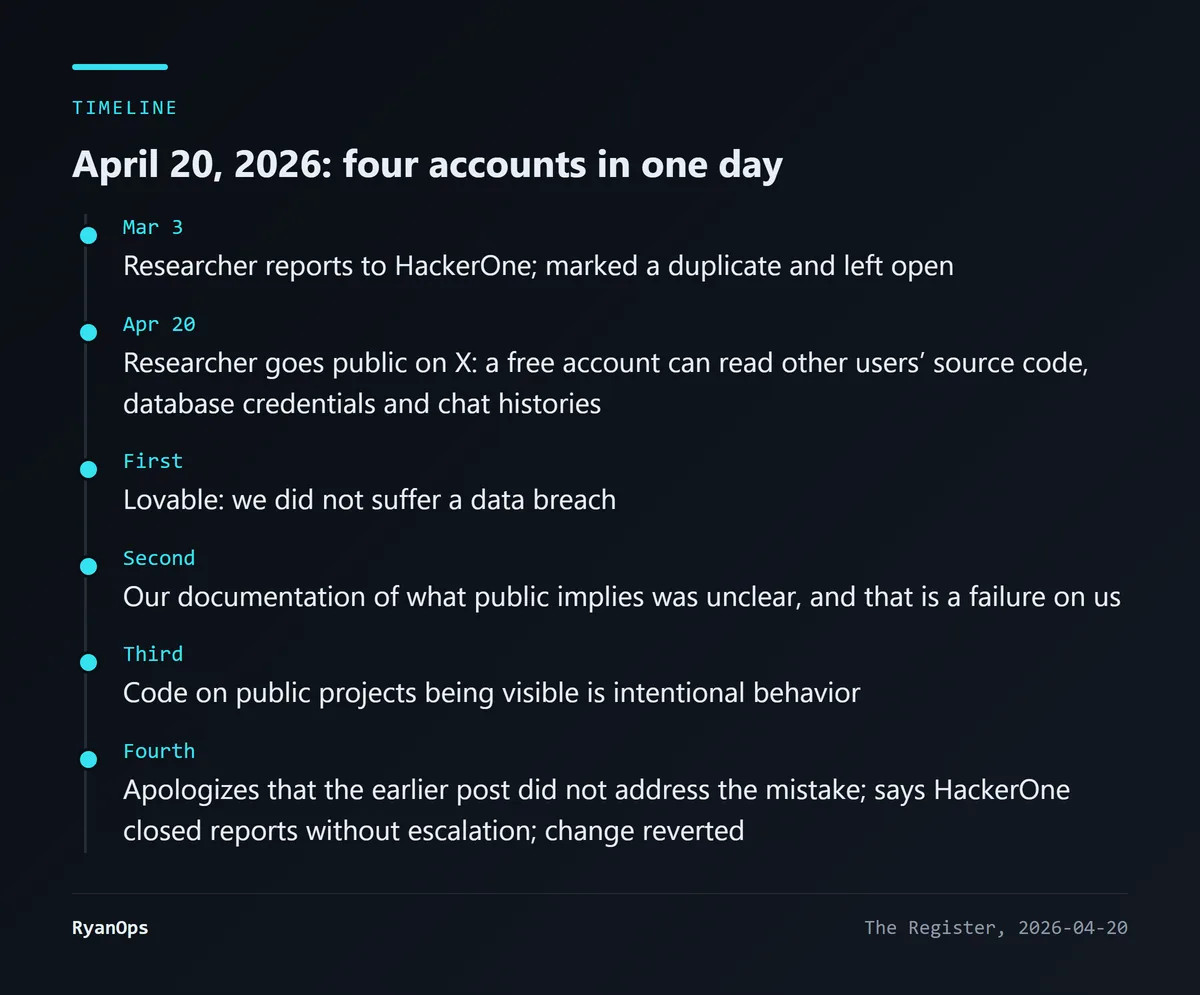 Figure: How Lovable’s account changed within one day (compiled for this article from The Register’s report of 2026-04-20)
The Register recorded Lovable’s responses that day one by one.
First: we were made aware of concerns regarding the visibility of chat messages and code on projects with public visibility settings. “To be clear: We did not suffer a data breach.”
Second: “our documentation of what ‘public’ implies was unclear, and that’s a failure on us.”
Third: code on public projects being visible “is intentional behavior”, and the core behavior has been consistent and by design.
Fourth, a revised statement later that day: an apology that the earlier post “didn’t properly address our mistake”. It said the reports had been closed at HackerOne without escalation. It said the change had been reverted.
The revised statement also set out the technical history. In December 2025 Lovable made projects private by default on all tiers. In February this year, while unifying back-end permissions, it “accidentally re-enabled access to chats on public projects”. Once it knew, it reverted the change. The final line: pointing to documentation issues alone was not enough here, and “We’ll do better.”
My August piece said Osika apologized publicly, quoted him as saying “I take full responsibility for this, and I’m sorry”, and said the company later brought in a security firm for penetration testing. I can find no source for any of that this time. The apology The Register recorded came from the company account, and it came after denial and justification. The earlier version made this look better than it was, and that was my error.
It was not the first time
Wikipedia records an earlier case. In March 2025 a Replit employee found a problem common to websites built with Lovable: many were connected to a Supabase database with access controls misconfigured, so their contents were effectively public. Semafor reported it in May of that year.
Lovable’s response then was to add an automatic scan that checks whether a site has access controls set. Wikipedia adds a sentence: the scan checks only whether they exist, not whether they are correct.
The two incidents differ in kind. In 2025 the flaw was in the apps users had built. In 2026 it was in Lovable’s own platform.
I regard the first kind as a structural problem for the whole vibe coding category. Someone who cannot code builds an app that stores user data. They do not know what row-level permissions are, and the AI did not set them. I wrote about the same thing in the Moltbook piece: Supabase again, no permissions again, and a site written with AI again.
The second kind is Lovable’s own responsibility. A platform valued at over ten billion dollars had an API that did not check ownership, and a report sat unhandled for 48 days.
How do I see it?
My view of this company comes in two halves, and they do not really cancel each other out.
On the business half, I am a little more positive than in August. The doubled valuation is backed by revenue, and the multiple is in fact falling. It is moving toward being a hosting platform, which is stickier than simply selling AI that writes code.
On the trust half, I am more reserved than in August. A vulnerability is nothing unusual. Every company has them. What I care about is the order of events that day in April: deny first, then call it a documentation problem, then call it intentional design, and only then apologize, while passing part of the blame to the outsourced bug platform. A company’s first reaction under pressure says more about its habits than its statement afterwards.
What would change my view? If Lovable publishes a full incident report stating which projects were accessed and whether there was any abuse, it would mean it treats this as something it owes its users and not only as a public relations problem. When The Register reported, no such report had appeared.
If you use Lovable or a tool like it, or plan to, I suggest three things:
- Set your project to private, then confirm it yourself. Do not assume the default is what you think it is. April happened because a default was switched back.
- Do not write keys into your code. That researcher got database credentials from source code. Use the platform’s environment variables or secrets management.
- If the app you build stores other people’s data, have someone who understands permissions look at them before launch. An AI can write code that runs. That does not mean it has thought through who can read what on your behalf.
What this rewrite corrected
- The original said CEO Osika apologized publicly for the April incident, quoted a sentence from him, and said the company later reworked its reporting process and partnered with a security firm. I found no source for any of this. The Register records the company denying first, changing its account, and apologizing last, and this version follows that reporting.
- The original named Tencent and Balderton Capital as investors and said the company expected annualized revenue to approach $600 million by the end of August. TechCrunch’s report contains neither and they are removed.
- The original said Osika had been a particle physicist at CERN and that the company made a TIME list. I found no source this time and removed both.
- The original said Replit employees found at least 170 vulnerable sites in May 2025 and that another engineer extracted sensitive data in 47 minutes. This time I confirmed only the incident itself as recorded by Wikipedia and Semafor, and the detailed numbers are gone.
- The original said annualized revenue was a little over $200 million at the start of the year. What can be found is $200 million reached in November 2025.
- The original did not work out the valuation as a multiple of revenue. That is added, with the limits of the calculation noted.


