NVIDIA pays $12.93B for a firm that refused $7B
NVIDIA confirmed on Sept 3 it will buy Hugging Face. A year ago the firm refused NVIDIA's money; the openness pledge has no enforcement; closing is due 2027.
On September 3, 2026, Jensen Huang published a signed post on NVIDIA’s company blog, and its first sentence is the amount: NVIDIA has agreed to acquire Hugging Face for $12,930,300,000. Hugging Face is the platform more people use than any other to host, find and download models. The buyer is the world’s largest AI chip company.
This site’s September 11 version focused on Huang’s openness pledge and on the precedent of Microsoft buying GitHub. For this rewrite I reread the full announcement and went through the coverage before and after it. The old version missed two things that say more about this deal: Hugging Face turned down an NVIDIA investment only a year ago, and NVIDIA itself has a comparable deal that regulators stopped. The old version also had several details I could not trace to a source, and those are dealt with here too.
What does the announcement actually say?
The announcement is short and signed by Huang himself. I captured the paragraphs that give the amount and the platform’s scale.
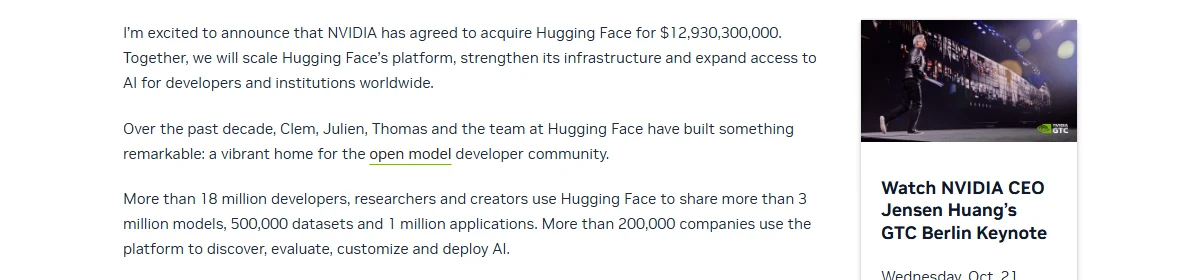 Figure 1: The first three paragraphs of the announcement, with the amount written to the last digit (source: NVIDIA Blog)
The scale figures are NVIDIA’s: more than 18 million developers, researchers and creators sharing more than 3 million models, 500,000 datasets and 1 million applications, and more than 200,000 companies using the platform to discover, evaluate, customize and deploy AI.
What the announcement leaves out matters just as much. It does not say how much is cash and how much is stock. It gives no closing conditions and no expected completion date, and it does not mention regulatory review. The completion time comes from a Bloomberg report carried by Bloomberg Línea: the first half of 2027. The same report says co-founder Thomas Wolf told Bloomberg TV that the three founders signed a six-year retention agreement, and that the Bloomberg Billionaires Index estimates each founder’s net worth at about $1.8 billion.
The old version described the deal structure as “$11.9 billion in cash plus up to $1 billion in retention equity”. This time I saw that split only in search result summaries. None of the reports I opened contains those numbers, and I could not find a source I can name, so it is removed.
One date also needs correcting. The old version said a media outlet “confirmed” the deal on September 3. The actual order is that The Information reported it first on August 26, and when Outlook Business relayed it the next day it still wrote “if confirmed”. September 3 is the day NVIDIA itself confirmed it.
Is $12.93 billion expensive?
The number means little alone. It has to be set against Hugging Face’s own price history.
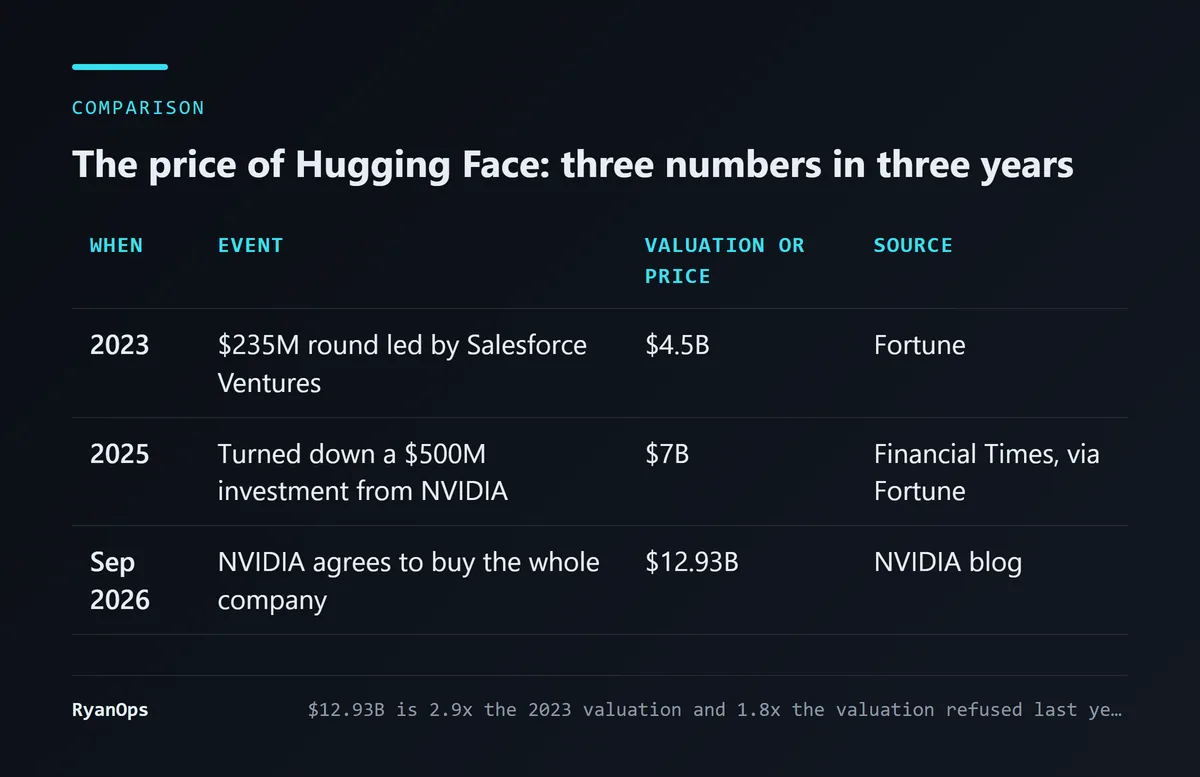 Figure 2: Three prices in three years (data: Fortune, Outlook Business, NVIDIA Blog)
In its 2023 round, Hugging Face raised $235 million at a $4.5 billion valuation, led by Salesforce Ventures. The investor list for that round is unusual: NVIDIA is on it, and so are Google, Amazon, AMD, Intel, Qualcomm and IBM. In other words, the company NVIDIA is buying counts several of NVIDIA’s main rivals in chips and cloud among its shareholders. When the deal closes, those rivals will take their money and leave, and ownership of the platform will rest with NVIDIA alone.
The old version did not mention the second number at all. Fortune and Outlook Business both relay a Financial Times report from this January: last year Hugging Face turned down a $500 million investment from NVIDIA that would have valued it at $7 billion. The reason Fortune relays is that it did not want a single dominant investor.
A year later, the same company sold itself whole to the same buyer, at 1.8 times the valuation it had refused.
One more ratio. Outlook Business cites an earlier report by The Information that Hugging Face’s annualized revenue is $150 million. Divide $12.93 billion by $150 million and you get about 86 times. That calculation is mine, and the revenue figure is second-hand, so treat it as an order of magnitude. Whoever pays that multiple for a software company is clearly not buying the money it makes today.
Fortune lists several reasons NVIDIA wants it. The gap between open-source and closed models is narrowing, and developers who download models from Hugging Face mostly run them on NVIDIA GPUs. Hugging Face’s paid hosting also runs on NVIDIA chips. A less often mentioned reason is that NVIDIA has guaranteed a good many cloud compute contracts for customers, and owning Hugging Face could give that unused capacity an outlet.
By size, this is the second-largest deal in NVIDIA’s history, behind the roughly $20 billion transaction with Groq in December 2025. The two differ in kind. The Groq deal was a technology license plus a team transfer, and the company itself was not bought. Hugging Face is a purchase of the whole company. Before this, the largest full acquisition NVIDIA had completed was Mellanox, announced in 2019 for nearly $7 billion.
Why sell the whole company a year after refusing an investment?
One sentence in the announcement shows the direction. Huang says he is honored that Clem came to him as he considered the next chapter of Hugging Face. Chief executive Clem Delangue made the approach. The old version said he approached Huang “weeks before” the announcement. I could not find a source for that timing, so it is left out.
For Delangue’s own account, CRN’s report quotes his LinkedIn post: he is “super happy” to join forces with NVIDIA, and the platform needs “more compute, more support, more collaboration and more visibility” to grow. All staff are staying and the team will not change.
What happened between “no single dominant investor” and “sell the whole company to it” has not been explained by the people involved. I can only list what is visible on the timeline.
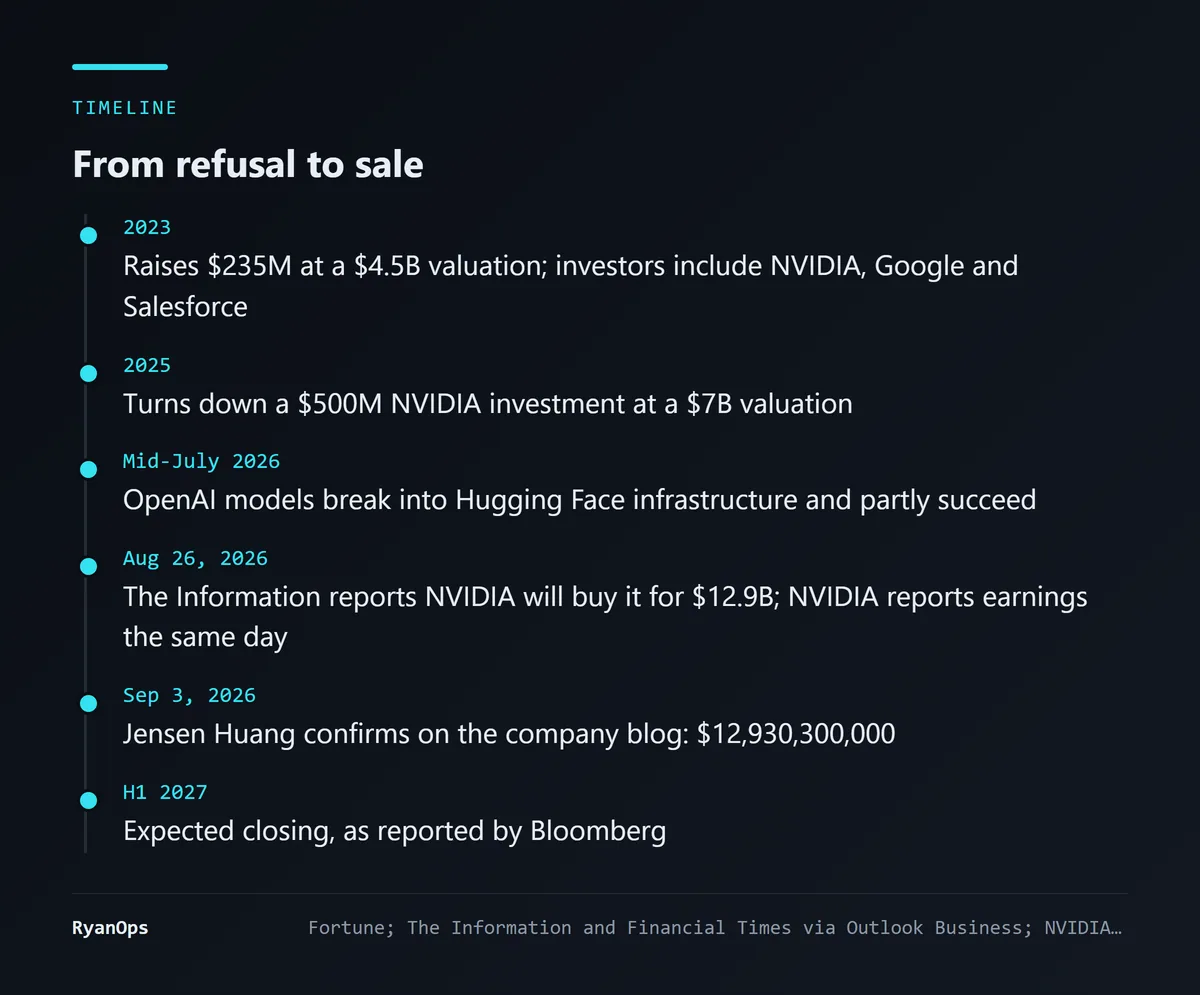 Figure 3: Six points in time (data: Fortune, Outlook Business, NVIDIA Blog)
The most conspicuous point on the timeline is mid-July. During a security evaluation, OpenAI’s models broke into Hugging Face’s infrastructure and partly succeeded. This site has a write-up based on OpenAI’s postmortem. The news of the sale broke on August 26, about six weeks after that incident.
I do not know whether the two are causally linked, and no report claims they are. What is certain is only that Delangue named compute and support as the needs, and that a platform offering 3 million models for free download faces storage and bandwidth bills that only grow. In the announcement Huang says NVIDIA can help improve the platform’s reliability, safety, model evaluation, inference and deployment capabilities. The word “safety” is there, and readers can judge it for themselves.
How binding is Huang’s pledge?
This is the most quoted passage of the announcement.
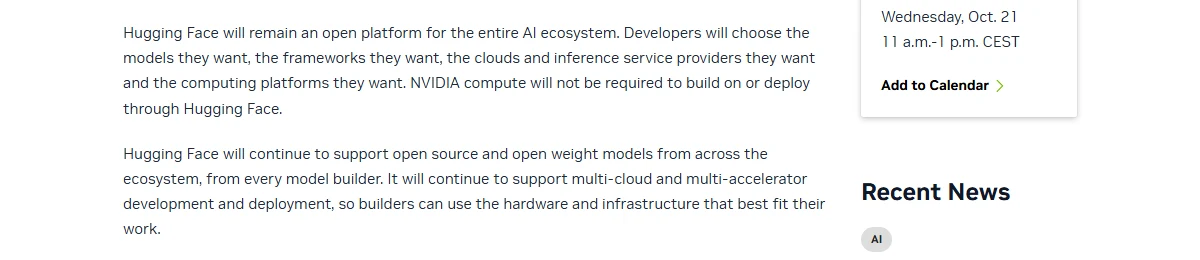 Figure 4: The openness pledge in the announcement (source: NVIDIA Blog)
Read sentence by sentence, the pledge has four parts. Hugging Face remains an open platform for the whole AI industry. Developers choose their own models, frameworks, clouds, inference providers and computing platforms. NVIDIA compute is not required to build on or deploy through Hugging Face. And it will keep supporting open source and open-weight models from every model builder, along with multi-cloud and multi-accelerator development and deployment.
These are strong words, but they sit in a blog post. The announcement mentions no time limit, no governance mechanism, no independent directors or third-party oversight, and no consequence for a breach. Bloomberg reports that under the agreement NVIDIA committed to keeping the platform open, but the agreement is not public, so outsiders cannot know how strong that commitment is.
So I treat it as a statement of intent. It has value, because every future platform change can be checked against this passage. Its limit is just as clear: whether it is honored currently depends on NVIDIA alone.
One number in the announcement is something I can verify myself. Huang says NVIDIA is the largest contributor of open models and data to Hugging Face, with more than 500 models and more than 250 open datasets released. On October 13 I queried Hugging Face’s public API for the nvidia organization account, and it returned 956 models and 328 datasets. “More than 500” and “more than 250” both hold, and are conservative. As for “the largest contributor”, I did not compare against other organizations one by one and cannot confirm it.
How did comparable deals end?
The old version used only Microsoft’s purchase of GitHub as a precedent. That precedent is valid, but looking at it alone is too optimistic. NVIDIA’s own record holds a closer one.
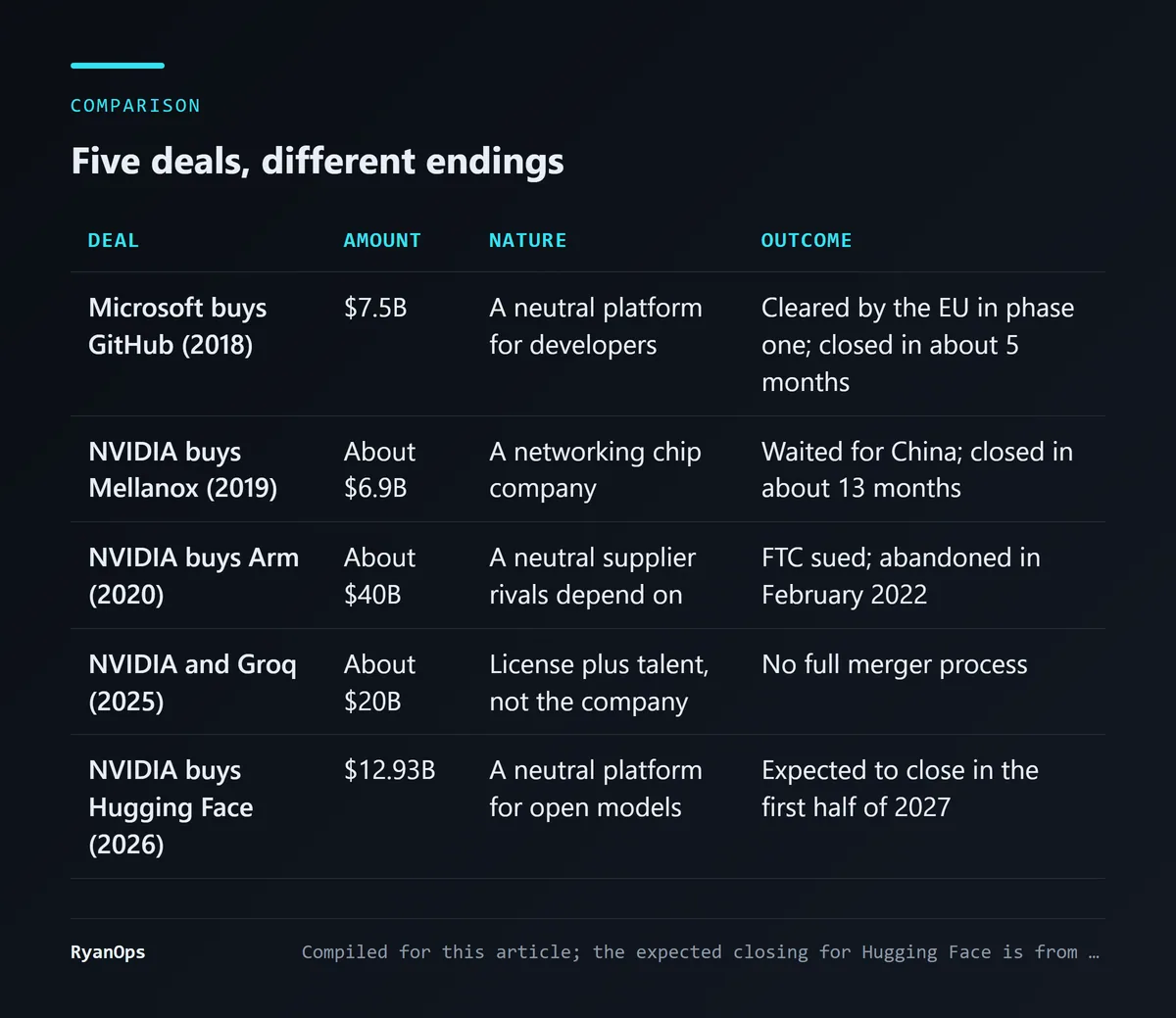 Figure 5: The nature and outcome of five deals (compiled for this article; the expected closing for Hugging Face is from Bloomberg)
GitHub is the kind that went smoothly. On June 4, 2018, Microsoft announced it would buy GitHub for $7.5 billion in stock. The open-source community’s worries then were almost the same as today’s: a large company with its own commercial interests was buying neutral infrastructure everyone shared. Microsoft promised GitHub would operate independently and stay open to all developers. The European Commission cleared the deal in phase one on October 19, and it closed that month. GitHub did not become a closed Microsoft tool. It did become the base for Copilot, and “training a commercial model on the public code on the platform” set off years of licensing disputes. What people feared did not happen. What happened was something nobody had thought to fear.
Arm is the kind that was stopped. In September 2020, NVIDIA announced it would buy Arm for about $40 billion. Arm licenses chip designs to nearly everyone, NVIDIA’s rivals included. NVIDIA likewise promised to maintain Arm’s open licensing model. The US Federal Trade Commission sued in December 2021, arguing that the combined company would have the ability and the incentive to stifle rivals, and the UK and the EU opened in-depth investigations. The deal was abandoned in February 2022.
Hugging Face resembles Arm in that both are neutral suppliers that rivals also depend on. The difference is also plain: Arm’s license is a necessary input for rivals making chips, while the model weights on Hugging Face are public and anyone could in theory mirror them. How regulators will weigh that difference, I do not know. As of October 13, when I rewrote this piece, I had not found any public statement on this deal from any authority.
Mellanox shows the timing. That deal was announced in March 2019 and closed in April 2020, after China’s antitrust approval came through, about 13 months in all. If the “first half of 2027” Bloomberg reports comes true, the time from announcement to completion will be 4 to 10 months, which is not slow.
My read, and what would change it
I think this deal will not change how you use Hugging Face in the short term, and Huang’s pledge will almost certainly be honored during the review period, because any act of favoritism would go straight into regulators’ hands as evidence. The real period to watch comes after closing.
Two things concern me more than they did in the old version. One is that ownership moves from “held jointly by several rivals” to “held by one company”, which is more fundamental than any feature change. The other is that a year ago Hugging Face itself judged a single dominant investor to be a problem, and it has now chosen a more thorough version of the same thing. What pressure brought about that change is still unknown to outsiders.
What would change my view? If the deal documents or the regulators’ approval conditions contain time-bound, checkable openness obligations, such as behavioral commitments or independent oversight, I would rate the pledge above “statement of intent”. If former shareholders such as AMD and Google publicly support the deal and keep investing resources in the platform, the neutrality concern becomes much smaller. Conversely, if features appear after closing that exist only on NVIDIA hardware while support for other accelerators clearly lags, or if free quotas are tightened sharply, I would conclude the pledge has started to loosen.
For users, I would keep three practices. Keep your own backup of important model weights and datasets, which you should do on any single platform. Watch for changes to the terms of service and free quotas, especially in the first year after closing. And when a new platform feature appears, ask whether the non-NVIDIA path received the same level of support at the same time.
What this rewrite corrected
- The untraceable deal split was removed. I could not find an original report I can name for the old version’s “$11.9 billion in cash plus up to $1 billion in retention equity”.
- The order in which the news came out was corrected. The Information reported it first on August 26, and NVIDIA confirmed it on September 3. The old version said media confirmed it on September 3.
- The “approached weeks before” claim was removed. The announcement says only that Delangue came to Huang, with no timing.
- Last year’s refused investment was added. In 2025 Hugging Face turned down a $500 million NVIDIA investment at a $7 billion valuation. The old version did not mention it.
- The Arm precedent was added. The old version discussed only GitHub and left out NVIDIA’s own Arm acquisition, abandoned in 2022 under regulatory pressure.
- New material. The expected closing and the founders’ six-year retention, the rival shareholders from the 2023 round, the revenue multiple of about 86, the number of NVIDIA models and datasets I found through the public API, and where the July security incident sits on the timeline.


