SoftBank eyes 1X at $6B: 10,000 $200 deposits
SoftBank is reportedly in talks for control of humanoid maker 1X at 40% below last year's price. Its 10,000 orders are refundable $200 deposits.
On August 26, 2026, The Information reported that SoftBank is in talks to take a majority stake in the humanoid robot company 1X Technologies, in a deal valuing 1X at about $6 billion. The talks are still under way, the terms may change, and nobody has signed anything.
This site’s September 11 version led with “$6 billion is 40% below last year’s $10 billion asking price”. That point is correct. But one sentence in the old version sent me back to check: it said “public information cannot tell” whether the 10,000 orders 1X claims are fully paid or refundable deposits. In fact 1X’s own order page says which. For this rewrite I read the order page, 1X’s factory press coverage and SoftBank’s official document on buying ABB’s robotics business, and added the numbers the old version passed over in a sentence.
First, the limits of my sources. The Information’s article is behind a paywall and I have not read the full text. The deal details rest on DigitalToday’s account and several other same-day pickups.
What does the report say, and what does it leave out?
Only a few things are certain. SoftBank is discussing a majority stake, which means control. The valuation basis is about $6 billion. When 1X went out to raise money last fall, it sought $1 billion at a $10 billion valuation and ended up raising less than half of its target.
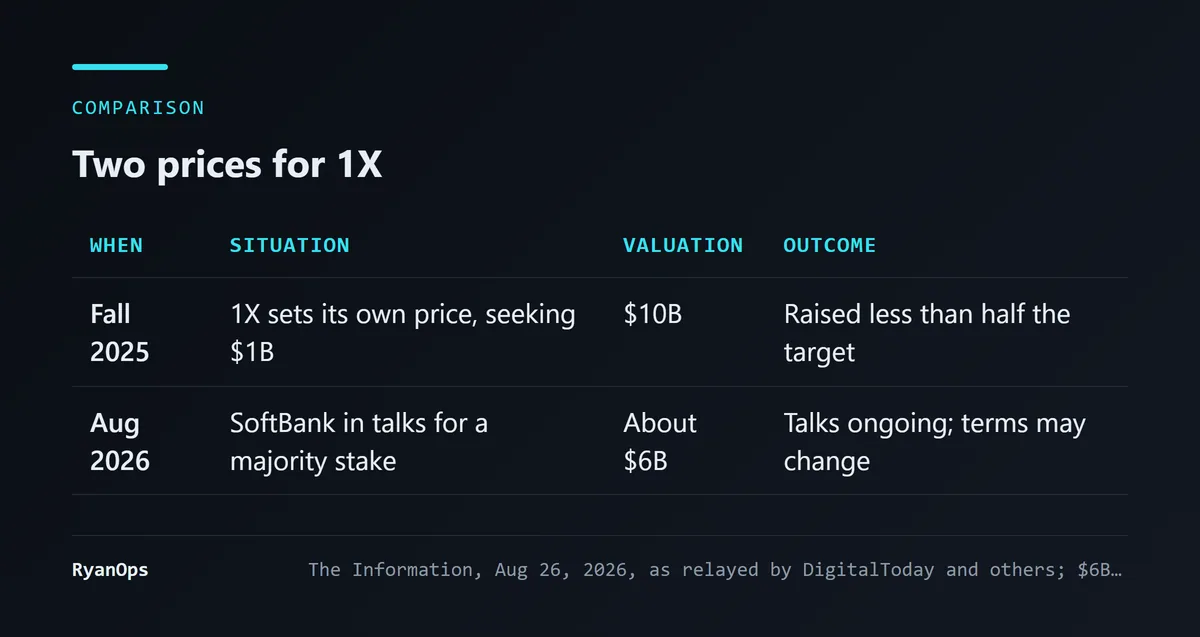 Figure 1: Two valuations within a year (data: The Information, as relayed by DigitalToday)
More is left unsaid. There are no numbers for what share SoftBank would buy, how much it would pay, or whether it would buy existing shares or inject new money. “Valued at $6 billion” and “SoftBank pays $6 billion” are different things. If the stake were 51%, the corresponding amount would be about $3 billion, but that is only my pro-rata illustration, and the report gives no amount. For last year’s round the report says only “less than half”, with no exact figure.
Neither company has confirmed it. According to pickups at the time, Reuters could not immediately confirm the report, SoftBank declined to comment, and 1X did not respond.
As of October 13, when I rewrote this piece, I could not find any follow-up about a signing or a collapse. From August 26 until now, the status of this story has stayed at “reportedly in talks”.
What kind of orders are the 10,000 orders?
1X is known for NEO, a humanoid robot for the home. It opened preorders in October 2025, and the company says its first year of capacity, more than 10,000 units, was taken within five days. That number appears in almost every article.
I opened 1X’s order page on October 13, and this is what it says.
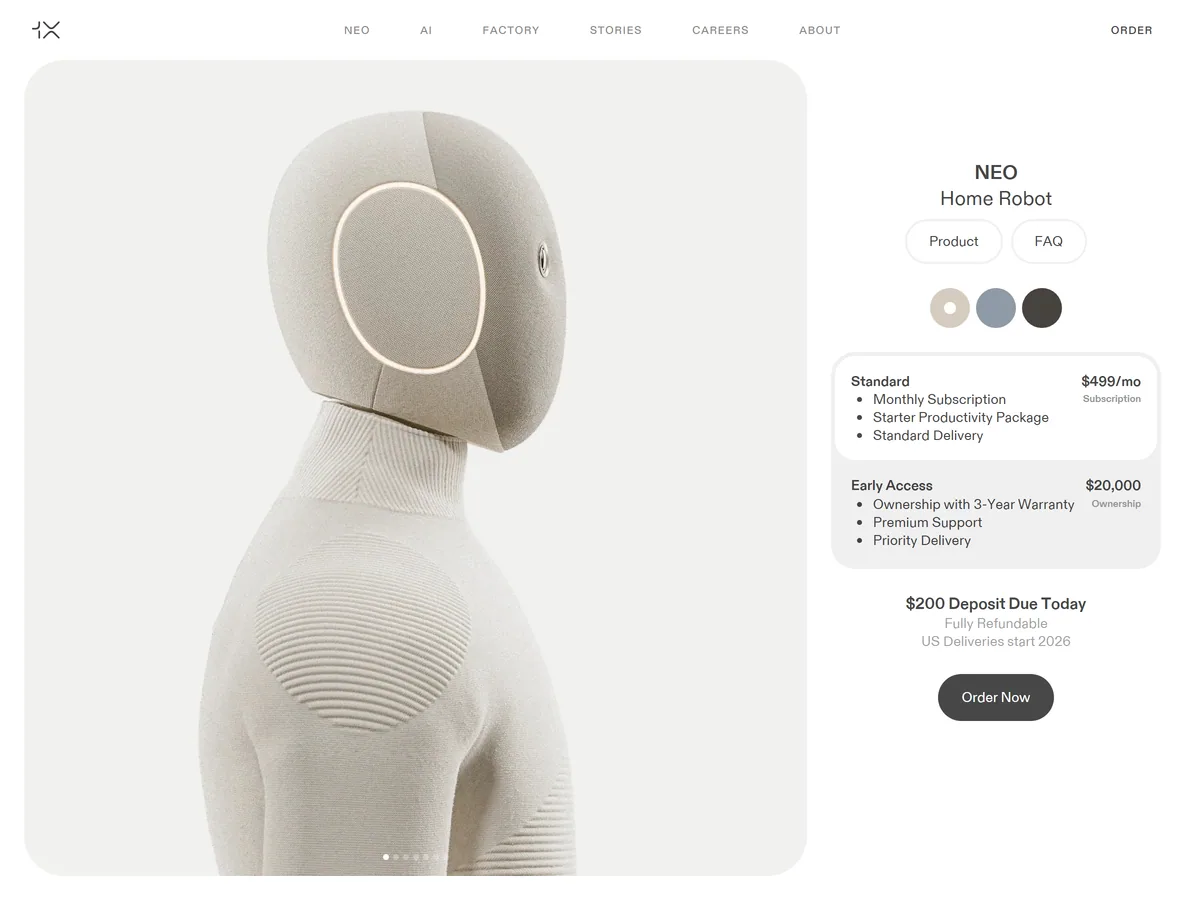 Figure 2: The NEO order page, captured October 13, 2026 (source: 1x.tech/order)
The page offers two plans. Standard is a $499-a-month subscription. Early Access is $20,000 for ownership, with a three-year warranty and priority delivery. Whichever you choose, what is due today is a $200 deposit, marked “Fully Refundable”, with a line below saying US deliveries start in 2026.
So the accurate description of “10,000 orders” is this: more than ten thousand people each paid a $200 deposit they can take back at any time. I converted that into money.
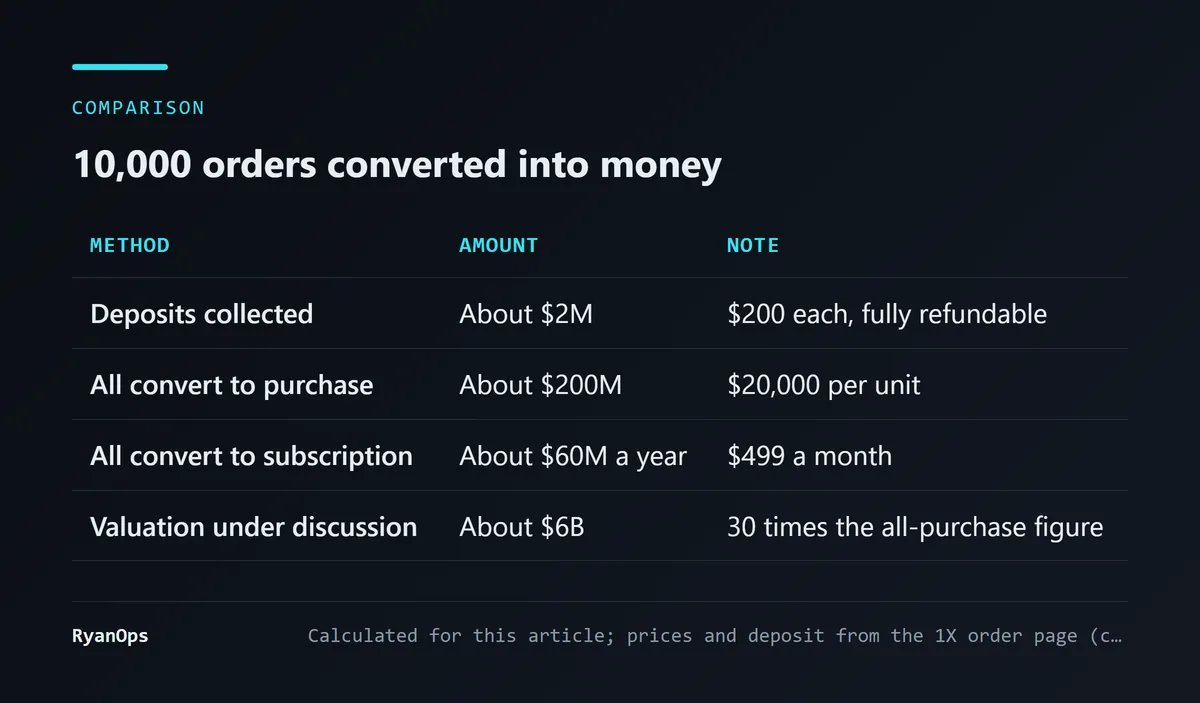 Figure 3: Four ways to count the same orders (calculated for this article; prices and deposit from the 1X order page)
The deposits that actually reached 1X’s accounts come to about $2 million. If all ten thousand people end up choosing to buy and none asks for a refund, revenue is $200 million. If all subscribe, it is about $60 million a year. A $6 billion valuation is 30 times that most optimistic scenario.
This arithmetic has two limits I should state. The 10,000 figure is the company’s own claim and I have no means of verifying it. The order page still takes orders, so the real number of deposits may be above 10,000, and some people may already have asked for refunds. Also, a valuation looks at the future, and dividing it by first-year orders is unfair to begin with. I list this table for one purpose only: to bring the words “10,000 orders” back to their actual weight.
Have any been delivered? On April 30, 2026, 1X announced that its factory in Hayward, California had begun full-scale production. According to Robotics 24/7, the factory covers 58,000 square feet, has more than 200 staff and an annual capacity of 10,000 units, with a target of more than 100,000 a year by the end of 2027. The same article states that robots coming off the line are going to 1X’s own R&D lab and internal home testing, and that first customer shipments are “planned for 2026”. DigitalToday’s report of August 28 says NEO has not yet been delivered to customers. I went through the news page on 1X’s site. The latest items are a hand design and executive appointments from July, and none announces the start of deliveries.
The “deliveries start 2026” on the order page has less than three months left.
Can NEO do chores by itself?
The old version did not touch this at all, yet it bears directly on what the company is worth.
1X’s product page has a feature called Expert Mode. The text reads: NEO works autonomously by default. For any chore it doesn’t know, you can schedule a 1X Expert to guide it, helping NEO learn while getting the job done. Another passage on the same page says NEO is built for full autonomy, Early Access offers “foundational autonomy”, and with continued use NEO learns and unlocks new capabilities.
Put plainly, part of an early NEO’s work needs a real person to take over remotely. That is a legitimate practice in robotics, and the data collected through remote operation is exactly what trains autonomy. For a buyer, though, it means how much the thing you pay for can do unaided today depends on which chores it has already been taught. For an investor, it means each additional unit sold may bring an additional labor cost until autonomy catches up.
1X has not published what share of tasks is currently completed autonomously. Until that number appears, I cannot judge how far NEO is from “leave it at home to work unsupervised”.
In August this site covered production progress on Tesla’s Optimus, with a similar conclusion: the demo videos are persuasive and verifiable delivery numbers are scarce. What humanoid robotics has in common right now is that claimed scale far exceeds actual shipments.
What is SoftBank actually buying?
Looking at 1X alone, it is easy to think SoftBank is picking up a startup at a low price. Add another deal and the outline changes.
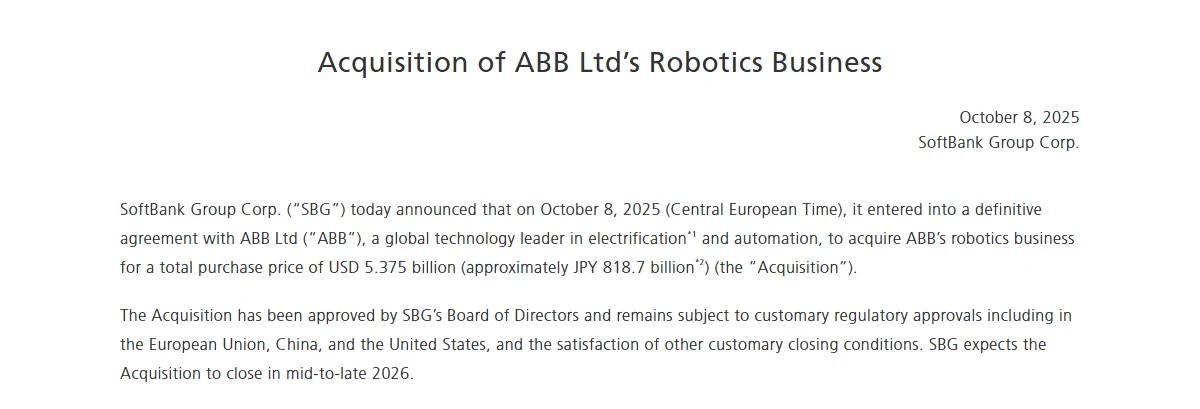 Figure 4: SoftBank’s official announcement of the ABB robotics acquisition (source: SoftBank Group)
On October 8, 2025, SoftBank signed an agreement to buy ABB’s robotics business for $5.375 billion, with closing expected in mid-to-late 2026 and regulatory approvals still needed in the EU, China and the United States. The old version wrote $5.4 billion, which is the rounded figure. Masayoshi Son’s words in the release are “SoftBank’s next frontier is Physical AI.” When I wrote this, I had not found an announcement that the deal has closed.
The release includes financial figures for ABB’s robotics business, which happen to make a useful comparison with 1X.
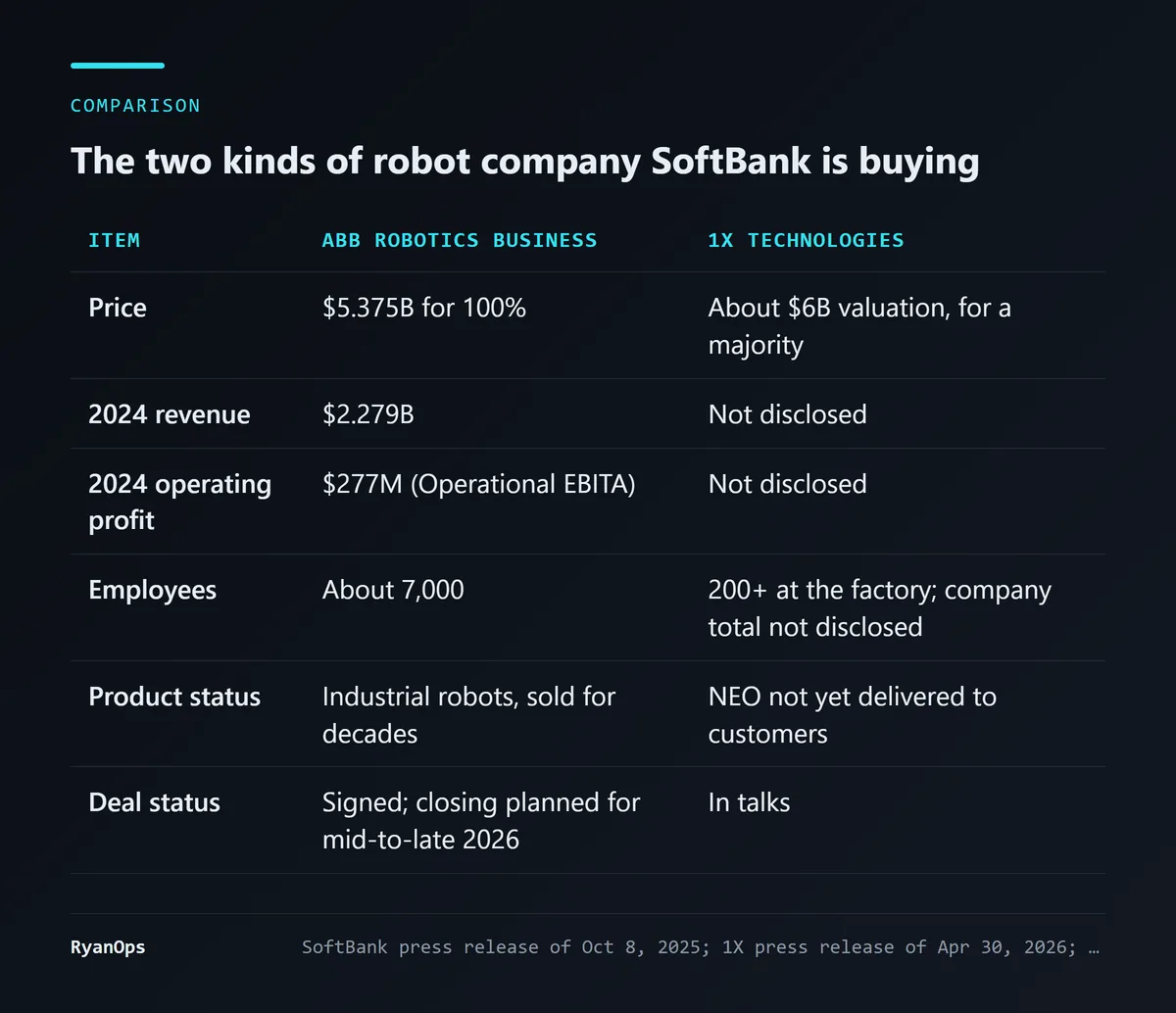 Figure 5: ABB’s robotics business against 1X (data: SoftBank Group press release, Robotics 24/7, DigitalToday)
ABB’s robotics business had 2024 revenue of $2.279 billion, operating profit of $277 million and about 7,000 employees. SoftBank is buying all of it for $5.375 billion, roughly 2.4 times revenue. Its revenue fell from $2.452 billion in 2023 to $2.279 billion in 2024. It is a mature, profitable business that is not growing.
1X is valued higher than that, has disclosed neither revenue nor profit, and has not yet put a product in customers’ hands.
Set the two side by side and SoftBank’s approach becomes clear. One purchase is industrial robot arms that have run in factories for decades, with cash flow, sales channels and manufacturing experience. The other is a humanoid robot that has not been commercialized. In the release SoftBank lists its own robotics investments, including SoftBank Robotics, Berkshire Grey, AutoStore, Agile Robots and Skild AI, and names “AI robots” as one of four priority investment areas. If the 1X deal closes, 1X would be the only company on that list making humanoid robots for the home.
As for why 1X is willing to discuss control, the people involved have not said. The visible facts are only that last year’s round missed its target, and that building factories and taking annual capacity from 10,000 to 100,000 takes a great deal of capital. Founders discussing the sale of a majority stake on the eve of product delivery suggests, at the least, that raising this money independently is not easy.
One layer of shareholder relationships deserves attention. 1X’s existing shareholders include OpenAI, and SoftBank itself is a major shareholder of OpenAI. If SoftBank takes control, there is no public information yet on what happens to OpenAI’s shares in 1X.
My read, and what would change it
I think the hardest piece of information in this story is the 40% markdown, and the softest is the “10,000 orders”. The first is a price both sides are willing to accept at the negotiating table. The second is ten thousand or so $200 payments that can be refunded at any time. The old version set both down side by side as facts. This time I separate them.
I would not read this as the whole humanoid robotics field cooling. One company’s lower valuation may only mean that it asked too much last year, or that its progress fell behind what it said. To conclude that the field is cooling, I would need to see funding terms for several other humanoid robot companies moving down as well, and I have no data on that at present.
What would change my view? If 1X publishes, before year-end, the actual number of units delivered to paying customers, even a few hundred, I would give the orders more weight. If it publishes the share of work completed autonomously, I could finally assess whether the labor cost of Expert Mode would crush its margins. If the deal closes at a valuation clearly above $6 billion, or 1X raises money elsewhere without giving up control, then the judgment that “independent fundraising is hard” was wrong. Conversely, if the delivery year on the order page quietly changes from 2026 to 2027, I would mark my assessment down further.
If you are thinking of paying that $200 yourself, my advice is simple. It is fully refundable, so the risk is small. But until you see reports from the first customers’ actual use, do not treat it as having bought a robot that does chores.
What this rewrite corrected
- The nature of the orders can be checked. The old version said public information could not tell whether the 10,000 orders were paid in full or deposits. 1X’s order page states a $200, fully refundable deposit.
- The ABB deal amount is more precise. The old version said $5.4 billion. SoftBank’s release says $5.375 billion, with closing expected in mid-to-late 2026, pending regulatory approval in three jurisdictions.
- The two companies’ responses were added. According to pickups at the time, SoftBank declined to comment, 1X did not respond, and Reuters could not immediately confirm. The old version said only “not officially confirmed”.
- Expert Mode was added. Part of an early NEO’s work needs remote guidance from 1X staff, which the old version did not mention.
- Comparable numbers were added. The revenue, profit and headcount of ABB’s robotics business; the floor area, staffing and capacity of the 1X factory; and four ways of converting the orders into money.
- Source limits are stated. I have not read The Information’s full text behind the paywall, and the deal details rely on other outlets’ accounts. As of October 13 I had found no follow-up.


