ChatGPT's $200 Plan Came Back With Half the Usage
OpenAI paused new Pro 200 sign-ups on Sept 10 and reopened Sept 30 at the same price with a lower allowance and a new $500 tier. Timeline, terms, legacy cutoff.
This article first went out on September 13, right after OpenAI had switched off sales of the most expensive ChatGPT plan, the $200 one, and nobody knew how long that would last.
Now there’s an answer: 20 days. It went back on sale on September 30, still $200 a month, but with less usage included and a new $500 plan sitting above it.
I’ve rewritten the whole piece. The original asked whether this was artificial scarcity, and at the time I could only argue from circumstantial evidence. With the reopening terms published, that question has a more direct answer. A few things in the original also turned out to be claims I couldn’t find support for this time, and I’ve removed or corrected them; they’re listed at the end.
What exactly couldn’t you buy on September 10?
The plan that was halted is ChatGPT Pro at $200 a month. Pro had two tiers then, $100 and $200, which the community told apart as “Pro 5x” and “Pro 20x”, meaning the usage multiple relative to Plus.
The announcement came from OpenAI’s product lead Thibault Sottiaux (everyone calls him Tibo). His post looks like this:
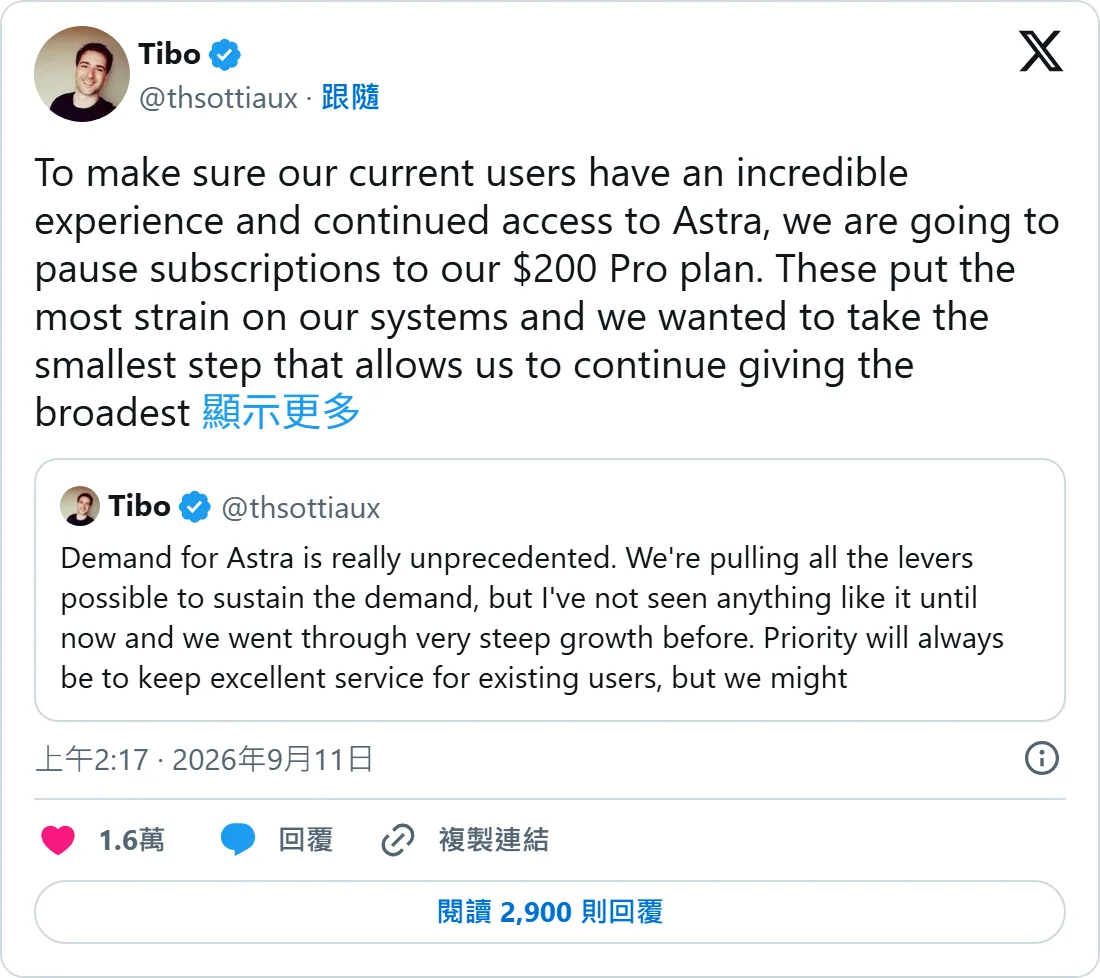 Figure: Sottiaux’s post announcing the pause of the $200 Pro plan, with his warning from the previous day quoted below (source: x.com)
There are actually two posts in that image. The quoted one underneath is the previous day’s warning: demand for Astra is “really unprecedented”, the team is pulling every lever available, the priority will always be to keep excellent service for existing users, but if this continues “we might have to pause new Pro subscriptions for a bit”. The next day the post above made it real. The reason he gave is that Pro puts the most strain on the systems, and they wanted to take the smallest step that lets them keep giving the broadest access.
The scope was narrower than it sounds. TechCrunch’s report at the time said the API, Go and Plus all carried on as normal, and the OpenAI help text quoted by several outlets says what was paused was “new sign-ups and upgrades” to the $200 plan, with existing subscribers unaffected. The exit was open and the entrance shut: you could keep using it, you could downgrade, you just couldn’t move up.
The trigger was GPT-6 Astra, which launched on September 3 and which OpenAI described as the start of the “AGI era”. One week after it shipped, the most expensive plan couldn’t keep up.
How did it come back?
On September 29 the same person posted a second time:
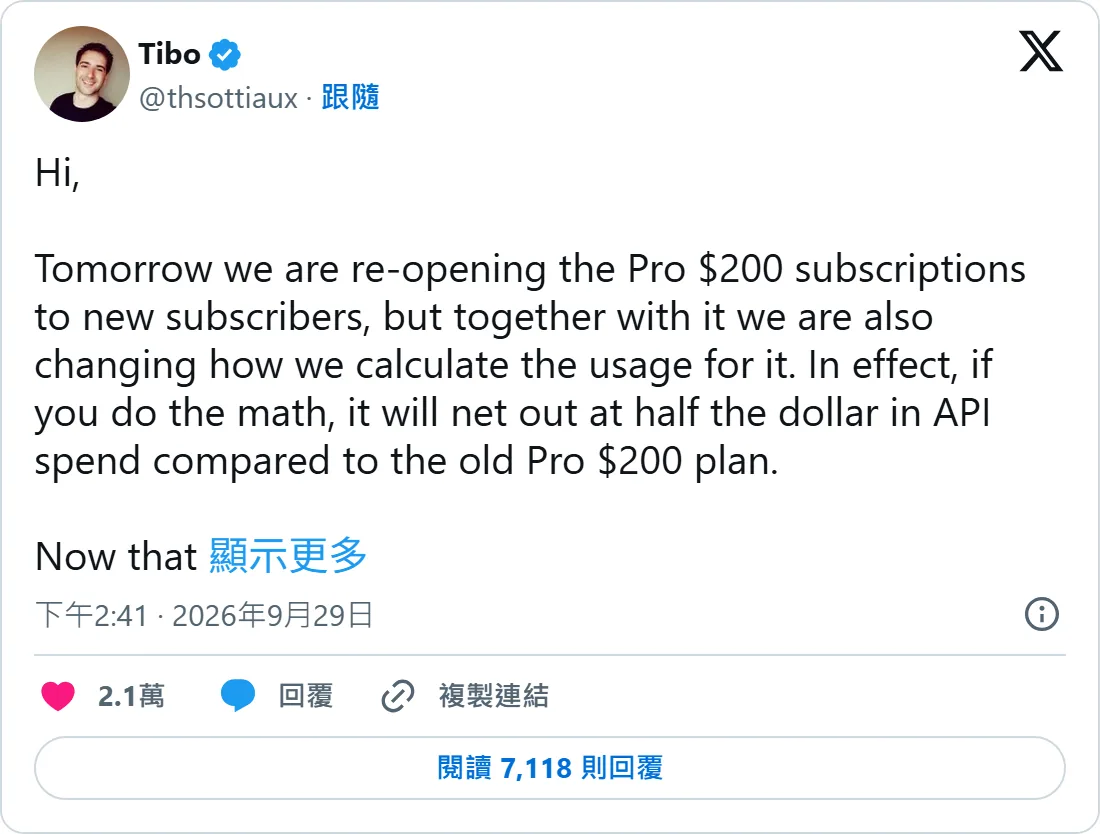 Figure: Sottiaux’s post announcing that Pro 200 reopens the next day with a new usage calculation (source: x.com)
The second sentence is the important one. Along with reopening, the usage calculation changed. He does the arithmetic for you: in API spend, the new Pro 200 nets out at about half the old plan.
Laid out as a timeline, the whole episode looks like this:
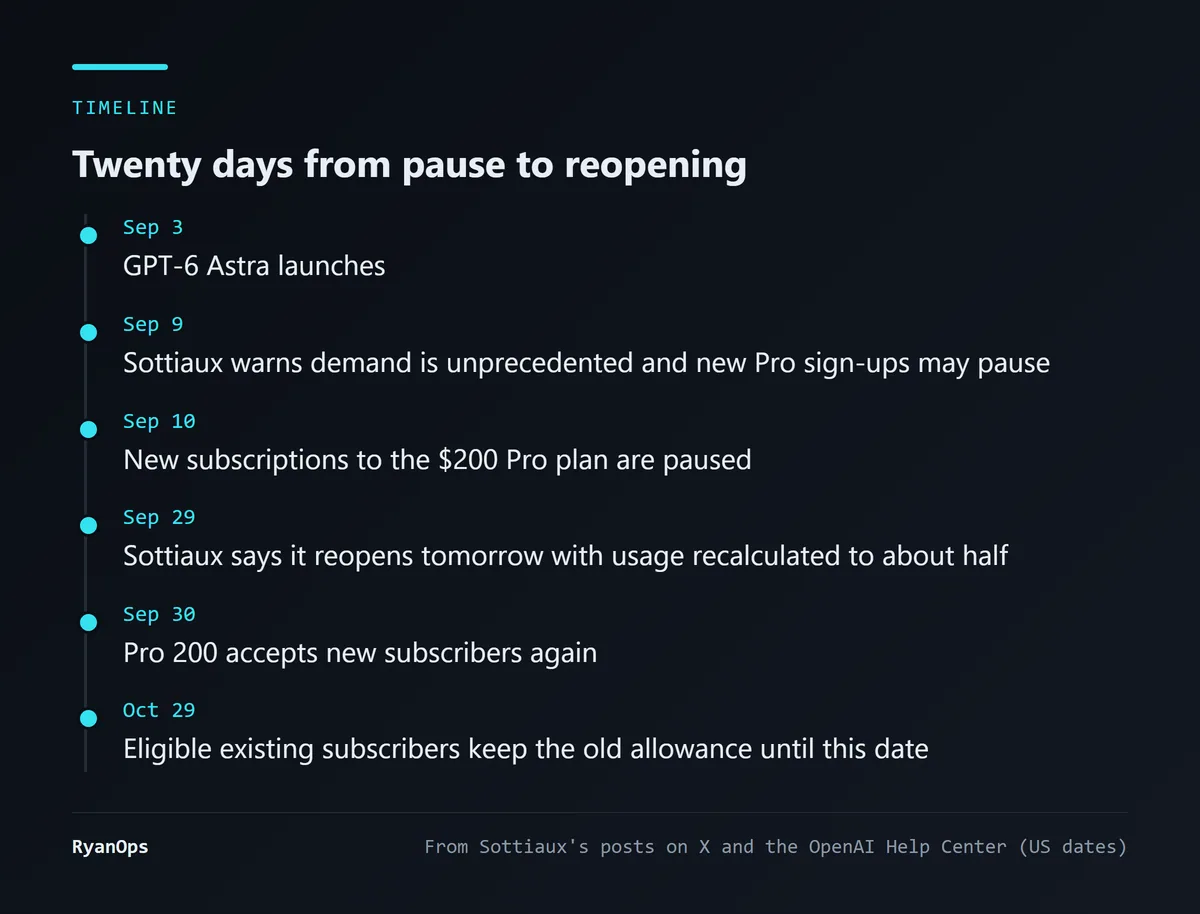 Figure: Pro 200 from pause to reopening (compiled for this article from Sottiaux’s posts and the OpenAI Help Center)
What do the official terms say now?
The posts are only a few sentences, so for detail you need OpenAI’s help page, “About ChatGPT Pro tiers”. That page blocks automated browsers, so I read it through a Wayback Machine capture. The plan table on it now has three tiers:
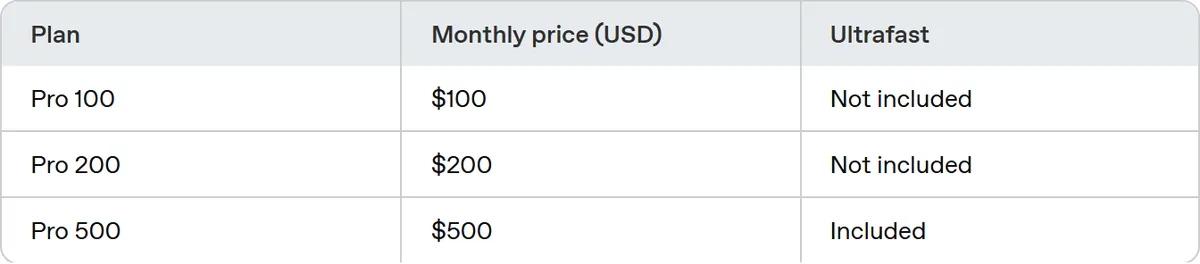 Figure: the three Pro plans listed in the OpenAI Help Center (source: Wayback Machine capture of help.openai.com)
A few things I read on that page:
Pro 200 really is open again, and OpenAI states in writing that the usage is lower. The wording is that new subscriptions “include a lower usage allowance than previously offered with Pro 200 to reflect our increasingly efficient models”, followed immediately by: the monthly price remains $200.
There’s a Pro 500. At $500 a month, it has the highest included usage of the three and is the only one with Ultrafast. Ultrafast isn’t free speed; the help page says it consumes your allowance at 8 times the Standard rate. The same page puts Fast mode at 2.5 times.
Existing subscribers get a retention period, with a deadline. If you had an active Pro 200 subscription at any point from September 22 through 10 a.m. Pacific on September 29, you can use the previous allowance through October 29. After that date the price is still $200 and the allowance moves to the new, lower level. OpenAI says it will email only the people affected.
Keeping the old allowance doesn’t give you Pro 500 features. The page has a specific entry for that.
I put the before and after into one table:
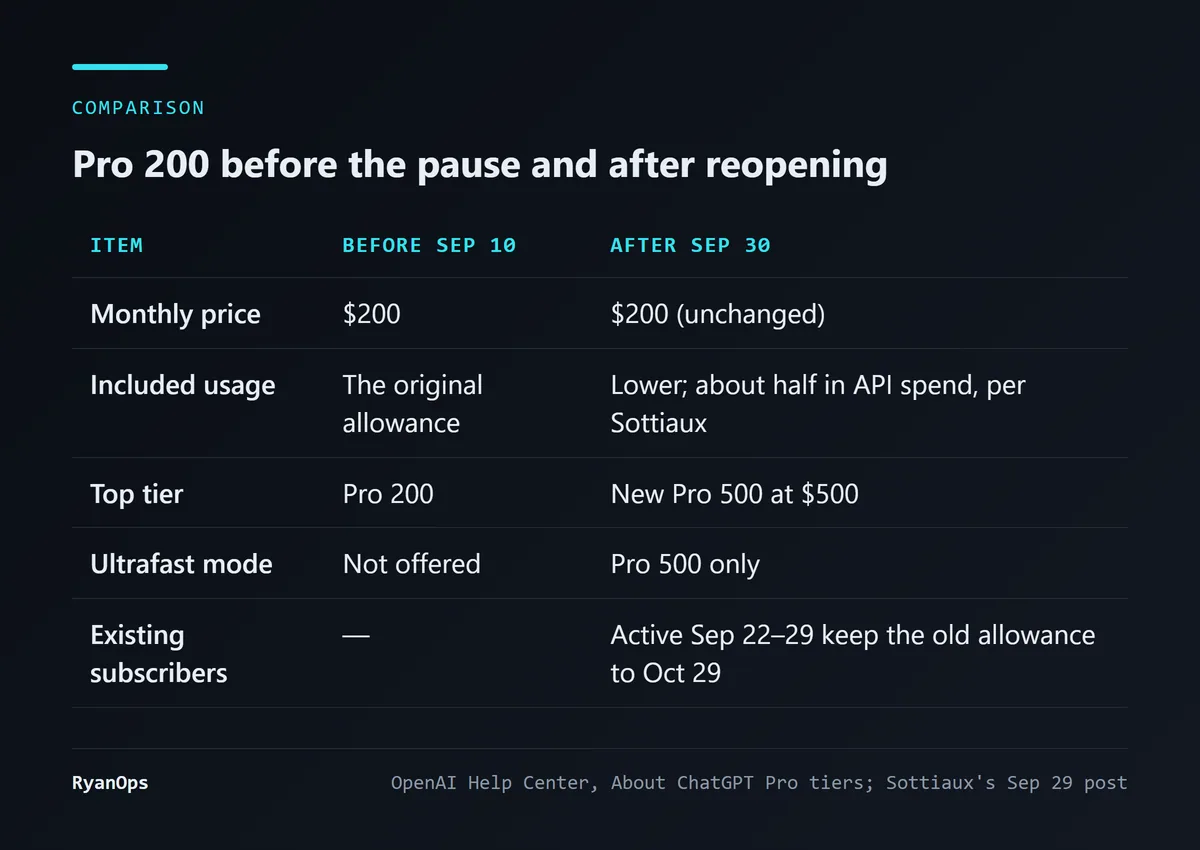 Figure: how Pro 200 differs before the pause and after reopening (compiled for this article from the OpenAI Help Center and Sottiaux’s Sept 29 post)
One thing I should be straight about. Some reports say the new Pro 200 is “10 times Plus” and Pro 500 is “25 times”. I didn’t see either number in the help page capture or in Sottiaux’s post, so they aren’t in the table. All I can confirm is OpenAI’s “lower than previously” and Sottiaux’s “about half”.
So was this artificial scarcity?
In September this was the question most people asked. Limited supply, can’t get it, the company says demand is too high: it does look the part.
My judgment then was that it wasn’t, and I’m more sure now. Three reasons.
First, this plan was already losing money, and Sam Altman said so himself:
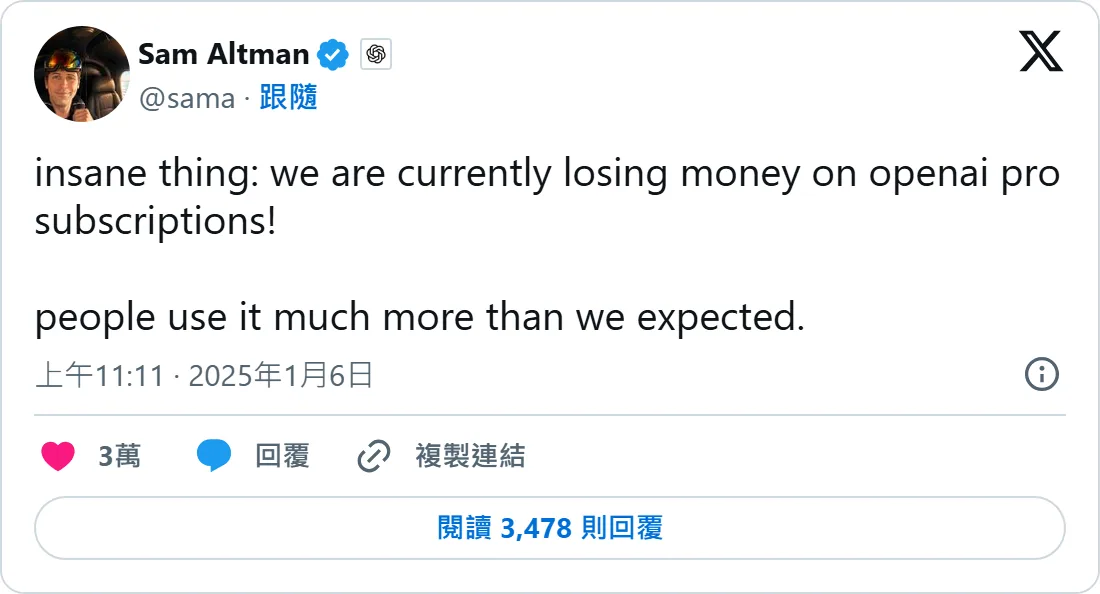 Figure: Altman saying publicly in January 2025 that Pro subscriptions lose money (source: x.com)
That was January 2025, when Pro already cost $200. So twenty months before the pause, the company had publicly admitted this price couldn’t cover actual usage. When a product is already sold at a loss, failing to sell more of it isn’t a loss to the company.
Second, the reopening terms themselves. If the pause had been about manufacturing scarcity to justify a higher price, it should have come back more expensive. In fact the price didn’t move by a cent; what moved is how much you get. This is a company fixing a price it got wrong, and the method was halving the portion. Sottiaux’s argument in the post is that models have become more efficient and API prices have come down, so the same allowance gets more done than it did a month earlier. That may well be true, but it doesn’t change one thing: for the same $200, the API-equivalent spend you receive is half what it was.
Third, this wasn’t the first time. CIO.com quotes Bhupendra Chopra, COO of the consultancy Kanerika, saying this is “at least the third time in two years OpenAI has throttled or paused access at launch”. Another outlet, BigGo Finance, counts differently, tallying only the times an entire paid tier was shut, and calls this the second in three years, the previous one being the November 2023 freeze on new ChatGPT Plus registrations. The two counts measure different things and reach the same conclusion: this is something that recurs.
Chopra has another line that I think gets at the core: it signals that frontier capacity is still rationed. Who gets locked out first reflects the vendor’s priorities. This time the ones blocked were new heavy consumer users, while enterprise contracts and the API were never touched.
Is selling it as “20x” a problem in itself?
At this point the original article described a coincidence, saying Anthropic’s Claude Max plan was sued “the same week”. I need to correct that.
Checking again this time, the case is Kahn v. Anthropic PBC, and the filing date given across several reports is June 14, 2026, with an amended complaint on July 20, Anthropic’s motion to dismiss on August 19, and a hearing set for November 6. It did not happen the same week as September’s pause; it was picked up again by the press around then. The original also quoted an attorney, and I couldn’t find the source for that quote this time, so it’s gone.
The substance of the lawsuit, though, is the same problem as the Pro 200 story. The plaintiff argues the advertised multipliers on Max 5x and Max 20x overstate actual usage. The number quoted most in coverage is 1.7 times: reportedly from emails Anthropic itself sent users in July 2025, Max 20x offers about 1.7 times the weekly Sonnet time of Max 5x while costing twice as much. Anthropic’s position is that the restrictions were accessible through links at purchase and that 20x is defined per session. All of this is still allegation; no court has ruled on any of it.
My own view is that plans named after a multiplier will run into this sooner or later. “20x” promises a relative value, while what’s delivered is simultaneously limited by weekly caps, different consumption rates per mode, and whatever compute is available at the moment. Once models get stronger and users get better at using them, the promise can’t be kept. How OpenAI handled it this time is worth noticing: on the new help page the plan names are just “Pro 100”, “Pro 200” and “Pro 500”. Those are prices. The multipliers are gone.
What would change my mind? If any vendor wrote down, as a number, how much API-equivalent usage each plan buys, I’d conclude that multiplier pricing was only a marketing-wrapper problem. Nobody does that today.
What should you do now?
September’s advice was “don’t cancel, don’t downgrade”, because the entrance was shut then and leaving meant you couldn’t return. The entrance is open now and that advice is void. What matters is which case you’re in:
- You had an active Pro 200 between September 22 and 29. Your old allowance lasts through October 29. The help page says that even if you cancel afterwards and subscribe again on the same account, it still counts as long as you meet that window. After October 29 it drops regardless.
- You subscribed on or after September 30. You get the new, lower allowance, with no retention period.
- You’re deciding whether to subscribe. Work out which kind of thing you actually want. Sottiaux says it himself in the later part of his post: API prices will keep falling, and for many people buying only the extra usage they need may fit better. Coming from the person selling the subscription, I think that can be taken at face value.
- You need the highest allowance. That’s Pro 500 now, but remember Ultrafast burns allowance at 8 times the rate.
One more thing that has nothing to do with plans. In the CIO.com piece, Chopra’s advice to enterprises is that critical workloads should run on contracts with committed capacity, and that you should have a second tested model ready. This episode shows the advice holds for individuals too. When a $200-a-month plan can have its entrance closed within a day and return twenty days later at half the portion, you’d better not have anything important depend on it alone.
If you want to know what happened to OpenAI’s model line after Astra: the successor planned for October was cancelled by OpenAI itself, and then GPT-6 Sol and Luna arrived in ChatGPT. If the billing terms are unfamiliar, the usage-limits entry in the glossary covers them.
What this rewrite corrected
- The original said Anthropic was sued “on September 8” and “the same week”. Corrected to a June 14, 2026 filing, with one attorney quote of untraceable origin removed.
- The original attributed Chopra’s comments to Computerworld. The outlet I found carrying those quotes this time is CIO.com.
- The original cited weekly message counts, gross-margin threshold estimates, gigawatt figures for OpenAI’s compute, and a claim that the sales switch was a pre-built feature flag. I couldn’t find sources that directly confirm these this time, so all of them were taken out.
- The original’s “don’t do these things right now” was written for people during the pause. It no longer applies after reopening and has been rewritten.
- I have never subscribed to Pro myself; everything this article says about usage comes from the official help page and Sottiaux’s posts.


