DeepSeek Weekends Go Off-Peak: 49 Peak Hours to 35
Six days into time-of-day pricing, DeepSeek made weekends off-peak, then added Chinese public holidays. Archived pricing pages show each change.
DeepSeek’s peak and off-peak pricing took effect on August 17. Six days later the rule changed: weekends became off-peak all day.
You will not find this in DeepSeek’s changelog. In late August that page had two entries, the V4 Pro update of August 13 and the vision model of August 21, and neither mentions weekends. The change happened in one line of notes under the table on the pricing page, which gained a few words.
So what I did for this rewrite is simple: I pulled archived copies of the pricing page from different dates and compared what that line said each time.
What changed in that line?
On the pricing page the Wayback Machine saved on August 19, the note reads:
 Figure: The note on the DeepSeek pricing page, captured 2026-08-19 (source: web.archive.org)
Peak hours are 9 to 12 and 14 to 18 Beijing time. No day of the week is mentioned, which means every day counts.
The August 23 capture:
 Figure: The same note, captured 2026-08-23, now with “Monday to Friday” (source: web.archive.org)
“Monday to Friday” has been added. The hours and the prices are unchanged. Saturday and Sunday were simply taken out of the peak range for the whole day.
The August piece gave the effective time as 00:00 on August 23, Beijing time, based on a notice email. I could not verify that email this time. What the captures prove is this: the page at 07:23 UTC on August 19 did not have the words, and the page at 12:05 UTC on August 23 did. The two accounts do not conflict, but that is as far as I can narrow it.
Taiwan shares Beijing’s time zone, so if you are there, no conversion is needed.
How much peak time disappeared?
Seven hours a day are peak. Counting every day, that is 49 hours a week. Counting weekdays only, it is 35. Fourteen hours went away, and the share of the week fell from 29% to 21%.
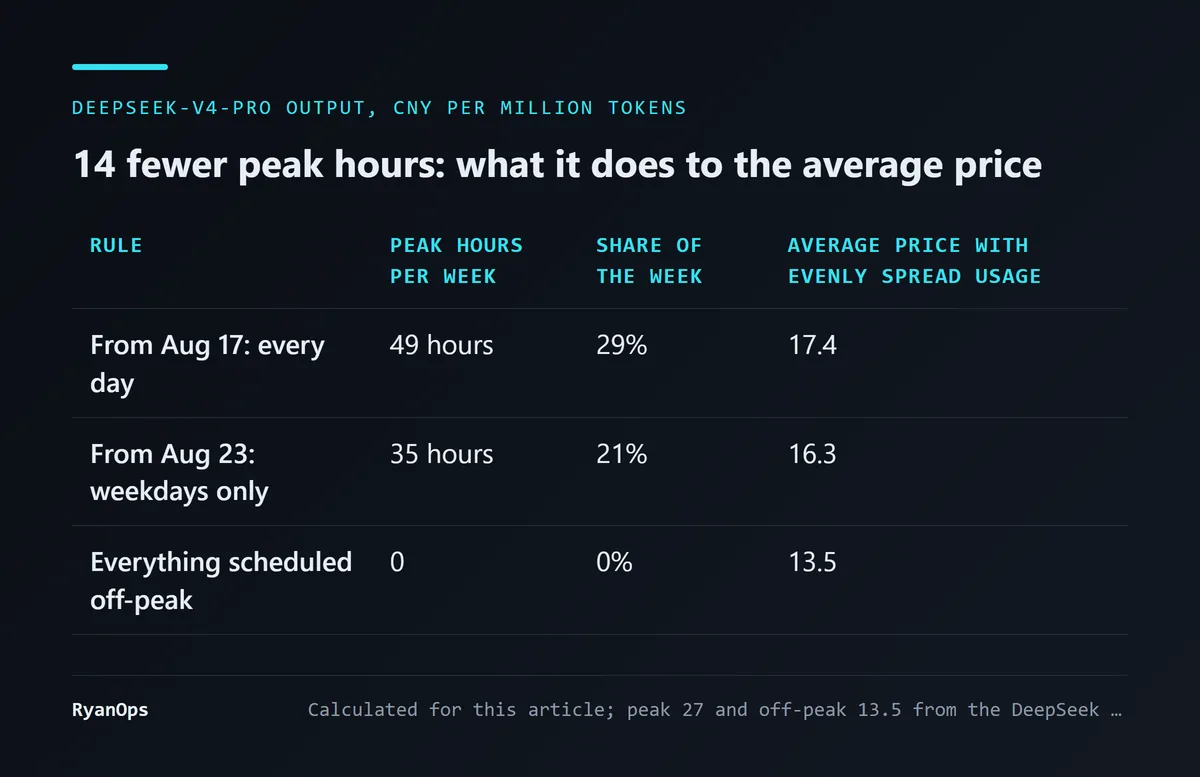 Figure: Peak hours and average V4 Pro output price under the two rules (calculated for this article from DeepSeek pricing page unit prices)
Now in money. Assume your requests are spread evenly across the 168 hours of a week, and use the deepseek-v4-pro output price: 27 yuan at peak and 13.5 yuan off-peak (CNY per million tokens).
- Every day counted: 13.5 × 71% + 27 × 29%, an average of 17.4 yuan.
- Weekdays only: 13.5 × 79% + 27 × 21%, an average of 16.3 yuan.
The difference is 6.5%. For a user who did nothing at all, this change made the bill about 6% cheaper.
The number is not large, and it assumes evenly spread usage. If your service is for office workers and requests already cluster in weekday daytime, the weekend change makes almost no difference to you. If your service is for consumers and weekend traffic is higher than weekday traffic, you save more than 6.5%.
I worked out the size of the August 17 change itself on sample bills in a separate piece: overall it was 1.7x to 3.6x the old price. This 6.5% pulls that back a little.
What was added in September?
On the pricing page today, that line is longer again:
 Figure: The late September version of the same note, with Chinese public holidays added (source: api-docs.deepseek.com; image taken from the Wayback Machine capture closest to September 28)
“Excluding Chinese public holidays” and “including whole weekends and Chinese public holidays” are new.
When was it added? I took captures at several points. The ones closest to September 12 and September 18 still have the August wording, and the one closest to September 28 has the new wording. So it changed in the second half of September, and I do not have the exact date. The changelog does not record this one either.
The timing is easy to understand. According to the 2026 holiday schedule published by the General Office of China’s State Council, Mid-Autumn Festival is September 25 to 27 and National Day is October 1 to 7. The wording appeared just ahead of both.
What happens when Taiwan and China take different days off?
I think this is the most practical part for developers in Taiwan. DeepSeek follows China’s calendar, not yours.
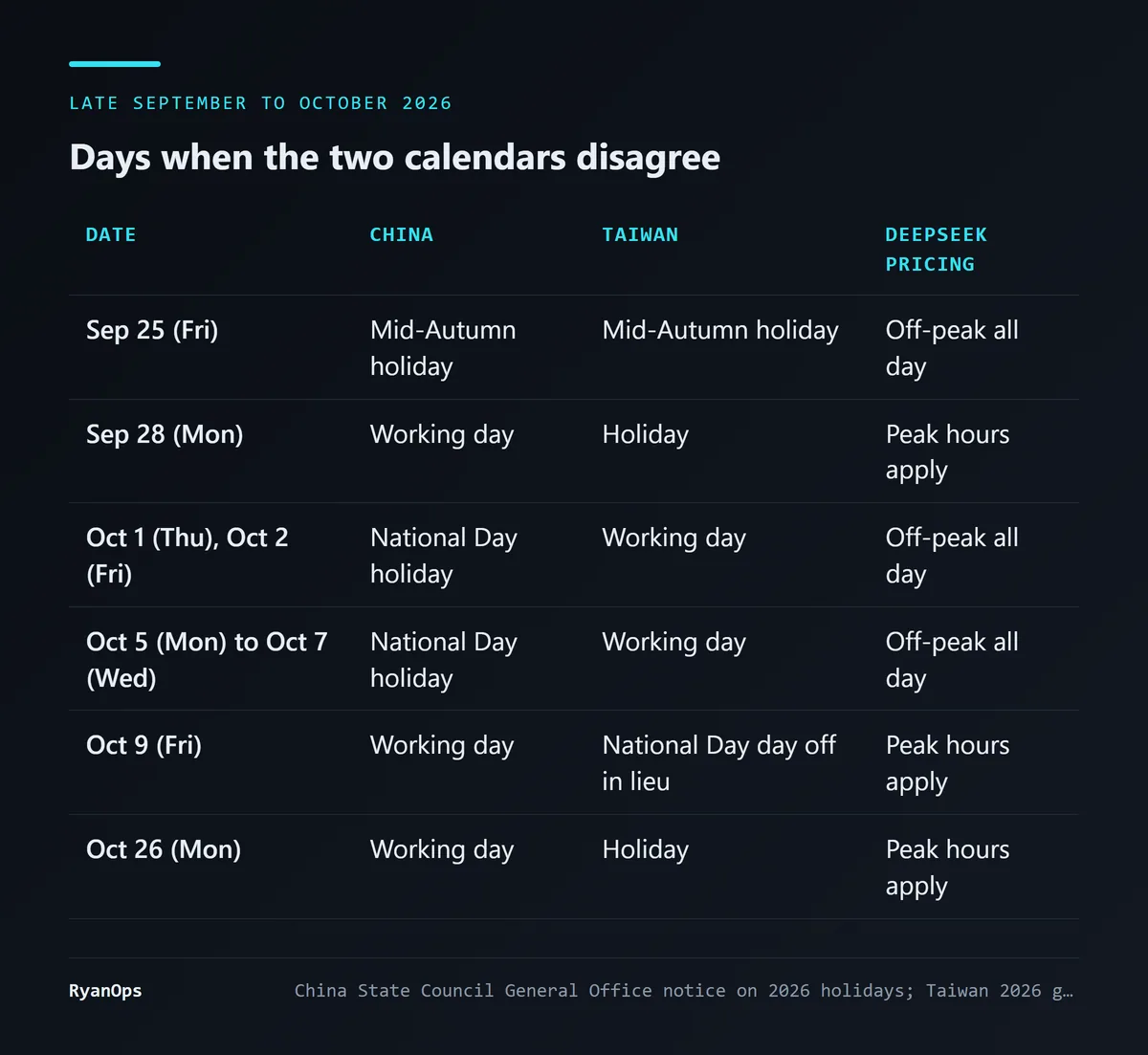 Figure: Days in autumn 2026 when China and Taiwan take different days off (compiled for this article from the State Council General Office holiday notice and Taiwan’s 2026 government office calendar; the pricing column is my inference from the note)
It cuts both ways.
You work, they are off. October 1 and 2, plus October 5 to 7, five weekdays in all. Taiwan works as usual on those days and DeepSeek charges the off-peak price all day. You make real-time calls during office hours and pay half.
You are off, they work. September 28, October 9 (the day off in lieu of National Day) and October 26. Taiwan is on holiday, China has an ordinary working day, and peak hours apply. If you plan to run batch jobs over a long weekend, those seven daytime hours are at the peak price.
To be clear, I derived the pricing column in this table from the wording of the note. I have not checked it against a bill day by day.
Are make-up working days peak or off-peak?
Here is a question I cannot answer.
China’s long holidays come with adjusted rest days, which turn some weekend days into working days. For National Day 2026 the make-up working days are September 20 (a Sunday) and October 10 (a Saturday). The whole country is at work on those two days, and load should resemble a weekday.
But the note says “Monday to Friday” is peak and “weekends” are off-peak all day. Read literally, a make-up Saturday or Sunday is still off-peak.
I lean towards the literal reading, because billing rules usually run on the conditions as written. But DeepSeek has said nothing specific about make-up days and I have no bill from those two days to verify it. If you happened to send a lot of requests during the day on October 10, your bill has the answer.
The model that lived for twenty days
The August 23 capture records something else: the price table went from two columns to three.
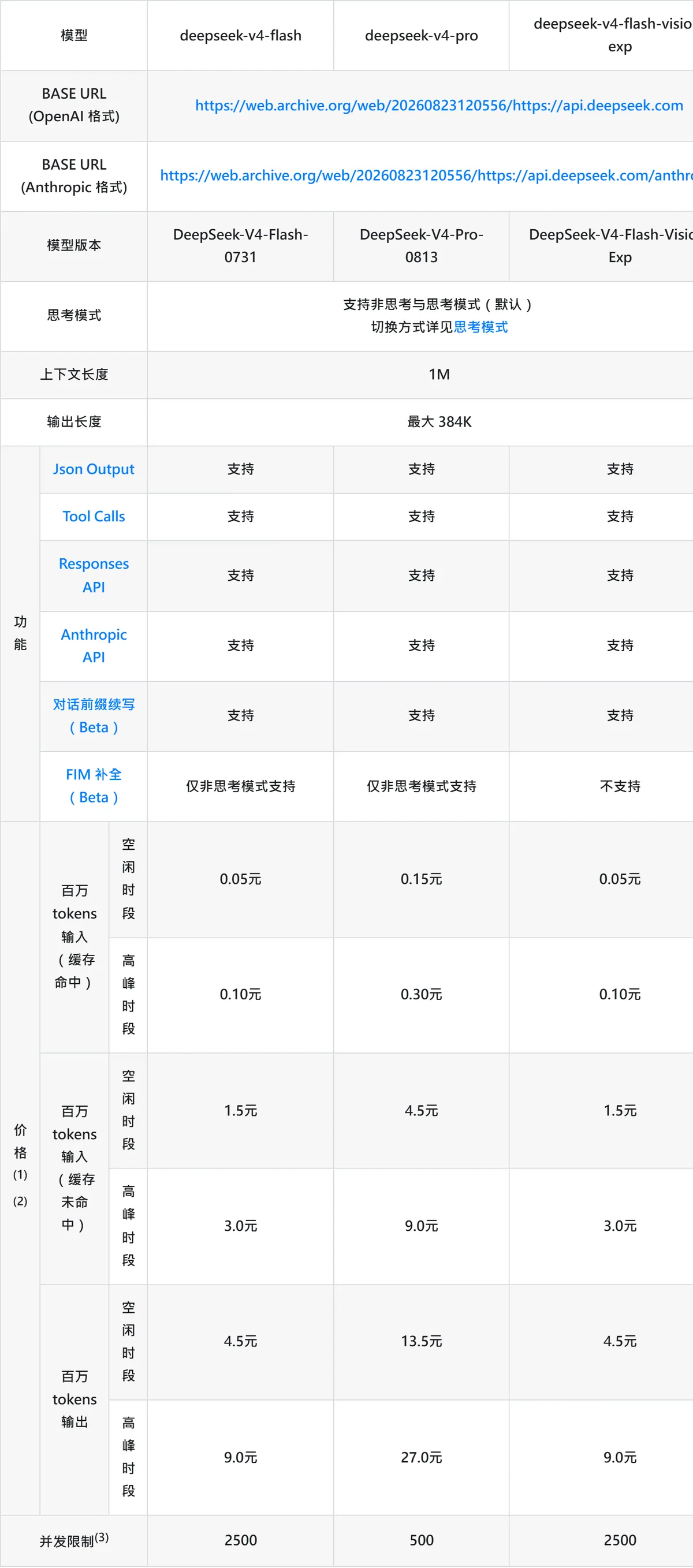 Figure: The price table as captured 2026-08-23, with an experimental vision model added (source: web.archive.org)
The addition is deepseek-v4-flash-vision-exp. According to the changelog it went live on August 21 as an experimental multimodal vision model, with pure-text ability on par with the production V4 Flash.
The archived table shows the same prices as Flash (0.05, 1.5 and 4.5 yuan off-peak), the same concurrency limit of 2500, 1M context and up to 384K output. There are two differences. It does not support FIM completion. Images sent to it are converted into tokens by size and billed together with text.
The model had a short life. V4.1 Flash was released on September 10 with image support built in. The changelog says V4 Flash and V4 Flash Vision Exp were both retired, with the old names temporarily routed to the new model. From August 21 to September 10 is exactly twenty days.
The “exp” in the name was honest. If you tend to hard-code model names in config files, take this as a reminder: a name carrying exp or preview can be swapped for something else at any time. The details of the V4.1 Flash release are in this piece.
What do these changes show when put together?
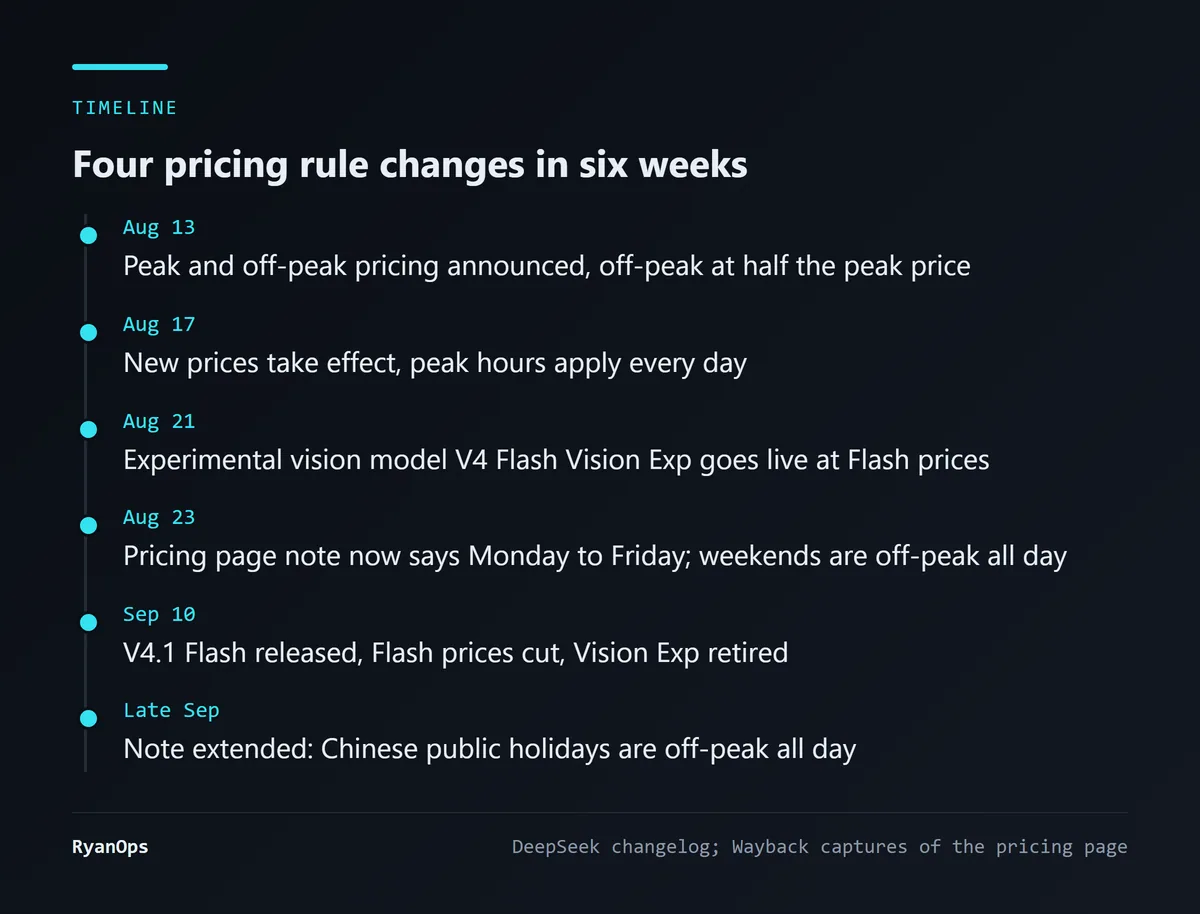 Figure: Changes to DeepSeek’s pricing rules over six weeks (compiled for this article from the DeepSeek changelog and Wayback captures of the pricing page)
Six weeks, four rule changes. Two of them, weekends and public holidays, changed only a line on the pricing page and were never recorded in the changelog.
My reading is that DeepSeek was tuning as it went. If the point of time-of-day pricing is to move load away from the peak, then weekends and long holidays have no peak to speak of, and charging peak prices for them makes no sense. Fixing it six days in looks like a reaction to real data. That is my guess, though. DeepSeek has not explained it.
For you, there are three practical conclusions.
- Schedule batch work on weekends. Saturday and Sunday are at the off-peak price at any hour, so there is no need to avoid the daytime. Evaluations, data preprocessing and offline generation all fit.
- Watch the gap between the two calendars. The table above is different every year. China’s holiday schedule is usually published at the end of the preceding year.
- Do not rely on the changelog alone. Neither of these two changes appeared there. If your cost estimate depends on the definition of peak hours, check the pricing page yourself on a schedule. Whichever page states the token pricing rules is the one that counts.
What would change my “schedule on weekends” advice? If weekend concurrency limits tighten later, or responses become clearly slower, the money saved has to be paid for in time. The concurrency limits on the pricing page do not currently differ between weekdays and holidays, and I have not measured weekend speed.
What this rewrite corrected
- The original quoted a DeepSeek notice email, including the stated reasons (more flexible weekend scheduling, balancing compute load), a no-backdating transition rule, and a clause allowing cancellation and refund for those who disagreed. I could not verify that email this time. Those passages are removed and two captures of the pricing page are the basis now.
- The original did not mention public holidays. That rule was added in the second half of September and is covered here.
- The original described the vision model as a current model. It was retired on September 10 and is now treated as history.
- The original called this a “more user-friendly correction” without a number. This version works out an effect of about 6.5% under an assumption of evenly spread usage.


