DeepSeek Kept V4 Pro After Saying It Would Go
DeepSeek shipped V4.1 Flash at 1/83 of Astra's output price and said V4 Pro would be rerouted on Sept 14, then kept it. Prices, monthly costs and cache math.
When this article went out in September, the second half of its headline said V4 Pro would be retired on September 14.
It wasn’t. I opened DeepSeek’s pricing page today and deepseek-v4-pro is still listed there, at exactly the September prices.
So the first half of this rewrite has to set that straight: on the public record, DeepSeek’s handling of V4 Pro changed at least three times. The price comparison and the cost-saving advice in the second half mostly still hold; I rechecked the numbers and added material that wasn’t available then.
Was V4 Pro retired or not?
No. Here are the official records I could find, in order:
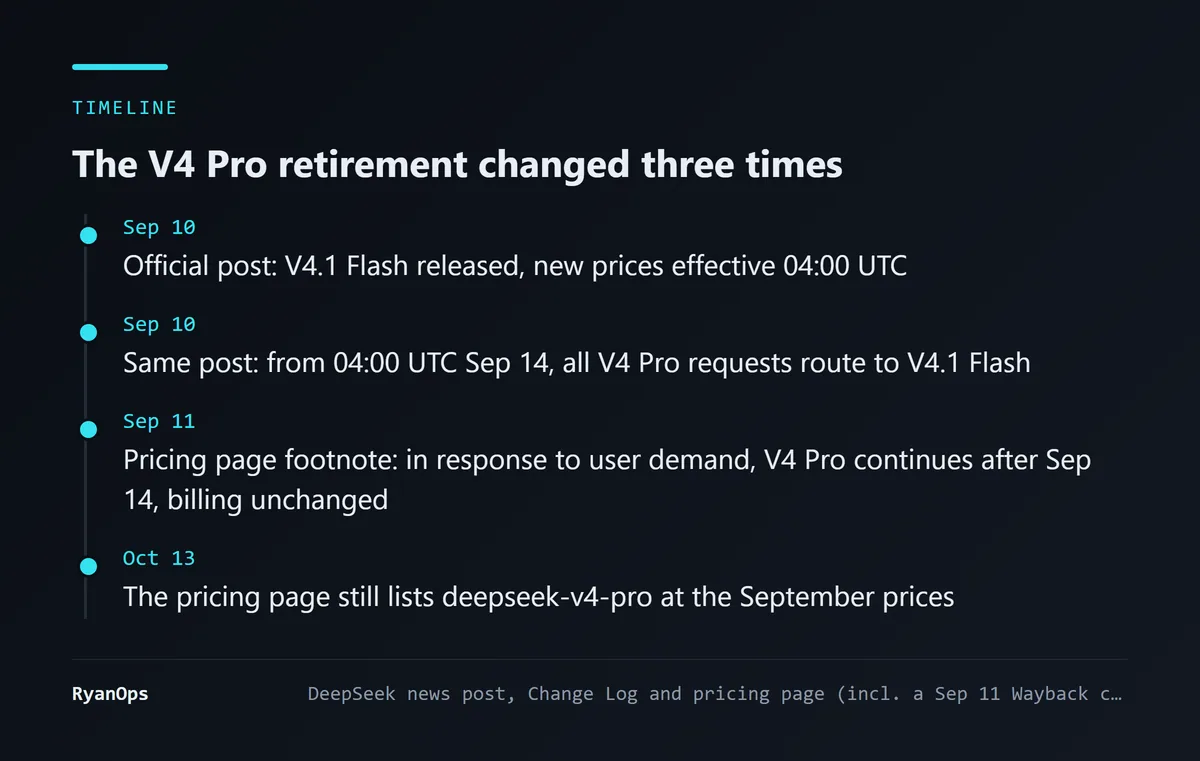 Figure: three versions of V4 Pro’s fate (compiled for this article from DeepSeek’s news post, Change Log and pricing page)
The first version is in the official September 10 post, “DeepSeek-V4.1-Flash: Smarter, Faster, More Efficient”. It says that from 04:00 UTC on September 14, all requests to deepseek-v4-pro would be handled by V4.1 Flash and billed at Flash rates, until V4.1 Pro launches. 04:00 UTC is noon in Taipei.
The second version arrived quickly. The pricing page as captured by the Wayback Machine on September 11 had gained a footnote:
 Figure: the pricing page footnote announcing V4 Pro continues after Sept 14 (source: Wayback Machine capture of api-docs.deepseek.com)
“In response to user demand, we have decided to continue.” The official Change Log entry for September 10 carries the same sentence. The post said it would be replaced, and the pricing page and changelog said it wouldn’t, roughly a day apart.
The third state is today. That footnote has been removed from the pricing page, and V4 Pro simply sits in the price table with no expiry note at all.
The September version of this article also described an earlier twist: based on two notification emails received at the time, DeepSeek first intended to reroute immediately and less than 14 hours later pushed that to September 14. I can’t re-verify those emails this time, and no “reroute immediately” version exists on the public pages, so I’m leaving it out of the timeline above. What’s certain is the three steps on the public record.
The practical effect for you: if you changed the model name in your code back then to beat the September 14 deadline, that change wasn’t necessary. If you didn’t, you’ve been on V4 Pro all along.
What does the price table look like now?
This is the pricing page as I captured it today:
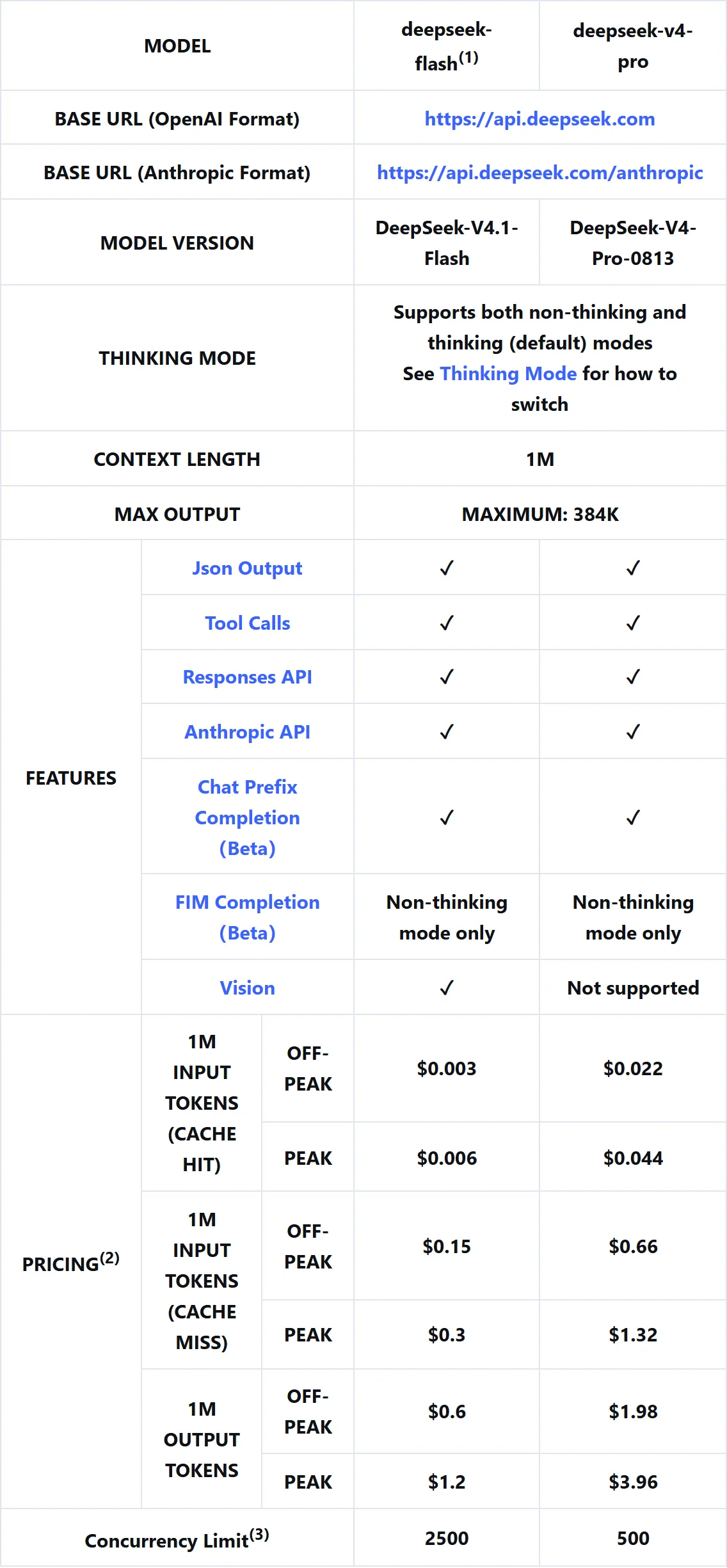 Figure: the model and price table on DeepSeek’s pricing page, captured 2026-10-13 (source: api-docs.deepseek.com)
A few things you can read straight off the table:
- The model name to use is
deepseek-flash. The olddeepseek-v4-flashanddeepseek-v4-flash-vision-expare still accepted, but the footnote states those two models have been retired; requests are served by V4.1 Flash and billed at the Flash price. They are what actually got replaced, not Pro. - V4.1 Flash accepts image input; V4 Pro doesn’t.
- The concurrency limit is 2500 for Flash and 500 for Pro.
- Both have a 1M context length and 384K maximum output.
The gap within the same generation: output falls from Pro’s $1.98 to Flash’s $0.60, a factor of 3.3. Cache-miss input falls from $0.66 to $0.15, a factor of 4.4. Cache-hit input falls from $0.022 to $0.003, a factor of 7.3. The official post gives the effective time of the new prices as 04:00 UTC on September 10.
The post also contains a few things the September article didn’t mention. V4.1 Flash is a 552B-parameter MoE (mixture of experts) model, and its weights are on Hugging Face. DeepSeek says that compared with the previous generation, its KV cache needs about a quarter of the HBM and an eighth of the SSD storage. That’s probably part of why the price could drop this far: each request it serves occupies less memory.
How far is it from Astra and Fable 5.1?
I looked up all three vendors’ public list prices again:
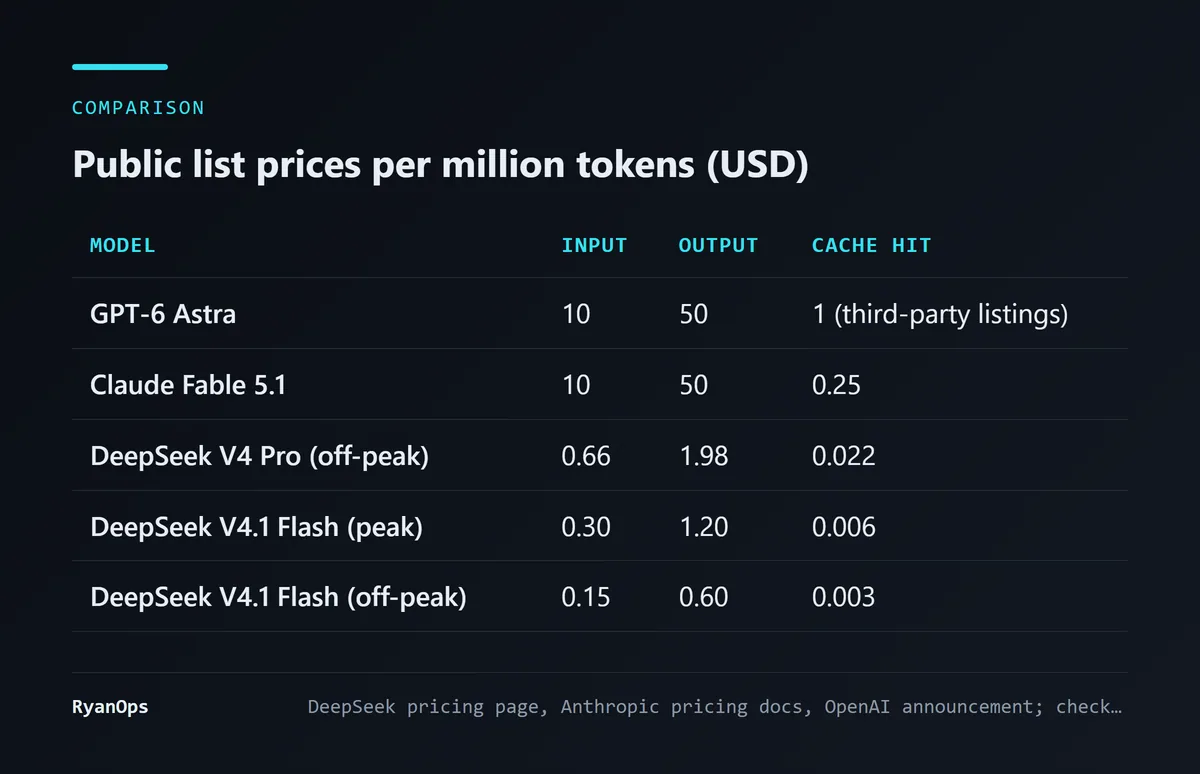 Figure: public list prices for the three vendors’ models (compiled for this article; DeepSeek pricing page, Anthropic pricing docs, OpenAI announcement, checked 2026-10-13)
A word on sources. I read the Claude Fable 5.1 numbers from Anthropic’s pricing documentation: $10 input, $50 output, $0.25 for cache hits. GPT-6 Astra’s $10 input and $50 output come from OpenAI’s launch announcement. Astra’s $1 cache-read figure I only saw on third-party price listing sites; OpenAI’s own pricing page blocks automated browsers and I couldn’t confirm it directly, which is why the table flags it.
On output price, V4.1 Flash off-peak is 1/83 of the other two. On input it’s 1/67.
It lands harder as a monthly bill. Suppose you use 10 million input tokens a month (none hitting cache) plus 2 million output tokens:
| Model | Monthly cost |
|---|---|
| GPT-6 Astra | $200.00 |
| Claude Fable 5.1 | $200.00 |
| DeepSeek V4 Pro (off-peak) | $10.56 |
| DeepSeek V4.1 Flash (peak) | $5.40 |
| DeepSeek V4.1 Flash (off-peak) | $2.70 |
$200 against $2.70, about 74 times.
So is it 74 times cheaper and just as good?
The table is easy to read that way, so I want to be clear about what it can’t establish.
The comparison in DeepSeek’s post is against its own previous generation. It says V4.1 Flash’s benchmark results are ahead of flagship models including V4 Pro, and cites third-party tests putting it ahead of V4 Pro on performance, cost, speed and total runtime. The benchmark results in the post are images; the text gives no scores.
It doesn’t claim to beat Astra or Fable 5.1. I also found no independent head-to-head test of V4.1 Flash against those two this time.
Then there’s the mismatch in class. Astra and Fable 5.1 are each company’s top model, while Flash is lightweight by name and by positioning. The like-for-like comparison would be V4.1 Pro, and the post only says that’s coming later.
There’s one more signal worth thinking about. DeepSeek itself says the new model beats the old one across the board, yet users asked for the old one to stay, and the company complied. I have no way of knowing those users’ reasons. Output quality may differ on certain tasks, they may simply not want to retune prompts, or Pro’s lack of image input may actually keep some pipelines simpler. But it does show there’s a distance between “wins the vendor’s benchmarks across the board” and “your workload can switch without trouble”.
My view: the price gap is large enough to be worth an afternoon of testing, and not large enough to switch without testing.
Do peak hours happen to cover the Taiwanese workday?
Yes, and the pricing page won’t do the conversion for you.
The official definition is 01:00 to 04:00 and 06:00 to 10:00 UTC, Monday through Friday, as peak, with off-peak at half the peak rate. Taiwan is UTC+8, so that becomes 09:00 to 12:00 and 14:00 to 18:00 on weekdays. In other words, your office hours, with only the two-hour lunch break left out.
The pricing page now says one thing more than it did in September: Chinese public holidays don’t count as peak, and weekends and Chinese public holidays are off-peak all day. The all-day weekend rule was added in late August, which this piece covered at the time. The public-holiday rule is something I only saw on the page this time. For users in Taiwan it has one small upside: on days when China is on holiday and Taiwan isn’t, your working hours are billed off-peak too.
What you can do about it is simple. Work that doesn’t need its results right away, such as data cleaning, batch summarization and nightly regression runs, can be scheduled after 6 p.m. or on weekends for half the unit price. In the estimate above that’s $5.40 becoming $2.70.
If peak/off-peak pricing is new to you, the glossary covers it, and the background on DeepSeek first introducing it in August is in this article.
What’s actually worth optimizing?
Cache hit rate. Peak and off-peak differ by 2 times; a cache hit and a cache miss differ by 50 times ($0.003 against $0.15).
I worked out the input cost for the same 10 million input tokens a month, at off-peak prices, across different hit rates:
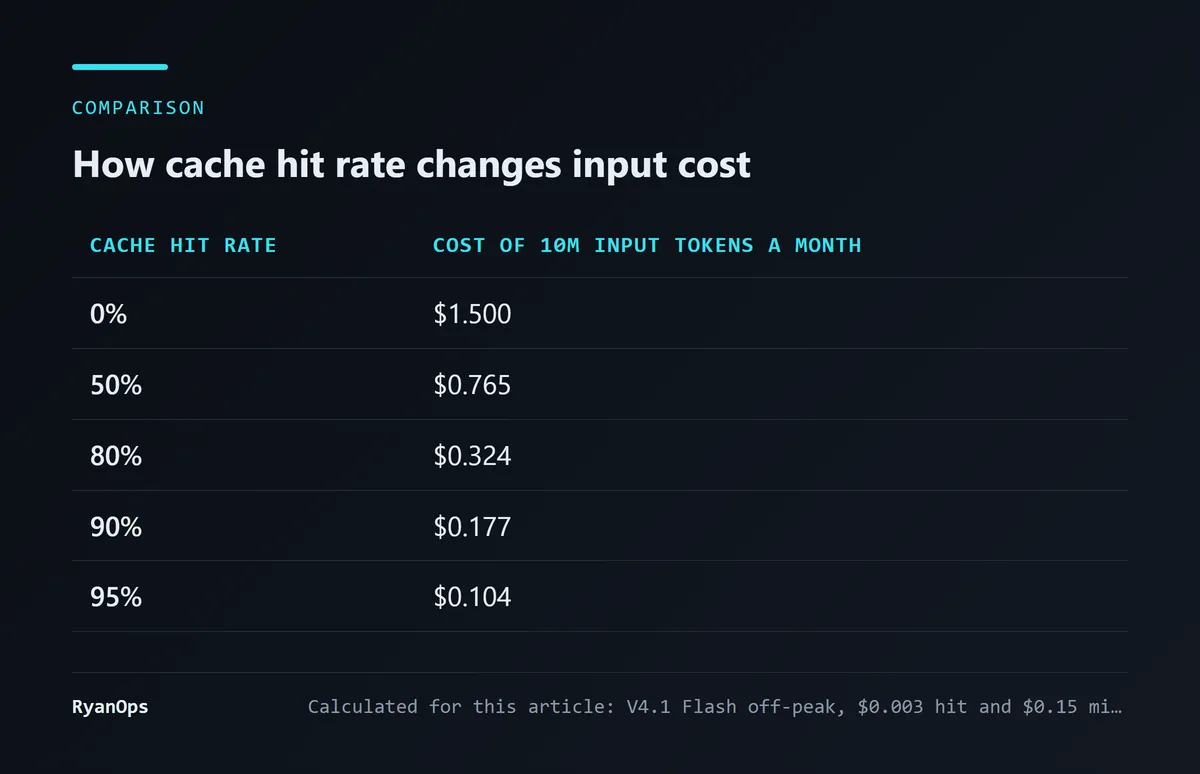 Figure: cost of 10 million input tokens a month at different cache hit rates (calculated for this article at V4.1 Flash off-peak prices)
Going from no hits at all to a 90% hit rate brings input cost down to 1/8.5 of the original. Moving every job to off-peak only saves half. You can do both, but if time is short, deal with caching first.
For the cache to hit, the start of each request has to be identical every time. The most common ways to break it: putting the current time or a per-request UUID at the very top of the system prompt, serializing tool definitions with unsorted JSON, and adding or removing tools dynamically per request. Any one of these changes the prefix, and everything after it is billed afresh. The approach is to put stable content first and volatile content last, then look at the cached-token count the API returns. If it’s zero several requests in a row, something is silently invalidating the cache.
This section is general principle; I haven’t run hit-rate tests against DeepSeek’s API. Vendors differ on minimum cacheable length and cache lifetime, so go by what its documentation says. For the billing terms, see the API pricing entry in the glossary.
What should you check now?
September’s checklist was written for people racing the September 14 deadline. The deadline was cancelled, so the list changes:
- Look at which model name your code uses. If it says
deepseek-v4-pro, you’re on Pro and paying Pro prices; nothing was swapped underneath you. If it saysdeepseek-v4-flash, you’re in fact already on V4.1 Flash, because the old Flash has been retired. - If you’re still on Pro, now is a good time to test Flash. Both models exist side by side, so you can run your own prompts through each. That won’t last forever: the footnote on the pricing page itself said further notice would follow if anything changed, and the post says Pro is a bridge until V4.1 Pro launches.
- Compare cost per completed task. The unit price is 3.3 times lower, but if the new model needs more turns or longer output to finish the same job, the saving won’t be as large as it looks on paper.
- Don’t treat this one as an exception. A model’s retirement schedule was announced and withdrawn within two days; the next one may not be withdrawn. Making your code able to switch models through configuration is more practical than betting on whether the vendor changes its mind.
Was this price cut forced by competitors?
The September version spent a whole section on this and concluded that it’s unknown. That conclusion hasn’t changed.
The facts that can be established: V4.1 Flash was released on September 10 and GPT-6 Astra launched on September 3, a week apart. DeepSeek’s post and pricing page mention no competitor. Model release schedules are usually set months ahead, and a week’s gap may just be a collision.
The September article also gave Claude Fable 5.1’s release date as September 1 and built “nine days, three vendors” on it. I didn’t re-verify that date this time, so the whole passage is gone.
If I have to offer a view, I find the interesting part isn’t why it cut prices but that it could. The post explains the reason quite specifically: the new architecture sharply reduces the memory each request occupies. In a year when memory capacity has been bought out, that explains the 1/83 figure better than any competition story.
Which numbers here I haven’t verified
- DeepSeek’s prices, peak hours and model capabilities all come from the official pricing page and post, and I checked them.
- Fable 5.1’s prices come from Anthropic’s pricing documentation, and I checked them. Astra’s cache-read price comes from third-party listings.
- The monthly cost and cache hit rate tables are my own arithmetic, with the assumptions stated beside them. A different usage mix gives a different result.
- I haven’t tested V4.1 Flash’s actual output quality. Of the benchmarks in the post I only read the text description.
- The timing details the September version drew from the notification emails are not included this time.


