Stripe Buys OpenRouter: Four Prices, None Official
Stripe announced its purchase of AI gateway OpenRouter on August 19 without a price. Reports range from $7B to $10B. How OpenRouter earns money.
My August headline was “Stripe spends $7 billion to buy OpenRouter”, and the first sentence said “Stripe confirmed an acquisition that shook the AI world”.
That piece was written on August 17. At that point Stripe had confirmed nothing. Its spokesperson told Bloomberg the company does not comment on rumors or speculation. The $7 billion was Bloomberg citing people familiar with the matter, and the report noted specifically that the final price could change.
Two days later, on August 19, the two companies made it official. The announcements contain no amount.
So this rewrite first sorts out the order and the sources, then answers three questions the original did not: how OpenRouter actually makes money, what Stripe wants it for, and how much its promise of neutrality is worth.
What was officially announced?
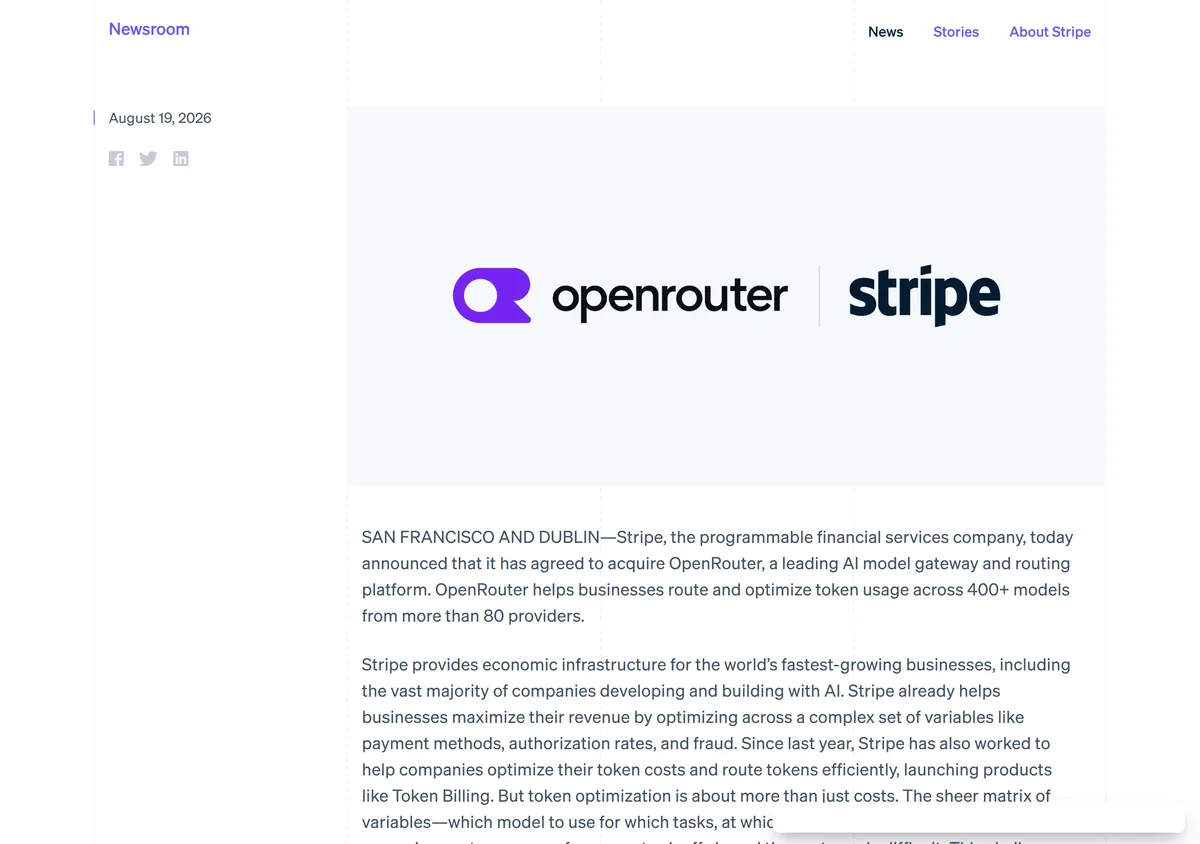 Figure: Stripe’s press release on agreeing to acquire OpenRouter, 2026-08-19 (source: stripe.com)
The headline of Stripe’s release is: Stripe agrees to acquire OpenRouter to help businesses optimize token routing and usage.
The reasoning in the text runs like this. Stripe already helps businesses maximize revenue by optimizing across variables such as payment methods, authorization rates and fraud. Since last year it has also worked on helping companies cut token costs, and launched a product called Token Billing. But token optimization is about more than cost. Which model to use for which task, how fast, at what price: there are too many variables, and models keep being released and repriced. OpenRouter’s job is to decide where each request should go.
The release names three customers already using OpenRouter: NVIDIA, Zoom and Lovable.
CEO Patrick Collison says tokens are the central currency for companies building with AI, and that Stripe will work with OpenRouter to help businesses maximize profitability by routing requests intelligently and spending tokens efficiently.
The release gives no amount and no closing timetable. OpenRouter’s own announcement adds one sentence: the transaction is subject to customary closing conditions and is expected to close “in the coming weeks”. As I write, I have not found an announcement that it has closed.
What is the price?
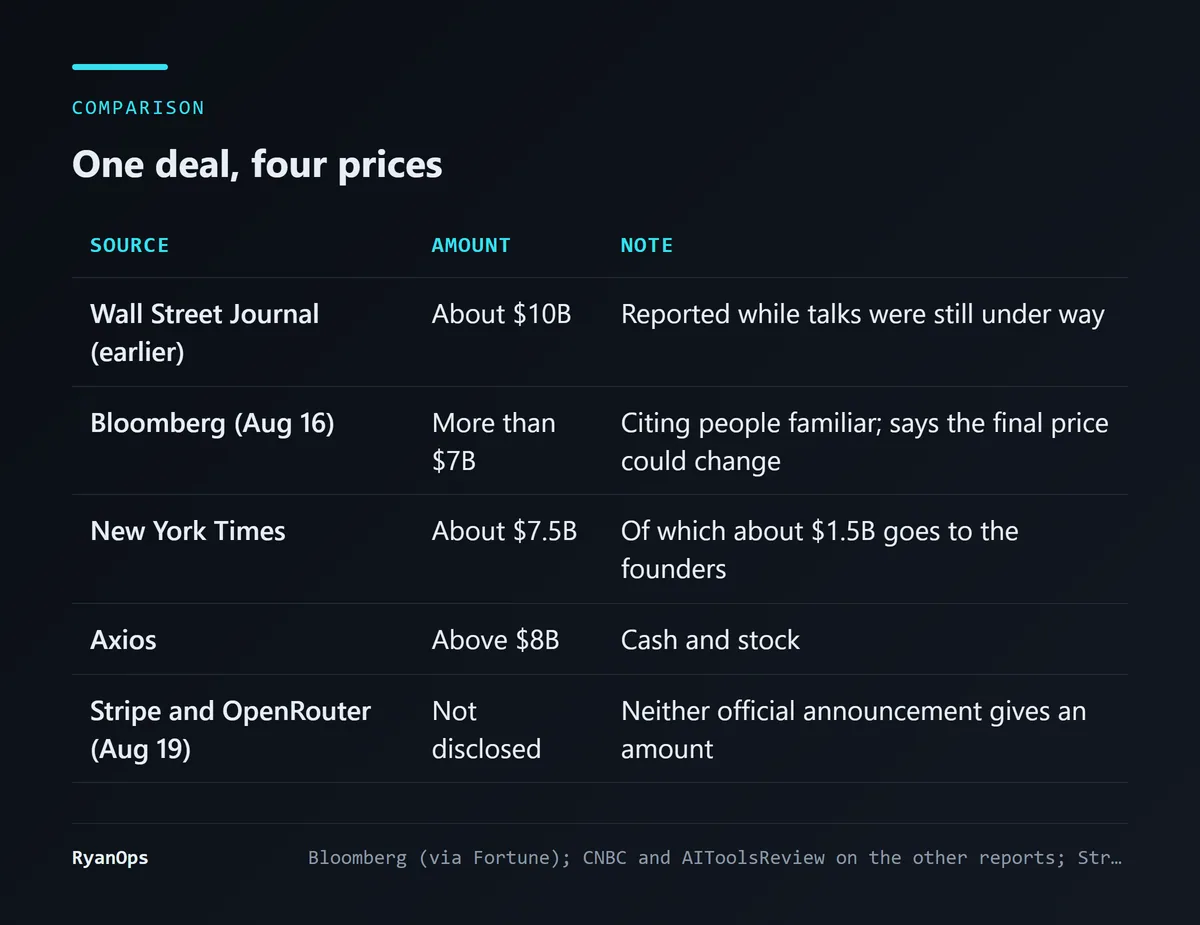 Figure: Acquisition prices reported by different outlets (compiled for this article from Bloomberg, summaries by CNBC and AIToolsReview, and Stripe’s press release)
Nobody knows the exact number except the parties.
First the Wall Street Journal reported that the two were in talks at about $10 billion. On August 16 Bloomberg reported a deal had been struck at more than $7 billion. Later the New York Times reported about $7.5 billion, with about $1.5 billion of it going to the founders. Axios reported above $8 billion in cash and stock.
Four numbers, with $3 billion between the lowest and the highest.
The August piece had a section called “Price gap: $7 billion or $10 billion”, which did mention the discrepancy and that neither side would comment. But the headline still chose $7 billion and the first sentence still said “confirmed”. It is a case of a headline more certain than its own text.
Why would the numbers differ so much? I can think of three explanations, all guesses. The deal is cash plus stock, Stripe is not listed, and the value of its shares can be computed in different ways. The deal may include payments tied to future performance. And $10 billion may have been an early negotiating figure that was later talked down.
What is OpenRouter?
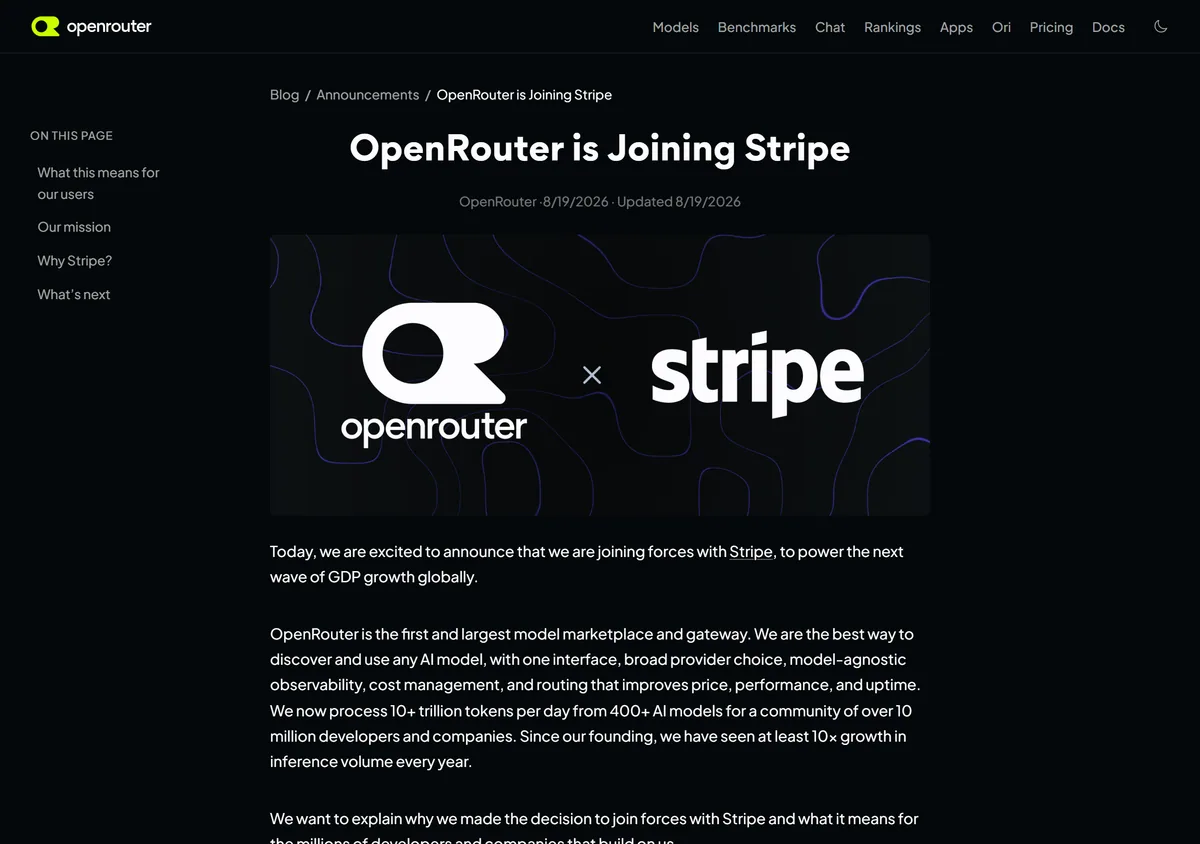 Figure: OpenRouter’s announcement that it is joining Stripe, 2026-08-19 (source: openrouter.ai)
If you have not used it, think of it as a switchboard for AI models.
To use GPT, Claude, Gemini and DeepSeek, the normal route is to sign up with each vendor, attach a credit card, get a key and read each set of documentation. OpenRouter lets you sign up once, take one key, and call 400+ models from 80+ providers in one format. If one provider goes down, it switches to the next automatically.
The figures in the announcement:
- More than 10 trillion tokens processed per day.
- More than 10 million developers and companies using it.
- At least 10x growth in inference volume every year since its founding.
- Founded in early 2023, with about 90 employees.
In May OpenRouter spoke of 8 million developers, the figure Bloomberg quoted. Three months later the announcement says 10 million “developers and companies”. The wording has gained “and companies”, so the two figures are not necessarily on the same basis.
CEO Alex Atallah co-founded the NFT marketplace OpenSea. Bloomberg writes that OpenSea raised more than $400 million and later saw usage crater. He stepped down in July 2022 and started OpenRouter less than a year later.
One more detail I find amusing. According to a New York Times report cited by Bloomberg, Atallah earlier this year described OpenRouter as “the AI equivalent” of Stripe. A few months later Stripe bought it.
How much has its value risen?
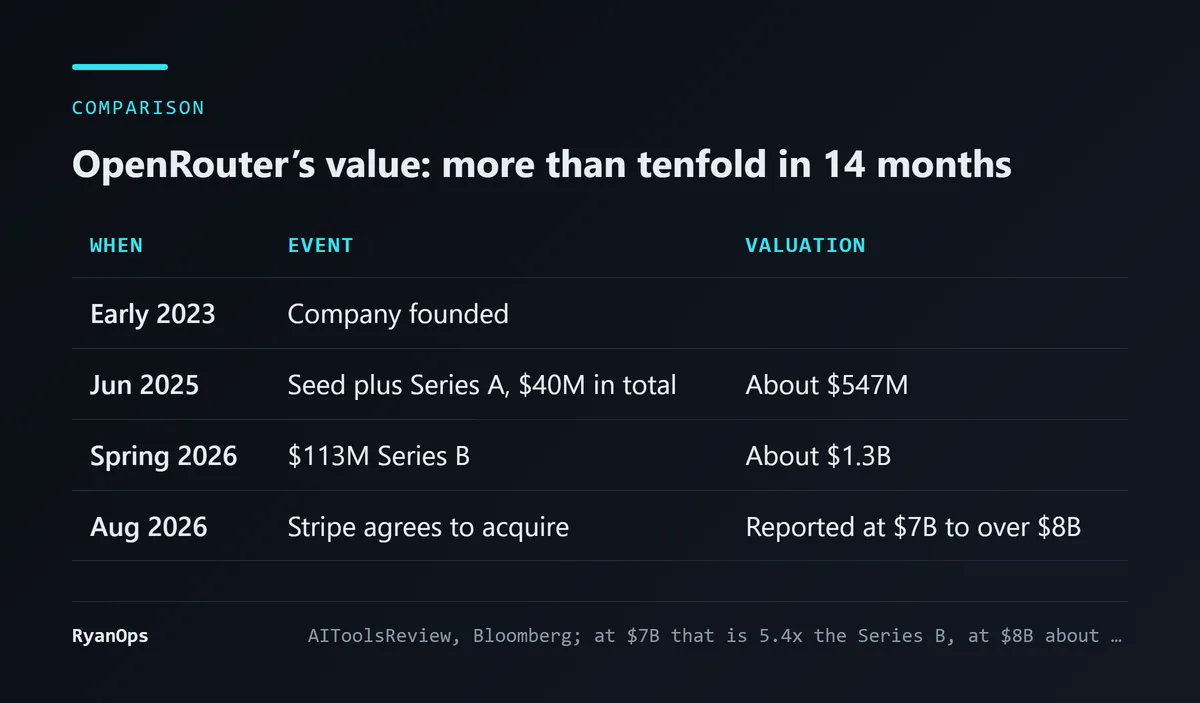 Figure: OpenRouter’s funding and valuation (compiled for this article from AIToolsReview’s summary and Bloomberg’s report)
June 2025: seed plus Series A, $40 million in total, at a valuation of about $547 million. Spring 2026: a $113 million Series B at about $1.3 billion. August 2026: an acquisition price reported at between $7 billion and a little over $8 billion.
At $7 billion that is 5.4 times the Series B. At $8 billion it is 6.2 times. The “value up 5.4x” in my August headline used $7 billion.
Counting from the Series A it is more extreme: 13 to 15 times in 14 months.
There is another way to count. Ninety employees and $7 billion come to $78 million a head.
How does the price compare with other deals in the AI industry? I rewrote two comparable pieces this month. Cursor’s purchase by SpaceX was $60 billion on annualized revenue of about $3 billion, or 20 times. Lovable was $13.3 billion on $500 million, or 27 times.
I found no public figure for OpenRouter’s revenue, so the same multiple cannot be computed. That is the largest information gap in this deal. The next section helps you estimate an order of magnitude.
How does it make money?
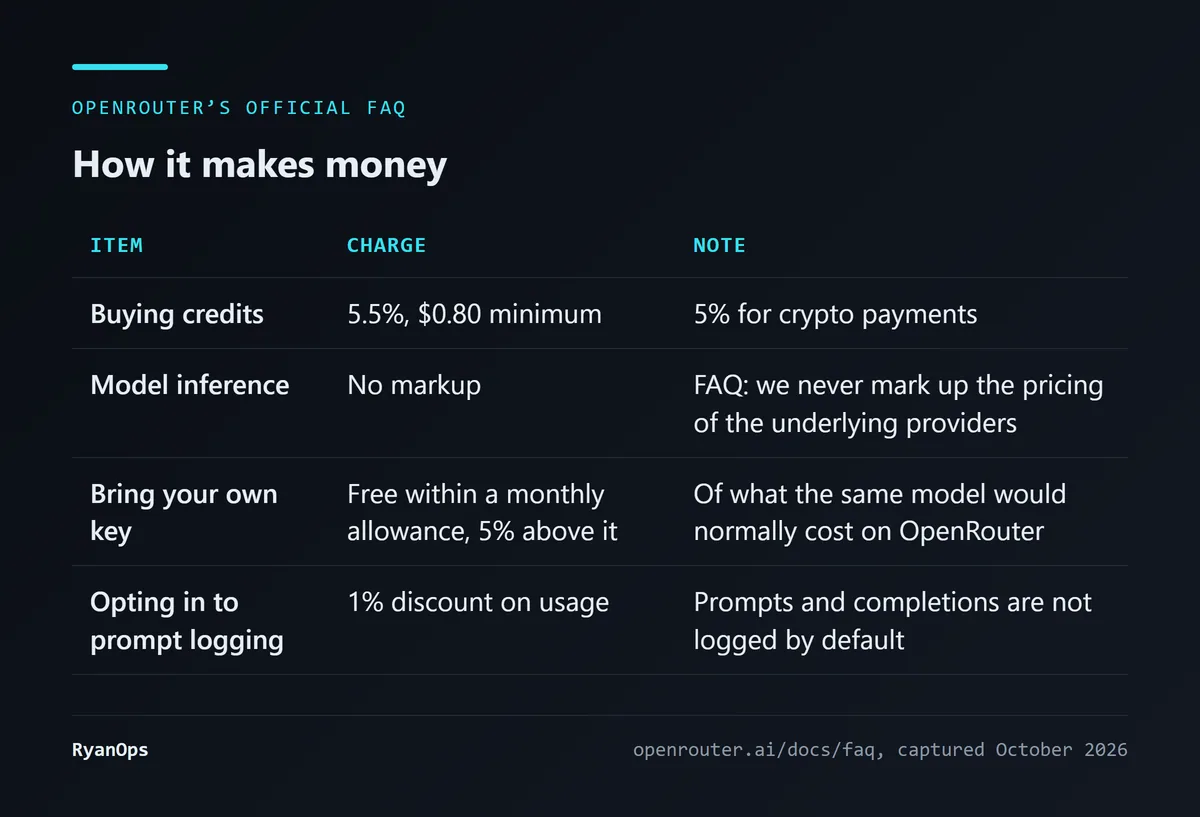 Figure: OpenRouter’s fees (compiled for this article from the official FAQ at openrouter.ai, captured October 2026)
The August piece said nothing about this, so this time I read its FAQ.
OpenRouter does not mark up model prices. The FAQ’s words: “We never mark-up the pricing of the underlying providers.” Using a model through it, you pay the same per-token price as going to the provider directly.
It earns a fee on top-ups. When you buy credits it charges 5.5%, with a $0.80 minimum. Load $100 and the fee is $5.50.
If you bring your own key (BYOK), there is a free monthly allowance, and above it the fee is 5% of what the same model would normally cost on OpenRouter.
So the business model is very simple: take about 5% of every dollar that flows through.
That is why Stripe would want it. Stripe’s core business is processing payments and taking a small slice of each transaction. OpenRouter is in the same kind of business, except that what flows through is tokens and not money. Atallah’s “the AI equivalent of Stripe” is an accurate comparison as far as the business model goes.
The FAQ has one more small detail: when you top up on OpenRouter today with a credit card, the payment already runs through Stripe. The only place the FAQ mentions Stripe is in explaining that credits sometimes arrive late.
Let me try to estimate the order of magnitude, though this is only an arithmetic exercise. Suppose the model spend passing through OpenRouter in a year is X. Its revenue is then about 5% of X. To support a $7 billion price, even at a revenue multiple of 30, revenue would need to be around $230 million, which corresponds to nearly $4.7 billion passing through. I have no basis for these assumptions. The point is only to show the scale the price implies.
What happens to data?
The FAQ says your prompts and completions are not logged by default, not even when an error occurs. You may opt in to logging in exchange for a 1% discount on usage.
I think this design deserves credit. Compare Meta’s Muse Code: its subscriptions turn on “let Meta train on your content” by default, and you have to switch it off yourself. OpenRouter does not log by default, you have to switch logging on yourself, and you get a discount if you do.
OpenRouter’s acquisition announcement does not say whether its data policy will change. I would put that on the list of things to watch. Stripe already holds a large share of the world’s online payment data, and now adds the routing data for 10 trillion tokens a day. It knows which companies use which models, how much, and what they spend. Even without looking at any content, that data is very valuable.
How much is the promise of neutrality worth?
OpenRouter’s announcement spends a good deal of space on what does not change: the mission, the name, the product, the roadmap, and existing integrations, which need no changes.
Then there is one sentence I want to single out. The announcement says OpenRouter will not favor any model, any provider, or any parent company, and that routing decisions are driven by what is best for the user.
The words “or any parent company” are addressed to Stripe as much as to users.
Set this beside Cursor and the difference is plain. Cursor was bought by SpaceX, and SpaceX has its own Grok. Cursor’s acquisition announcement said nothing at all about whether third-party models would stay, and two weeks later OpenAI announced it was leaving.
Stripe has no model of its own. It has no reason to want OpenRouter to steer traffic to any one vendor. What it cares about is the total volume. Structurally, this neutrality is easier to keep than Cursor’s.
But I would not say there is no conflict of interest at all. Stripe has Token Billing, which will certainly be integrated with OpenRouter. If some model providers have deeper partnerships with Stripe, whether routing is affected is something that will only become visible later.
How do I see it?
The August piece concluded that with competition at the model layer white-hot, capital is turning to the layer that “connects models and businesses”, and that this layer is worth more than expected.
I still agree with that direction, and the past two months have added two supporting cases. Cursor at $60 billion and OpenRouter at over $7 billion: in neither case was a model being bought. It was the layer between models and users.
What I want to add is why this layer is valuable. The reason is the sentence in Stripe’s own release: models keep being released and repriced. Among the pieces I rewrote this month, Gemini Flash shipped four versions in three and a half months, and DeepSeek changed its pricing rules four times in six weeks. Nobody can keep chasing that. If a layer does the chasing for you and takes 5%, many people will consider that a fair deal.
What would change my view? If model prices and capabilities stabilize and the gaps between vendors narrow, “which model should I pick” stops being a problem and this layer loses value. The other direction: if the big cloud providers build the same routing into their own platforms without taking a cut, OpenRouter’s 5.5% comes under pressure.
If you are already using OpenRouter, my suggestions:
- Leave existing integrations alone. The announcement is clear on that.
- Watch the fee rate and the data policy. The announcement makes no commitment on either. Today they are 5.5% and no logging by default. If that changes, the changelog or the FAQ will show it first.
- Work out whether 5.5% is worth it to you. If you use models from only one or two vendors, buying directly saves the fee. If you switch models often and need fallback, the fee buys you not having to maintain those integrations yourself. How vendors differ on token pricing is covered in the glossary.
What this rewrite corrected
- The original said Stripe “confirmed” the acquisition on August 16. That day Stripe’s response to the press was no comment. The formal announcement came on August 19.
- The original headline and text treated $7 billion as a settled amount. No amount has been officially disclosed, and press reports run from $7 billion to $10 billion. All of them are listed here.
- The original said the 8 million developers was “a figure disclosed by Stripe”. OpenRouter published it itself in May. The August announcement gives more than 10 million developers and companies.
- The original said the Series B was in May this year, “only 3 months” before the acquisition. What can be found is spring 2026, with outlets differing on the exact month, so no month is fixed here.
- The original did not explain OpenRouter’s fees, its data policy, or the neutrality commitment in its announcement. They are added.


