Meta's Muse Code: 12x-75x Cheaper, Trains on You
Meta's Muse Code sells one model at two prices. The cheap one lets Meta train on your code, and subscriptions now turn that on by default.
On August 5, 2026, Meta released its first AI coding tool, called Muse Code.
The tool itself is not especially unusual. What got it talked about is the pricing: one model at two prices, the cheaper one a small fraction of the other. The condition is that Meta may use the code you send in, and the model’s replies, to train future models.
My August headline said “up to 21x cheaper”. This time I checked Meta’s pricing data. The 21x is the gap on output, and cached input differs by 75x. More important, the subscription plans introduced later set “let Meta train” to on by default. That was not the case in August.
What is Muse Code?
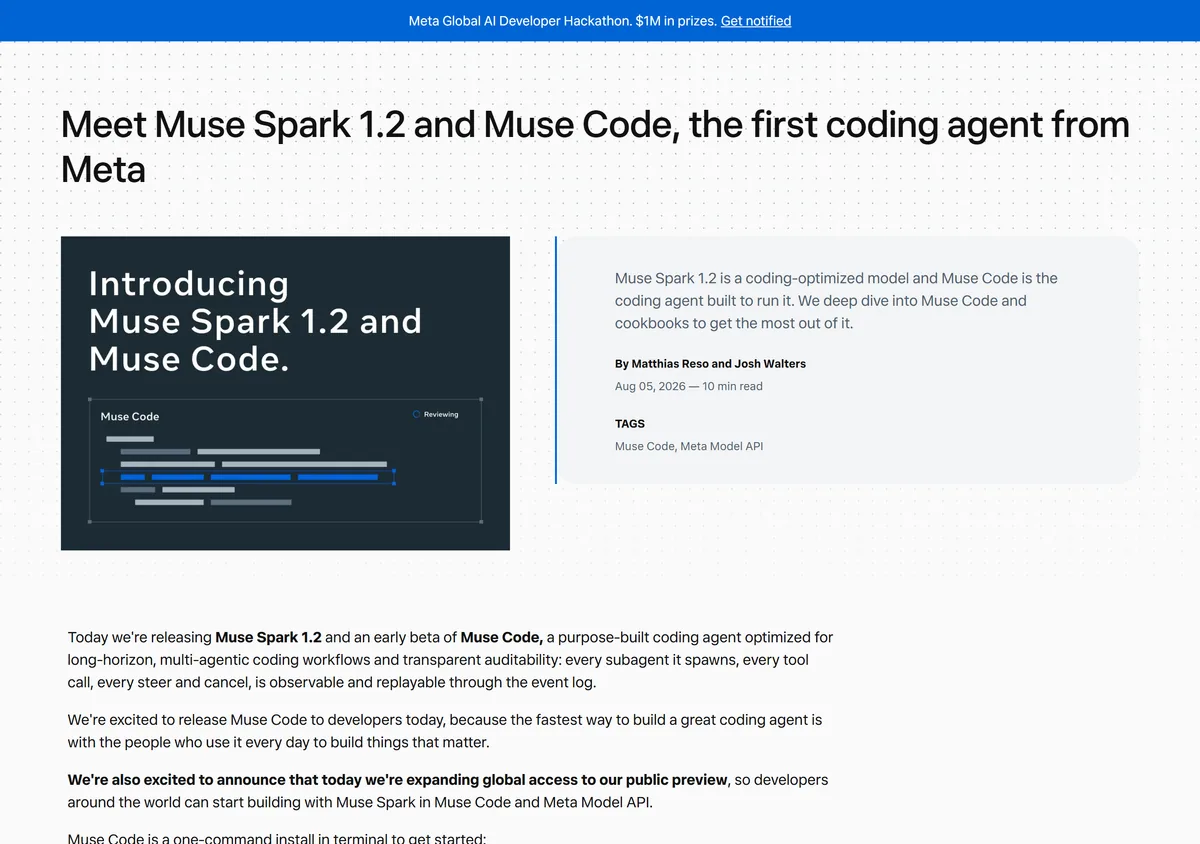 Figure: Meta’s post introducing Muse Spark 1.2 and Muse Code, 2026-08-05 (source: dev.meta.ai)
It is a coding agent that runs in the terminal, used the same way as Claude Code or Codex CLI. You type muse in a project directory, describe in words what you want, and it reads files, edits files and runs commands directly.
Installation is one line:
curl -fsSL https://dev.meta.ai/install.sh | bashAfter that you sign in at dev.meta.ai in a browser and it is ready. Wavect’s write-up notes that it currently supports macOS and Linux, with no native Windows version listed.
The model behind it is Muse Spark 1.2. Meta’s post calls it “a coding-optimized model”, with a 1 million token context, co-trained with the Muse Code harness. The post positions it modestly, in its own words as “a moderate improvement over Muse Spark 1.1”.
The post includes four benchmark charts: Terminal-Bench, DeepSWE, a Meta internal code benchmark and GDPval. But the text gives no scores. My August piece cited 59.3% on DeepSWE and a ranking against several rivals. I cannot confirm those from the text of the official post this time, so I no longer cite them.
How does it differ from the others?
Meta’s post spends most of its length on two things.
Parallel subagents. The parent agent can split up the work and hand each piece to a write-capable child. Each child gets its own git worktree, created automatically under .muse/worktrees/, so they do not step on one another’s files. Children commit to their own branches, and the parent reviews or merges them one at a time. The demo runs six tasks at once on a sample game. The host’s concurrency limit is four, so the fifth and sixth wait in a queue.
The event log. Every action is written as JSONL under ~/.local/share/muse/sessions/. The sentence at the top of the post is that every subagent it spawns, every tool call, every steer and cancel, is observable and replayable through the event log. You can query it with jq, and after a crash muse resume picks up from the last recorded step.
I think both are well designed. When several agents change the same project at once, the worst outcome is not knowing afterwards who changed what. Isolating each agent in its own worktree and keeping a full log is a practical answer.
There are also four built-in commands, each of which takes effect only when invoked by hand:
/plan: reads the real files, names the key decisions with a recommendation for each, saves the plan to.agents/plans/, and stops for your approval. It does not touch code./grilling: asks you one decision-forcing question at a time until the design holds up./grill-with-docs: the same interview, but it writes the settled decisions into the project docs./taste: a checklist of default visual styles to avoid, so generated interfaces look less machine-made.
How far apart are the two prices?
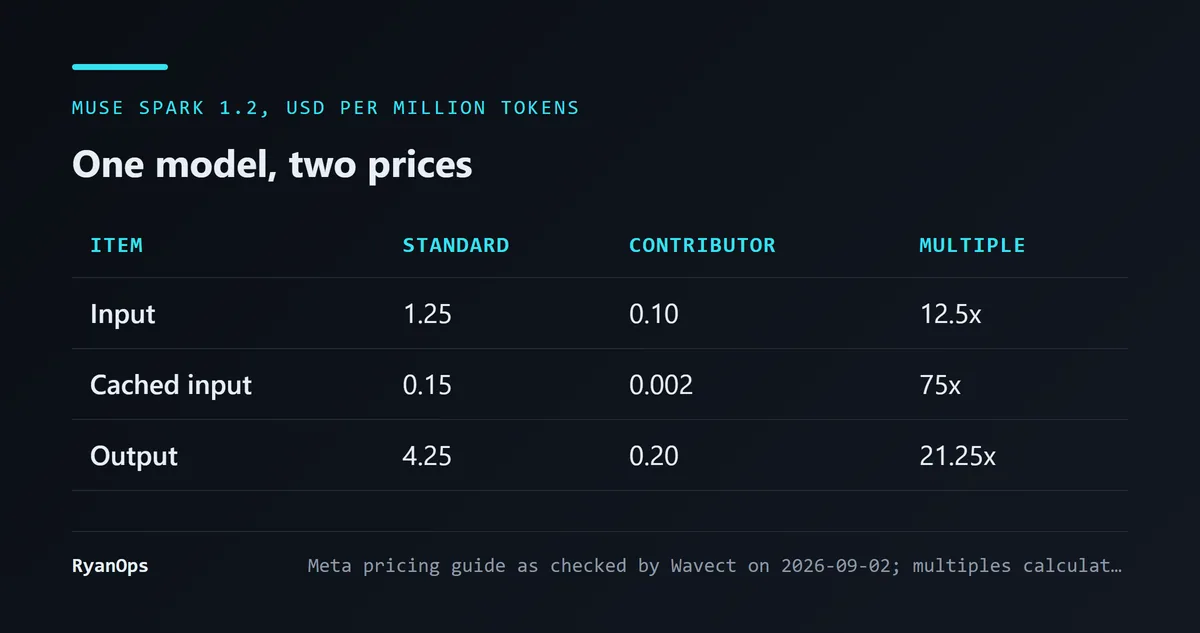 Figure: Standard and Contributor prices for Muse Spark 1.2 (compiled for this article; numbers from Meta’s pricing guide as checked by Wavect on 2026-09-02)
The API has two model IDs: muse-spark-1.2 and muse-spark-1.2-contributor. In Muse Code you switch with /model.
The Standard price is in Meta’s launch post: $1.25 per million input tokens, $0.15 for cached input, $4.25 for output.
The launch post does not give the Contributor price. It says only that this tier is rate-limited “by tokens in a rolling 5-hour window, not by request count”, and is available in select countries. My August piece cited a figure from press coverage. This time I found a write-up by the development consultancy Wavect, whose author checked Meta’s pricing guide on September 2: $0.10 for input, $0.002 for cached input, $0.20 for output.
That works out to 12.5x on input, 21.25x on output and 75x on cached input.
Wavect stresses one point: Contributor is not a smaller model. Both run the same model, and the only difference is how the data is used.
What is that on a monthly bill?
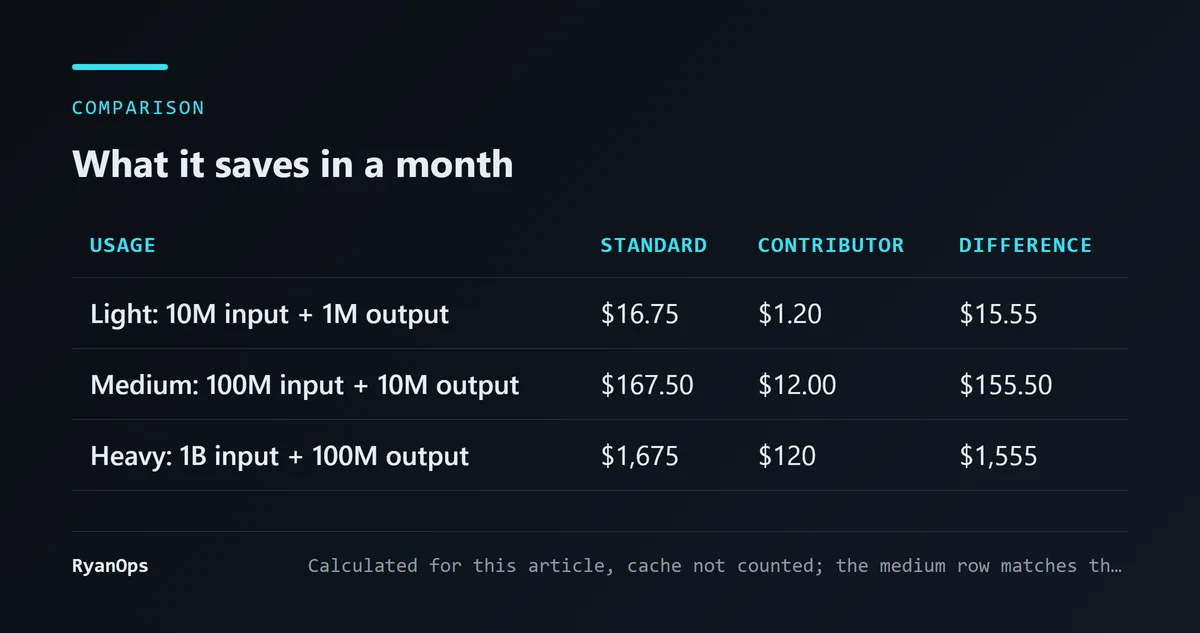 Figure: Monthly bills at the two prices for three levels of usage (calculated for this article, cache not counted)
The multiples are large, but the absolute amount depends on usage.
Light use, 10 million input plus 1 million output tokens a month: $16.75 at Standard and $1.20 at Contributor. The difference is a little over $15.
Medium use, ten times that: $167.50 against $12.00. A difference of about $155.
Heavy use, ten times again: $1,675 against $120. A difference of $1,555.
So if you are an individual developer with modest usage, this choice saves you the price of a meal each month. Whether licensing out your code is worth a meal depends on what code it is.
If you are a team running large numbers of agent tasks every day, saving more than a thousand dollars a month is a real incentive. But a team’s code is usually also the kind that must not leak. The people for whom the price gap is most attractive are exactly the ones who should least choose it.
One detail here. Muse Spark 1.2 is a reasoning model whose thinking tokens are billed as output, and /effort adjusts how long it thinks. So output will be a larger share than you expect, and the 21x cell matters more. The basics of token pricing are in the glossary.
What does Meta take?
The summary of the launch post has one sentence on it: content on the Contributor tier “may be used to improve our products”.
The help page for subscriptions is much clearer:
 Figure: Meta’s help page on Contributor mode, captured October 2026 (source: dev.meta.ai)
What gets used for training is four things plus one: the prompts, code, files and context you send, plus what the model sends back.
Watch the words “files” and “context”. A coding agent does not read only the passage you paste in. It goes and reads other files in the project to understand the situation. Those files count too, including the ones you did not think about: config files, test data, internal URLs in comments.
The first sentence is the most important new fact in this rewrite: Muse Code subscriptions default to Contributor mode.
In August, Contributor was a model ID you had to choose deliberately. Meta now has monthly plans, at $5, $15, $50 and $200 a month according to the help page. Once you subscribe, without doing anything, you are already in Contributor mode. To leave it you have to go into settings and switch it off yourself.
The help page says that after you turn it off, your “future content” is not used for training. It does not say what happens to what has already been sent.
The other way out is Zero Data Retention. Accounts with it enabled cannot use Contributor mode. The launch post says Meta is beginning to accept requests for zero data retention, through its sales team.
Why is code worth buying this way?
One explanation in the August piece still holds, I think: code is especially good training material because right and wrong can be verified. Whether a program compiles and whether the tests pass is known at once. For other kinds of work, feedback takes a long time or never arrives.
A coding agent’s sessions are worth more than plain code. They record a whole process: how a person describes a need, how the model breaks it down, where it goes wrong, how the person corrects it, and which version is finally accepted. Data like that cannot be bought. It can only be collected from real use.
Meta entered this market later than Anthropic and OpenAI. By its own account its model is only a moderate improvement. From that position, trading price for data is a strategy that makes sense.
The August piece quoted a comment to the effect that Meta is offering to buy your source code and paying in compute credits. I find the comparison apt, but I could not open the original source this time and cannot confirm who said it, so I offer it only as one way of putting it.
Which code can go on the cheap tier?
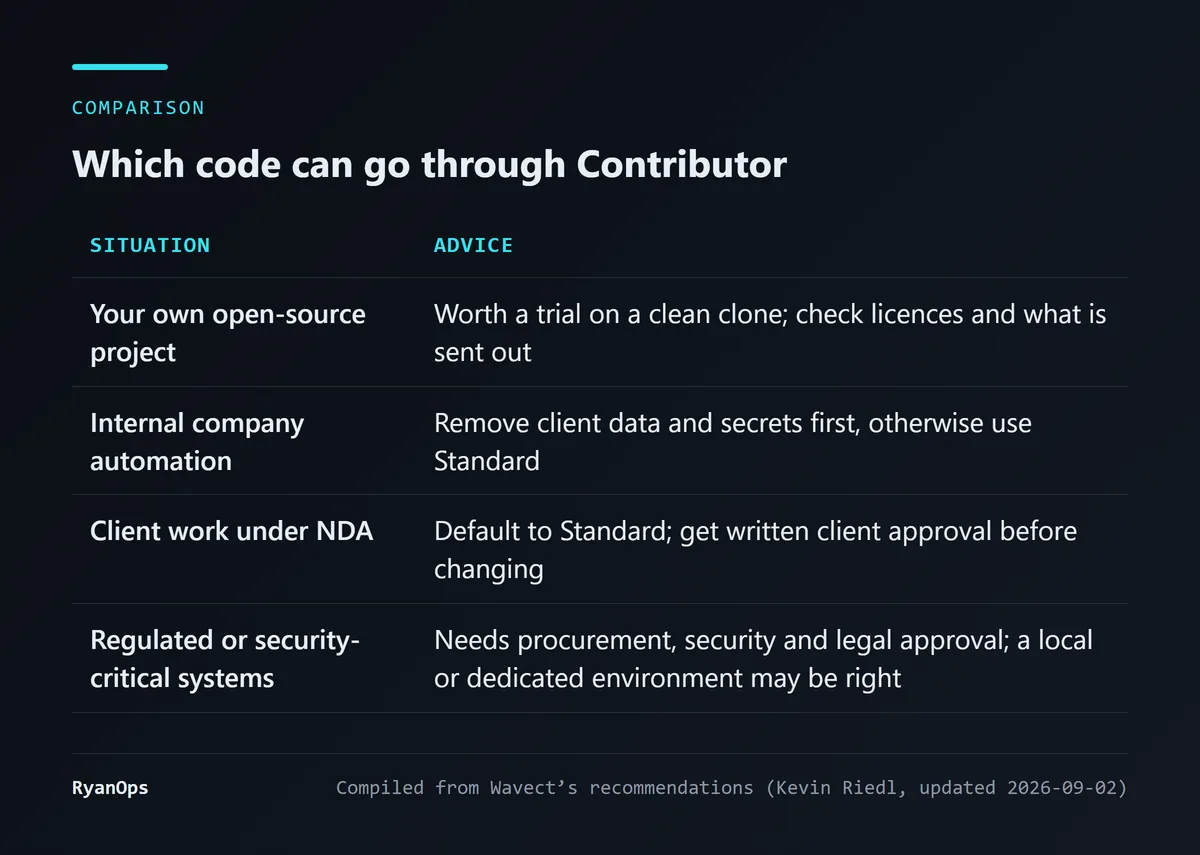 Figure: Which tier to use in four situations (compiled from Wavect’s recommendations by Kevin Riedl, updated 2026-09-02)
One line in the Wavect piece is worth quoting directly: “An NDA is not consent.”
That is, signing a confidentiality agreement with a client means you have a duty to keep things confidential. It does not mean the client agrees to your handing its code to a third party for model training. Those are two separate matters. Even if you personally see no harm, the rights to that code are not yours to grant.
According to other outlets, Meta’s API terms themselves bar sending Contributor models sensitive, confidential or personal information, or code you are required to keep confidential. In other words, if something goes wrong, the party in breach of the terms is you. I have not read the original wording of that clause, so please check it yourself.
My own test is simpler and comes down to one question: if this whole repo were made public tomorrow, would anyone be hurt?
- No: use Contributor. Projects that are already open source, practice projects and small personal tools all belong here. Open-source code has quite likely been in everyone’s training data for a long time already.
- Yes, or not sure: use Standard, or use a different tool altogether.
How do I see it?
I think Meta’s pricing is an honest trade in itself. The problem lies in the default that came later.
The August design was two model IDs, with “contributor” plainly in the name, the price gap in the open, and the choice yours. There is nothing to criticize in a trade like that. If someone is willing to exchange data for a discount, that is their decision.
Subscriptions changed this. On by default means most people will not change it. A user paying $15 a month may well have no idea that they are also paying a second kind of fee. And what they are paying with may not be theirs. It may belong to their employer or their client.
Other vendors handle data in their own ways, and you should look at the settings page of the tool you actually use. My advice on this is the same for every tool: the first thing to do after installing is to find the data-use switch.
What would change my view? If Meta switches the subscription default to off, or adds an explicit choice screen to the subscription flow, we are back to the honest trade of August. Conversely, if a concrete case later emerges of company code leaking through this channel, the cost of the default will no longer be theoretical.
One more change to mention. Wavect’s write-up says Meta began rolling out Muse Spark 1.3 on September 2. The prices here are for 1.2, and you will need to check the new model’s prices and terms yourself. How quota is granted and adjusted is changing at every vendor, and I went through OpenAI’s approach in the piece on Codex resets.
What this rewrite corrected
- The original headline said up to 21x cheaper. That is the gap on output. According to Meta’s pricing guide, cached input differs by 75x, and all three are listed here.
- The original did not mention that subscriptions default to Contributor mode. That change came after launch. It is added here with a screenshot of the help page.
- The original said Mark Zuckerberg announced it personally. This time I confirmed only the Meta developer blog post, written by two engineering staff, and removed the claim.
- The original said Muse Spark 1.2 scored 59.3% on DeepSWE and gave a ranking against other models. The text of the official post gives no scores and I could not confirm them, so they are removed.
- The original’s last paragraph cited Meta’s second-quarter revenue, free cash flow and capital expenditure. I did not re-verify these this time and removed them.
- The original attributed the Contributor price to a single press report. This version cites a write-up checked against Meta’s pricing guide and adds the cached price.


