OpenAI's September IPO Never Came: After -122%
Reports in August had OpenAI listing in September. It did not. A negative 122% quarter, leaked audited accounts and OpenAI's own notice, in order.
The first paragraph of this piece in August said OpenAI had confidentially filed to go public on May 22, was aiming to list in September, and was looking at a valuation of up to $1 trillion.
September is over. OpenAI did not list, and not even a public prospectus has appeared.
So this rewrite has two jobs. The first is to look again at the “loses $1.22 for every $1 earned” figure, because audited accounts that leaked later give a fuller picture. The second is to explain why September did not happen.
The conclusion first: the 1.22 figure was really reported, but it is an adjusted number, and the true operating loss ratio is higher. As for a September listing, OpenAI itself never committed to one.
Where did negative 122% come from?
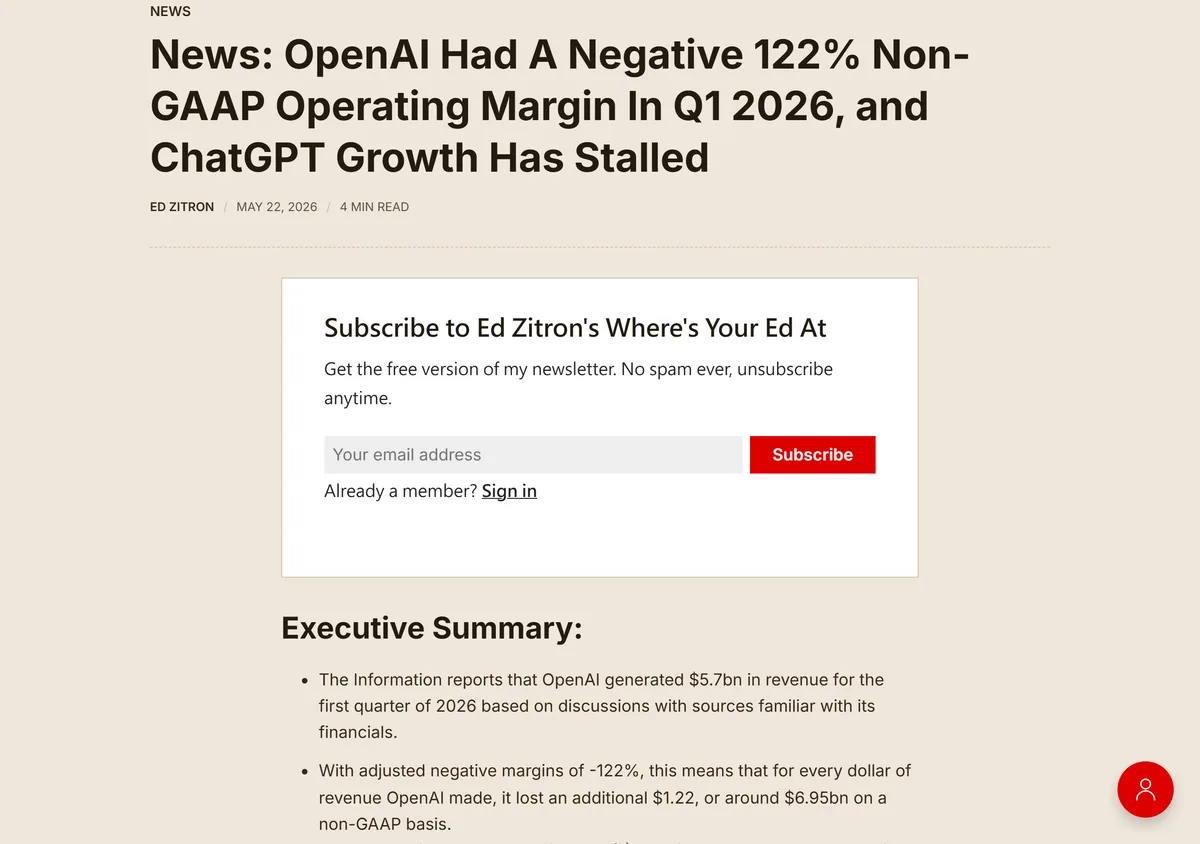 Figure: The opening of Ed Zitron’s article, 2026-05-22 (source: wheresyoured.at)
The source for this piece is a short commentary that tech critic Ed Zitron published on May 22. The numbers themselves come from a report by The Information, based on “sources familiar with its financials”.
There are three main points.
- Revenue for the first quarter of 2026 was $5.7 billion.
- The adjusted operating margin was negative 122%.
- Zitron did the arithmetic himself: $5.7 billion times 1.22 is a loss of about $6.95 billion.
Note the third point. The $6.95 billion is not a reported figure. It is derived. My August piece wrote that “the loss for the quarter reached $6.95 billion”, which was too definite.
Then there is the question of basis. The negative 122% is an adjusted, non-GAAP number. Zitron points out that adjusted figures exclude some large items, and the example he gives is stock-based compensation. The report does not make clear whether the cost of training models is included.
In other words, 1.22 is a floor. Under formal accounting standards the number can only look worse.
What do the audited numbers look like?
A little over three weeks later, a fuller answer arrived.
Around June 16, OpenAI’s audited financial statements for 2025 leaked. According to Techstrong.ai, Zitron obtained the documents and the Financial Times verified them.
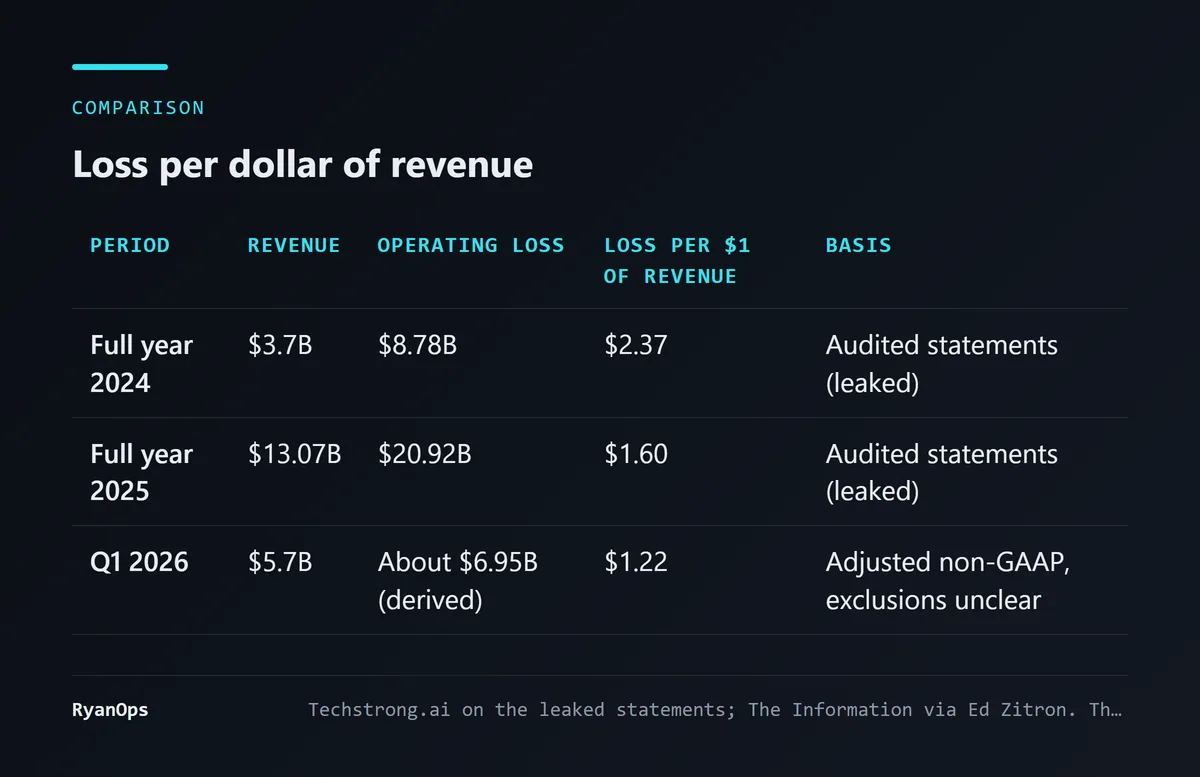 Figure: OpenAI’s operating loss per dollar of revenue in three periods (compiled for this article from Techstrong.ai’s account of the leaked statements and The Information’s report; the third row uses a different basis)
For the full year 2025, revenue was $13.07 billion, 253% more than the $3.7 billion of the year before. The loss from operations was $20.92 billion, against $8.78 billion the year before.
On one yardstick: in 2024 it lost $2.37 for every $1 earned, and in 2025 it lost $1.60.
The part of this table most easily misread is the third row. Lined up as 2.37, 1.60 and 1.22, the numbers look like a steady improvement. But the first two are audited operating losses and the third is an adjusted figure with unknown exclusions. They cannot be joined into one line.
All I can be sure of is the change between the first two: the loss as a share of revenue did fall, but the absolute loss went from $8.8 billion to $20.9 billion, more than double.
The net loss is larger still, about $39 billion. It includes a very large non-cash accounting charge related to the company’s conversion from a non-profit structure to a for-profit one, which various reports put at between $30 billion and $41.6 billion. That money was not really paid out, so I find the operating loss more meaningful.
Where did the money go?
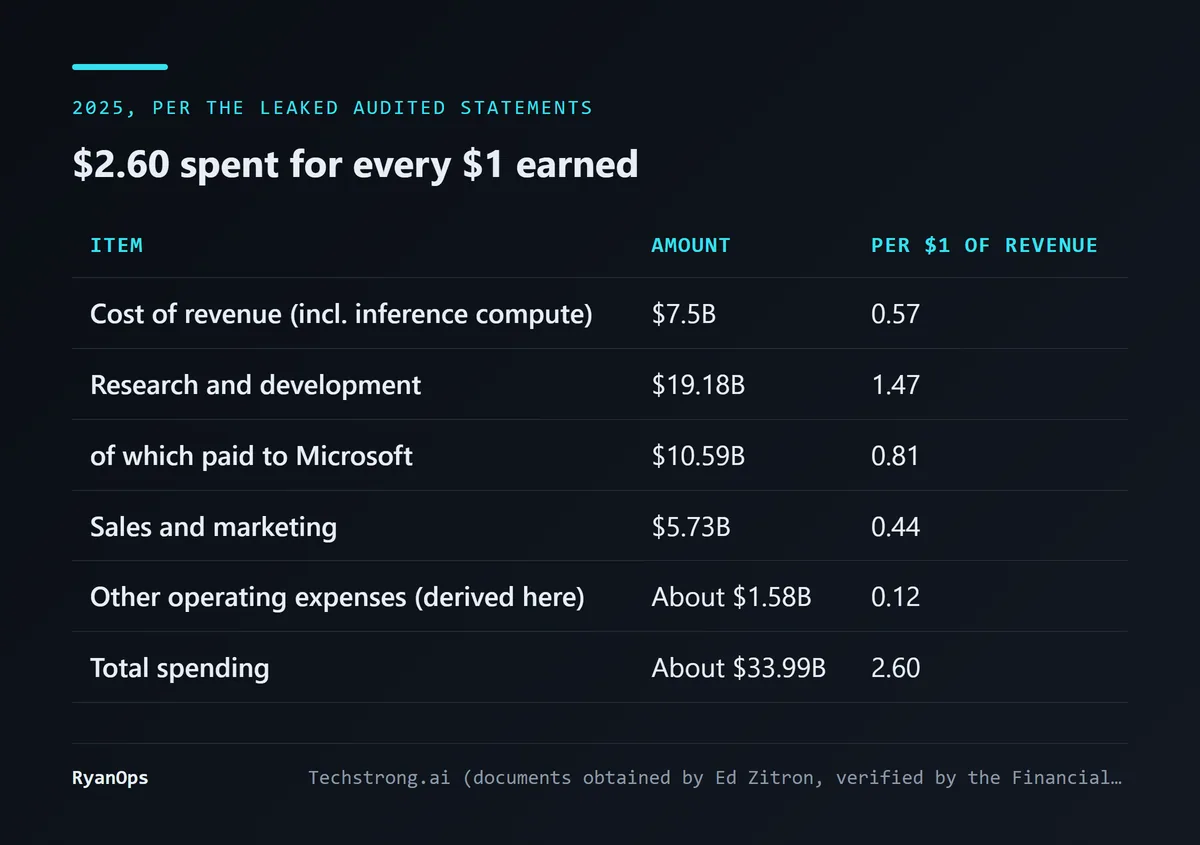 Figure: OpenAI’s spending for every dollar earned in 2025 (calculated for this article; amounts from Techstrong.ai’s account of the leaked audited statements)
I divided the main lines of the leaked statements by revenue to get this table.
For every $1 earned, OpenAI spent $2.60.
The largest block is research and development, at $1.47. That one line exceeds revenue. Of it, $0.81 went to Microsoft, an amount of $10.59 billion. The reports do not break that payment down, but OpenAI trains its models mainly on Microsoft’s cloud, so most of it is presumably compute.
The second block is cost of revenue, at $0.57. It includes the inference computing behind every question a user asks. This means the act of providing the service has a positive gross margin: $1 comes in, and serving it costs $0.57.
The third block is sales and marketing, at $0.44. The amount jumped from $1.11 billion the year before to $5.73 billion, a fivefold rise.
Taking the three together, my reading is this: OpenAI loses money mainly because it is spending more than its revenue on training the next generation of models, and not because every answer loses money. That spending is a choice. The problem is that without it, the next generation of models falls behind.
The cash actually burned is less than the book loss. Techstrong.ai quotes people familiar with the matter as saying that after excluding non-cash charges, stock-based compensation and computing credits from Microsoft, about $8 billion in cash went out in 2025. In the first quarter of 2026, it burned $3.7 billion against revenue of $5.7 billion.
Are users still growing?
The other half of Zitron’s article is about this.
The figures he cites: ChatGPT’s weekly active users were 920 million in February, and the average for the whole first quarter was 905 million. A quarterly average below February means January or March was lower. OpenAI had originally expected to reach 1 billion in 2025.
On paying users, the reported figure for the end of the first quarter is 55 million, up from 47 million at the end of 2025. Zitron divides 55 million by 905 million to get a paying share of about 6%. He says himself that this is probably an overestimate, since monthly active users would make a larger denominator.
I have two caveats to add.
First, “growth has stalled” is Zitron’s reading, and his stance on OpenAI has long been highly critical. The 920 million and 905 million figures are on different bases, a single month against a quarterly average, and differ by 1.6%. I would say growth has clearly slowed, but these two numbers alone are not enough evidence that it has turned down.
Second, paying users rose by 8 million in one quarter, or 17%. That is not a bad number. Zitron mentions that OpenAI launched an ad-supported Go plan at $5 to $8 a month, which may have lifted the paying share. I wrote about another case of how usage limits shape willingness to pay in the piece on the $200 plan being withdrawn and brought back.
What does OpenAI itself say about going public?
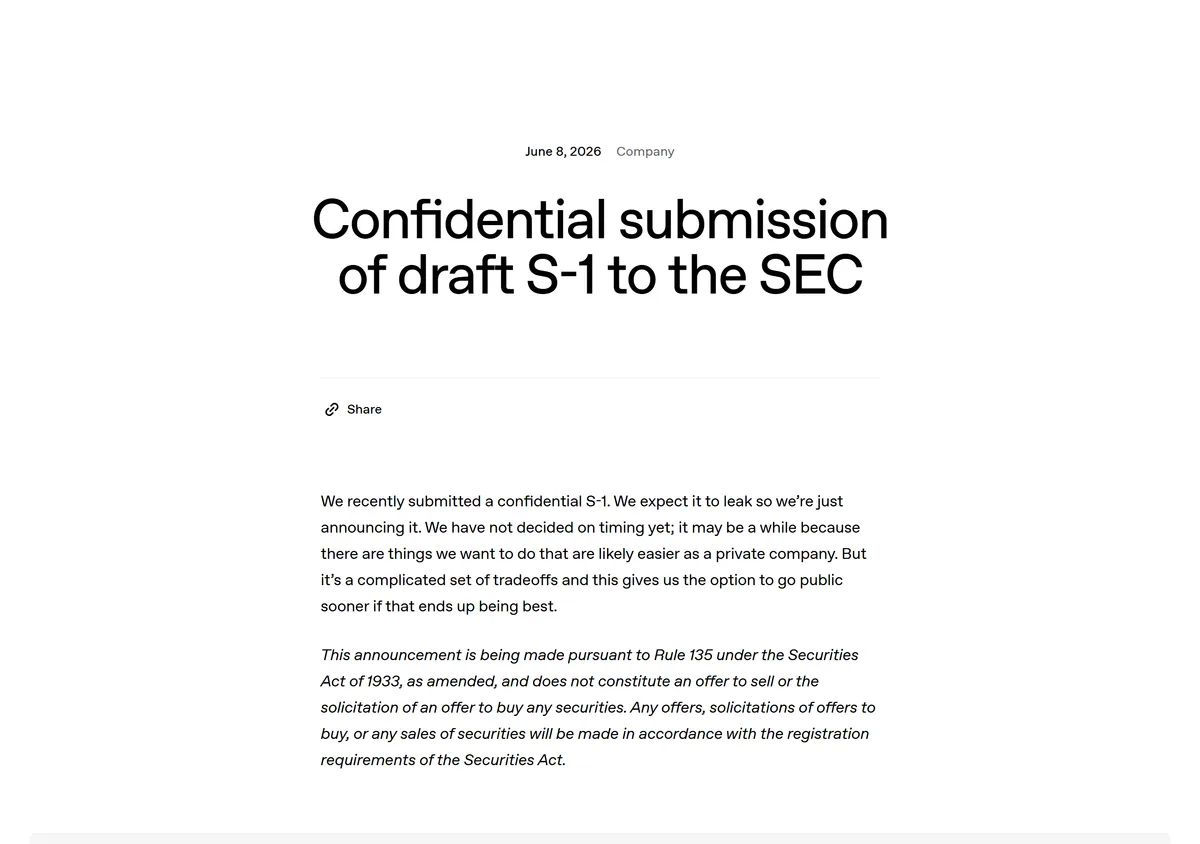 Figure: OpenAI’s notice on the confidential submission of a draft S-1, 2026-06-08 (source: openai.com; image taken from a Wayback Machine capture)
The notice is only two paragraphs long, and I think it is the primary document most worth reading in this whole affair.
The first paragraph says: “We recently submitted a confidential S-1. We expect it to leak so we’re just announcing it. We have not decided on timing yet; it may be a while because there are things we want to do that are likely easier as a private company. But it’s a complicated set of tradeoffs and this gives us the option to go public sooner if that ends up being best.”
“We expect it to leak so we’re just announcing it” is quite blunt for a company on its way to a listing.
Set against my August piece, two things need correcting.
The date. The August piece said the filing was made on May 22 and that several outlets confirmed it. What Zitron’s article says is that The Wall Street Journal reported OpenAI planned to file “as soon as” May 22. OpenAI’s own notice is dated June 8 and says only “recently”. There is no public record of the actual day.
A September listing. That was a timeline the press worked out from the standard process. It was not OpenAI’s statement. OpenAI’s notice says it has “not decided on timing yet” and that “it may be a while”.
A confidential submission is a standard SEC mechanism. A company can have the regulator start reviewing its documents without making them public straight away. The rule is that the public registration statement must appear at least 15 days before the roadshow begins. So far, the public version has not appeared.
Why did September become 2027?
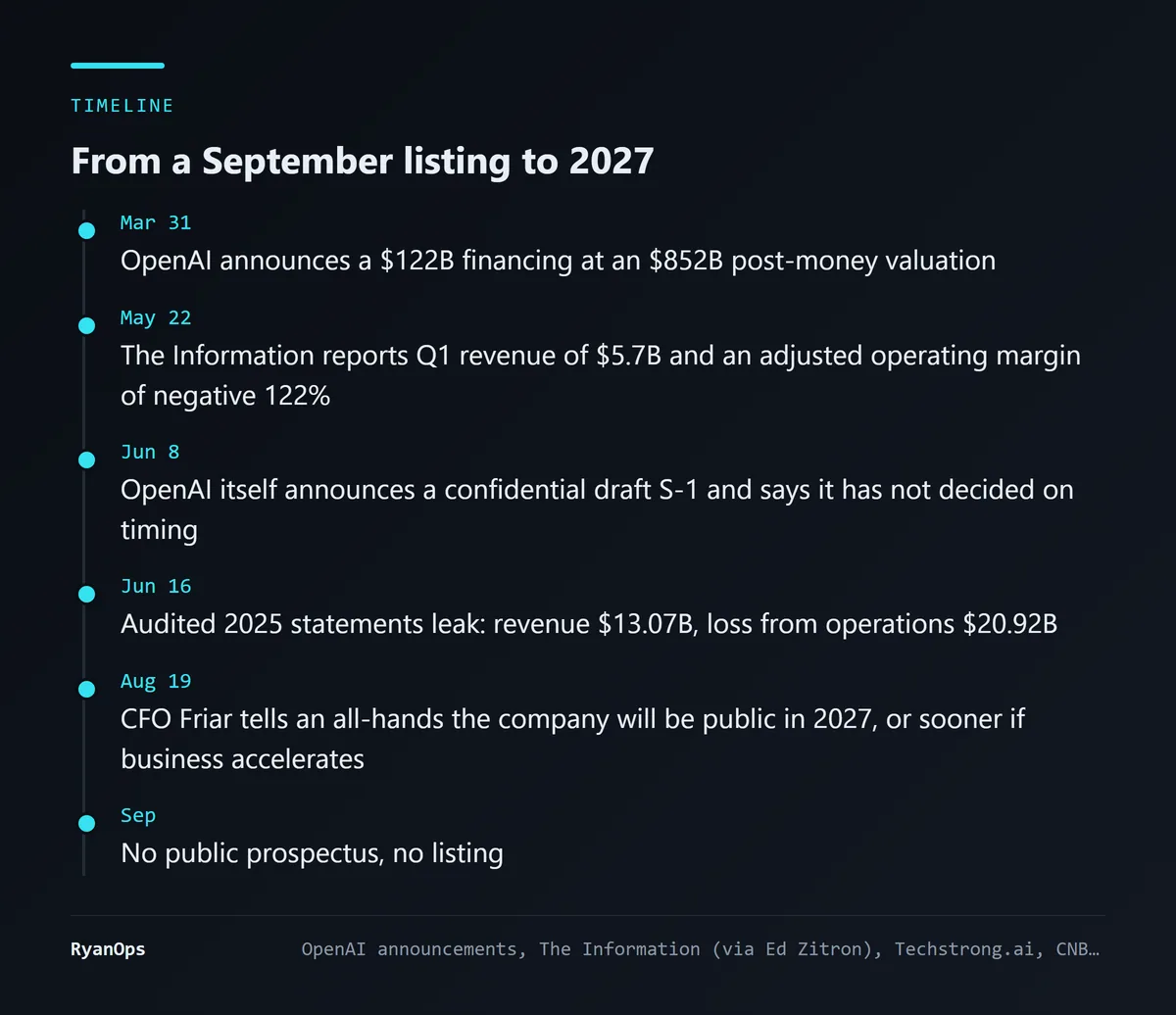 Figure: Key points in OpenAI’s listing timeline (compiled for this article from OpenAI’s announcements, Ed Zitron, Techstrong.ai and AI Weekly’s relay of a CNBC report)
On August 19, CFO Sarah Friar named a time at an all-hands meeting. According to CNBC, which I read through AI Weekly’s summary, she said OpenAI “will be a public company in 2027”, or possibly sooner if the business keeps accelerating.
My August piece was published on August 13. Six days later the timeline had changed.
OpenAI has not explained publicly why it slipped. AI Weekly cites earlier reporting that there were different views inside the company: Friar favored a 2027 listing at a valuation of about $1 trillion, while CEO Sam Altman wanted 2026. I did not find an original source for this, so treat it as hearsay.
My own guess is that the statements leaked in June made a September listing very hard. Once a public prospectus is out, the $20.9 billion operating loss becomes the first question at every roadshow meeting. But that is purely my inference.
Money pressure, on the other hand, is not urgent. On March 31 OpenAI announced a financing of $122 billion in committed capital at an $852 billion post-money valuation. At the first-quarter 2026 rate of $3.7 billion of cash burned per quarter, that money would also last for several years.
So Zitron’s inference at the time, that OpenAI was rushing to list because it had tapped out private investors, does not seem to hold for now. At least the company is not behaving as if it were in a hurry.
Microsoft’s share
The August piece said Microsoft held 26.79% on a fully diluted basis, citing “reports by several outlets on the S-1”. The S-1 has never been public, and I can no longer find a source for a figure that precise.
What can be found is this: when OpenAI completed its recapitalization on October 28, 2025, the ownership was roughly 26% for the OpenAI Foundation, 27% for Microsoft, and 47% for employees and other investors. That was a snapshot at the time. There have been new financings since, and the shares have presumably been diluted.
A rough calculation at $852 billion and 27% gives about $230 billion. Take it only as an order of magnitude.
How do I see it?
I think the headline “loses $1.22 for every $1 earned” was right in direction and wrong in precision.
Right in direction: OpenAI is indeed losing more than its revenue, and the absolute loss is still widening.
Wrong in precision: 1.22 is an adjusted quarterly figure. On audited annual figures, 2025 was 1.60. And most of the money lost went into training, not into serving existing users. Those two kinds of loss mean very different things.
Anthropic’s prospectus leaked at the end of September, and I wrote about it. The two companies are in similar positions: revenue growing extremely fast, losses growing faster, and both treating a listing as a financing tool. The difference is that Anthropic’s document is already out, and OpenAI’s is not.
What would change my view? A public S-1. It would contain quarterly figures prepared under GAAP, and one could see directly whether research and development as a share of revenue has come down. If that ratio falls from 1.47 to below 1 in 2026, the story of “growth diluting the losses” would have numbers behind it. Until then I will treat every statement about when OpenAI turns a profit as a forecast. OpenAI’s own stated target is 2030.
For you, the next time you see “company X loses Y for every dollar it earns”, it is worth asking one more question: on what basis, and is the lost money being spent on today’s customers or on a product that does not exist yet?
What this rewrite corrected
- The original said OpenAI filed on May 22 and that several outlets confirmed it at once. The source article says The Wall Street Journal reported a filing “as soon as” that day. OpenAI announced the submission itself on June 8 without giving the exact date.
- The original said the target was a September listing at up to $1 trillion and named underwriters. None of that was information published by OpenAI, and there was no listing in September. The timeline the CFO gave staff on August 19 is 2027. I did not find a reliable source for the underwriters this time and removed them.
- The original gave $6.95 billion as the loss for the quarter. That is a non-GAAP figure Zitron derived by multiplying revenue by 1.22. This version makes that clear and adds the full-year figures from the audited statements.
- The original said OpenAI’s target of 1 billion weekly active users “was ultimately missed”. The source says only that it had expected to reach it in 2025, and this version keeps to that.
- The original figure of 26.79% for Microsoft’s stake has no traceable source. It is replaced with the “about 27%” that can be found, marked as a snapshot from October 2025.
- The original had a passage about SpaceX also testing a trillion-dollar valuation. I did not re-verify it this time and removed it.


