Tesla's Optimus Line: 46-Day Teardown, Vague Dates
Tesla tore out its Model S and X line for the Optimus robot. Between two earnings reports the start date went from late July to later this year.
Tesla took 46 days to dismantle a car production line. The number is Tesla’s own, and it came with a video.
What the cleared space will build is, in Musk’s words, “the biggest product ever”. But Tesla has never given a single figure for how many of that product it has made.
My August headline said production “is still zero”. Checking again, I found that “zero” was too categorical, and the original also contained several details I cannot trace to a source. The more accurate statement is this: there is no official number, and the official description of the timing became vaguer within three months.
How was that line freed up?
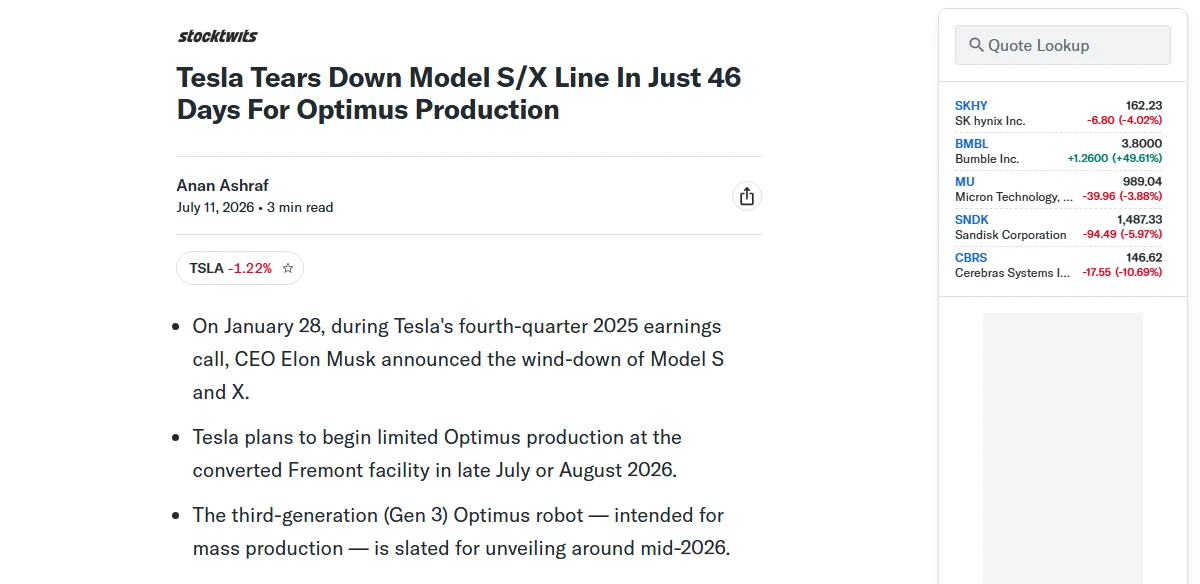 Figure: The StockTwits report as carried by Yahoo Finance, 2026-07-11 (source: finance.yahoo.com)
The sequence went like this.
On January 28, 2026, Tesla held its earnings call for the fourth quarter of 2025. Musk announced the end of the Model S and Model X, saying it was time to bring the two programs to an end “with an honorable discharge”, and tied the decision to the company’s pivot toward an “autonomous future”.
The Model S was introduced in 2012 and the Model X in 2015. According to this report, the two sold about 750,000 units combined, and in recent years production had given way to the cheaper Model Y and Model 3.
The final vehicles left the line in early May. On July 10, Tesla posted a video on X saying the line at its Fremont factory had been fully dismantled in 46 days. The video shows heavy machinery breaking out concrete trenches and removing robotic equipment, and workers tying rebar for new flooring.
The freed space is for Tesla’s first dedicated humanoid robot line. The report says the line is designed for a long-term capacity of up to 1 million units a year.
One million is a design ceiling, which is a different thing from actual output. That distinction comes up again and again below.
How did the start date change?
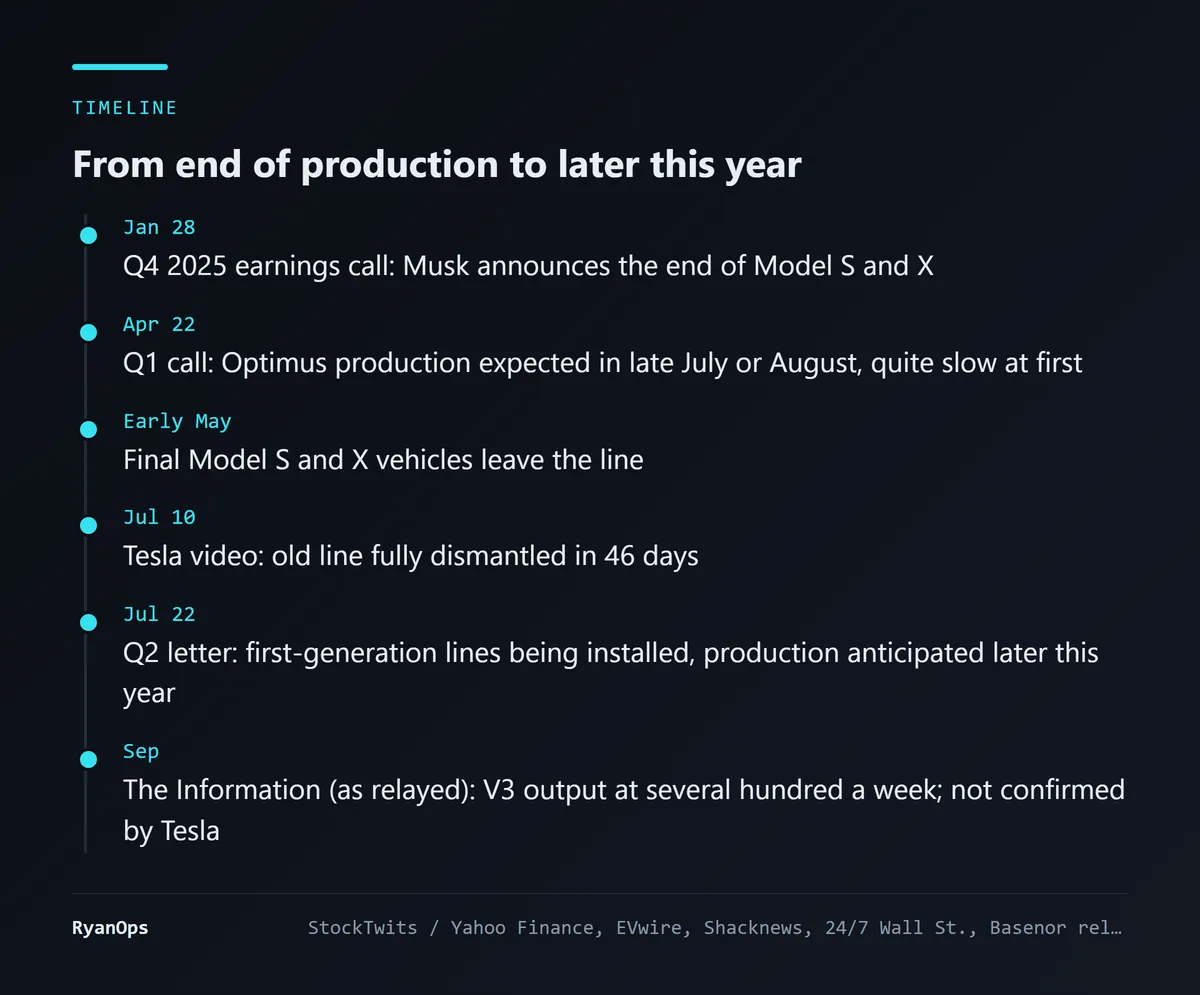 Figure: Timeline from the end of Model S and X to the start of Optimus (compiled for this article from reports by StockTwits, EVwire, Shacknews and 24/7 Wall St., and Basenor’s relay of a report by The Information)
On the first-quarter earnings call on April 22, Musk gave a specific time: Optimus production would begin in late July or August. He also warned that it would be “quite slow” at first.
The second-quarter letter on July 22 reads differently. The sentence EVwire quotes is that the company has decommissioned the Model S and X lines at Fremont and is “installing the first-generation lines for Optimus, where we expect to start production soon”. Another sentence quoted by Shacknews says “anticipated production later this year”. The outlook section says “in anticipation of production in 2026”.
From “late July or August” to “soon”, “later this year” and “in 2026”. No sentence says there is a delay, but the specific month has gone.
TechCrunch noticed another change: the first-quarter letter had language about Optimus reaching “volume production”, and the second-quarter letter dropped it. In the same letter, the statements that Cybercab, Semi and Megapack 3 would reach volume production in 2026 also disappeared.
I should disclose one thing here. I could not open the PDF of Tesla’s letter this time, because it blocked my download. The quotations above all come from secondary reports, and I used them only after comparing the wording in at least two outlets.
What did Musk say on the call?
For the second-quarter call, what I found is Shacknews’ live notes. They are a bullet-point summary, not a verbatim transcript.
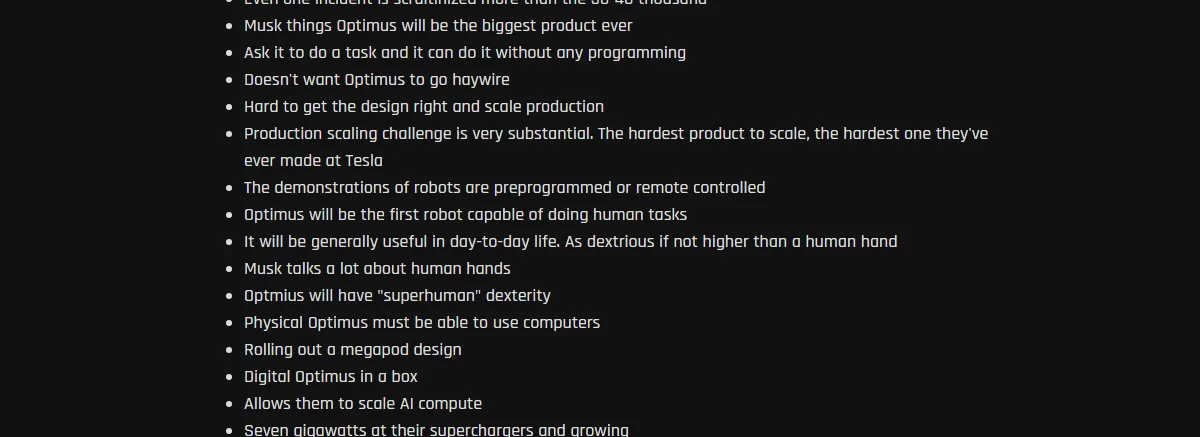 Figure: Shacknews’ notes on the Q2 earnings call, the Optimus passage (source: shacknews.com)
According to these notes, Musk said the following:
- Optimus will be the biggest product ever.
- You ask it to do a task and it can do it without any programming.
- Getting the design right and scaling production are both hard. It is the hardest product to scale, the hardest one Tesla has ever made.
- Its hands should be as dexterous as human hands, if not more.
- Physical Optimus must also be able to use computers.
“Biggest” and “hardest” sit in the same passage. I think this is a rare case of Musk stating both sides.
The more concrete account of where the difficulty lies comes from the April call. According to Electrek and 24/7 Wall St., Musk said the robot has more than 10,000 unique parts and that progress would move as fast as “the least lucky, slowest, dumbest part in the entire 10,000”. There is no established supply chain for humanoid robots, so that is probably the truth.
Who was “demonstrations are remote controlled” about?
The August piece had a passage saying that the Optimus demonstrations seen so far mostly rely on preprogramming or remote control. Its basis was this call.
This time I went back to the notes. The original line is:
The demonstrations of robots are preprogrammed or remote controlled
The next line is:
Optimus will be the first robot capable of doing human tasks
The subject is “robots”, not Optimus. Only then do the notes say that Optimus will be the first robot capable of doing human tasks. Read together, the two lines look more like Musk saying that other companies’ robot demonstrations are prerecorded or remote controlled, and that Optimus will be different.
I have no verbatim transcript and cannot be completely sure. But the August piece wrote it up as Tesla admitting its own demonstrations rely on remote control, and that reading does not hold.
Whether Optimus demonstrations have used remote control is a separate question, and it has been disputed in the past. The notes from this call simply cannot serve as evidence for it.
The notes also contain a line, “Digital Optimus in a box”, followed directly by “Allows them to scale AI compute”. The surrounding lines are about Megapack and Supercharger sites. The August piece read it as a product sold in a box. I can no longer see that meaning in it, so I removed it.
The two reports side by side
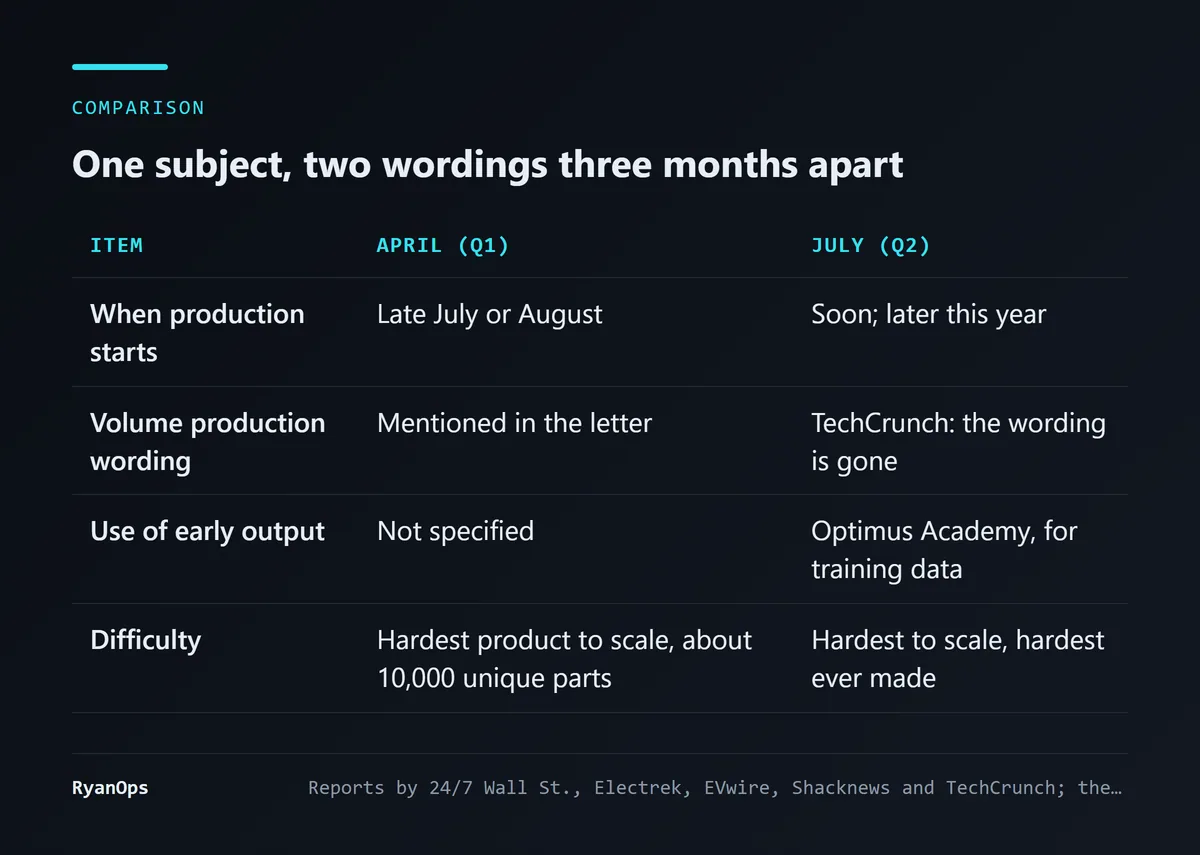 Figure: Two wordings for the same subject in April and July (compiled for this article from reports by 24/7 Wall St., Electrek, EVwire, Shacknews and TechCrunch)
One point added in the second quarter is what the robots are for. The letter says the initial Optimus builds will go to “Optimus Academy” for training data collection and further functionality development.
In other words, even once the line runs, the first batch of robots will not be sold and will not do regular work in a factory. They are going to school.
That matches what Musk said in January. According to the 24/7 Wall St. summary, he acknowledged then that the number of Optimus robots doing useful work at Tesla was zero, and that the robots in its facilities were there mainly to learn and collect data.
So how many have been made?
The official answer is that there is no answer. Tesla has never published Optimus output, a price, or revenue.
Unofficial accounts point in two directions.
Upwards. A report circulated in September saying The Information had learned that weekly V3 output went from a few dozen in the second quarter to several hundred by August, and that Tesla managers want more than 1,000 a week before year-end. What I read is Basenor’s relay. I have not read The Information’s original, and Tesla has not confirmed it.
Downwards. AI2Work cites an Omdia estimate, as reported by AP: fewer than 500 Optimus units shipped in 2025, where Musk had originally spoken of about 10,000 for that year.
How do these two accounts square with the July letter’s “expect to start production soon”? My understanding is that it is a matter of definition. Trial robots have been built all along, and the letter’s “start production” refers to the new line going into regular operation. That is my inference, though.
The August piece included several details: the Gen 3 line opening on July 1, more than 1,000 Gen 3 units operating in the factory since January, and a reply from Musk on X saying production would be very slow at first. I could not find a source for any of the three this time and have removed them.
Where does the money come from?
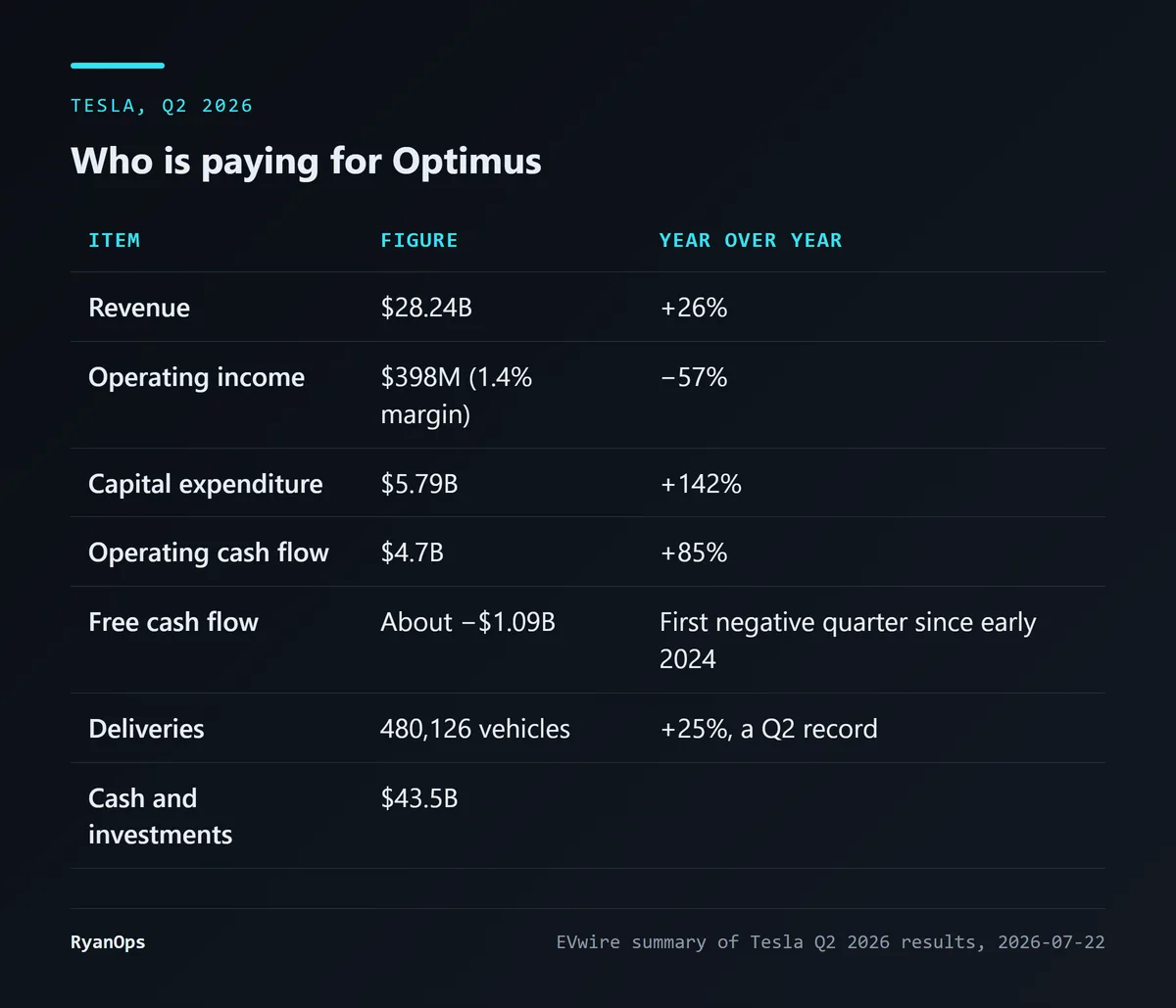 Figure: Selected Tesla figures for Q2 2026 (compiled for this article from EVwire’s summary of the results)
The table can be read in two halves.
The top half is pressure. Revenue grew 26%, yet operating income fell 57% and the margin is down to 1.4%. Capital expenditure was $5.79 billion in one quarter, 2.4 times the same period last year. Free cash flow turned negative for the first time since early 2024.
The bottom half is cushion. Deliveries of 480,000 vehicles are the highest for any second quarter. Operating cash flow was $4.7 billion. There is still $43.5 billion on the books.
One more number needs attention. Of the $1.11 billion GAAP net income, EVwire points out that about $1.0 billion is an unrealized gain on Tesla’s stake in SpaceX. Without it, profit from the core business is much thinner than the headline.
On the April call, the CFO expected 2026 capital expenditure to exceed $25 billion, covering the Fremont Optimus line, the Optimus factory in Texas, Cybercab capacity and a semiconductor research fab. He also said free cash flow would be negative for the following three quarters.
So the situation is that Tesla is using cash earned from selling cars to back several products that have no revenue yet. Optimus is one of them.
Where are the others?
I have only second-hand sources for the numbers in this section, so treat them as indicative.
AI2Work cites Smart Analytics Global: about 19,100 humanoid robots shipped worldwide in the first half of 2026, up 272% from 5,100 a year earlier. Of those, China’s AgiBot accounted for about 8,400 and Unitree for about 5,900.
A summary by Let’s Data Science mentions that Boston Dynamics is shipping its electric Atlas to Hyundai factories, Figure AI has a pilot at BMW, and Agility Robotics’ Digit is commercially deployed at a Toyota warehouse.
If these numbers are roughly right, Tesla is not currently ahead. Its bet is that once the line runs smoothly, carmaker-grade manufacturing will leave the others behind. The logic is sound, but it has not been demonstrated.
There is a larger plan in Texas. According to several reports, a dedicated Optimus factory is under construction at Giga Texas, targeting volume production around summer 2027 and a long-term capacity of 10 million units a year. AI2Work calculates that as about 5.5 times Tesla’s global annual vehicle output.
How do I see it?
I think the 46 days and the figures of 1 million and 10 million are different in kind.
The 46 days already happened. Dismantling a line, digging up a floor and tying rebar are things Tesla is good at, and it can film them.
One million is design capacity and 10 million is a vision. For them to hold, every one of those 10,000 parts needs a supplier who can deliver reliably, and the robot has to do useful work with nobody controlling it remotely. There is no public evidence yet for either.
AI agents have improved quickly in software over the past year, but putting the same ability into a body that must keep its own balance and grip things itself is a problem of another order. I wrote about NVIDIA’s Nemotron 3.5 Lightning; models of that kind run in a data center and never have to worry about falling over.
What would change my view? Simply, a number. If Tesla publishes actual Optimus output in a coming earnings report, or an outside customer says publicly that it has received robots and what work they do, the basis of the discussion changes. Musk says the target for supplying outside buyers is the end of 2027. Until then I will read every capacity figure as a plan.
For you, the next time a headline says “1 million units a year”, three questions are worth asking first. Is this design capacity or actual output? Has the company ever given a number for units built? Are the first units going to be sold, or used for training?
What this rewrite corrected
- The original headline and text said the production number “is zero”. Tesla has published no number, and unofficial reports range from fewer than 500 units (all of 2025) to several hundred a week. This version presents that as it is.
- The original said the call revealed that Optimus demonstrations mostly rely on preprogramming or remote control. By the wording of the notes, Musk was more likely referring to other robots’ demonstrations. The original lines are shown and explained here.
- The original said the Gen 3 line opened on July 1, that more than 1,000 Gen 3 units had been in the factory since January, and quoted a July 1 reply by Musk on X. I found no source for any of them this time and removed them.
- The original attributed “about 10,000 unique parts” to the second-quarter call. The remark comes from the first-quarter call on April 22.
- The original read “Digital Optimus in a box” as a product sold in a box. I cannot support that reading and removed it.
- The original did not mention that about $1.0 billion of GAAP net income came from an unrealized gain on the SpaceX stake. That is added here.


