Nvidia's Nemotron 3.5 Lightning Wins Zero of 14
Nvidia released the open-weight Nemotron 3.5 Lightning on Aug 11. Its model card, read end to end: the pitch, who beats it, and whether your GPU can run it.
In August this article’s headline said “runs on a single GPU, free for commercial use”. Neither half is wrong, and both are missing their second clause.
For this rewrite I went to Hugging Face and read the model card Nvidia itself published, start to finish. My impression afterwards: the model is more honest than the press coverage made it sound, and more ordinary. Nvidia put five rivals on its own results table, and across 14 tests Nemotron 3.5 Lightning doesn’t take first place in a single one.
That doesn’t make it useless. Scores were never its selling point.
What is it?
Nemotron 3.5 Lightning was released on August 11, 2026, on Hugging Face and on Nvidia’s own platform. The specs on the model card:
- 30 billion total parameters, with 3 billion active per inference. That’s a property of the mixture-of-experts (MoE) architecture: the model is large, but each token engages only a small part of it.
- The architecture is a hybrid, interleaving Mamba-2 layers with MoE layers plus some attention layers.
- Context length is up to 1 million tokens.
- The license is the OpenMDW License Agreement 1.1, and the card states it is ready for commercial use.
IBTimes’ report at the time relayed Nvidia’s description: a “lightweight” model that companies can download, modify and use without paying Nvidia or asking permission, built particularly for AI agents. The report also says CrowdStrike, CodeRabbit and Harvey have tested and customized it.
One point of wording deserves care. The August headline said “open source”, and the more precise term is “open weight”: the weights can be downloaded and used commercially, under OpenMDW. That isn’t the same thing as an open-source software license in the traditional sense; if you want the distinction, see the open-weight entry in the glossary.
Why is Jensen Huang giving a model away?
Because what he sells is chips. He’s entirely unguarded about it:
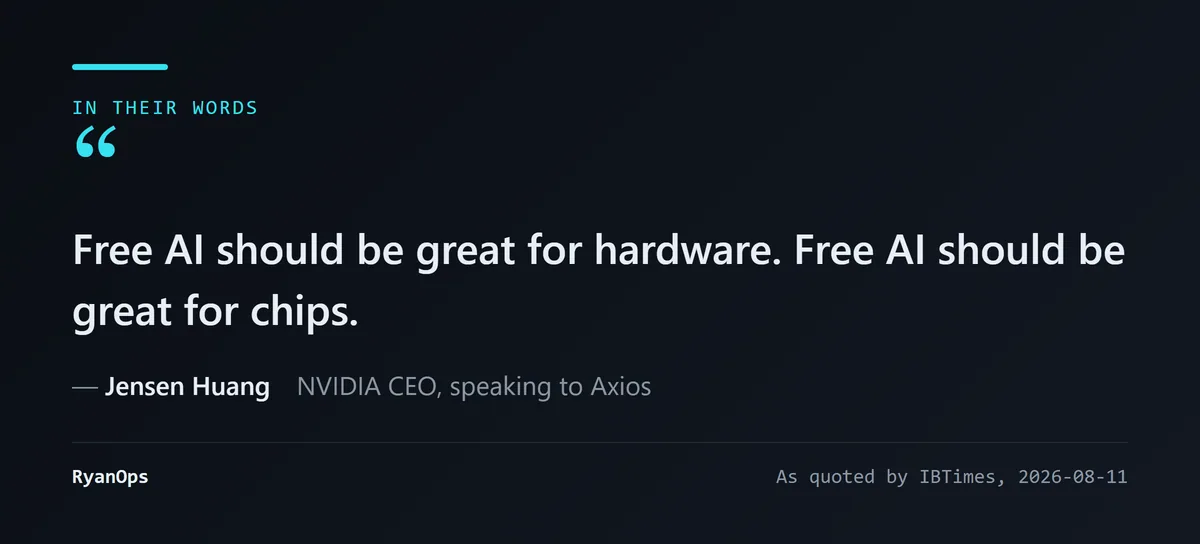 Figure: Jensen Huang on “free AI” (said to Axios, as quoted in IBTimes’ report of 2026-08-11)
The logic is direct. A free model gets more users; more users means more machines running models; and what’s inside those machines is his GPUs.
There’s context in the timing too. On July 24, Huang made his first post on X, sharing an industry open letter urging policymakers to preserve access to open models and avoid premature restrictions. In the post he wrote that open models “strengthen safety and cybersecurity, accelerate innovation and diffusion, and enable sovereignty”. A little over two weeks later this model came out.
The August article also said the letter’s signatories “grew from 25 to more than 150”. I couldn’t find that pair of numbers in the sources this time, and it’s been removed.
The shape of this business is easier to see in someone else. River AI, which announced a $1.1 billion round the same day, sells exactly the service of helping enterprises fine-tune open-weight models; the base model in its official code sample sits under nvidia/, and Nvidia is one of its investors. A month later Nvidia announced it was acquiring Hugging Face, buying the place where the models live. Giving a model away is only one step.
What does the official results table say?
This is the table on the model card I think is most worth looking at. Here it is directly:
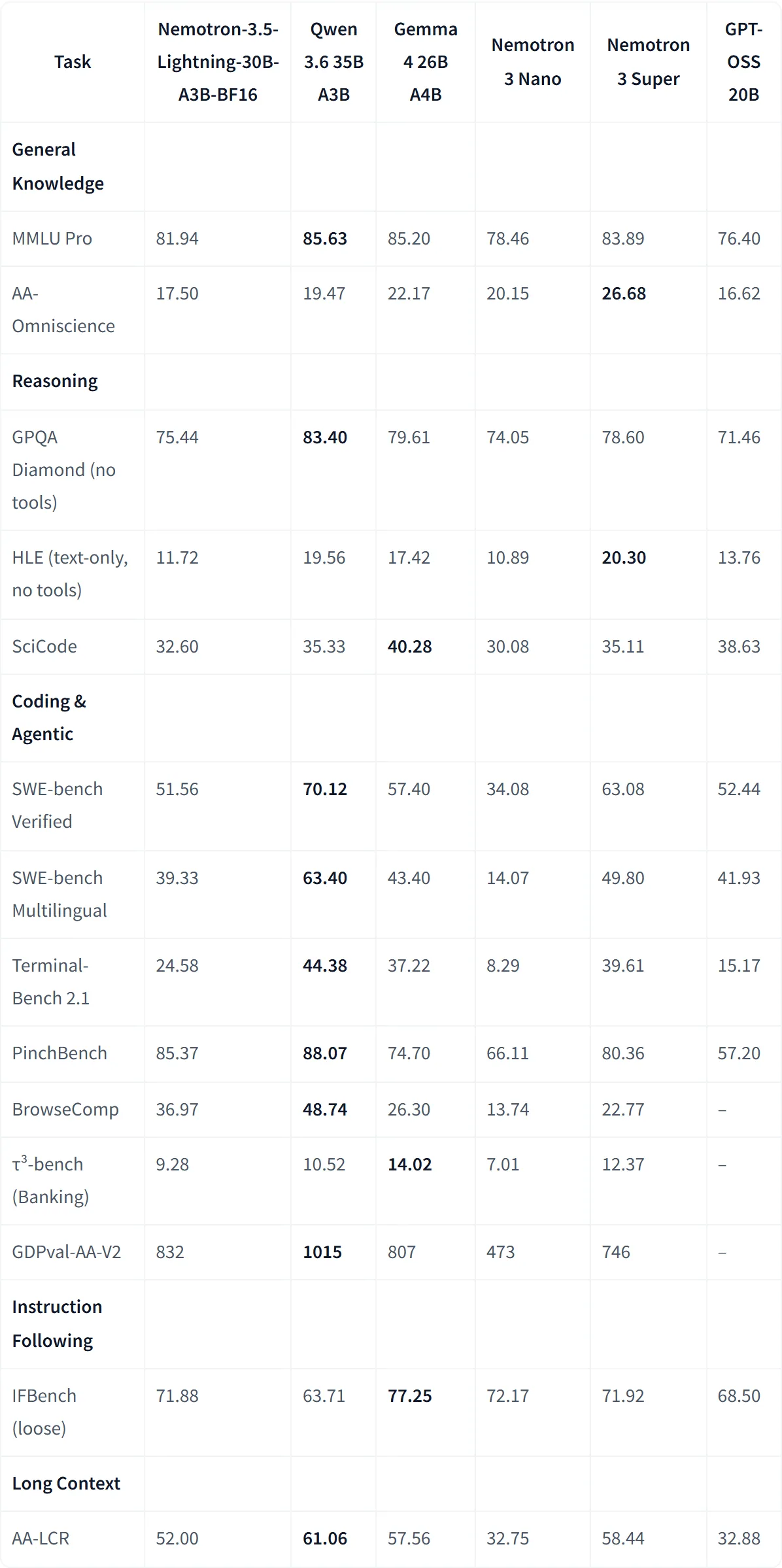 Figure: the evaluation table on the Nemotron 3.5 Lightning model card, best score per row in bold (source: huggingface.co)
Bold marks the best score in each row. I counted:
- Qwen 3.6 35B A3B takes 9 firsts.
- Gemma 4 26B A4B takes 3.
- Nvidia’s own larger Nemotron 3 Super takes 2.
- Nemotron 3.5 Lightning takes 0.
The gaps are widest in coding and agentic tasks. On SWE-bench Verified, Lightning scores 51.56 and Qwen 70.12. On Terminal-Bench 2.1 it’s 24.58 against 44.38. That happens to be the area Nvidia says this model was “built particularly for”.
But there’s another way to read the table, and I think it’s the fairer one.
Set it against Nvidia’s own previous small model, Nemotron 3 Nano, and the progress is plain. SWE-bench Verified goes from 34.08 to 51.56, Terminal-Bench from 8.29 to 24.58, BrowseComp from 13.74 to 36.97. Against OpenAI’s GPT-OSS 20B it trades wins and losses. It also beats Gemma 4 on PinchBench, BrowseComp and GDPval.
The card itself notes two things. These scores were measured by Nvidia under its own harness and may differ from the numbers each vendor reports. And this release (BF16, full precision) is meant mainly as a starting point for further training and customization, not primarily for direct production inference.
The point I’d make is a different one: a company putting a results table it loses on its own model card, untouched, is uncommon in this industry. Most press releases mention only the wins. On that basis alone, I trust the other numbers on this table more.
Then what exactly is the pitch?
Speed and efficiency, at least that’s how Nvidia positions it.
Unfortunately it’s also the part I could confirm least. The August article gave three numbers: output up to 4 times faster than comparable models, tasks completed about 30% faster, and cost cut to a third when paired with Anthropic’s Opus 4.8. I found none of the three this time, in IBTimes’ report or on either model card. They may come from Nvidia’s launch post, but I can’t confirm that, so all of them are gone. The original also said it was distilled from “Nemotron 3 Ultra”, a name that doesn’t appear on the model card. The card says post-training data was distilled from several models, gives GPT-OSS-120B as the example, and lists DeepSeek, Qwen, Kimi, GLM and others in its dataset tables.
The only speed-related statement I could read on the card is a design target: 40 or more tokens per second per user for interactive use on an H100 at concurrency up to 128. That’s a target, not a measurement.
Alongside the model, Nvidia announced NeMo Switchyard, routing software that picks the most appropriate and cost-effective model for each task. That’s probably the full story it wants to tell: hand simple work to a cheap small model and send only the hard work to an expensive large one. Lightning is the cheap option. I think the logic holds, but its payoff depends on how accurate the routing is, and I have no data on that.
Can your GPU run it?
This is the question most people care about, and the one the August article was vaguest on. The original said “a single consumer GPU (laptop or desktop class)”. IBTimes’ report does say it’s designed to run on a single GPU in a personal computer. The model card’s wording is far more precise, and far stricter.
Start with the official single-GPU configurations. The full-precision release lists one H100 80GB or A100 80GB, and in that setup the context is validated only to 256K; using the full 1 million takes 8 H100s. The quantized NVFP4 release lists DGX Spark or H100 as its single-machine options. None of these are things you have at home.
Consumer cards take a different route, running quantized versions through local tools such as llama.cpp, Ollama and LM Studio. The model card includes Ollama’s guidance, which I’ve put into a table:
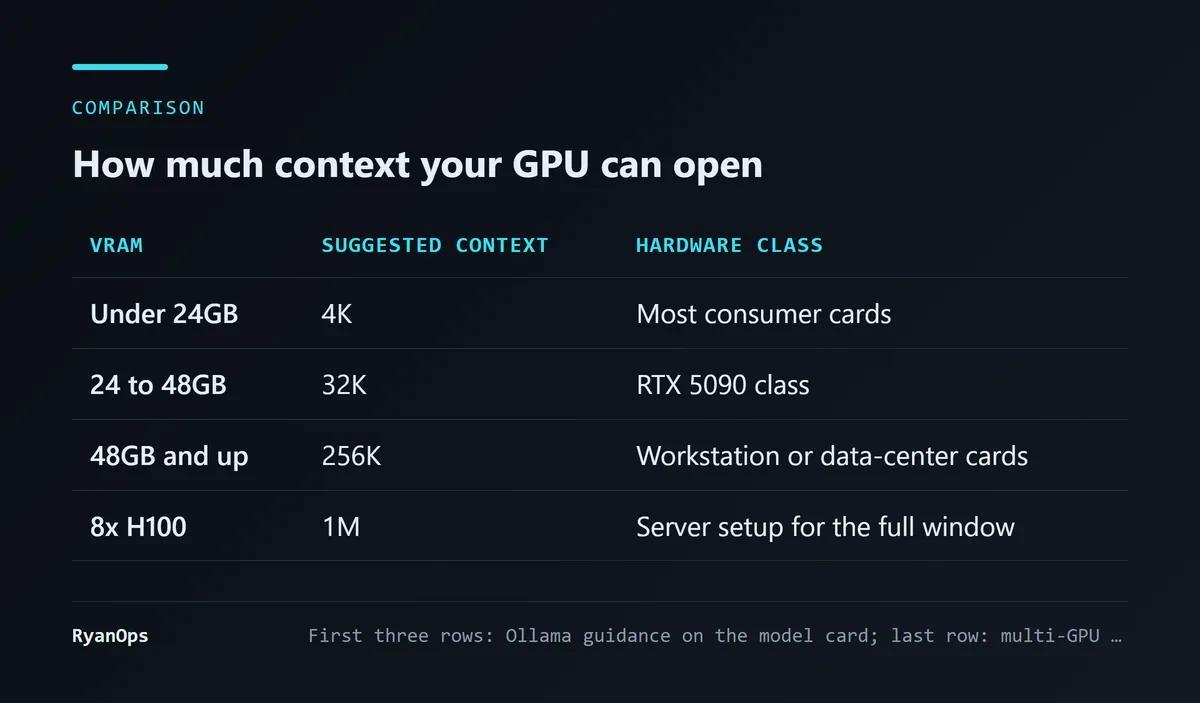 Figure: suggested context length by VRAM (compiled for this article from the Ollama guidance and multi-GPU setup on the Nemotron 3.5 Lightning model cards)
So “it runs” and “it’s useful” are two separate things. For cards under 24GB, the suggested context is just 4K. A model that advertises 1 million tokens and targets agentic work, seeing only 4,000 tokens on your card, is a long way from its advertised purpose. Agent tasks routinely stuff in a whole codebase and a long string of tool outputs.
Then there’s how big the files themselves are. The community quantization by unsloth is the most downloaded, so I looked at its file list:
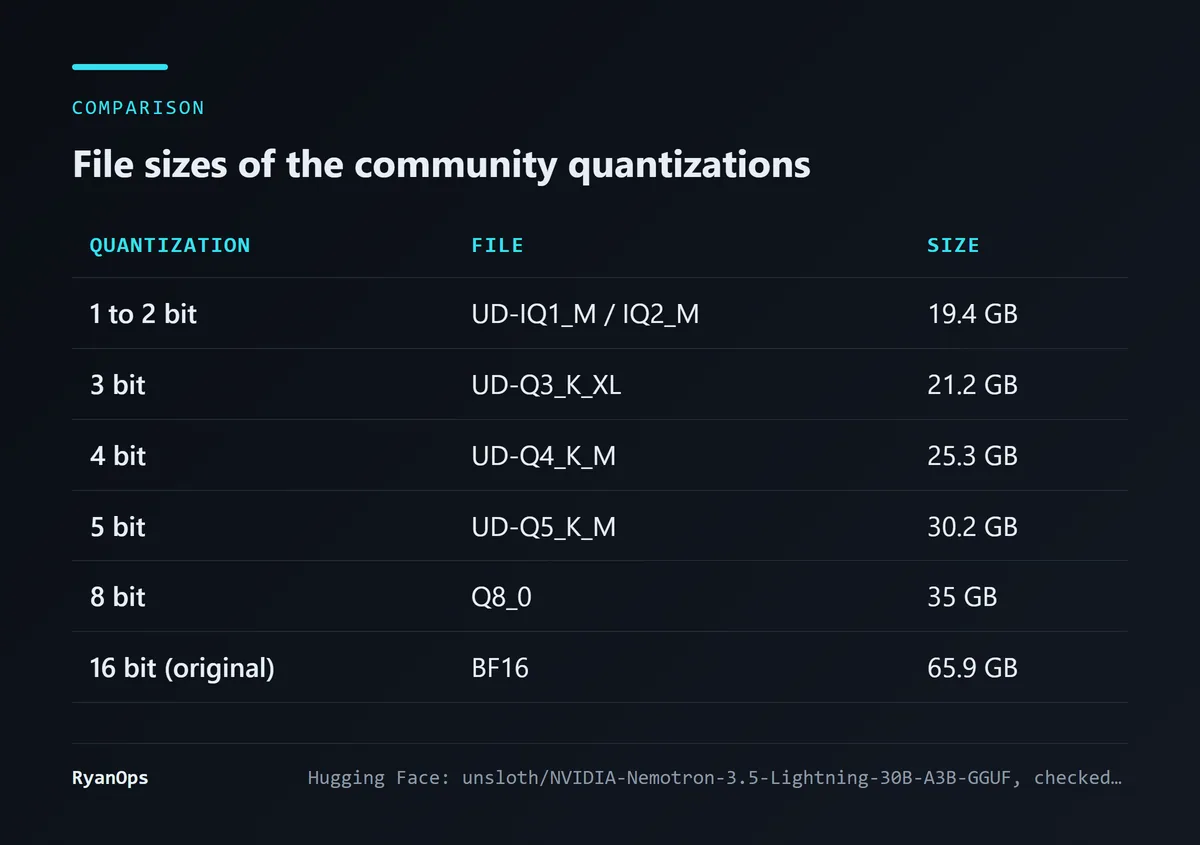 Figure: file sizes of unsloth’s quantizations (source: unsloth/NVIDIA-Nemotron-3.5-Lightning-30B-A3B-GGUF on Hugging Face, checked 2026-10-14)
Even the smallest version needs 19.4 GB. The commonly used 4-bit file (Q4_K_M) is 25.3 GB, already more than the memory of a 24GB card. Versions squeezed to 1 or 2 bits will fit, but quantization that aggressive usually costs noticeable quality, and the official results table above was measured on the full-precision release.
Here’s my conclusion. With a 24GB card it will run, but you have to accept either a very short context or very heavy quantization, and both move it further from the numbers on the table. With 48GB or more, or a machine like a DGX Spark, it comes closer to what Nvidia describes. That page shows more than forty-seven thousand downloads last month, so plenty of people are indeed trying.
I haven’t run this model locally myself; everything above is read off the model cards and the file list. If you’d like to see a local workflow that truly assumes a consumer card, the local AI animation piece is closer.
So should you use it?
It depends what you want.
If you want the highest-scoring open model at this size, then by Nvidia’s own table the answer is Qwen 3.6 35B A3B, not this one.
If you’re already on Nvidia’s toolchain and want a cleanly licensed, commercially usable starting point with officially supplied fine-tuning and reinforcement learning recipes, it’s a reasonable choice. The model card documents the training process in detail, which is a real benefit for teams that plan to train further themselves.
If you’re hoping to run a smart local model on the card in your home machine, look at the two tables above before deciding.
What would change my mind? Speed numbers measured by an independent party. The model’s entire case rests on being fast enough and cheap enough, and that happens to be the one part where I couldn’t find first-hand data this time.
What this rewrite corrected
- The original said it runs on “a consumer GPU (laptop or desktop class)”. The model card’s single-GPU configuration is an 80GB H100 or A100; consumer cards rely on quantized versions, with a very short context.
- The original’s three performance numbers (4 times faster, 30% faster, a third of the cost) and “distilled from Nemotron 3 Ultra” could not be found in the sources I checked this time and were deleted.
- The original’s signatory count for the open letter (25 to 150) had no traceable source and was deleted.
- The original called it “open source”; this version says “open weight” and names the actual license.
- The results table, hardware requirements and file sizes were all read directly from Hugging Face this time.


