Lightcap Left OpenAI. So Did 13 Other Executives.
Brad Lightcap is leaving OpenAI after eight years. In the full 2026 list he is one of 14 exits, with seven kinds of reasons, at a company preparing to IPO.
One senior executive leaving is normally hard to turn into an article. The announcement tends to be two lines: he’s gone, thanks for the contribution, best wishes.
Brad Lightcap’s departure notice is roughly that. Pull the camera back a little, though, and something more interesting comes into view: he is one of 14 executives who left OpenAI in 2026, and two days after his announcement the chief revenue officer left too. The company is preparing to go public at the same time.
This was originally a short news item from August, a bit over five hundred Chinese characters. This time I’ve rewritten it inside the context of the whole year, and the list, the reasons and what came after have all been checked again.
What did Lightcap himself say?
On August 11 he posted the note he’d written to staff on X:
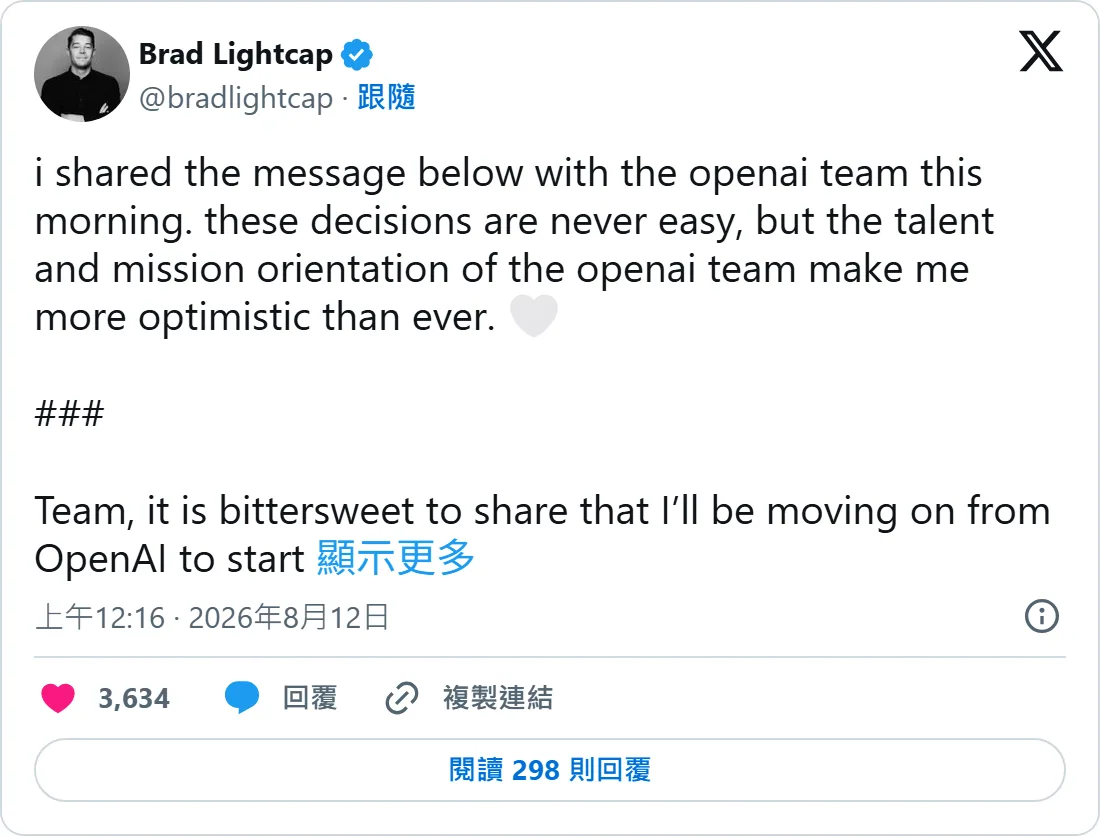 Figure: Lightcap’s public departure message (source: x.com)
The post is truncated, so I read the full text against TechCrunch’s report. The key lines:
- He calls the moment “bittersweet” and says he’s leaving to “start something new”.
- Looking back, he says he “had the privilege of building the first versions of most of our operations and business teams”.
- Over the last few months, he has been focused on “the next horizon and what would stand in the way of mission success”.
- He closes with “I believe in OpenAI more than ever” and looks forward to helping advance the mission “from a different vantage point”.
- On what the new venture is, there’s only “I’ll have more to share soon.”
As I write this in mid-October, two months have passed. I searched around and found no report naming his new company, its product or its funding. Some outlets relay his description of the direction, the challenges that emerge as AI enters its next phase, and that’s all. “Soon” hasn’t arrived yet.
What did he do at OpenAI?
He isn’t the kind of executive who parachutes in and leaves after two years. The timeline looks like this:
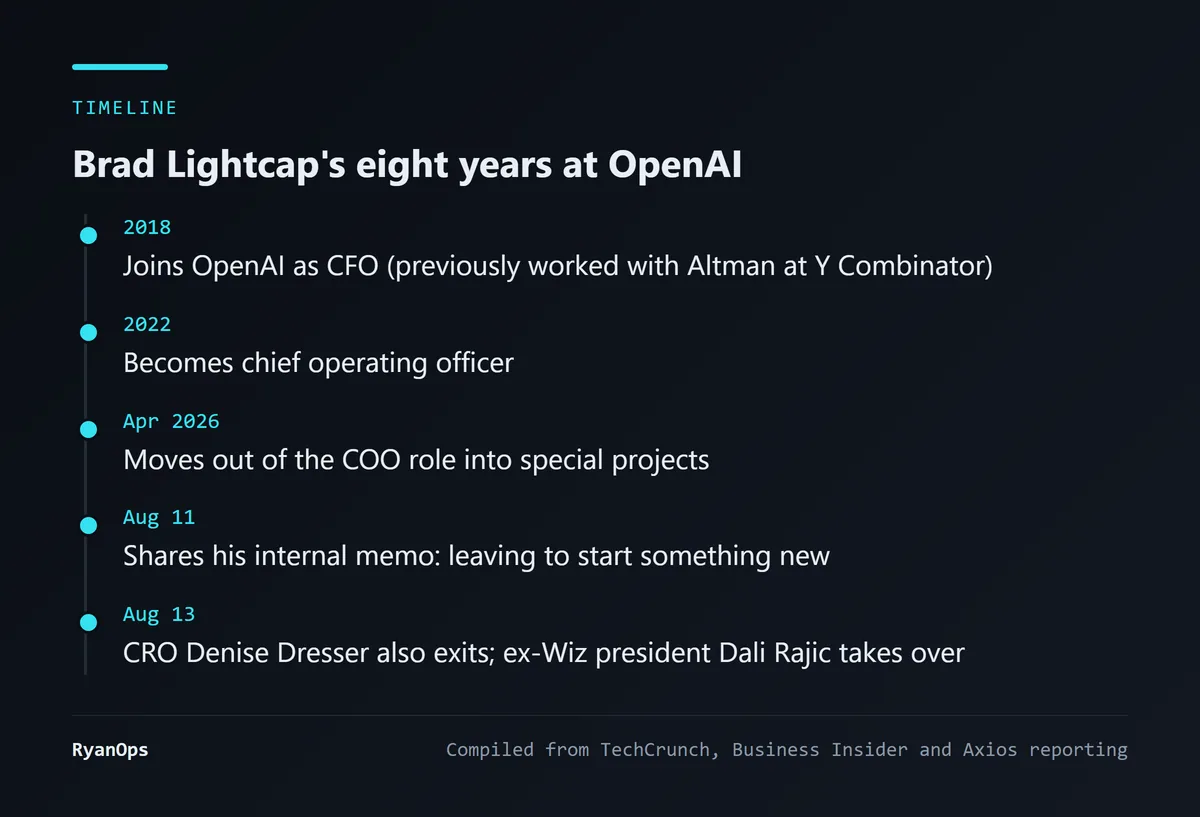 Figure: Lightcap’s eight years at OpenAI (compiled for this article from TechCrunch, Business Insider and Axios reporting)
When he joined in 2018, OpenAI was still a research lab and ChatGPT was four years away. He spent four years as CFO and took over as COO in 2022. Before OpenAI, he had already worked with Sam Altman at Y Combinator.
So that line in his memo about building “the first versions of most of our operations and business teams” isn’t a pleasantry. Finance, legal, HR, corporate security: the departments a company needs to go from lab to business, and he had a hand in nearly all of them.
There’s a detail the original article didn’t make clear. When he left in August, his title was no longer COO. In an executive reshuffle earlier this year he was moved to run “special projects”. Business Insider dates that to April. In other words, this departure looks more like the end of a handover that had been under way for months, and the original headline’s “sudden exit” wasn’t accurate; I’ve changed it this time.
How many people actually left this year?
On August 27, Business Insider compiled a list titled “14 executives who left OpenAI in 2026”. I’ve reordered it by month:
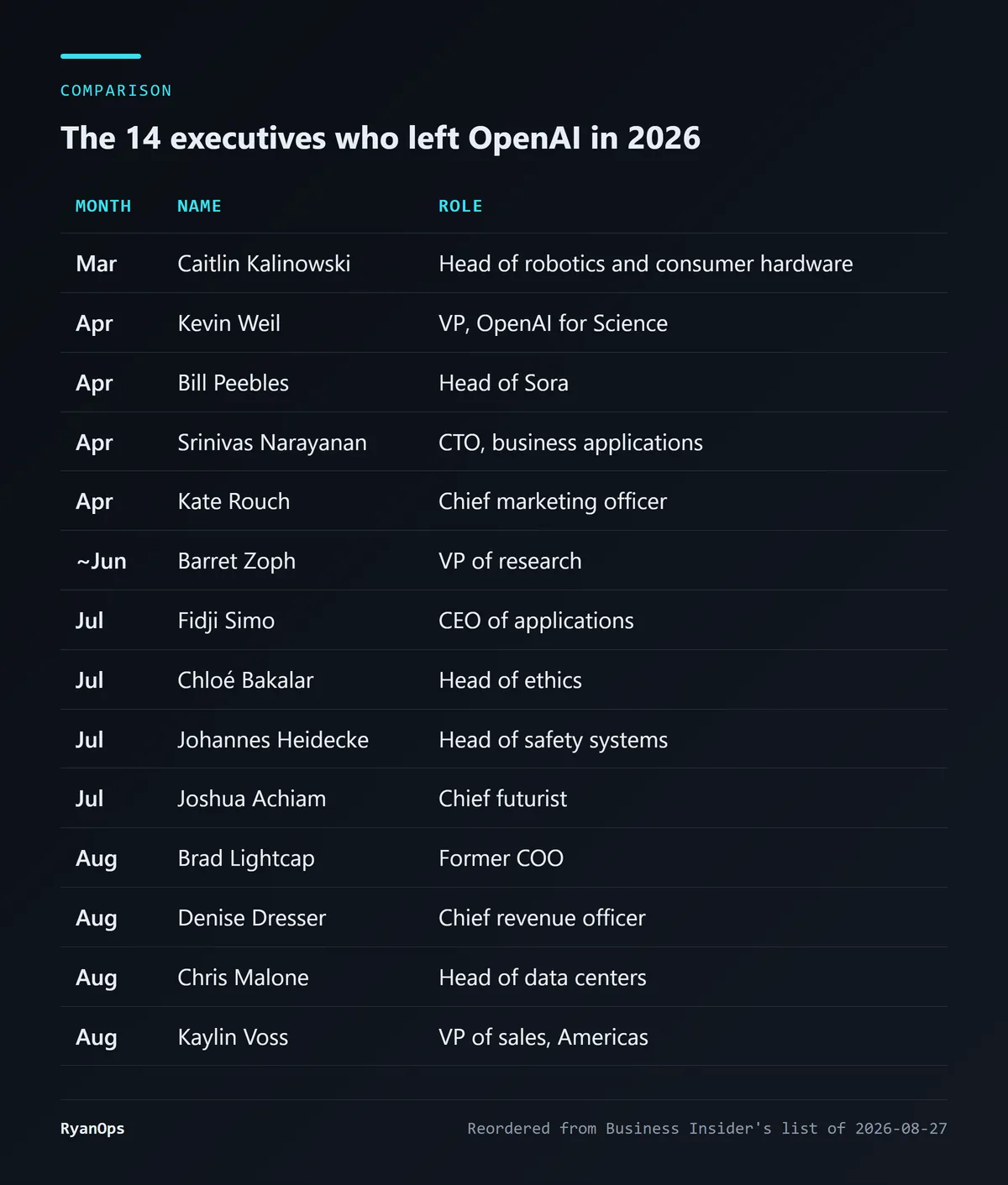 Figure: the 14 executives who left OpenAI in 2026 (reordered for this article from Business Insider’s list of 2026-08-27)
The roles on this list span a lot of ground. Product, research, marketing, revenue, ethics, safety, data centers, hardware: nearly every line has lost its head.
A few of these people have stories worth telling separately.
Barret Zoph came back for five months and left again. He had originally left OpenAI for Thinking Machines and returned in January as VP of research. About five months later he left once more, this time for Google DeepMind, with the same title, VP of research.
Kevin Weil’s startup isn’t asking for a small number. He was chief product officer and later led OpenAI for Science. After he left in April, Business Insider says, he heads an AI science startup seeking a valuation of at least $750 million.
Caitlin Kalinowski is the only one who stated her reason plainly. She led robotics and consumer hardware and resigned in March. The reported cause is concerns about the company’s agreement with the Pentagon, mainly on governance.
Fidji Simo didn’t leave entirely. She was CEO of applications and regarded as the company’s number two. She went on medical leave in April and announced in July that she was stepping down because of a chronic illness (POTS, postural orthostatic tachycardia syndrome). Business Insider says she moved to a part-time advisor role.
Denise Dresser lasted eight months. The former Slack CEO joined as chief revenue officer only last December. OpenAI announced her departure on August 13, two days after Lightcap’s memo. Her replacement is Dali Rajic, previously president and COO of the security company Wiz, whose $32 billion acquisition by Google closed in March.
One more: “chief futurist” Joshua Achiam also left in July. That a company has that title, and that the person holding it left, is a little thought-provoking in itself.
Why did they leave?
This is the part that most easily gets waved through in one sentence. The usual framing is “an executive exodus”, implying everyone left because they lost faith in the company. Spread the list out and that isn’t what it shows.
I sorted Business Insider’s description of each person into categories:
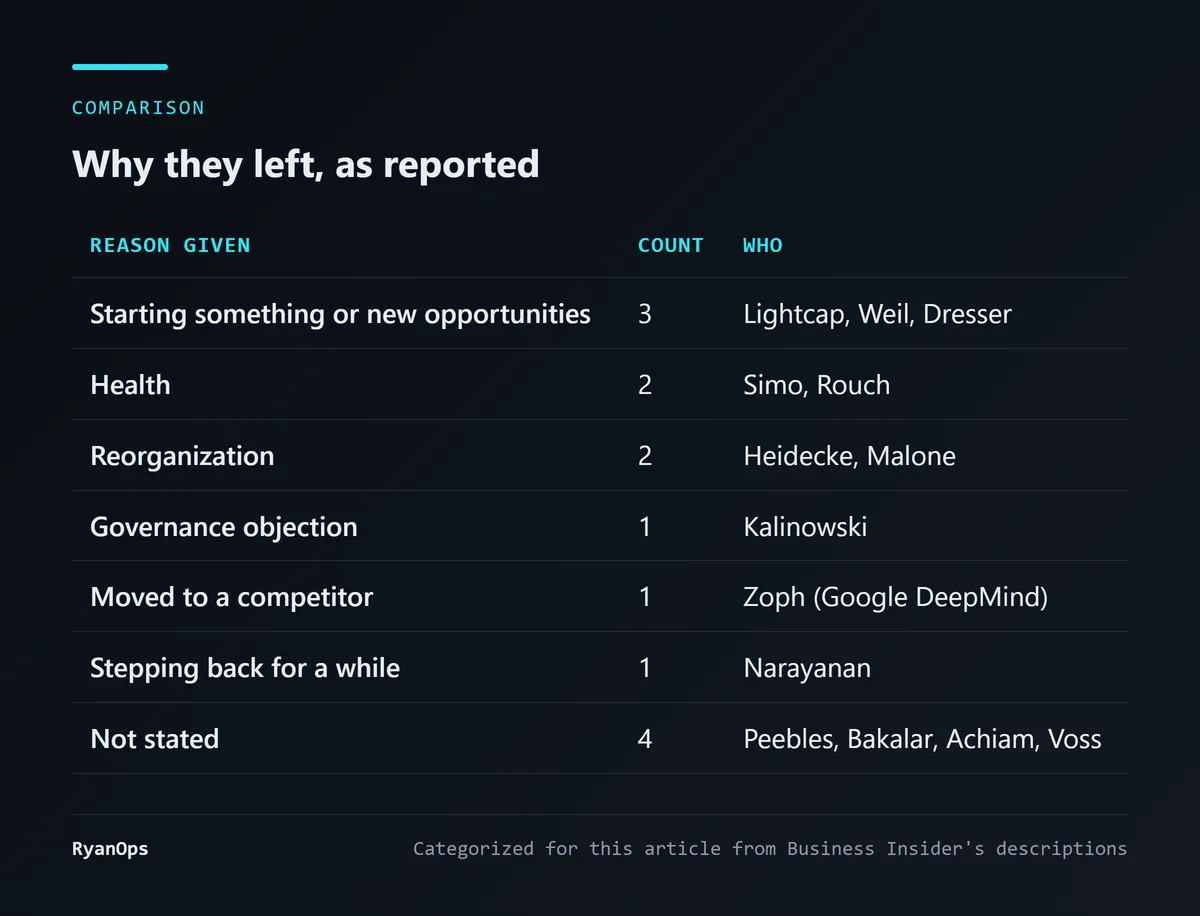 Figure: reasons given for the 14 departures (categorized for this article from Business Insider’s descriptions)
Of the fourteen, two were ill (besides Simo, CMO Kate Rouch left to focus on recovering from breast cancer). Two were changes under a reorganization. One wanted to step back for a while and spend time in India. For four, the reporting gives no reason at all.
The only one the list explicitly records as leaving over disagreement with the company’s direction is Kalinowski. The only one who went to a direct competitor is Zoph.
So I don’t agree with the “collective loss of faith” reading; at least the public record can’t support it. The categorization has its own limits: the reason given publicly isn’t necessarily the whole reason, and anyone can say “pursuing other opportunities”. But the reverse holds too: stringing fourteen events with different causes into a single story is equally unfounded.
As for OpenAI’s own position, president Greg Brockman is reported to have said in an interview that he doesn’t think this level of turnover is all that atypical.
Then why is it still worth attention?
Because of the timing.
OpenAI is preparing to go public. The Next Web reports that the company has filed confidentially, has just closed a $7 billion employee tender offer valuing it at $852 billion, and has reportedly weighed delaying the listing to 2027 to go after a $1 trillion valuation. The same piece cites the company’s claim that its products reach more than a billion weekly users and more than two million businesses, twice as many companies as a year ago.
What a company about to list needs most is for investors to believe management is stable. And within this one year, the founding-era finance and operations hand (Lightcap), the revenue chief (Dresser), the number two (Simo), the chief product officer (Weil) and the CMO (Rouch) have all been replaced.
The arrangement for replacing Dresser shows where the company wants to go. Brockman’s expectation of Rajic, in his words, is to “turn what we’ve learned into repeatable execution”, and OpenAI says it wants him to build a “revenue operating system”. The company has also brought in RPT Partners, a firm that specializes in recruiting sales leadership, to rebuild its sales team.
These moves point at one thing: OpenAI is shifting from the stage where the product sells itself to the playbook of an ordinary large enterprise software company. Lightcap’s generation was good at building departments from nothing; what’s needed next is scaling what has already been built. Those two jobs usually aren’t done by the same people.
That’s my own reading, not something either side has said. What would change my mind: if the people leaving next start to cluster in research and safety, and state their objections publicly, it would look more like a fight over direction than a change of stage. In July the list shows the head of ethics, the head of safety systems and the chief futurist all leaving, and those three are the ones I’ll keep watching.
Did anyone else leave after August?
Yes. On October 9 it was reported that Sanghyun Lee, OpenAI’s head of public policy for Asia-Pacific, is leaving six months into the job, with no reason disclosed. So “he wasn’t the last” in the headline doesn’t refer only to Dresser and the others.
The company itself hasn’t been calm over the same stretch. After GPT-6 Astra launched in early September, demand ran so high that the $200 Pro plan was off sale for 20 days. In late September, GPT-6.1 Astra, planned for October, was cancelled after failing safety evaluations. Further back, in August, people were already debating how much OpenAI loses for every dollar it earns and whether it can still list.
If you want another AI company that’s also preparing to list for comparison, Anthropic’s prospectus leaked in late September, with its own financials and risk disclosures. The two are at the same point in time and facing very different problems.
What this article can’t tell you
- What Lightcap’s new company does. Two months on, I can’t find anything concrete.
- The exact month he left the COO role. Business Insider says April; another report cites The Information as saying changes were under way in January. I’ve used the former and am noting it here.
- Each person’s real reason for leaving. This article can only organize what was said publicly.
- The number 14 is Business Insider’s count as of August 27. Outlets count differently, some say 12, and more people have left since.
- The IPO timeline. Both the confidential filing and the possible delay to 2027 are media reports; OpenAI hasn’t published an official schedule.


