River AI, Two Months Old, Raises $1.1 Billion
Igor Babuschkin's River AI raised $1.1B two months after going public. It sells an API for tuning open-weight models. The code sample, the backers, the scale.
A company that had been public for only two months raised $1.1 billion.
The number is large enough that every outlet covered it in August. I only wrote a short item myself at the time: who founded it, who invested, how much.
In this rewrite I want to answer three questions that went unanswered then. What is it actually selling? Why did these particular investors back it? And is $1.1 billion really outlandish in 2026?
Who is behind River AI?
The founder is Igor Babuschkin. He’s best known as a co-founder of xAI, and earlier he did research at both DeepMind and OpenAI. Some reports mention that at xAI he was responsible for building out its large-scale training cluster.
What later happened to the company he left is worth explaining, because it’s the backdrop for understanding River.
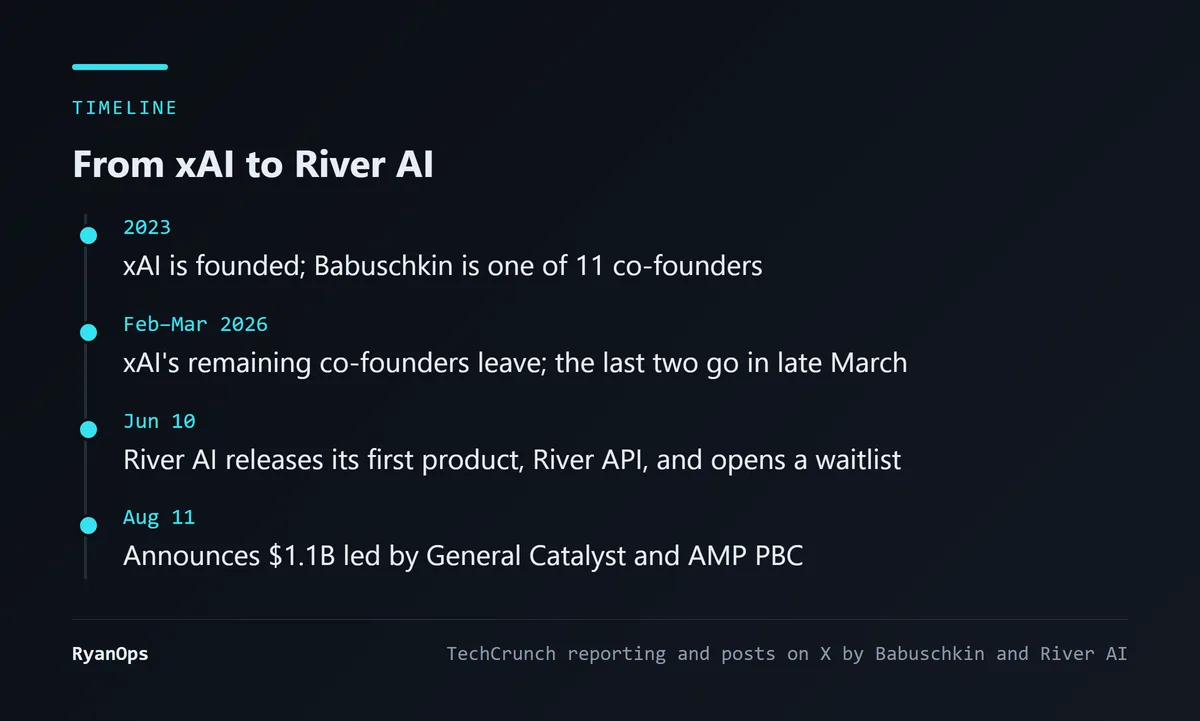 Figure: from xAI to River AI (compiled for this article from TechCrunch reporting and posts on X by Babuschkin and River AI)
xAI had 11 co-founders when it was founded in 2023. A TechCrunch report from March 28 this year is headlined “Elon Musk’s last co-founder reportedly leaves xAI”: by the end of March the final two had gone as well. That piece also gives the context: SpaceX acquired xAI, and Musk himself said xAI “was not built right” the first time around and is being rebuilt “from the foundations up”.
Babuschkin wasn’t among those last two. As for the exact day he left, the accounts I found don’t agree, so I’m not giving a date.
All 11 founders leaving one company is rare in any industry. They’re now scattered in various places, and River is the destination that has raised the most money.
What is it actually selling?
This is where I think the August article was least clear. The original said it wants to “rebuild the entire AI stack”, which is true; Babuschkin’s launch post says the stack has to be rebuilt “end to end”, from training and models to the product layer and new hardware. But that’s the vision. What it actually sells today is much smaller and much more concrete.
On June 10, Babuschkin posted the first product:
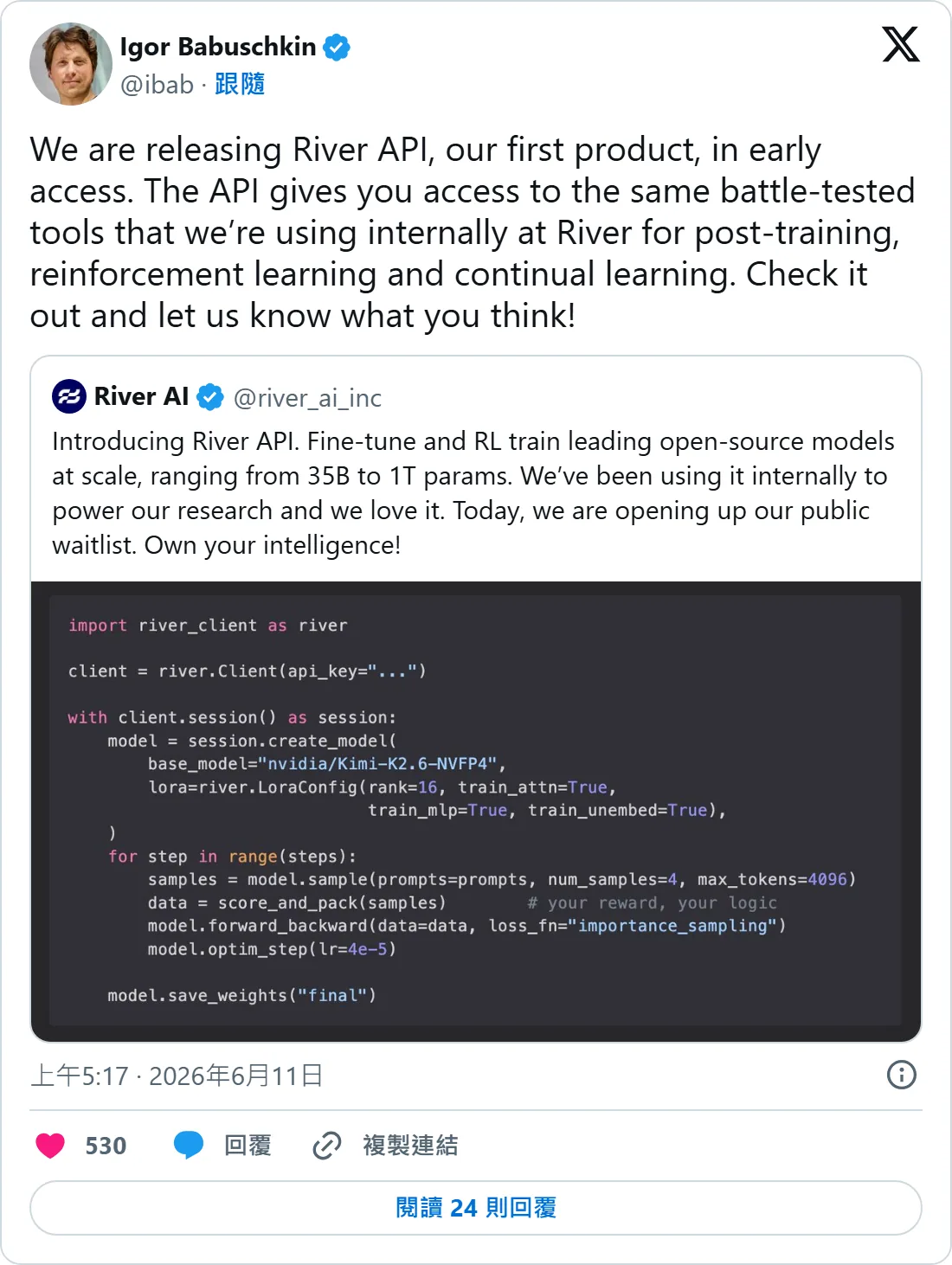 Figure: Babuschkin’s post announcing River API, including the official code sample (source: x.com)
What River API does, in the company’s words, is fine-tune and RL-train open-source models “ranging from 35B to 1T params”. The code in the post explains the workflow more clearly than any press release, so let me read through it:
- You start by choosing a base model. The string in the sample is
nvidia/Kimi-K2.6-NVFP4, an existing open-weight model. - You configure LoRA. LoRA is a fine-tuning method that trains only a small set of added parameters and leaves the original model’s full weights alone; the sample uses
rank=16. - Then comes a loop. Each round first has the model produce several samples for your prompts (
num_samples=4). - Next it calls a function named
score_and_packto score those samples. The comment beside it reads “your reward, your logic”: how reward is computed and what the logic is are up to you. - The scored data is sent back for a forward and backward pass, updating the parameters.
- When it finishes, the weights are saved.
That’s reinforcement learning in its most basic shape: generate, score, adjust by the score. What River sells is running the hardware-hungry steps in the middle for you, so all you write is the scoring function that defines what “good” means. TechCrunch quotes a line from River’s product literature that I think states its position plainly: “Prompting steers a model you don’t own and can’t improve.”
The company’s slogan is “Own your intelligence”. The bet is that enterprises won’t want to only rent general-purpose models from the big labs, and will want a model tuned on their own data and standards with the weights in their own hands.
Billing is per million tokens, with rates depending on which open model you choose. The funding announcement has two numbers: enterprises can complete a complex reinforcement learning run in 15 to 20 minutes with no infrastructure team of their own, and cost-effectiveness is two to four times that of closed-source alternatives. Both are the vendor’s own claims; I’ve seen no independent verification, and I didn’t find a public rate card with the exact per-million-token prices either.
If those terms are unfamiliar, the glossary has entries for open weights and reinforcement learning.
What does “guardian angel” mean?
Babuschkin’s description of future AI agents differs from how most labs talk:
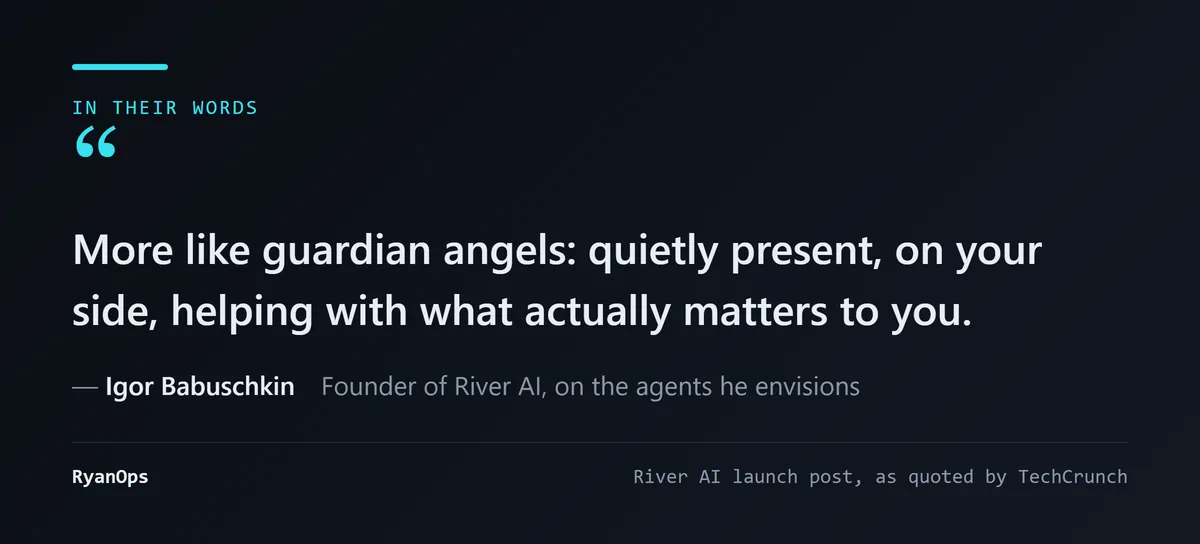 Figure: Babuschkin’s description of AI agents (from River AI’s launch post, as quoted by TechCrunch)
TechCrunch’s report sets this vision against other labs, which it says are building “human worker replacements”. Another line from Babuschkin: these agents will know you well, and they will be yours, not someone else’s.
Put that line next to the product above and the logic holds together. An agent that “belongs to you” presupposes that the model’s weights are in your hands. If you’re using a rented model, how well it knows you and whose side it’s on is ultimately the landlord’s call.
That’s the flattering version. The cooler reading is that at this stage River’s customers are enterprises, not individuals. An enterprise owning a model trained on its own processes is a long way from you personally having a guardian angel. TechCrunch notes the gap between vision and product itself: how River’s tech will differ remains to be seen.
Who put in the money?
The round was led by General Catalyst and AMP PBC, with Nvidia, AMD Ventures, Y Combinator and Temasek participating. The company didn’t disclose a valuation.
AMP PBC is the less familiar name. TechCrunch describes it as an AI investment firm founded this year by former Andreessen Horowitz general partner Anjney Midha, which has backed Black Forest Labs, Mistral AI, LMArena and OpenRouter. You may remember OpenRouter: in August, Stripe bought it for $7 billion.
What I find most interesting on the investor list is Nvidia and AMD appearing together. The two are rivals and both invested. The reason isn’t hard to guess: River’s business is getting more enterprises to train their own models, and what training requires buying is their chips. For chipmakers, customers going from “a handful of big labs” to “thousands of enterprises” is good news, and whoever wins needs compute. The base model in the sample code sitting under nvidia/ is probably no coincidence either. Nvidia has been pushing open models itself this year; Nemotron 3.5 Lightning was announced the same month.
How big is $1.1 billion this year?
Very big, but not unique.
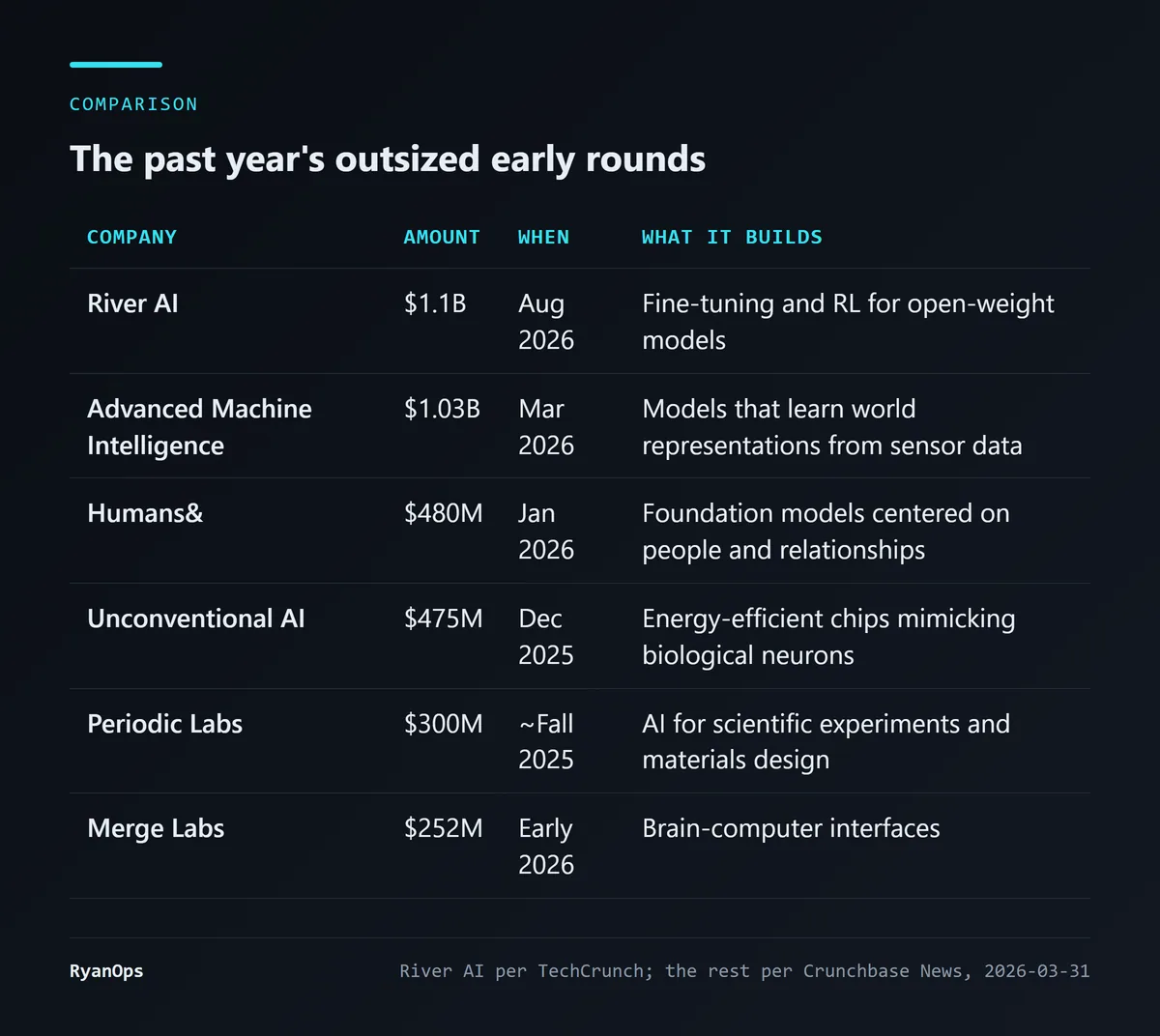 Figure: the past year’s outsized early rounds (compiled for this article; River AI per TechCrunch, the rest per Crunchbase News on 2026-03-31)
Crunchbase News compiled a list at the end of March. The largest then was Advanced Machine Intelligence, linked to Yann LeCun, at $1.03 billion. The same article gives a few statistics: at least 12 companies worldwide raised seed rounds above $100 million in the preceding six months, and there have been 27 such rounds since the start of 2025. Seed rounds of $10 million or more rose from 2% of deals in 2018 to 9%.
Crunchbase’s description of the trend is fewer deals and larger ones. Money is concentrating on a small number of founders with names.
One definitional issue to watch. In the announcement, River’s round is seed and Series A counted together, and some trackers list it as a Series A. So I won’t use a phrase like “largest seed round ever”, and the table’s title says only “early rounds”.
A comparison with another company makes it more tangible. Also a spinout from a big lab, TypeSafe AI, which came out of stealth in September (the company behind the Jev model, founded by a co-inventor of ChatGPT), raised a $40 million seed. The two differ by a factor of 27. The difference isn’t all résumé; it’s also the nature of the business. River intends to run training for others, a business that has to buy a great deal of compute up front. The company hasn’t said how much of the $1.1 billion turns directly into chip orders, but my guess is a sizeable share.
Is the money worth it?
I don’t know, and I don’t think anyone does right now.
The reasons in favor are concrete. It has a product, code and a pricing model, the founder has built large training clusters, and the demand, enterprises wanting to own their models, is visible.
The reasons for reservation are concrete too. TechCrunch writes outright that the round may be “another indication of the overheated AI atmosphere”. The two-to-four-times cost-effectiveness is self-reported. The company has been public for two months, with no public customer list and no revenue figures. The “closed-source alternatives” it refers to have also been cutting prices in recent months: DeepSeek’s new model has pushed output pricing down to 1/83 of Astra’s, and whether training your own is worthwhile will shift along with competitors’ prices.
My own view is that whether River’s business holds up depends on a question that doesn’t have an answer yet: can a tuned small model reliably beat an untuned large one on an enterprise’s own tasks? If it can, owning the weights has real value. If it can’t, “owning” is just a more expensive option. What would make me more confident? A named enterprise saying publicly that a model trained with River replaced some closed-source API, with numbers attached.
As I write this in mid-October, I haven’t found such a case, nor any new product announcement from River since the funding.
Information this article doesn’t have
- The valuation. The company didn’t disclose it.
- The actual price per million tokens. I didn’t find a public rate card.
- A customer list or revenue.
- The exact date Babuschkin left xAI; sources disagree.
- “15 to 20 minutes” and “two to four times” are claims from the announcement, with no third-party verification.
- I don’t have access to River API. What I say about it comes from public posts and reporting, and I read that code sample; I didn’t run it.


