AI Flying an F-16 Is Not New. What Is, This Time?
DARPA and the US Air Force say an AI agent flew a converted operational F-16. AI first flew a fighter in 2022; the new part is the airframe.
On July 16, 2026, DARPA published a release headlined “DARPA, U.S. Air Force fly AI-controlled F-16”.
The first sentence of my August piece said that on July 16 a modified F-16 took off from Eglin Air Force Base. It also said this was the first time an AI flew a real fighter outside a simulator.
Both sentences have problems. July 16 is the date of the release, not of the flight. And an AI flew an F-16 in a real aircraft three and a half years ago.
So the question for this rewrite is: if it was not the first time, what is new about it?
What does the release say?
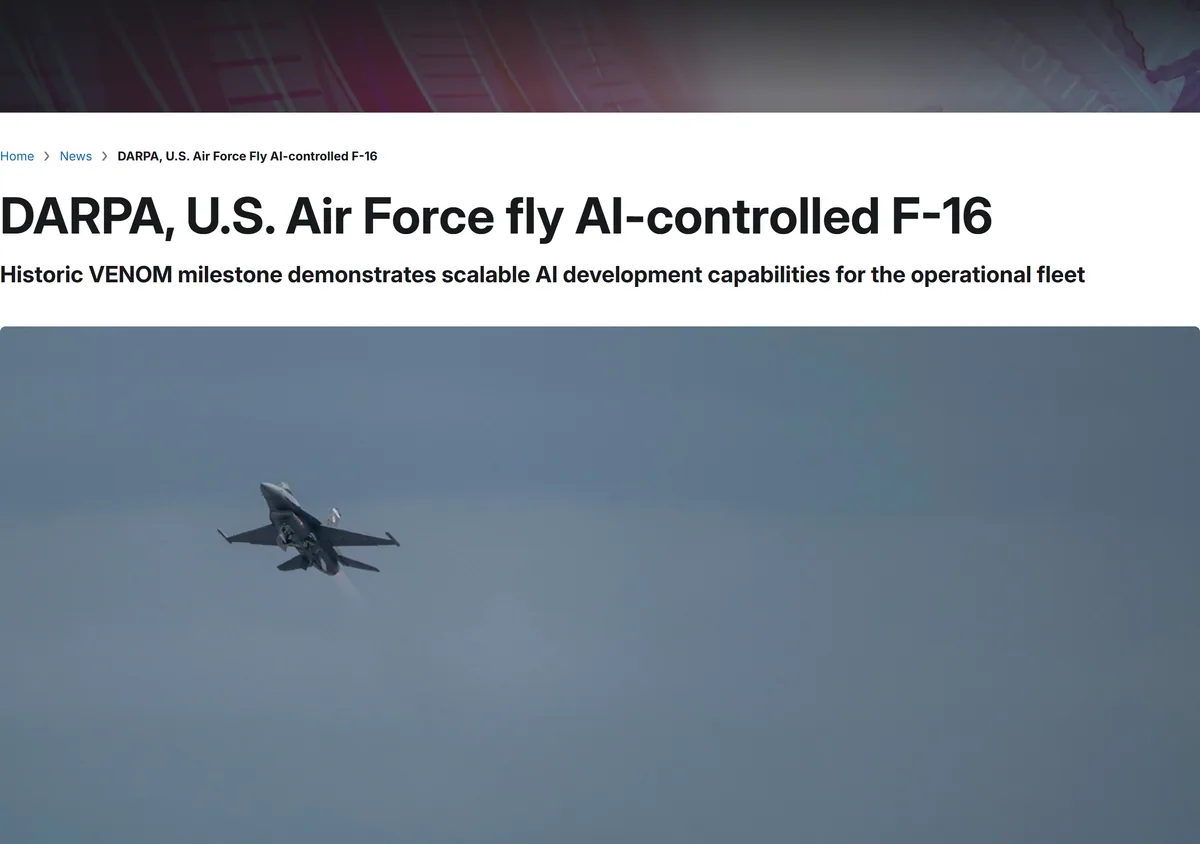 Figure: The DARPA release of 16 July 2026 (source: darpa.mil)
The program is called VENOM, short for Viper Experimentation and Next-generation Operations Model, a joint effort of the US Air Force and DARPA. Viper is what pilots call the F-16.
The release comes down to four points:
- The location is Eglin Air Force Base in Florida.
- The aircraft are standard operational F-16s converted into testbeds an AI can take over. The release says “a group of F-16s” and gives no number.
- The core of the modification is the VENOM Autonomy Kit (VAK). It automates the flight controls and sensors without changing the jet’s core software.
- A pilot stays in the cockpit and uses a switch to move between human control and AI control.
On timing, a photo caption in the release refers to ground and flight operations at Eglin in June 2026. ExecutiveGov’s report adds the order: the modified jets first flew airworthiness flights with pilots in June and moved to AI control in July.
The subhead deserves a second look: “Historic VENOM milestone demonstrates scalable AI development capabilities for the operational fleet.” The stress is on “operational fleet”, not on “first”.
When did an AI first fly an F-16?
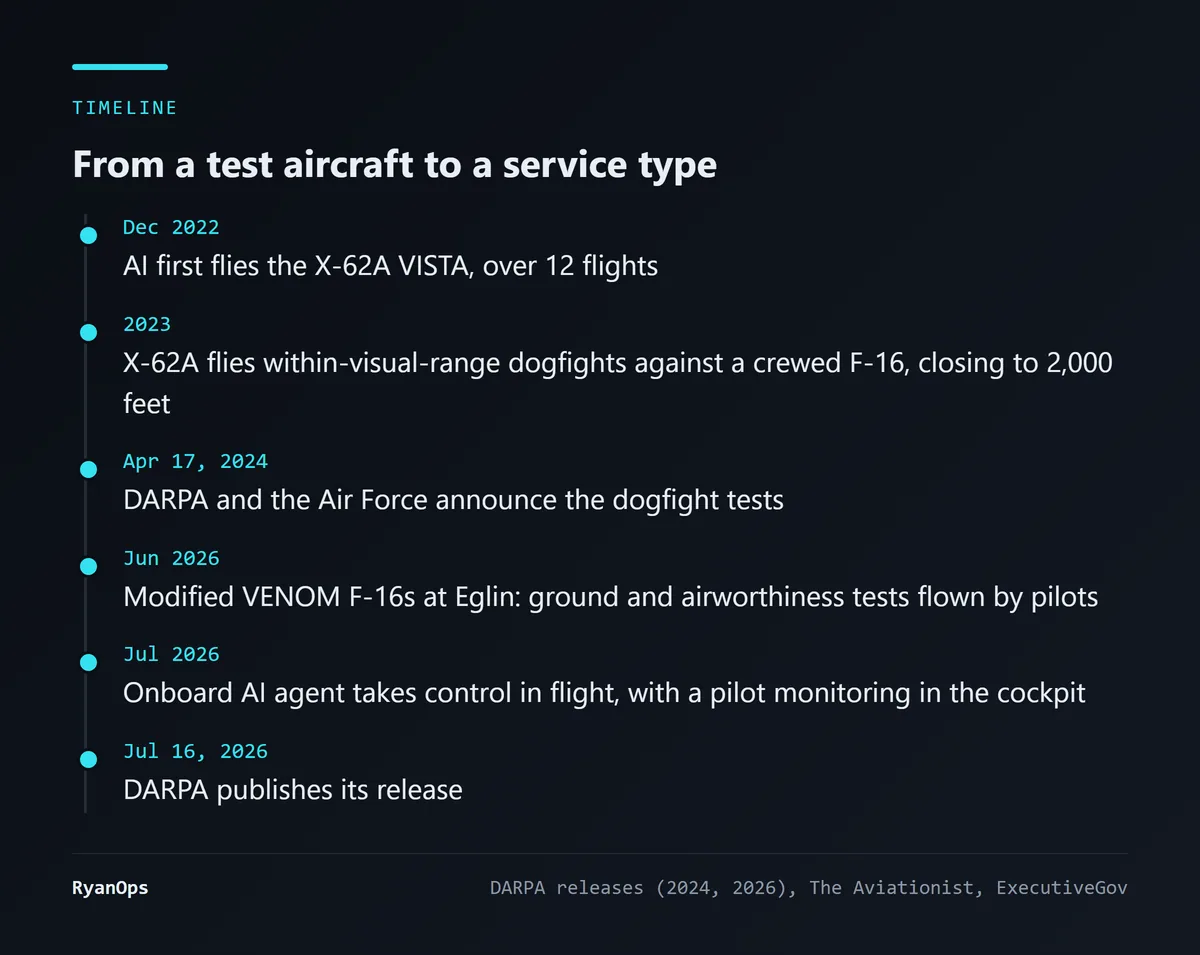 Figure: Key dates for AI flying the F-16 (compiled for this article from the 2024 and 2026 DARPA releases, The Aviationist and ExecutiveGov)
The answer is December 2022.
That aircraft is the X-62A VISTA, an F-16 rebuilt specifically for flight testing and based at Edwards Air Force Base in California. According to The Aviationist, AI agents flew it 12 times between December 1 and 16, 2022.
Then came dogfighting. On April 17, 2024, DARPA announced that the X-62A had flown within-visual-range combat maneuvers in the air against a crewed F-16, with tests taking place in 2023 and continuing in 2024. This was the work of DARPA’s Air Combat Evolution (ACE) program.
The Aviationist reported several details:
- The team flew 21 test flights and made over 100,000 lines of flight-critical software changes along the way.
- Safety was built up first with defensive maneuvers, then the tests moved to offensive nose-to-nose engagements.
- At their closest the two aircraft were 2,000 feet apart, at 1,200 miles per hour.
- Safety pilots were aboard and could independently disengage the AI. In these engagements at Edwards they never used that safety switch.
Frank Kendall, then Secretary of the Air Force, said the potential for autonomous air combat had been imaginable for decades but the reality “has remained a distant dream up until now”. The team was later named a finalist for the 2023 Collier Trophy.
My August piece said the dogfight happened in April 2024. That is the announcement date. DARPA did not say which day the engagements were flown, and The Aviationist guessed between summer and fall of 2023.
So what is new this time?
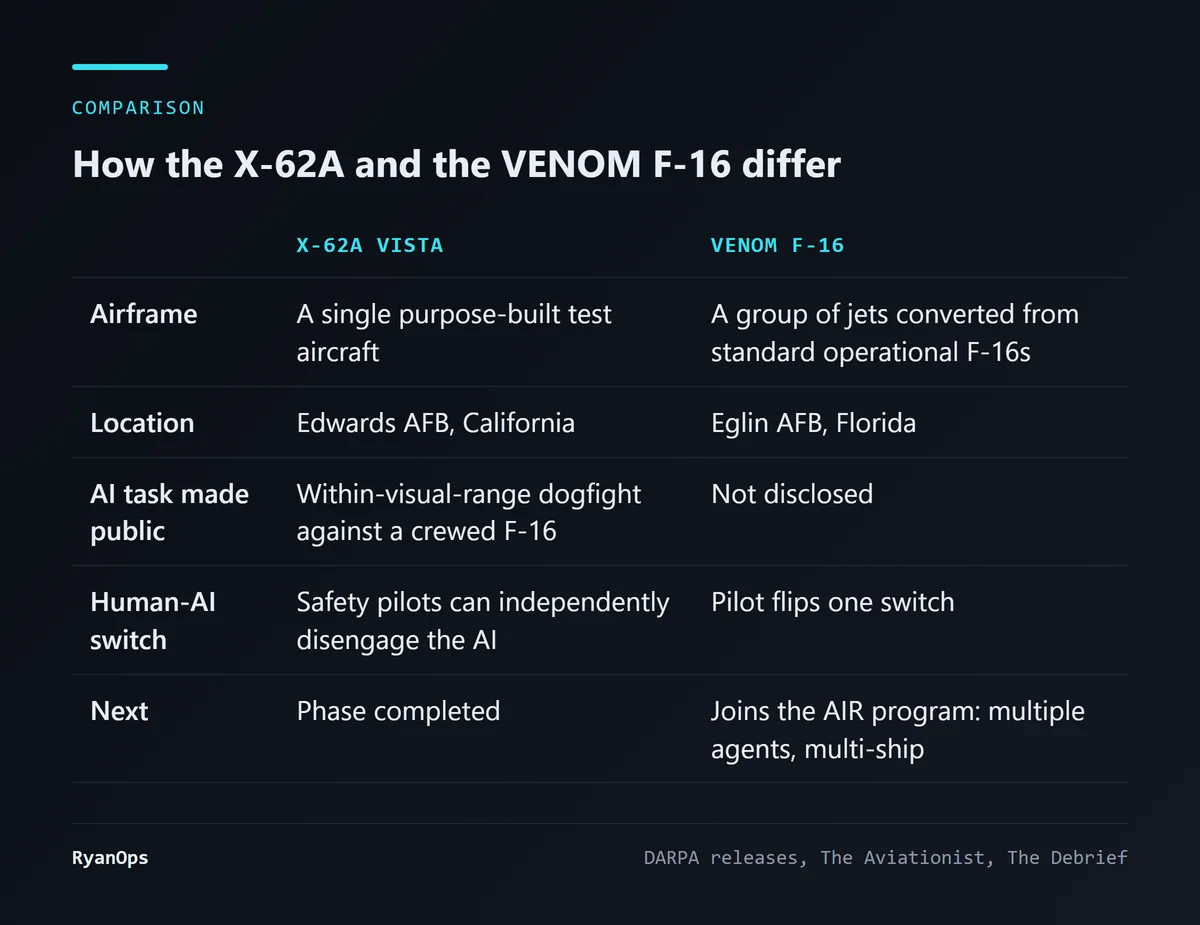 Figure: How the X-62A VISTA and the VENOM F-16 differ (compiled for this article from DARPA releases, The Aviationist and The Debrief)
The airframe is new. The AI is not.
There is only one X-62A. It is a very unusual aircraft, modified from nose to tail for experiments. Proving that an AI can fly it answers the question “can it be done”.
VENOM uses standard operational F-16s, and more than one. That is also what program manager Brig. Gen. James “Fangs” Valpiani stressed in the release: the team automated the flight controls and sensors of a standard F-16 without changing the jet’s core software. He described it as an “efficient pipeline” for developing air combat AI.
Put another way, the X-62A is like the only prototype in a laboratory. VENOM turns the same capability into a kit that can be fitted to a production item. The first proves the principle. Only the second can become scale.
This also explains why the subhead says “for the operational fleet”. For the military, one test aircraft that an AI can fly tests one AI agent at a time. A group of F-16s that an AI can fly can test several at once, and can test how they work together.
Leaving the core software alone is, to my mind, the smartest engineering choice here. A fighter’s flight control software goes through strict certification, and every changed line has to be verified again. The X-62A work changed more than 100,000 lines. As the release describes it, VENOM attaches the AI on the outside and leaves the original system untouched, so when something goes wrong, one flick of a switch returns the jet to a system that has already been verified.
What is that switch?
The release does not say much about the switch. It says VAK has a “novel interface” with the aircraft’s flight controls and mission systems, and that the pilot aboard can move between his own control and AI control with a switch.
DARPA calls this arrangement human-on-the-loop. The person does not take part in every action, but watches throughout and can take over at any moment. Its counterpart is human-in-the-loop, where every decision needs a person’s approval.
Anyone who has built automation will recognize the arrangement. What matters is less how strong the automated part is and more how short the way back is. One switch is a very short way back.
What does the release leave out?
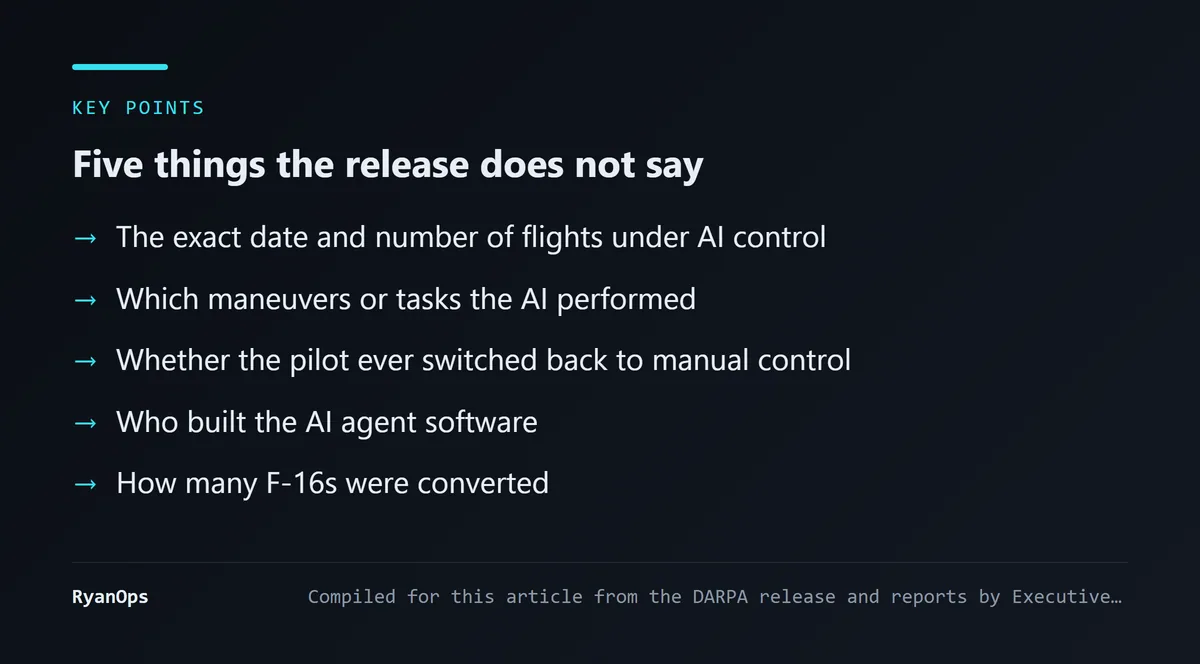 Figure: What the DARPA release does not cover (compiled for this article from the DARPA release and reports by ExecutiveGov and The Debrief)
I think this list is worth more attention than the release itself.
ExecutiveGov’s report points out that DARPA did not discuss which maneuvers or tasks the AI performed in these flights, and did not identify who made the AI agent software. The release says only that VAK was designed and integrated by “multiple performers” under the ACE program.
Compare that with 2024. The X-62A announcement gave the engagement distance, the speed, the number of tests and whether the safety switch was used. This time there is not one number.
So I would no longer use a phrase like “AI in full control”. The release says an AI agent controlled the flight. How long it was in control, what it did and whether the pilot took over midway are unknown. One second-hand report says a safety pilot handled takeoff and the AI controlled most of the flight, but I could not find its original source.
This does not mean DARPA is hiding something. It is normal for military tests to go unpublished in detail. It does mean that any description you read of “how the AI performed” has no public data behind it.
Humanoid robot demonstrations run into much the same problem. I raised it in the Optimus piece: what a demonstration proves depends on how many of the conditions the other side is willing to publish.
What does the program manager himself say?
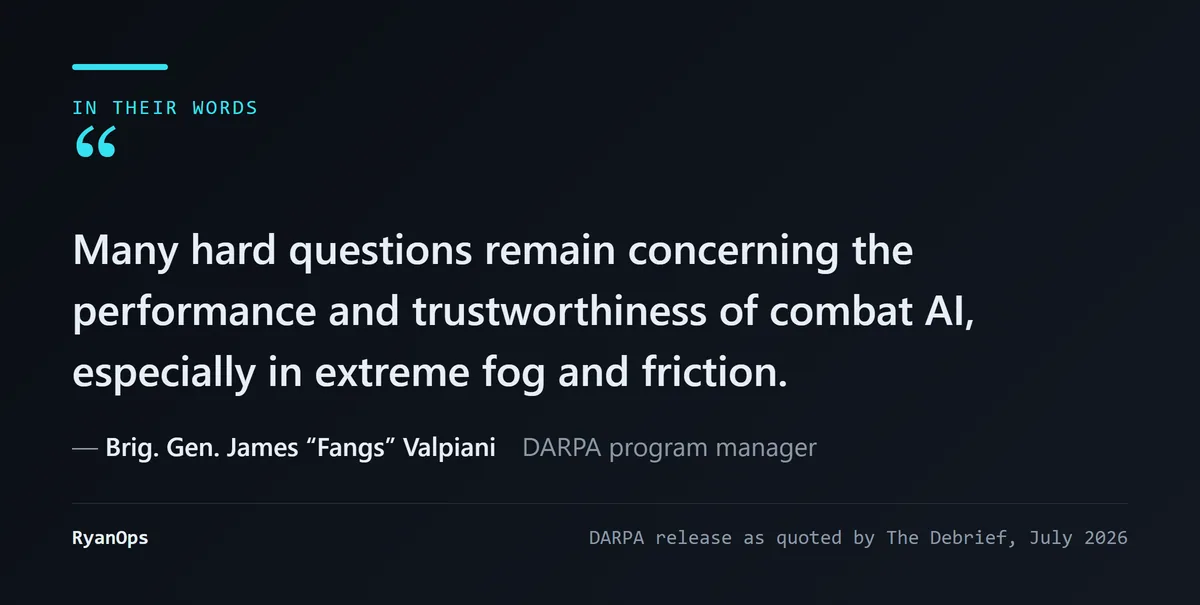 Figure: A passage from VENOM program manager Valpiani in the release (graphic made for this article; quoted from the DARPA release via The Debrief)
Valpiani’s statement has two halves. The first is that these flight tests “advance the infrastructure needed to develop trusted, autonomous air combat capabilities”. The second is the sentence above.
“Fog and friction” is an old term in military theory for the state of a battlefield where information is incomplete and things do not go to plan. An AI flying well in arranged test airspace is one thing. Being dependable when signals are jammed and the opponent does the unexpected is another. Valpiani is saying the second has no answer yet.
The release also notes that he was due to leave DARPA within weeks of the announcement. His successor is Lt. Col. Patrick “Dice” Highland, whose wording is more ambitious: there is now an opportunity to create dominant autonomy for beyond-visual-range, multi-ship combat.
Deputy program manager Terry Wilson, from the Air Force Research Laboratory, is staying on. He said he looks forward to moving these capabilities “out of simulation and into the sky”.
What comes next?
The VENOM aircraft will pass to another DARPA program, Artificial Intelligence Reinforcements, or AIR.
AIR will use these jets to test several AI agents in live flight at once, then scale up to multi-ship operations. The long-term aim is for one human pilot to command a team of uncrewed aircraft. The release ties this to the Air Force’s Collaborative Combat Aircraft programs, the uncrewed wingmen that fly alongside crewed fighters.
Note that Highland said “beyond-visual-range”. The X-62A flew within-visual-range dogfights, where the two aircraft can see each other. Beyond visual range means fighting with radar and missiles from tens of kilometers away, which tests sensor interpretation and the division of work among several aircraft. It is a different problem, and closer to what modern air combat is really like.
How do I see it?
I think the headline inflated this story, and inflated it in the wrong direction.
“AI flies a fighter jet” sounds startling, but that was news in 2022. The real progress this time is duller and more important: someone turned that capability into a kit that fits operational aircraft, without touching the aircraft’s original software. Going from one aircraft to a group means part of the engineering problem has been solved.
As for how well the AI itself flew, there is no public information at all this time. The program manager himself says many hard questions remain. I would take that sentence as the most reliable assessment available.
What would change my view? If the AIR program later publishes concrete test conditions and results the way the 2024 announcement did, such as the number of multi-ship engagements or how often pilots took over, there would be something to assess. Until then this is a story about a test platform, not about AI capability.
For you, the next time a headline says “AI does X for the first time”, check two things first: whether it really is the first time, and which numbers were published this time.
What this rewrite corrected
- The original said the flight took place on July 16. That is the date of the release. The release mentions only ground and flight operations in June, reports place the AI takeover in July, and no exact date has been published.
- The original said this was the first time an AI flew a real fighter outside a simulator. An AI flew the X-62A in December 2022. What is new is the use of converted standard operational F-16s.
- The original said the X-62A dogfight took place in April 2024. That is the announcement date. The tests were flown in 2023.
- The original said the 21 test flights took place between December 2022 and September 2023. The figure of 21 has a source. I did not find the start and end months this time and removed them.
- The original described the flight as “AI in full control”. The release does not state the scope or duration of AI control, so that wording is gone.
- The original left out deputy program manager Terry Wilson’s remarks and did not mention that Valpiani was about to leave. Both are added here.


