Anthropic Hires an Ex-Justice: One Win, One Loss
Mid-lawsuit with the Pentagon, Anthropic made former justice Tino Cuéllar its first global affairs chief. Two months on, two courts disagree.
On August 4, 2026, Anthropic announced that Mariano-Florentino Cuéllar would become the company’s first Chief Global Affairs Officer. People call him Tino.
Personnel announcements are usually dull, and this one is no exception: a long list of titles and two paragraphs of polite quotation. The interesting part is what it leaves out. It never mentions the Pentagon, never mentions Trump, and never mentions that Anthropic was at that moment fighting the US government in two courts.
My August piece filled in the background, but I can no longer trace some of its details to a source. For this rewrite I read the announcement alongside Reuters’ report and two court rulings that came later. Two months into the job, the situation this role faces has already turned over once.
What does the announcement say?
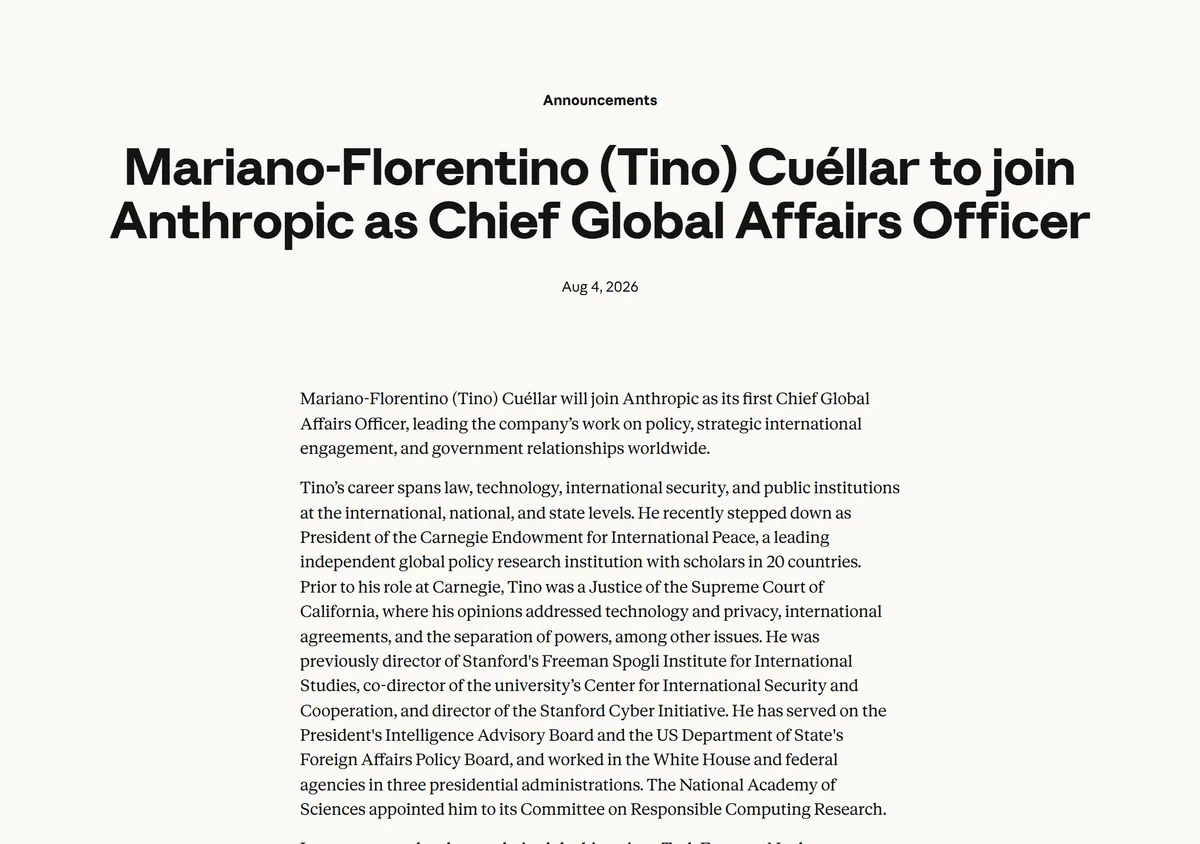 Figure: Anthropic’s announcement of the appointment, 2026-08-04 (source: anthropic.com)
The first sentence covers the whole remit: leading the company’s work on policy, strategic international engagement, and government relationships worldwide.
The announcement does not say whom he reports to. Reuters asked: a company spokesperson said Cuéllar reports to President Daniela Amodei and is based at the San Francisco headquarters, and that the job includes managing relationships with the US government and with the many countries where Anthropic is expanding.
The spokesperson described him as a “consensus builder”. In the circumstances of the time, the meaning of that word is plain.
Who is he?
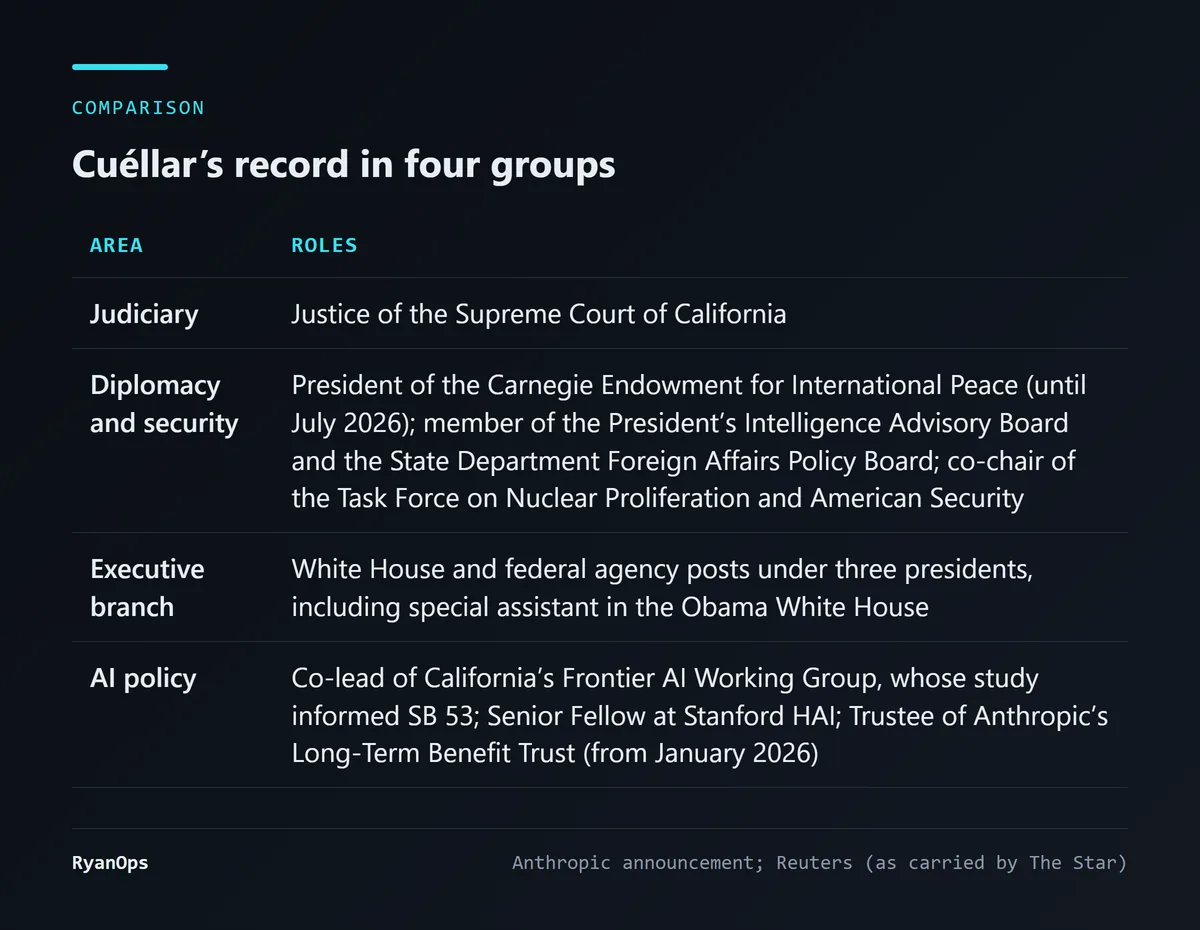 Figure: Cuéllar’s main roles (compiled for this article from Anthropic’s announcement and Reuters’ report)
The announcement lists more than a dozen titles. I find them easier to read in four groups.
Judge. He was a justice of the Supreme Court of California. The announcement says his opinions addressed technology and privacy, international agreements, and the separation of powers.
Diplomacy and security. Before Anthropic he was president of the Carnegie Endowment for International Peace, until July of this year according to Reuters. It is a policy research institution with scholars in 20 countries. He also served on the President’s Intelligence Advisory Board and the State Department’s Foreign Affairs Policy Board, and co-chaired a bipartisan task force on nuclear proliferation and American security.
Executive branch. The announcement says he worked in the White House and federal agencies under three presidents. Reuters adds that he was a special assistant in the Obama White House.
AI policy. He co-led California’s Frontier AI Working Group. Reuters notes that a study he co-led in 2025 informed California’s SB 53. That law protects AI whistleblowers, requires high-revenue developers to report on safety standards and incidents, and carries a maximum fine of $1 million per violation. Anthropic publicly endorsed the bill at the time.
He remains a chaired professor at Stanford Law School and a Senior Fellow at Stanford’s Institute for Human-Centered Artificial Intelligence (HAI).
What marks this record is that it spans three circles: the courts, national security and diplomacy, and AI regulation. Anthropic’s troubles at the time sat exactly where those three meet.
Why at this moment?
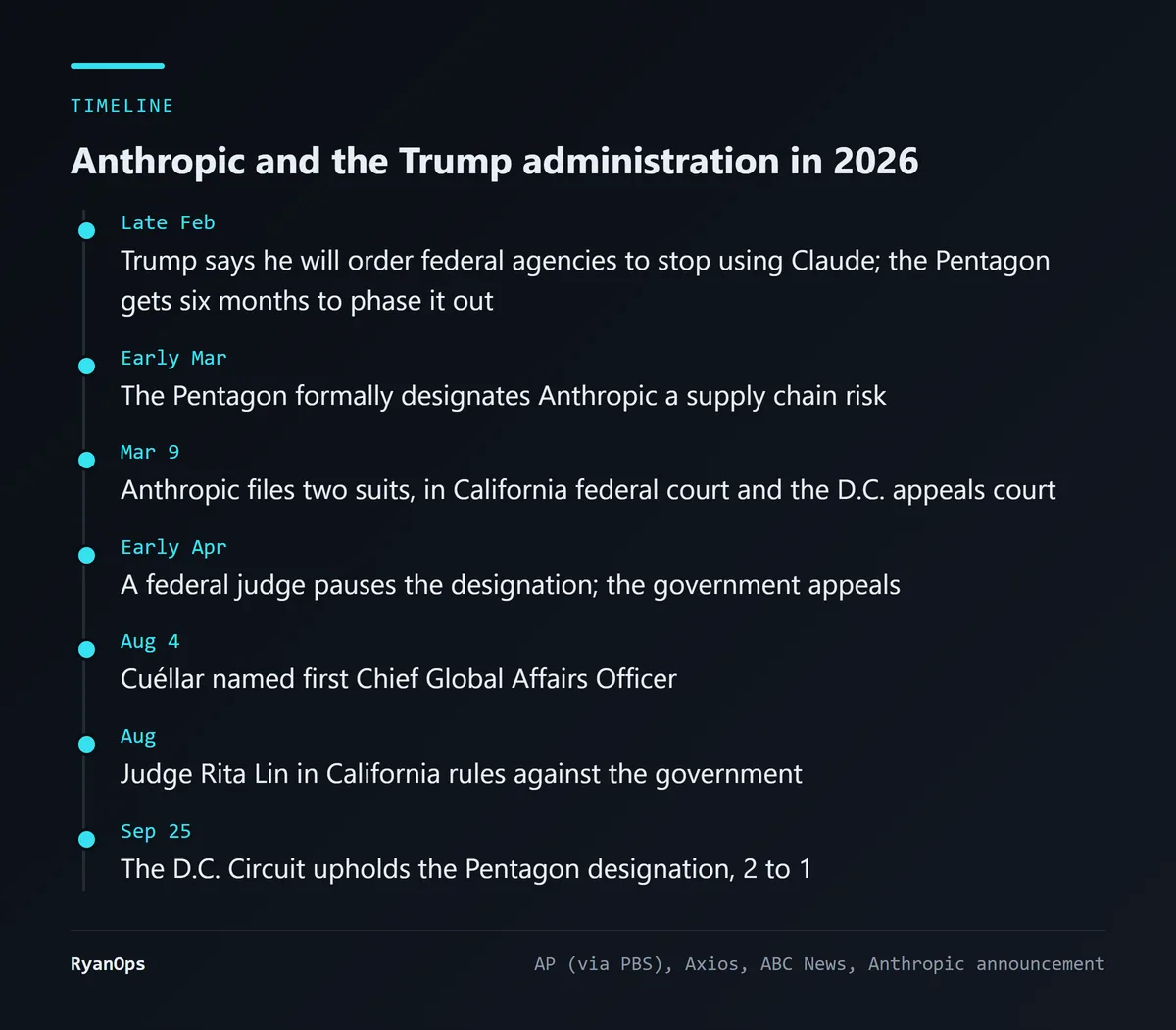 Figure: Timeline of the 2026 conflict between Anthropic and the Trump administration (compiled for this article from reports by AP, Axios and ABC News, and Anthropic’s announcement)
It started with two red lines on military use.
According to AP’s reporting in March, Anthropic sought to restrict Claude from use for “mass surveillance of Americans and fully autonomous weapons”. Defense Secretary Pete Hegseth insisted on “all lawful uses”. The two sides could not agree.
Then Trump said he would order federal agencies to stop using Claude and gave the Pentagon six months to phase it out, because the product was deeply embedded in classified military systems. In early March the Pentagon formally designated Anthropic a “supply chain risk”. AP wrote that it was the first known use of that authority against a US company.
On March 9, Anthropic filed two lawsuits, one in federal court in California and one in the federal appeals court in Washington, each challenging different parts of the government’s actions. The complaint called the actions “unprecedented and unlawful” and said the Constitution does not allow the government to wield its enormous power to punish a company for its protected speech.
There was a second front. In its report on Cuéllar’s appointment, Reuters mentioned that the administration later issued an export control directive that temporarily banned Anthropic from selling its top models, Mythos 5 and Fable 5, to foreigners, citing national security.
So on August 4, Anthropic had two court cases running at once, and overseas sales of its flagship models had just been through a round of controls. Reuters’ description of the appointment is that his task is to find common ground with the Trump administration.
My August piece had more detail in this section, including a phone call on June 12, a 90-minute deadline, and Trump’s words about “civil and criminal consequences”. I could not find a source for any of these this time and removed them.
How has the situation changed in two months?
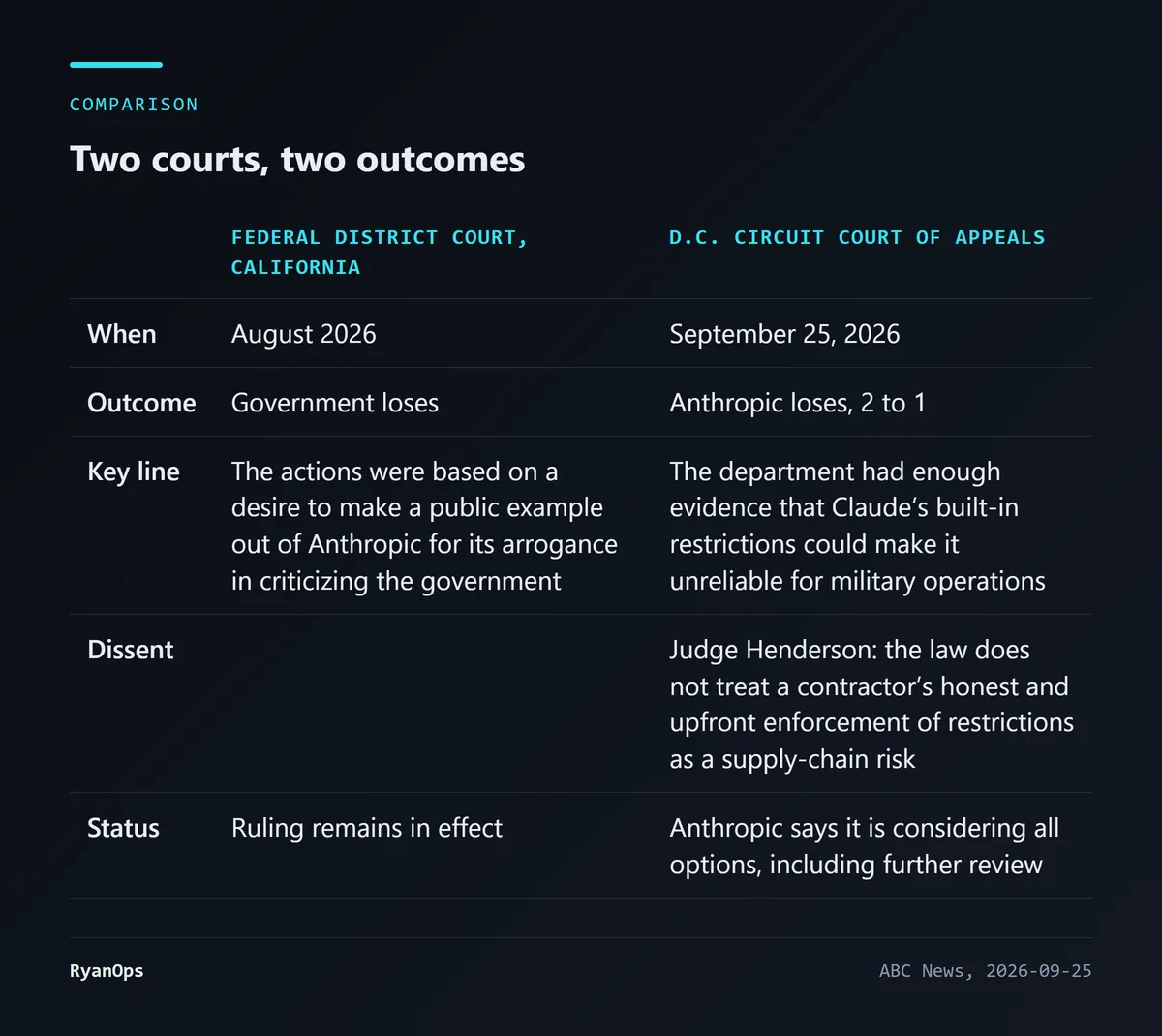 Figure: The two courts’ rulings in the Anthropic cases (compiled for this article from ABC News’ report of 2026-09-25)
The August piece stopped at “the litigation is ongoing”. Two rulings have come out since, pointing in opposite directions.
August, California. US District Judge Rita Lin ruled against the government. ABC News quotes one line of hers: the government’s actions “were based on a desire to make a public example out of Anthropic for its ‘arrogance’ in criticizing the government”. That ruling remains in effect.
September 25, Washington. The federal appeals court upheld the Pentagon’s designation by 2 to 1. The majority found that the department had enough evidence to conclude that Claude’s built-in restrictions, together with the unresolved contract dispute, could make it unreliable for military operations. The court also rejected Anthropic’s free speech and due process claims.
Judge Karen LeCraft Henderson dissented. In her view the law does not treat “a contractor’s honest and upfront enforcement of restrictions” as a supply-chain risk.
Hegseth’s reaction on X was one line: “Confirmed: @AnthropicAI = Supply Chain Risk.” Anthropic’s response was that it disagreed with the ruling, noted that another federal court had already held the government’s parallel designation unlawful, and said it was considering all options, including further review.
How can both rulings stand at once? Because they deal with different parts of the government’s actions. Put simply, the California case blocked the broader federal restrictions, and the Washington case upheld the Pentagon’s own designation.
I think one piece of the majority’s logic deserves your attention. According to The Next Web and other outlets, the court held that the law covers risks created by how a product operates, whether or not the supplier intended harm. On that reading, an AI company setting usage restrictions on its model can itself be treated as a source of risk. That affects every company that wants to sell models to the government, not only Anthropic.
What does he say himself?
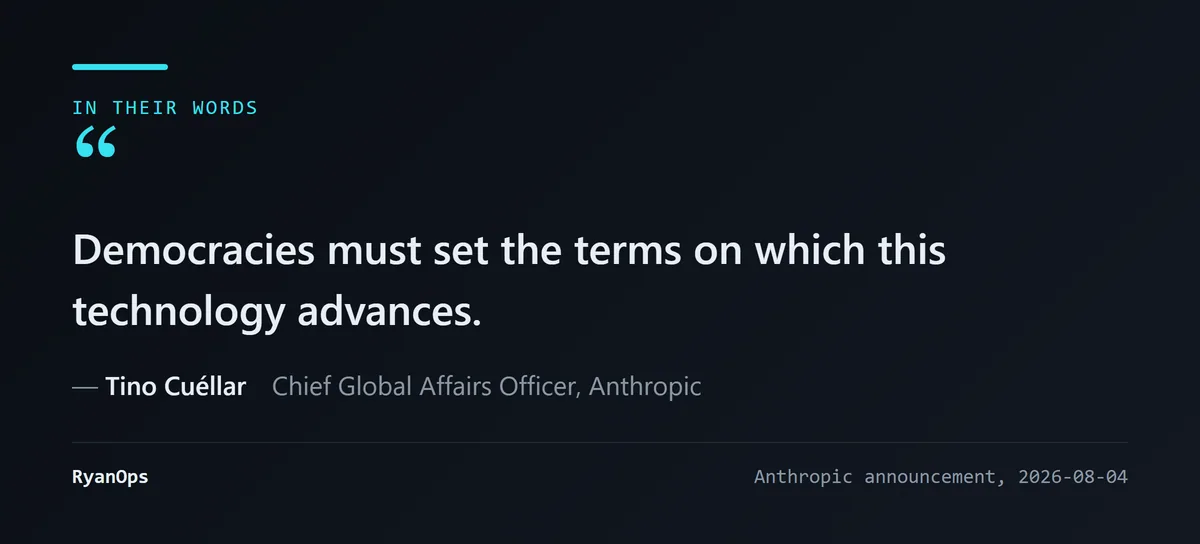 Figure: A line from Cuéllar in the appointment announcement (graphic made for this article; quoted from Anthropic’s announcement of 2026-08-04)
Cuéllar declined to be interviewed by Reuters. There is only a written statement.
In the announcement he says policymakers are realizing that “we are at a critical inflection point” in how AI is governed and developed. Then comes the line above, followed by the remark that there is no more consequential place to be shaping that work right now than Anthropic. In the statement Reuters quotes, he also mentions “enormous risk and growing inequality”.
Daniela Amodei’s version is that Tino has spent his career helping public institutions respond to times of change with thoughtfulness and pragmatism, and that she cannot think of anyone better prepared to partner with governments, civil society and community groups.
The outside comment carries more information. Oren Cass, founder of the conservative think tank American Compass, told Reuters that Cuéllar would be “open-minded” toward the Trump administration’s positions and that his approach would provoke good deliberative policymaking with the administration.
A former assistant in the Obama White House gets a favorable word from the founder of a conservative think tank. That is presumably the effect Anthropic wanted.
From overseer to executive
There is one detail to which the August piece gave a single sentence, and I now think it deserves more.
Since January 2026, Cuéllar had been a Trustee of Anthropic’s Long-Term Benefit Trust. He stepped down from the Trust to take this post.
The Trust is one of the more unusual designs in Anthropic’s governance. According to Reuters it is an independent four-person body. It exists so that a group of people with no direct stake in the company’s profits can act as a check on the company’s direction.
So this appointment amounts to a person who stood outside overseeing the company walking in to become an executive who reports to the president. The announcement says the Trust will select a successor through its normal process.
It is no scandal, and the process has been accounted for. But it does leave that four-person body one short, the one missing is someone who knows law and national security, and it happened while the company is in litigation with the government. I have not yet seen a successor announced.
Anthropic’s governance structure has been much discussed this year. In the piece on its leaked prospectus I went through what it wrote into its risk factors.
How do I see it?
I think this is the right person, but he can change less than the headline suggests.
Right, because Anthropic’s problem is no longer technical and not entirely legal either. The appeals court ruling is clear: once the Defense Department considers that your product’s restrictions make it “unreliable”, the law is on the department’s side. A situation like that cannot be won entirely in court. Someone has to negotiate. A person who has been a justice, has worked in the White House, and is regarded by the other camp as someone it can talk to is a reasonable choice.
Less, because the root of the conflict has not changed. Anthropic will not let its models be used for mass surveillance or fully autonomous weapons, and the government wants all lawful uses. That is a gap in positions, which better communication alone does not close. CEO Dario Amodei’s open letter in September showed the same insistence: there are things on which the company would rather apply the brakes itself. A global affairs chief can make the conversation smoother, but he cannot give ground on the company’s behalf unless the company decides to.
What would change my view? Two things. If the Pentagon withdraws the supply chain risk designation without a court order, negotiation really worked. Conversely, if Anthropic quietly rewrites the wording of those two red lines, the price of “finding common ground” was principle. Neither has happened so far.
For you, the practical meaning is this: if your product or workflow depends on one AI company’s models, that company’s relationship with governments is now one of the risks you have to weigh. Export controls can make a model unavailable in some regions overnight.
What this rewrite corrected
- The original said the government phoned Anthropic on June 12 and gave it 90 minutes to comply with an export control order, and that Trump threatened “major civil and criminal consequences”. I found no source for any of this and removed it. What can be found is Reuters’ description of an export control directive, with no date.
- The original said Trump issued his order on February 27 and Hegseth made the designation on March 3. AP’s report of March 9 says only that the designation came “last week”. I did not find exact dates, so this version says “late February” and “early March”.
- The original said he reports directly to the president without giving a source. The announcement itself does not say so. A company spokesperson told Reuters.
- The original stopped at “the litigation is ongoing”. This version adds the August ruling in California and the September 25 ruling of the D.C. Circuit.
- The original’s last paragraph said more and more AI labs were strengthening their policy teams, without giving an example. It had no basis and was removed.


