DeepSeek V4 Pro Went GA Quietly. DeepSWE Rose 5x.
V4 Pro left preview on Aug 12 with no announcement. What changed: weights a day later, a price rise in four days, near-retirement in a month.
On August 12, DeepSeek’s flagship model V4 Pro ended a preview period of nearly four months. The company published no post and no announcement page; the version string quietly became 0813.
When I wrote this story up in August, all I had was second-hand reporting, and I treated it as a preview being renamed and made official. Two months on, the material has filled in: the model card went up on Hugging Face, the price changed twice, and it came close to being replaced by the company’s own newer model.
Put together, V4 Pro’s graduation mattered more than it looked at the time, and it was shorter-lived than it looked.
What did “going official” actually change?
I assumed at the time that it was only the preview label coming off. The model card says otherwise:
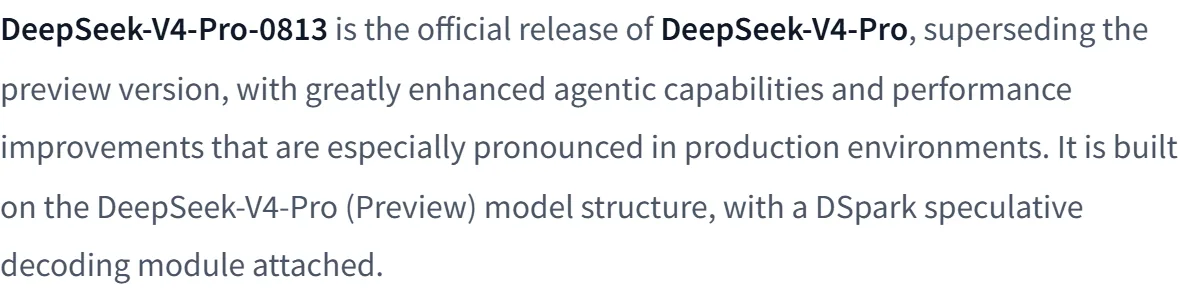 Figure: the opening description on the DeepSeek-V4-Pro-0813 model card (source: huggingface.co)
Three points: it supersedes the preview; agentic capabilities are “greatly enhanced”; the structure carries over from the preview, with a speculative decoding module called DSpark attached.
Everyone uses the word “greatly”, so I went to the numbers. On the same model card, DeepSeek lists the preview and the 0813 build side by side:
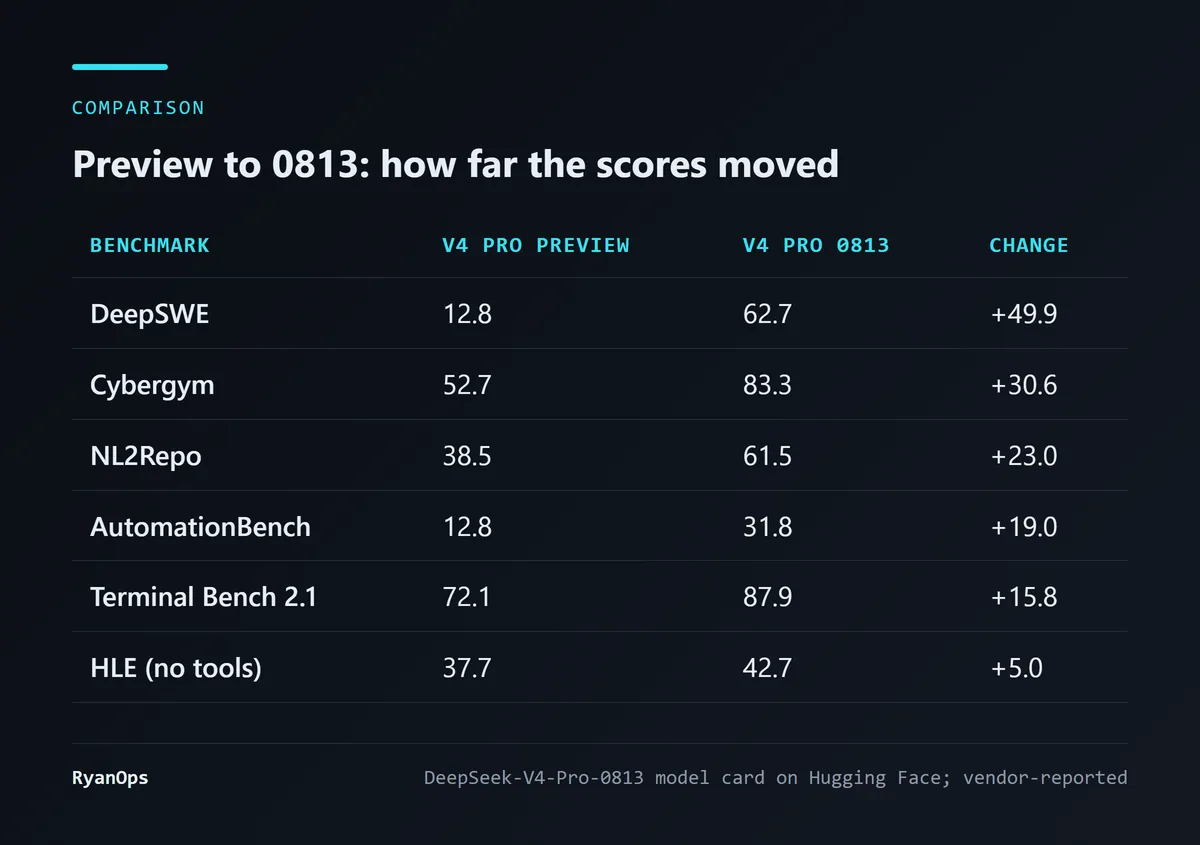 Figure: the gap between the V4 Pro preview and the 0813 build (compiled for this article; figures from the DeepSeek-V4-Pro-0813 model card, vendor-reported)
DeepSWE goes from 12.8 to 62.7, nearly five times. Cybergym gains 30 points. Terminal Bench 2.1 gains 15.8.
Look at HLE (Humanity’s Last Exam, which tests knowledge and reasoning) and it gains only 5.
That distribution alone tells you what the four months went into. The knowledge-type score barely moved, and every score that requires actually doing things rose sharply. In other words, the underlying model is about as “smart” as before; what changed is whether it finishes the job when acting as an agent.
It also explains something that looked odd at the time. On July 31 the smaller V4 Flash went official first, and the change log then said the official Pro release “will follow soon”. The small one shipping before the large one is probably because this agentic training was completed on the small model first. On the same table, Flash’s 0731 build scores 54.4 on DeepSWE, already far above the Pro preview’s 12.8.
The model card lists one more change: the reasoning_effort parameter now supports three levels, low, high and max.
How did this model get here?
Lining up the milestones I could find:
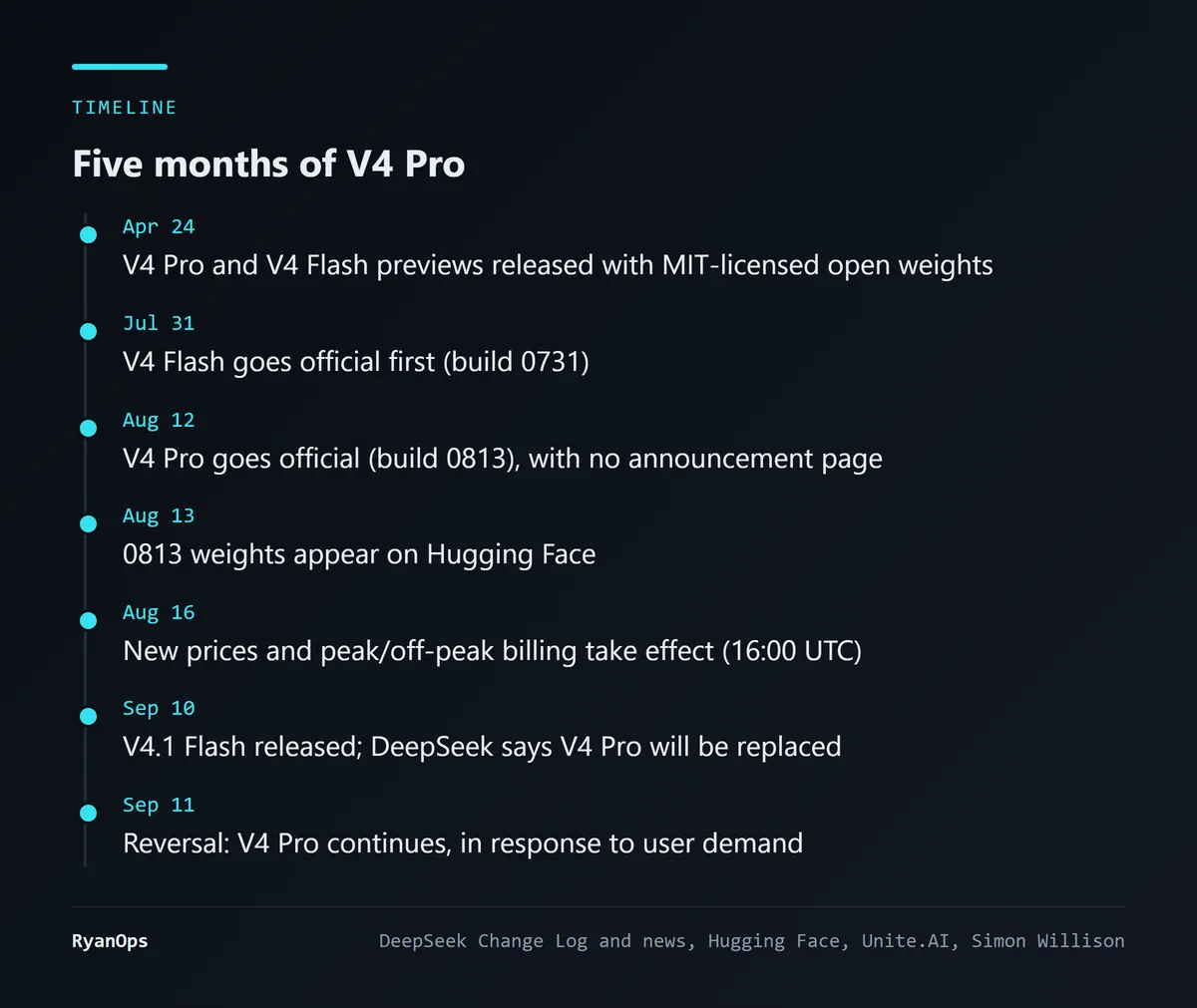 Figure: V4 Pro from preview to near-retirement (compiled for this article from DeepSeek’s change log and news, Hugging Face, Unite.AI and Simon Willison)
The April 24 preview is the starting point. Unite.AI cites the model card’s specs: 1.6 trillion total parameters, with 49 billion active per token, in a mixture-of-experts (MoE) architecture. MIT licensed, with open weights. A 1 million token context and a maximum output of 384,000.
The architectural selling point is two compressed attention mechanisms, which DeepSeek calls Compressed Sparse Attention and Heavily Compressed Attention. DeepSeek claims that at the million-token setting, compared with the previous generation V3.2, single-token inference compute falls to 27% and KV cache usage to 10%. Both numbers are the vendor’s own.
The August article described this mechanism as “DSA sparse attention”. I couldn’t find that abbreviation in the sources this time and have changed it.
Were the weights released?
The last section of the August article was headed “open source is still a question mark”. On the day it went official, Hugging Face had only the April preview builds, and Unite.AI wrote that DeepSeek hadn’t announced a timeline for 0813 weights.
The answer came the next day. Developer Simon Willison added an update to his August 12 note: the weights are up, 1.7 trillion parameters, 893 GB. I looked at DeepSeek’s model list on Hugging Face this time, and DeepSeek-V4-Pro-0813 shows a last-updated date of August 13, again under the MIT license.
So that question mark can go. Three times running (the April preview, July’s Flash, August’s Pro), DeepSeek has released the weights of the official build.
“Released” and “you can run it” are different things, though. For an 893 GB model, the inference example on the model card is a single node with four GB300s. That isn’t equipment an individual or a small team has. For most people, the practical meaning of open weights is that other cloud providers can host it, so you aren’t locked into DeepSeek’s own API. For the definition of the term, see the glossary.
What happened to the price?
This is the one place the August article got the future right. The pricing page then said a “significant increase” was planned, and I wrote that this might be the cheapest moment.
It was.
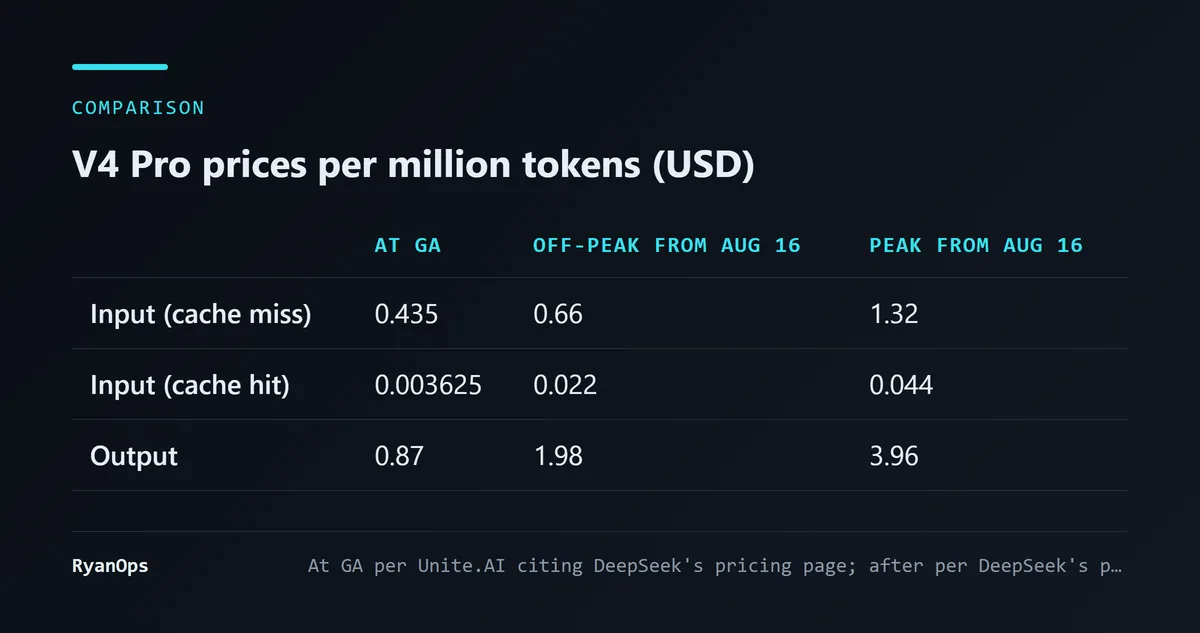 Figure: V4 Pro’s prices at GA and after the change (compiled for this article; at GA per the pricing page as cited by Unite.AI, after per DeepSeek’s pricing page)
At GA it kept the preview-period prices: $0.435 per million input tokens, $0.003625 for cache hits, $0.87 for output.
The August 13 entry in DeepSeek’s change log says new prices take effect at 16:00 UTC on August 16, introducing peak and off-peak rates, with off-peak at half of peak.
Worked out:
- Output goes from $0.87 to $1.98 off-peak, 2.3 times. Peak is $3.96, 4.6 times.
- Cache-miss input goes from $0.435 to $0.66 off-peak, 1.5 times. Peak is $1.32, 3 times.
- Cache-hit input rises the most, from $0.003625 to $0.022 off-peak, 6 times. Peak is $0.044, 12 times.
So the cheap price after going official existed for four days. I worked through the multiples in RMB in the price-hike countdown piece, with the same conclusion: cache hits rose hardest, and that happens to be the item agentic workloads use most, because agents send the same prefix over and over.
The sequence is interesting. The model got stronger on August 12, the price increase was announced on August 13, and it took effect on August 16. The capability upgrade and the price adjustment came as one package.
And a month later it was nearly retired?
Yes. On September 10 DeepSeek released V4.1 Flash, and the official post said that from September 14 all requests to V4 Pro would be handled by the new model. One month after going official, the flagship was to be replaced by a model named Flash.
The next day the pricing page gained a footnote: in response to user demand, V4 Pro continues after September 14. As I write this it’s still on the price list. I went through that sequence in another piece.
Seen end to end, V4 Pro’s life cycle runs like this: four months in preview, a price increase four days after going official, an announced replacement a month after going official, and then being kept by its users.
What does this mean if you use it?
Three points in my own view.
The version string matters more than the model name. Under the name “V4 Pro”, what existed in April and what existed in August differ several-fold on agentic tasks. If you tested it in April and found it wanting, that conclusion doesn’t hold for 0813. Conversely, if your pipeline was tuned against a particular build, an unchanged name doesn’t mean unchanged behavior.
DeepSeek doesn’t announce much, so you have to watch for yourself. There was no post for this release. The scores leaked first from a WeChat group; I wrote about that, and about the table where it measures itself against Anthropic’s flagship, in a separate piece the same day. To follow this company’s changes, its official change log and pricing page are more reliable than the news.
The cheap window is short. Four days. The next time a pricing page says an increase is planned, that’s meant literally.
What would change my assessment of this model? Independent testing. Every score in this piece is DeepSeek’s own, including the jump from 12.8 to 62.7. The model card itself notes that two of the rows (DSBench) are internal test sets. Until a third party reruns them, these numbers tell you the direction, not a precise ranking.
What this rewrite corrected
- The original treated going official as simply ending the preview. The model card shows the 0813 build’s scores on agentic tasks are far from the preview’s, with a new decoding module added.
- A set of scores the original listed (SWE-bench Verified 80.6% and others) are the April preview’s results, not the 0813 build’s. This version uses the comparison table on the 0813 model card.
- The original said Gemini 3.1 Pro scored 80.8% on SWE-bench Verified. Unite.AI’s wording is that V4 Pro is level with Gemini 3.1 Pro and behind Claude Opus 4.6 at 80.8%. That comparison belongs to the preview and isn’t kept here.
- The original said whether 0813 weights would be released was a question mark. The weights were up on August 13.
- The original mentioned old API aliases being retired on July 24. I didn’t confirm that in the sources this time and removed it.
- I haven’t run this model myself and don’t have hardware that could.


