Codex Has Reset Limits 48 Times Since April
OpenAI's Codex lead announced 15 million users and a reset on August 13. His posts show a reset every four days and a user count redefined in July.
On August 13, Thibault Sottiaux, who leads Codex at OpenAI, announced on X that Codex had passed 15 million and that everyone’s usage limits were being reset. People call him Tibo.
When I wrote the August piece I did not have the original link to that post and could only cite second-hand accounts. This time I found the link, and while I was at it I went through his reset announcements one by one, back to April.
Two things came out of that. First, resets happen far more often than “once per additional million users”: 48 times from April to now. Second, somewhere between 3 million and 15 million, the thing being counted changed.
What did the August 13 post say?
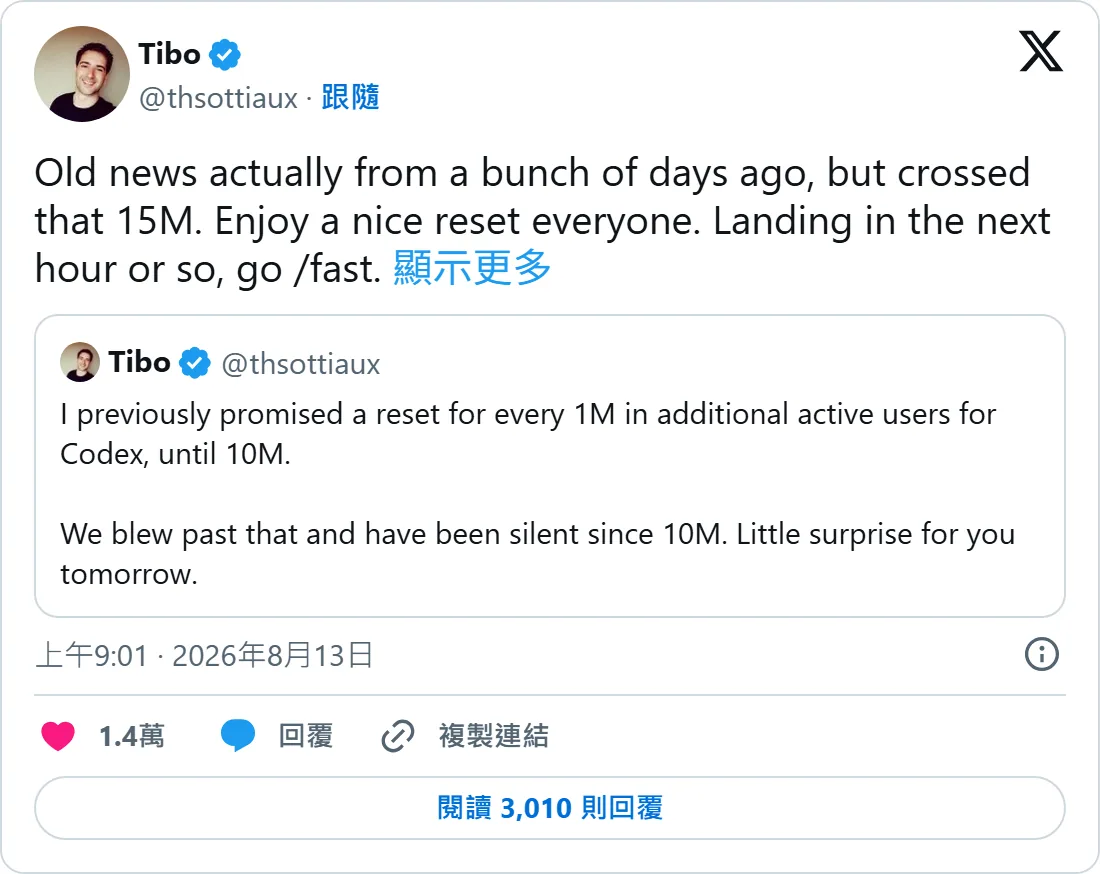 Figure: Tibo’s post announcing 15 million; the time shown is Taipei time, 9:01 AM on 2026-08-13 (source: x.com/thsottiaux)
It is two posts stacked together.
The quoted one underneath was posted the day before: “I previously promised a reset for every 1M in additional active users for Codex, until 10M. We blew past that and have been silent since 10M. Little surprise for you tomorrow.”
On top is the answer the next day: “Old news actually from a bunch of days ago, but crossed that 15M. Enjoy a nice reset everyone. Landing in the next hour or so, go /fast.”
/fast appears to refer to Codex’s fast mode. The sense is roughly: your quota is full, go ahead and use the fast one.
A “reset” here means wiping the usage you have already consumed this week. Paid Codex and ChatGPT plans both have weekly usage caps, and the idea of usage limits is explained in the glossary. One reset amounts to an extra week of quota.
The 15 million figure is OpenAI’s own and has not been audited by any third party. The August piece said so, and it is still the case.
How did “a reset per million” begin?
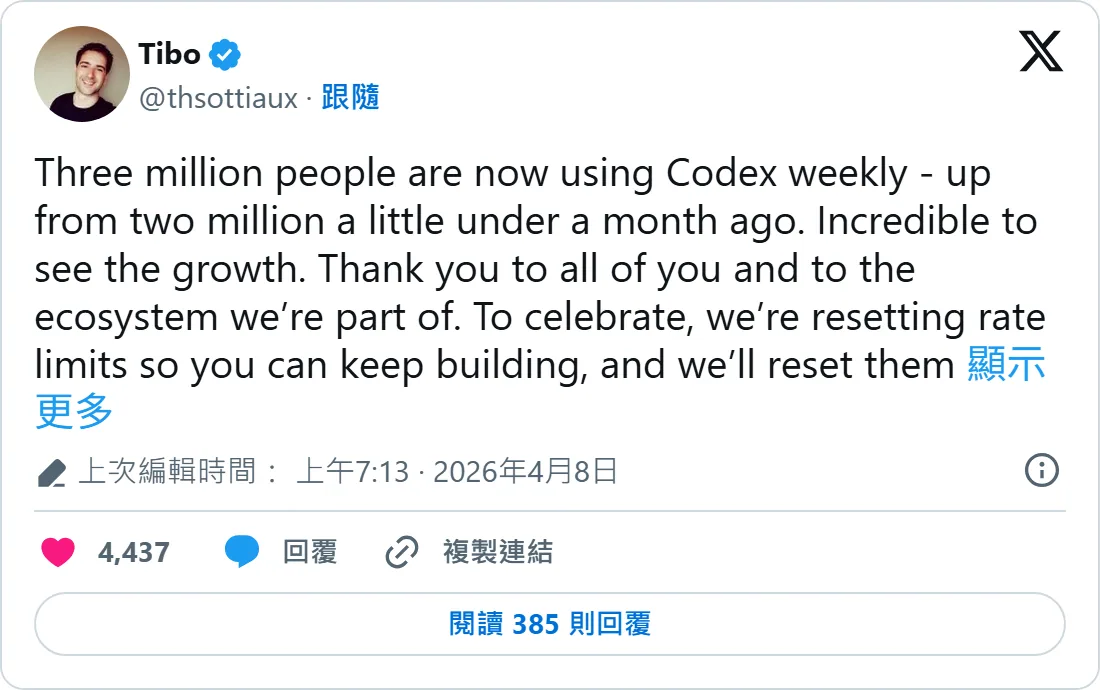 Figure: Tibo announcing 3 million weekly Codex users and a limit reset; the time shown is Taipei time, 7:13 AM on 2026-04-08 (source: x.com/thsottiaux)
It started on April 7, US time.
Tibo’s post says three million people are now using Codex weekly, up from two million a little under a month before, and that limits are being reset to celebrate.
Sam Altman posted the same day. As quoted by Business Today: “To celebrate 3 million weekly Codex users, we are resetting usage limits. We will do this for every million users up to 10 million.”
Note the wording: weekly Codex users. The number of people using Codex each week. That definition matters in a moment.
When did the yardstick change?
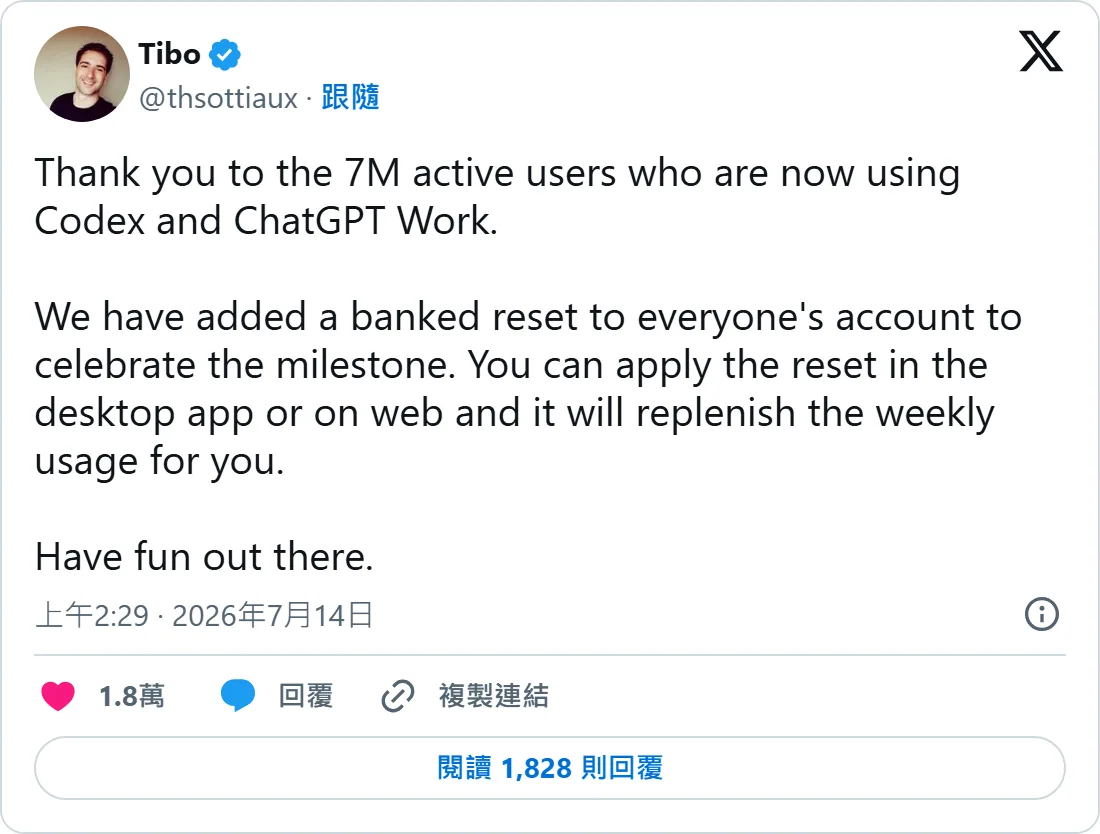 Figure: Tibo announcing 7 million active users; the time shown is Taipei time, 2:29 AM on 2026-07-14 (source: x.com/thsottiaux)
By July the wording had changed: “Thank you to the 7M active users who are now using Codex and ChatGPT Work.”
April counted weekly Codex users. July counted active users of Codex plus ChatGPT Work. ChatGPT Work is another product OpenAI launched in July, also powered by Codex.
Eight days later, on July 21, Tibo posted “10M!” with a chart titled “ChatGPT Work + Codex weekly active users”. Startup Fortune’s account notes that Bloomberg also reported 10 million across Codex and ChatGPT Work at the time, and that The Next Web pointed out this measures weekly usage of two products, not paid seats or revenue.
Line up the dates:
- April 7: 3 million (Codex)
- July 13: 7 million (Codex plus ChatGPT Work)
- July 21: 10 million (same)
- August 13: 15 million (the post says only Codex and does not state the basis)
Going from 3 million to 7 million took more than three months. Going from 7 million to 10 million took eight days. That acceleration came after ChatGPT Work launched, with the two products counted together.
So I would not read this line as “Codex users grew fivefold in four months”. The more accurate statement is that weekly actives across OpenAI’s agent products reached 15 million, and how many of them are Codex users in the original sense has not been published.
The August piece mentioned it was “unclear whether ChatGPT Work is included”. That can now be said more firmly: for the two July figures at least, the posts themselves say they are combined.
How frequent are the resets?
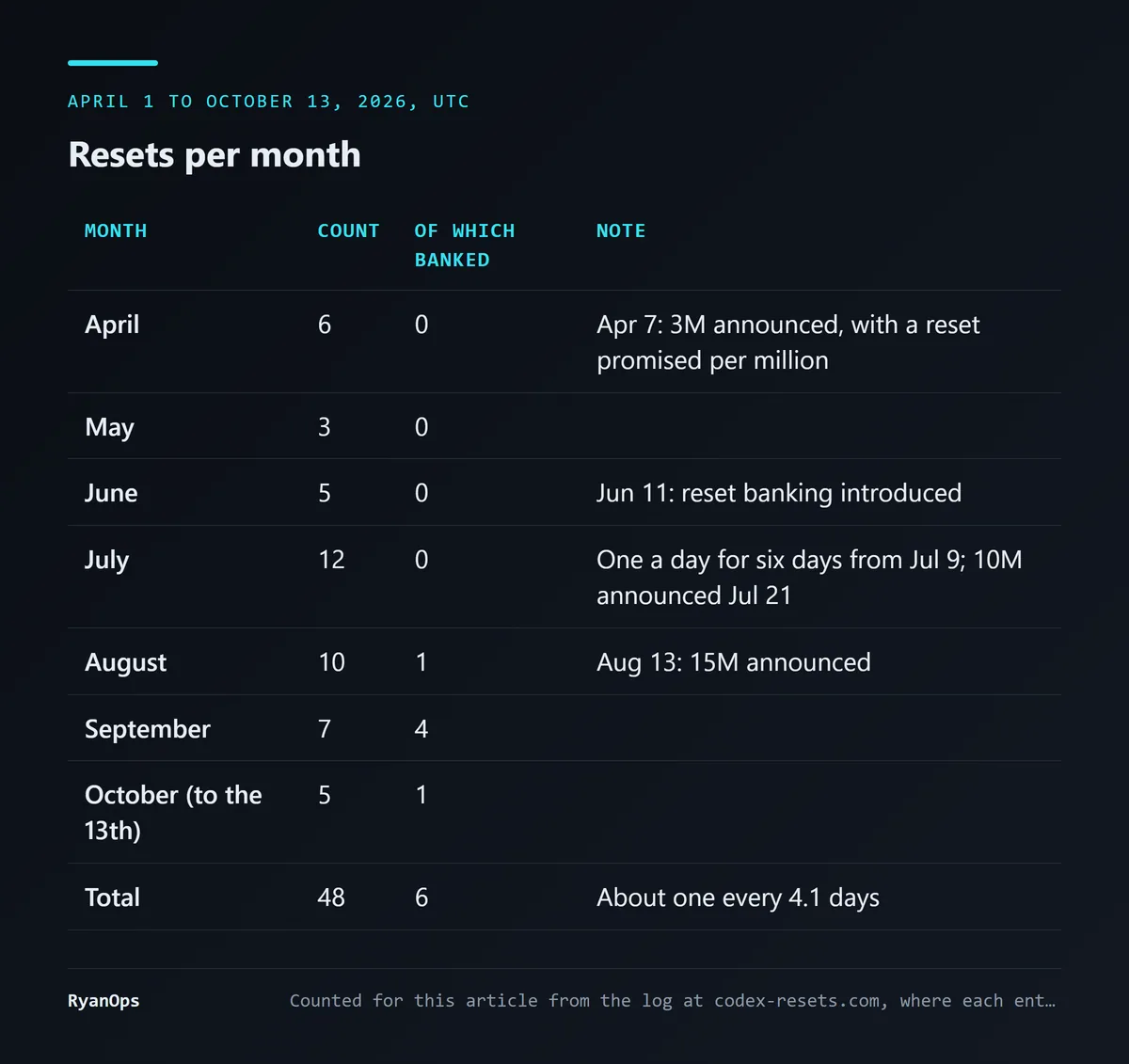 Figure: Codex resets per month since April 2026 (counted for this article from the log at codex-resets.com, where each entry links to a post by Tibo)
If it really were “one per million”, going from 3 million to 15 million would mean about 13 resets.
In fact there were 48. I counted them from the log kept by the tracker site codex-resets.com, for April 1 to October 13. Every entry there links to one of Tibo’s posts. I opened several of them and the contents matched.
That is one every 4.1 days on average. Codex quota already resets weekly, so this amounts to turning a weekly quota into one that is topped up roughly every four days.
July was the densest month. From July 9 to 14 there was one every day for six days. ChatGPT Work had just launched around that week. The August piece described this stretch in detail, including a temporary removal of the five-hour cap, an inference optimization worth about 10% more quota, and a make-up reset for about 500,000 people. I did not find a matching post for each of those details this time, so I will not repeat them. What is certain is that there was a reset announcement on each of those six days.
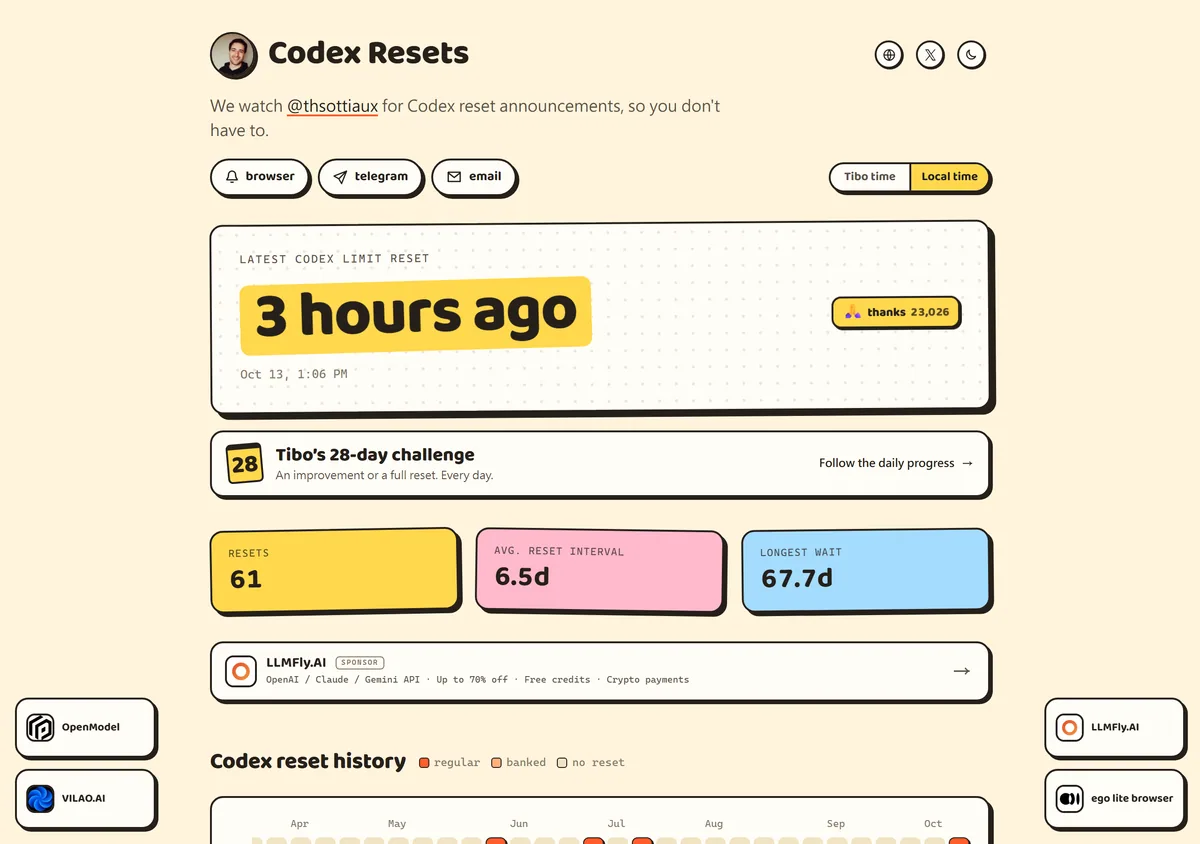 Figure: A community tracker of Codex resets, captured 2026-10-13 (source: codex-resets.com)
The tracker itself says a lot. Its tagline is “We watch @thsottiaux for Codex reset announcements, so you don’t have to”. It offers browser notifications, Telegram and email subscriptions.
A product’s quota policy requires someone to build a site that follows one executive’s personal account. I find that a little absurd, but it is real.
The running total on its home page is 61, counted from September 2025, with an average interval of 6.5 days. That differs from my 4.1 days because the starting point differs. Resets before April were sparse, and the longest wait was 67.7 days.
The August piece gave the site’s address as codex-reset.com, missing an s, and the count as 37, the figure at the time. Both are out of date.
What was the “performative reset” about?
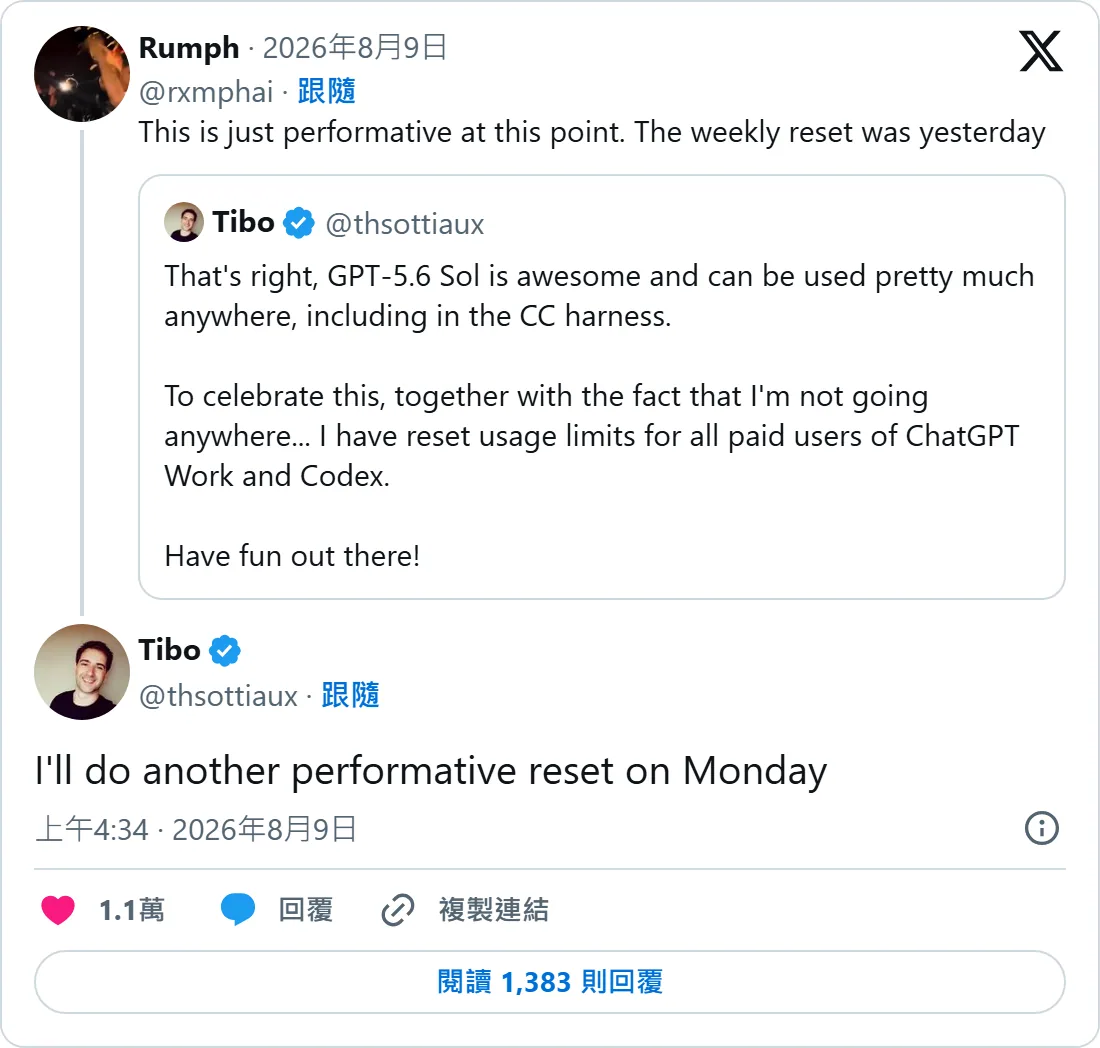 Figure: Tibo answering the charge that resets are for show; the date shown is Taipei time, 2026-08-09 (source: x.com/thsottiaux)
This exchange took place four days before the 15 million post.
Tibo had announced a reset, giving as reasons that GPT-5.6 Sol is awesome and “the fact that I’m not going anywhere”. A user replied: “This is just performative at this point. The weekly reset was yesterday.”
Meaning: my quota was wiped automatically yesterday, so if you reset it again today I gain nothing.
Tibo’s reply: “I’ll do another performative reset on Monday.”
He did. The tracker’s log has an entry at 00:27 UTC on August 11, which is Monday in US time.
The joke points at a real problem with the mechanism. An automatic reset is not worth the same to everyone. If your weekly quota is almost gone, it is an extra week. If your quota refreshed yesterday, it is nothing.
People on the OpenAI developer forum put it more bluntly. One user said automatic resets overwrite his remaining quota and that he would prefer to bank them and decide when to use them. Another said it is hard to plan usage around what “one guy on Twitter” says.
Did reset banking solve the problem?
Half of it.
According to Startup Fortune, OpenAI introduced reset banking on June 11. A reset you receive can be saved and applied manually later in the desktop app or on the web. The 7 million post above handed out one of that kind.
The tracker’s log shows more banked resets since August. Four of September’s seven were banked. That is the right direction.
But there is a time limit. OpenAI’s release notes say banked resets are usable for 30 days after they are granted. That is the subject of Startup Fortune’s headline, and its verdict is: “Thirty days is not a bank. It is a short-dated coupon.”
The article gives examples from the forum. One user saw four banked resets on July 8, used one, and later found only two left, expiring on August 1 and August 12. The interface at the time did not show the expiry date of each one. Someone also opened a GitHub issue asking for a longer window, on the grounds that in months with vacation, travel or illness there is no chance to use them.
In early September, OpenAI Support replied on the forum that banked and automatic resets work differently, that the request for more control over when promotional resets apply would be passed along, and that there was no timeline to share.
How do I see it?
The August piece ended with a question: once there are no more million-user thresholds to celebrate, will developers whose appetite has grown be willing to go back to the original quota?
Two months later, the answer is that the question has had no chance to be tested. The resets have not stopped. There have been 18 more since August 13. The tracker’s home page even shows a “Tibo’s 28-day challenge”, described as an improvement or a full reset every day.
My view is that at this frequency it is no longer a celebration. It is the actual quota policy. The weekly quota on paper is one number, and what you really get is at most about 1.7 times that number (7 days divided by 4.1), with the exact amount depending on which day of your cycle each reset lands. The extra part is not guaranteed, has no schedule, and depends on one person’s posts.
This suits OpenAI. It can withdraw the extra at any time without announcing a quota cut. Anthropic took a different route: it wrote the bonus up as a time-limited promotion and announced an extension before each expiry. I went through that in the piece on Claude Code’s 50% weekly bonus, which was extended four times. The two approaches have much the same effect. The difference is that one is written in an announcement and the other in a tweet.
For you, three pieces of advice are more practical.
- Estimate usage against the quota on paper, not the quota including resets. Treat the extra as a bonus. If the resets stop one day, your workflow will not break.
- Note the expiry date of banked resets. After 30 days they are gone, and the interface may not remind you.
- If your quota refreshes on a fixed day each week, what an automatic reset is worth to you is a matter of luck. You cannot control it, but knowing it at least spares you the feeling of being cheated.
What would change my view? If OpenAI wrote this extra quota into its plan descriptions, for example by raising the weekly cap outright, the bonus would become a commitment. So far it has chosen not to.
The August piece also had a passage guessing that the wave of resets was related to low-price competition from Chinese models. That was community speculation, and I marked it as such then. I have no new evidence for or against it, so I am not expanding on it this time.
What this rewrite corrected
- The original said the original links to Tibo’s two posts could not be found. They have been found, and screenshots and links are included.
- The original gave the tracker as codex-reset.com with a total of 37. The correct address is codex-resets.com and the total is now 61.
- The original said that on July 13 OpenAI reset limits for 6 million active users and issued a make-up reset to about 500,000. Tibo’s post that day says 7 million active users and grants a banked reset. I did not find a source for the 500,000 figure and removed it.
- The original quoted an Altman post about 4 million users and Hacker News comments such as “like Christmas” and “free spins on a slot machine”. I did not find the originals this time and removed them.
- The original did not point out that the basis of the user count changed from “weekly Codex users” to “active users of Codex and ChatGPT Work”. That is added here.
- The original attributed the 30-day limit on banked resets to the developer forum. The more direct source is OpenAI’s release notes of June 11, cited here via Startup Fortune.


