Gemini 3.7 Flash Lasted 56 Days at Half Price
Google launched Gemini 3.7 Flash at half the list price. The discount ends December 31, and the model itself was replaced by 3.8 on October 8.
On August 13, Google released Gemini 3.7 Flash at $0.75 per million input tokens and $3.75 per million output tokens, half the original price of the previous version.
My August headline said “price cut in half”. The text called it Google’s counterattack on OpenAI and Anthropic and “a rare window”.
Two months later I opened Google’s pricing page and 3.7 Flash was no longer on it. It was deprecated on October 8, 56 days after launch. If you send a request to gemini-3.7-flash now, a different model answers.
So this rewrite covers three things: what that half price really was, how the model disappeared, and what to watch for if your code has a Gemini model name written into it.
Half of what?
The Wayback Machine holds two versions of the pricing page from August, which makes a convenient comparison.
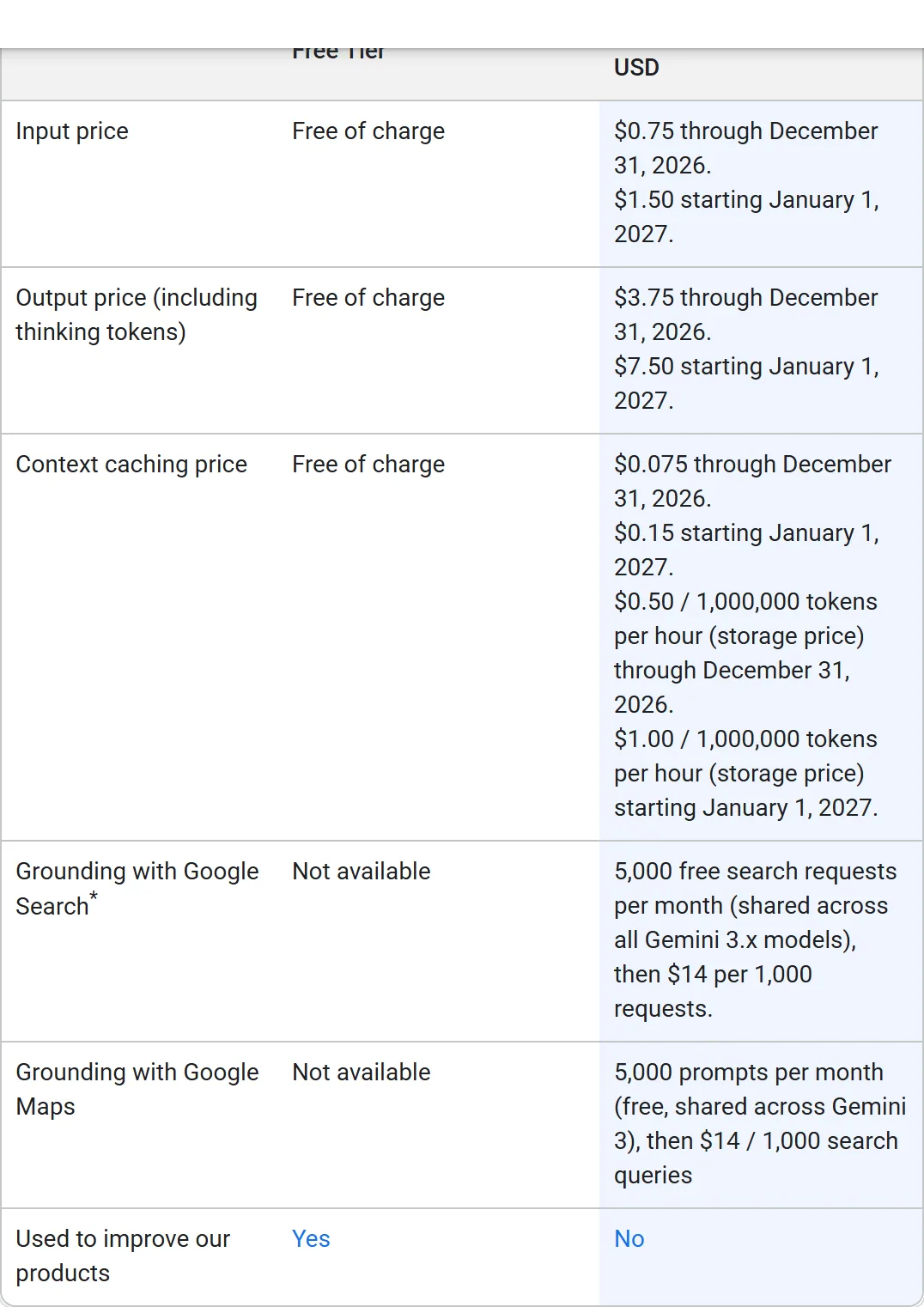 Figure: Gemini 3.7 Flash pricing, from the Wayback Machine capture closest to 2026-08-25 (source: ai.google.dev)
Every cell has two lines. Input is “$0.75 through December 31, 2026”, and the next line is “$1.50 starting January 1, 2027”. Output is $3.75, then $7.50. Caching likewise doubles afterwards.
So this model’s list price is in fact $1.50 and $7.50. The $0.75 and $3.75 are a time-limited offer.
Now the previous version. This is a capture from early August, before 3.7 Flash was released:
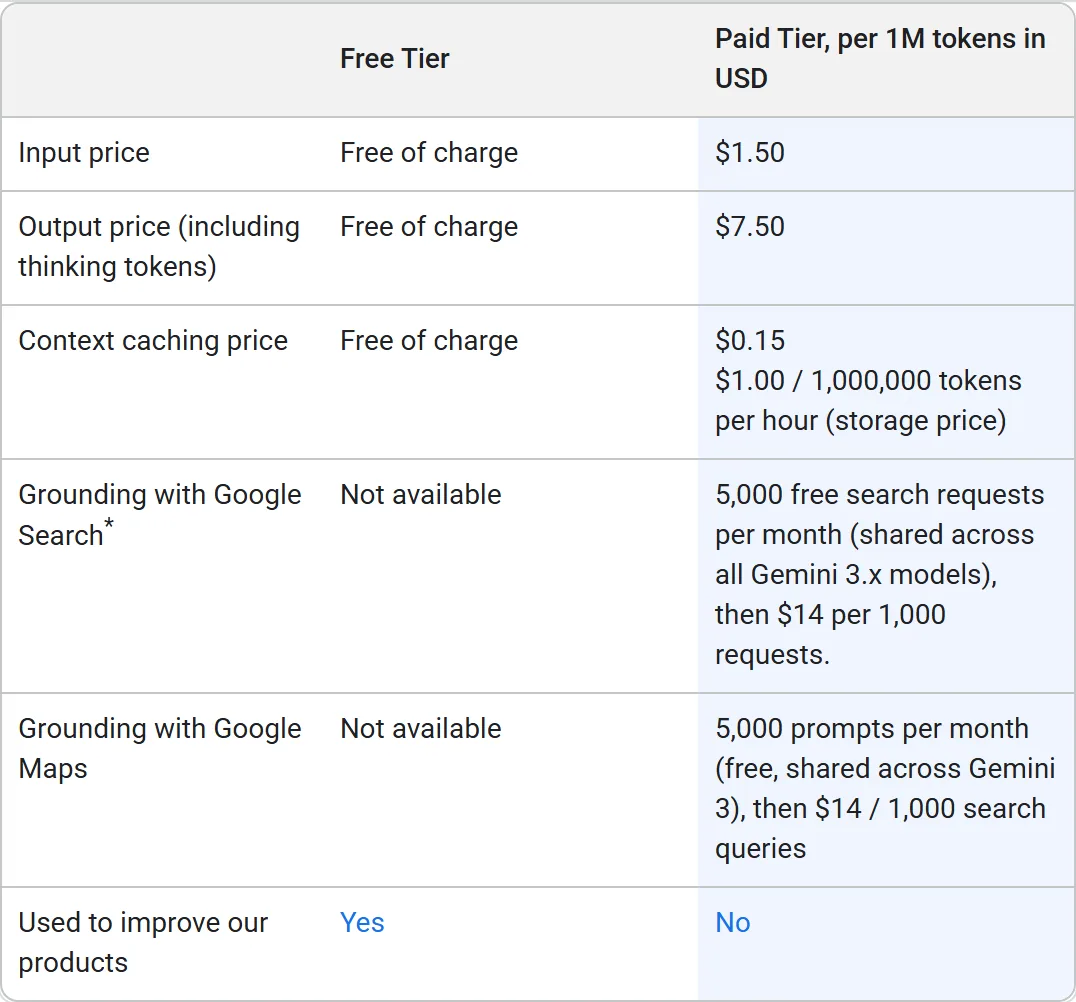 Figure: Gemini 3.6 Flash pricing before 3.7 was released, from the Wayback Machine capture closest to 2026-08-01 (source: ai.google.dev)
$1.50 and $7.50, with no note of any kind.
Put the two images side by side and the picture is clear. The list price of 3.7 Flash is identical to that of 3.6 Flash. Google did not cut the price of Flash. It gave the new model 50% off until the end of the year.
Verdict’s wording, relaying Google’s launch post, was accurate: the introductory rate is half of 3.6 Flash’s “original rate”, “through the end of the year”. My August piece did mention “temporary promotional pricing” and the end date, but the headline and the conclusion both treated it as a price cut. The two are very different. A price cut is a new normal. A promotion ends.
What improved in the model itself?
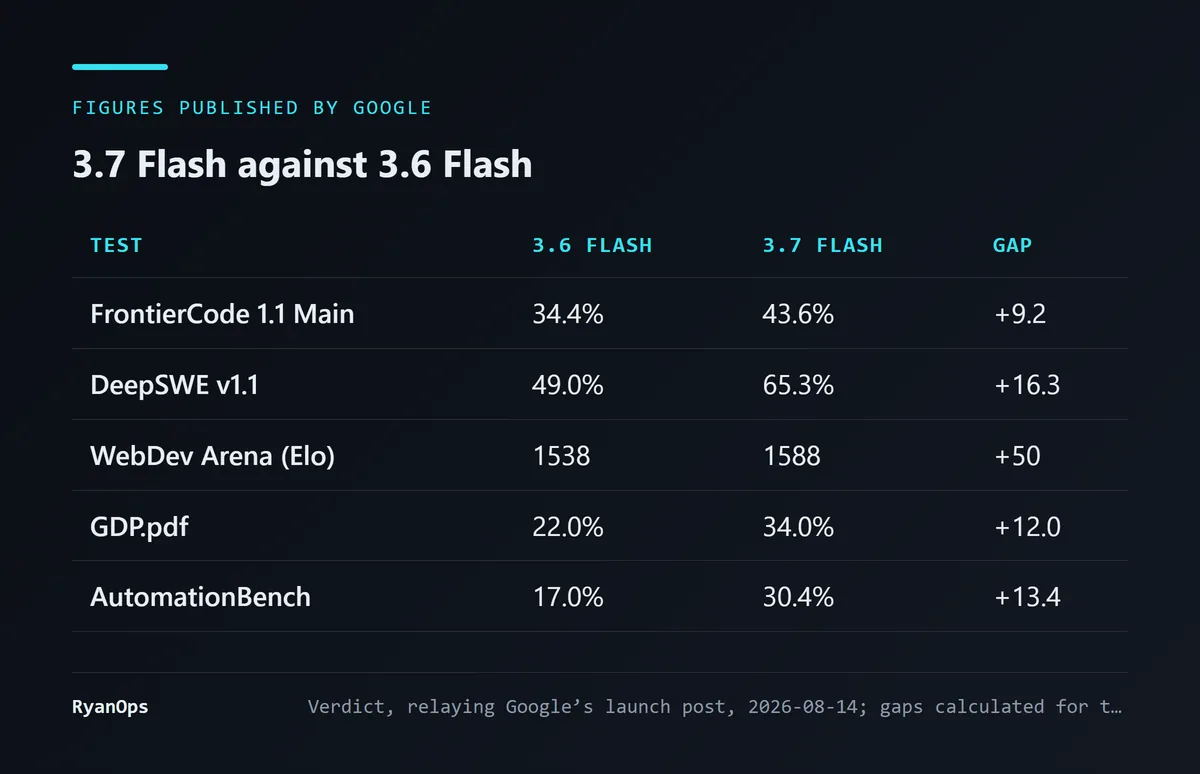 Figure: Google’s published comparison of 3.7 Flash and 3.6 Flash (compiled for this article from Verdict’s account of Google’s launch post, 2026-08-14)
These five numbers were published by Google, and the baseline is 3.6 Flash, released just three weeks earlier.
The largest gain is on DeepSWE, from 49.0% to 65.3%, up 16.3 points. That test measures whether a model can solve real software engineering problems. AutomationBench went from 17.0% to 30.4%, measuring business workflow automation. How to read benchmark scores is covered in the glossary.
According to Verdict, Google positions 3.7 Flash for coding and knowledge work: higher first-pass accuracy, debugging, issue resolution, and production-ready code generation. For web development it can generate interfaces directly from screenshots or reference designs. Google also says it has improved accuracy and reasoning in finance, law and biosciences.
The 65.3% on DeepSWE can be placed in a larger picture. In the DeepSeek V4 Pro piece I went through the same test: DeepSeek’s flagship scores 62.7 and Claude Fable 5 scores 70.0. That table was measured by DeepSeek and this number by Google, and the version labels differ slightly, so they cannot be ranked directly. But in order of magnitude at least, a Flash model positioned as “fast and cheap” now scores in the range of other vendors’ flagships.
Sixteen points on DeepSWE within three weeks is a very unusual jump. I cannot tell whether the model really improved that much or was tuned for these particular tests. Both numbers rest on Google’s word alone.
My August piece listed Google Antigravity among the access channels. Verdict’s report does not mention that name. It lists the Gemini API, Google AI Studio, Android Studio, and Google’s enterprise and consumer agent platforms. The consumer agent product is called Gemini Spark and is open to AI Pro and Ultra subscribers in more than 160 countries.
How did it disappear?
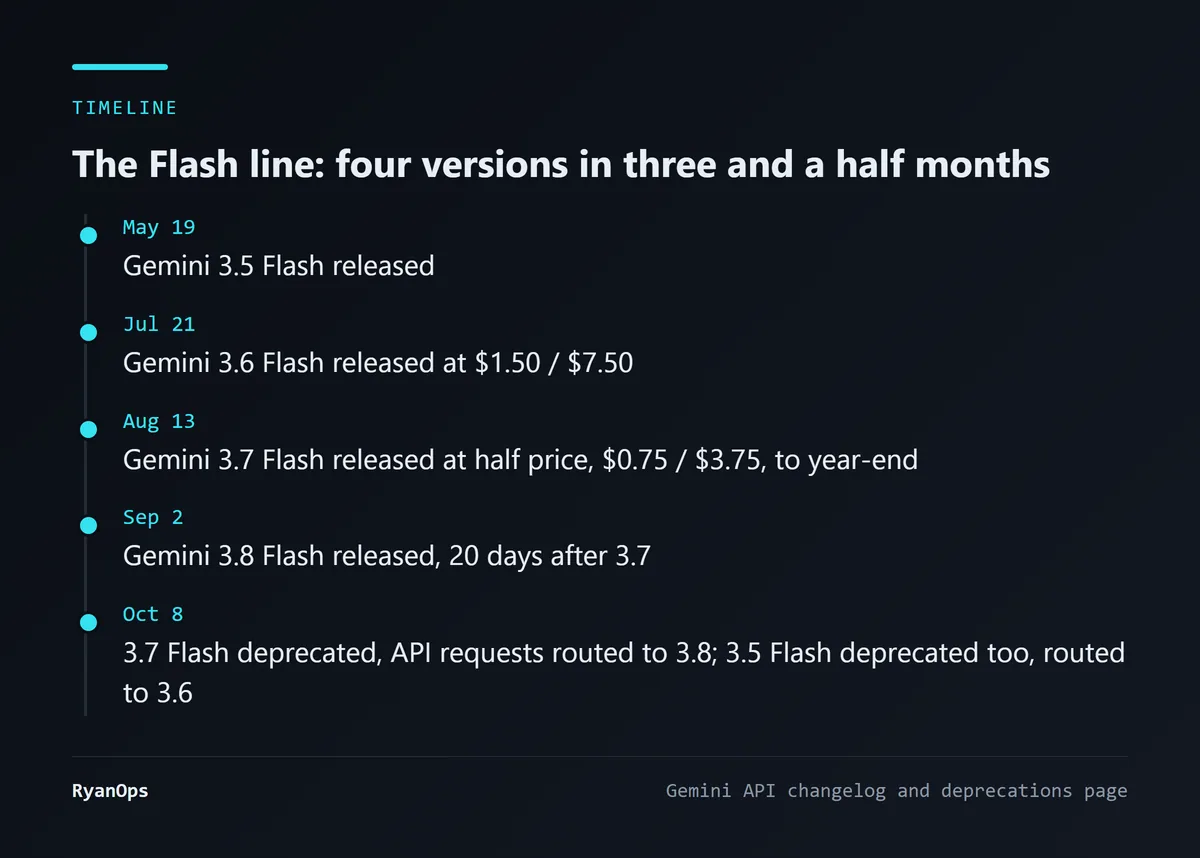 Figure: Release and deprecation dates for the Gemini Flash line in 2026 (compiled for this article from the Gemini API changelog and deprecations page)
The Gemini API changelog gives the dates plainly.
May 19: 3.5 Flash. July 21: 3.6 Flash. August 13: 3.7 Flash. A gap of 23 days. September 2: 3.8 Flash. A gap of 20 days.
Four versions in three and a half months. 3.7 Flash was the newest version for 20 days.
Then came October 8:
 Figure: The deprecation notice for 3.7 Flash in the Gemini API changelog (source: ai.google.dev)
The entry says three things. gemini-3.7-flash is deprecated and has been replaced by gemini-3.8-flash. It can no longer be selected in Google AI Studio. API requests to it are “automatically routed” to 3.8.
From August 13 to October 8 is 56 days.
The third point is the one I think most deserves your attention. Your program will not throw an error. The request still succeeds, and only the model answering has changed. On the deprecations page, the shutdown date for 3.7 Flash reads “N/A”, because it does not need shutting down. The name is still there. It just points at something else.
3.5 Flash was deprecated the same day, with requests routed to 3.6. Curiously, 3.6 Flash stays. The main Flash models on the pricing page are now 3.8 and 3.6. The 3.7 in between is gone while the older 3.6 remains. The changelog does not explain the arrangement.
I have seen this more than once in recent months. DeepSeek’s experimental vision model lived for only 20 days, and its name was likewise redirected to a new model. The difference is that that model had “exp” in its name, while the changelog labeled 3.7 Flash as GA, a production release.
What can go wrong with automatic routing?
For most people, nothing. 3.8 is the newer model, Google calls it “our most intelligent Flash model”, and the price is the same.
But there are three cases where you will care.
You tuned your prompts. If you spent time adjusting prompts, output formats or tool-call wording to 3.7’s behavior, those adjustments were made against a model that no longer exists. The new model may do better, or it may differ in some detail you rely on.
You ran an evaluation. If you ran an internal test in September and chose 3.7, that result no longer describes what you are using.
You need reproducible results. The same code with the same model name gives results from different models on October 7 and October 9. If you are doing research or need an audit trail, that is trouble.
My advice is to record the model version information returned in each response, and not only the name you sent. Then subscribe to the changelog or read it regularly. This deprecation notice was a few lines long, with no separate post.
What is the price now?
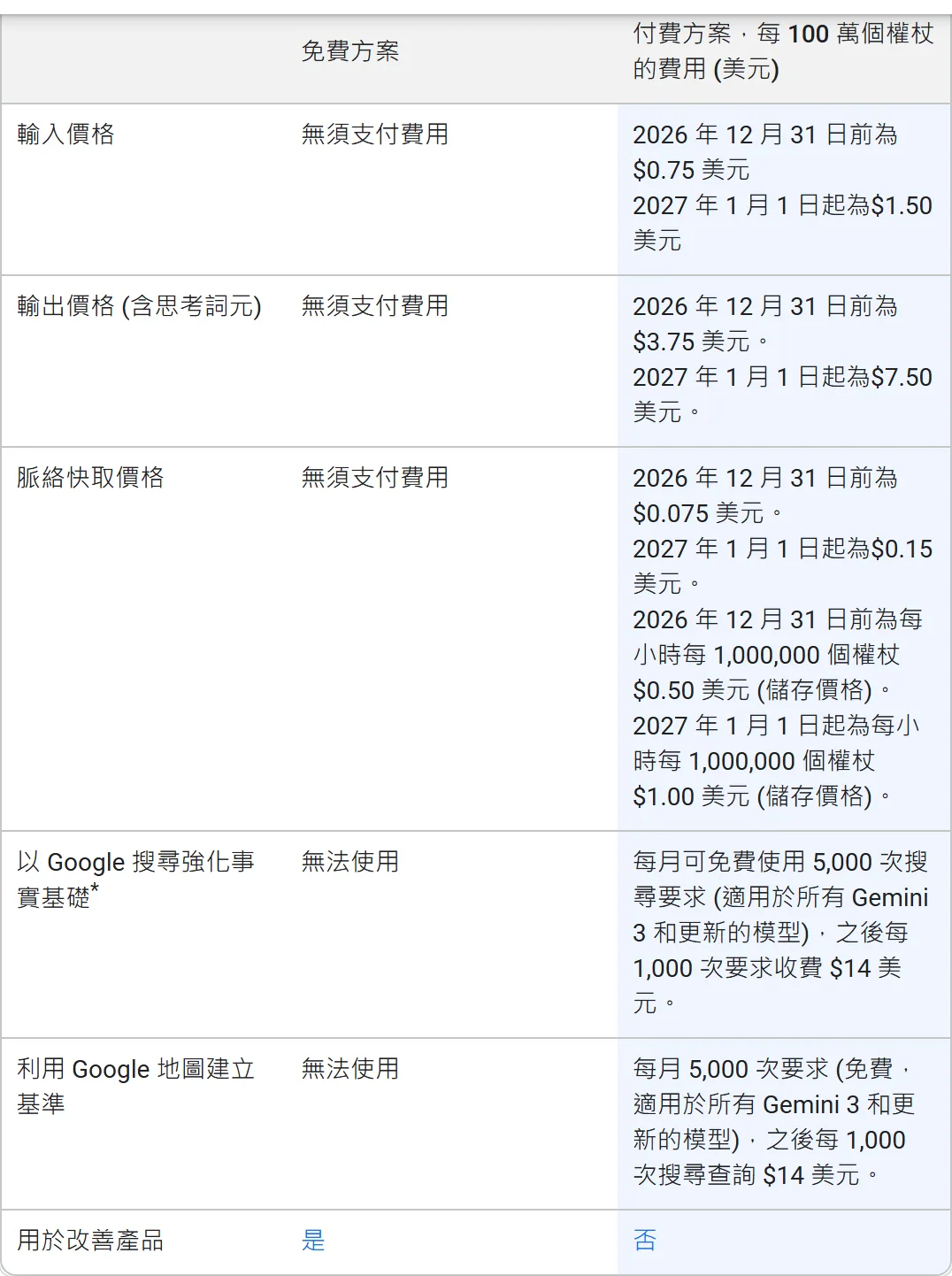 Figure: Current pricing for Gemini 3.8 Flash, captured October 2026 (source: ai.google.dev)
3.8 Flash took over the same price set: $0.75 and $3.75 through December 31, then $1.50 and $7.50.
There is one more change. On the current pricing page, 3.6 Flash is also $0.75 and $3.75, again to year-end. In early August it was still at the list price of $1.50. So the promotion was later extended to the older model. I did not find when.
Batch pricing is half the standard rate: $0.375 for input and $1.875 for output, likewise to year-end and doubling after.
How much does the bill change after New Year?
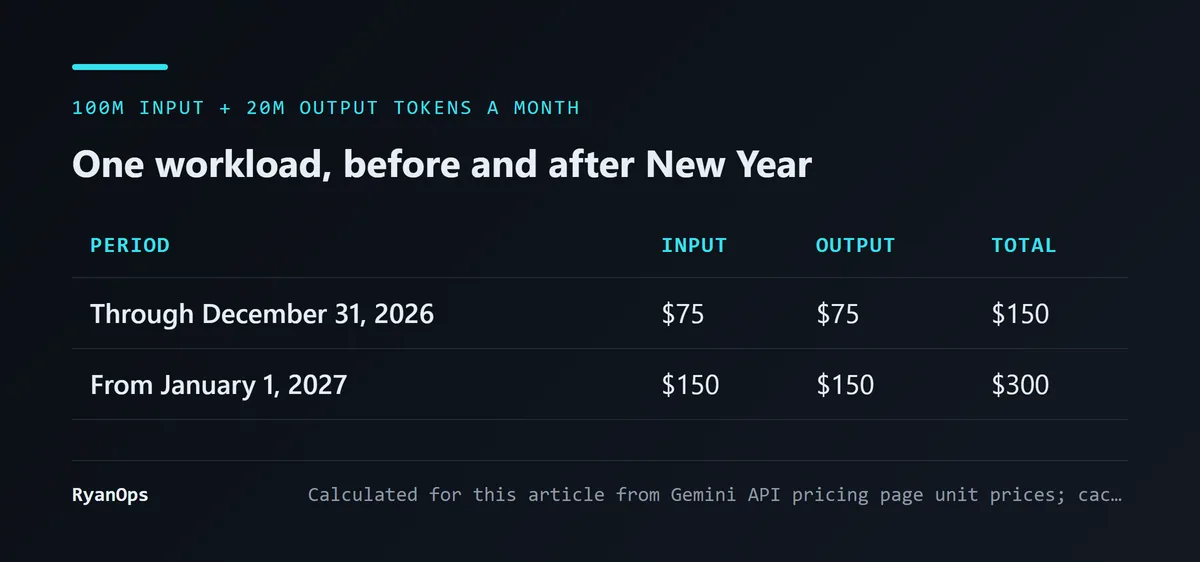 Figure: Estimated monthly bill before and after the promotion ends (calculated for this article from Gemini API pricing page unit prices)
The arithmetic is simple: everything times two.
Suppose you use 100 million input tokens and 20 million output tokens a month. Today that is $75 plus $75, or $150. From January 1 it is $300.
Note the full name of the output cell: “Output price (including thinking tokens)”. The Flash line consists of thinking models, and the tokens produced while thinking are billed at the output price. On tasks like coding agents, the thinking can be far larger than the final answer. So output is usually a bigger share of your real bill than you estimate. The details of token pricing are in the glossary.
If you are currently weighing whether to move a workload to Gemini Flash, run your cost estimate at $1.50 and $7.50. The $0.75 lasts until year-end, and your system will probably run longer than that.
Google may of course extend the promotion at year-end, or ship another version with a new promotion. At a pace of four versions in three and a half months, one or two more before December 31 would not be surprising. But that is a guess. What the pricing page says is that the list price returns on January 1.
How do I see it?
My August piece concluded that competition among AI models is shifting from comparing flagships to comparing whose everyday model is cheaper and more specialized, and that Google halving the price of its main model was a rare window.
I still agree with the first half. The second half needs correcting. Google did not cut the price. What it does is attach a time-limited discount to each new model and then ship the next one soon after.
The effect is to keep you permanently in a state of “it is cheap right now”, while the list price never moves. In early August 3.6 Flash was $1.50, and the list price on the books today is still $1.50.
I do not think there is anything dishonest in this. Both lines of pricing are on the page and the dates are clearly stated. The problem lies more with the reader, including me in August: I saw $0.75 and wrote “price cut”.
What bothers me more is the version cadence. Four versions in three and a half months, the one in the middle replaced after 56 days, with requests silently routed away. For someone who uses it now and then, that is a good thing: you always get the latest. For someone who has wired the model into a product, it means the ground under you changes every few weeks, and you will not necessarily be told.
What would change my view? If Google really puts the price back to $1.50 on January 1, this was a plain promotion and the warning in this piece is right. If it makes $0.75 permanent, the “price cut” in my August piece was merely a few months early. We will know at year-end.
For you, three things:
- Cost it at list price. $1.50 and $7.50.
- Treat the model version as something that moves. Log the actual version returned in responses, and rerun your own tests on important workflows at every version change.
- Read the changelog, not only the launch post. A launch gets a blog post and benchmark charts. A deprecation gets one line.
What this rewrite corrected
- The original headline and conclusion treated $0.75 / $3.75 as a price cut. The pricing page states it is a promotional rate through December 31, 2026, followed by $1.50 / $7.50, the same as 3.6 Flash’s price at release.
- The original presented 3.7 Flash as a current model. It was deprecated on October 8, with requests routed automatically to 3.8 Flash. The whole sequence is added here.
- The original said it could be accessed through Google Antigravity. The source report does not mention that platform and the claim is removed.
- The original said 3.7 came “three weeks” after 3.6. By the changelog the gap is 23 days, so that was roughly right, and exact dates are used now.
- The original mentioned DeepSeek’s just-announced price increase as a contrast with Google cutting prices against the trend. Since Google’s move was a time-limited promotion, the contrast does not hold and is removed.


