Nvidia's $63B Portfolio: Not One Share Bought
Nvidia's 13F grew by $45 billion in a quarter, 80% of it Intel and SpaceX. All of it was price gains and SpaceX listing, and a quarter is gone again.
On August 14, NVIDIA filed its second-quarter 13F with the US Securities and Exchange Commission. The numbers are striking: the market value of the listed stocks it holds went from $18.4 billion at the end of March to $63.4 billion at the end of June.
My August piece used the word “surged” and said NVIDIA was “putting real money on the whole AI ecosystem, upstream and downstream”.
This time I found an analysis that takes the filing apart line by line, and it showed me the problem with that description. NVIDIA did not buy a single new share in the quarter. Of the extra $45 billion, half came from price gains, and the other half is a holding it already had but had not previously been required to report.
Several numbers in that piece were also wrong, including the portfolio shares of Intel and SpaceX and the Nebius share count. They are corrected here together.
What does the filing actually say?
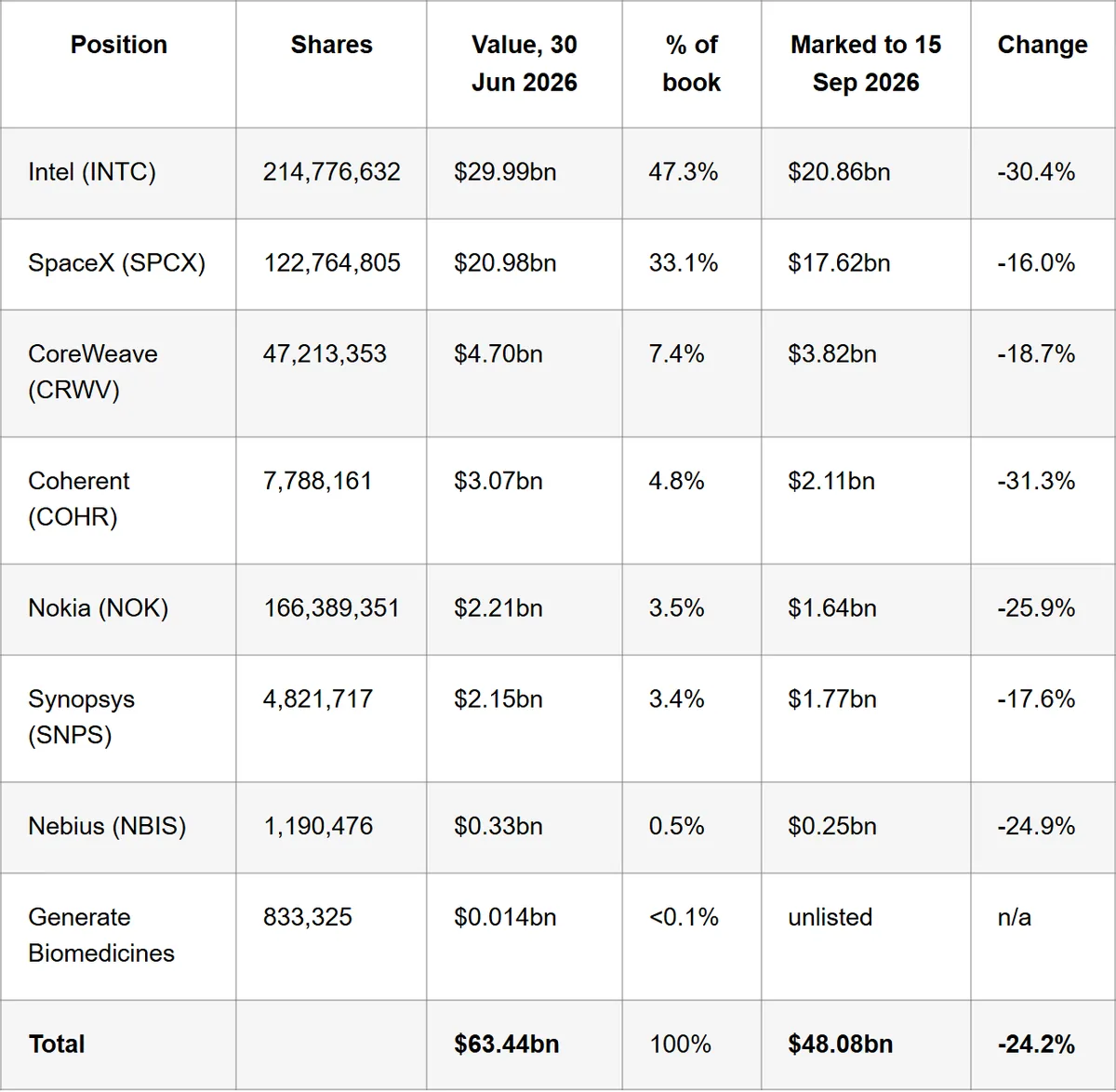 Figure: NVIDIA’s eight 13F holdings and their value two and a half months later (source: financefeeds.com, compiled from NVIDIA’s filings)
The 13F is a US requirement: institutions managing assets above a certain size report each quarter the US-listed stocks they hold. NVIDIA is a chip company, but it holds enough stock that it has to file too.
The filing lists eight positions worth $63.44 billion in total.
The top two are Intel and SpaceX. Intel is about $30 billion, 47.3%. SpaceX is about $21 billion, 33.1%. Together they are 80.3%.
The August piece gave the shares as 44.23% for Intel and 30.94% for SpaceX. Those figures do not match the amounts: $21 billion over $63.4 billion is 33% however you compute it. The source article carried this contradiction itself, and I copied it without checking the arithmetic.
The other six, in order: cloud compute provider CoreWeave ($4.7 billion), optical component maker Coherent ($3.07 billion), Nokia ($2.21 billion), chip design software maker Synopsys ($2.15 billion), another cloud compute provider, Nebius ($0.33 billion), and Generate Biomedicines, an AI drug discovery company ($14 million).
The August piece left out CoreWeave, the third largest, and described Nebius as “increased by 21.07 million shares, 6.91% of the portfolio”. In fact Nebius is 1.19 million shares and 0.5%, and the share count did not change.
Where did the extra $45 billion come from?
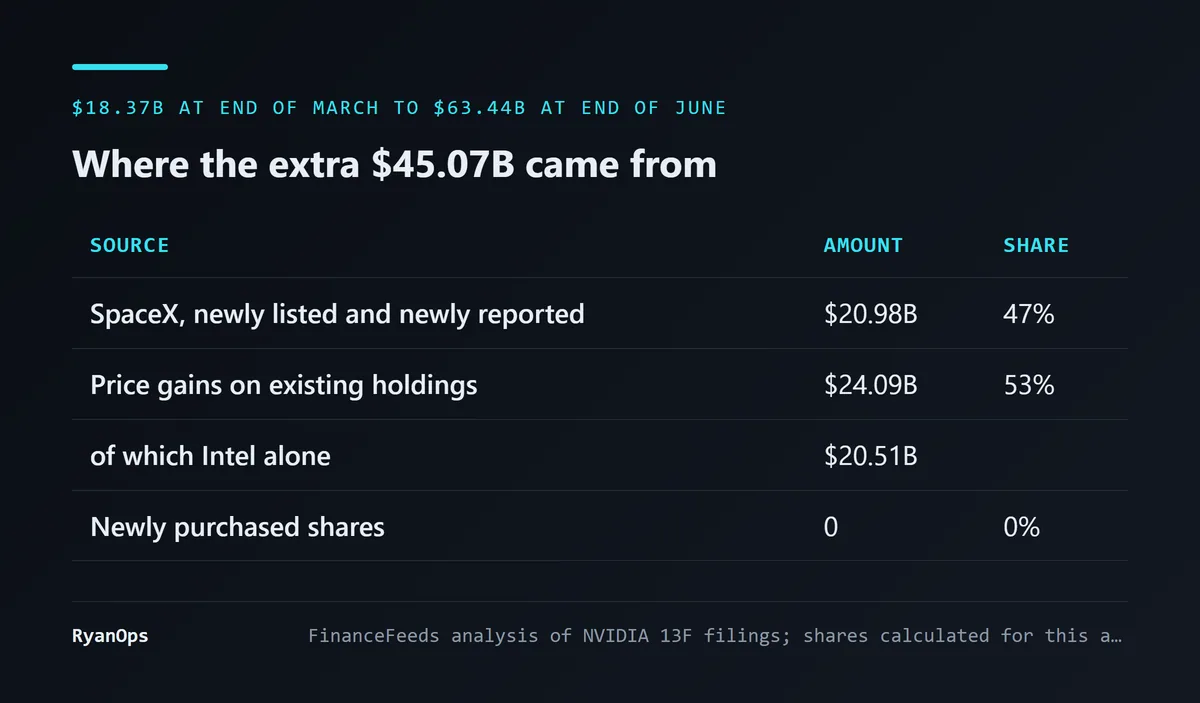 Figure: Sources of the $45.07 billion one-quarter rise in NVIDIA’s holdings (compiled for this article from FinanceFeeds’ analysis of the 13F filings)
This is the table I think most needs to be spelled out.
FinanceFeeds compared the filings for the end of March and the end of June. Its finding: apart from the newly appearing SpaceX, the share counts of the other seven positions are identical to the previous quarter.
So the $45.07 billion increase comes from two places.
Price gains, $24.09 billion. The seven positions already held did not gain a share. They simply became more expensive. Intel alone contributed $20.51 billion.
SpaceX newly reported, $20.98 billion. This was not bought either. The next section explains.
Newly purchased shares: zero.
“Public holdings surged to $63.4 billion” is not false. But if the impression you take away is that NVIDIA bought stock heavily this quarter, that is wrong. It did nothing. The market re-priced what it already held.
How did the Intel stake rise sixfold?
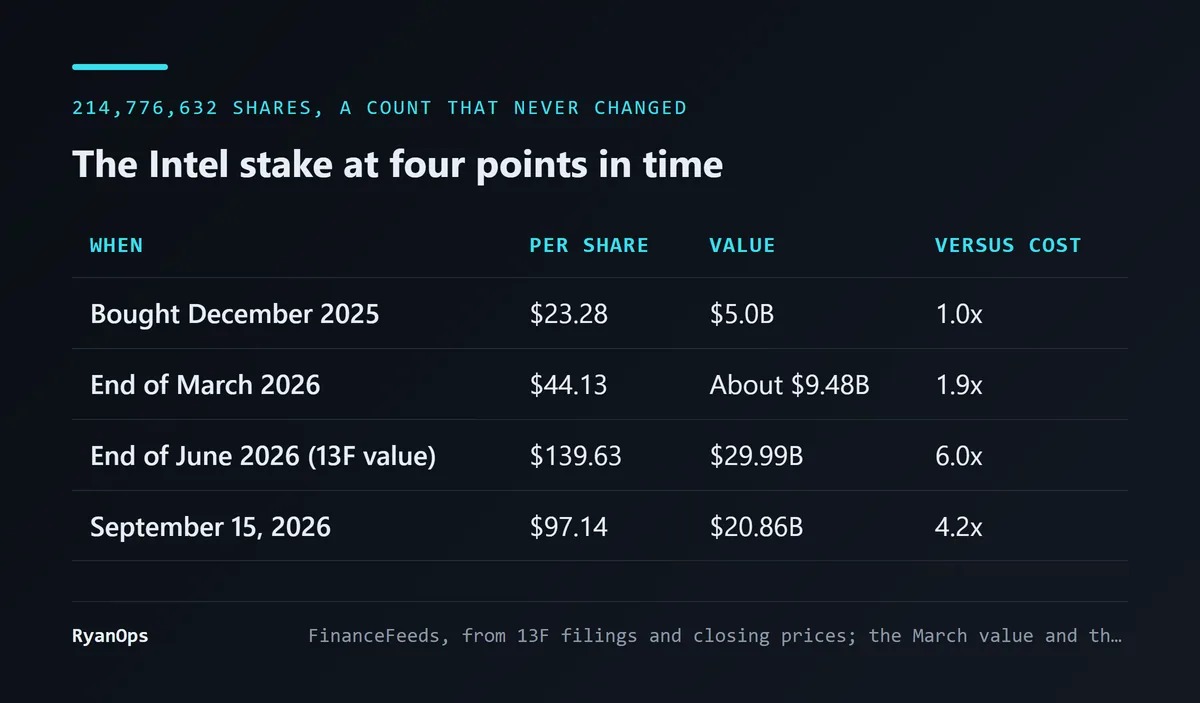 Figure: The value of NVIDIA’s Intel shares at four points in time (compiled for this article from FinanceFeeds’ figures)
In 2025 NVIDIA announced a $5 billion investment in Intel, and the two companies announced joint development of chips for PCs and data centers. According to FinanceFeeds, the deal closed on December 26, 2025: NVIDIA paid $5 billion in cash for 214,776,632 shares at $23.28 each.
The share count has not moved since. Only the price has.
At the end of March, at $44.13 a share, the stake was worth about $9.5 billion. At the end of June, at $139.63 a share, it was worth $30 billion. Six times cost.
Intel’s share price more than tripled within one quarter. The reasons are outside the scope of this piece and I have not looked into them. One thing is worth a thought, though: NVIDIA is a large shareholder in Intel and also its partner, and the announcement that NVIDIA is working with a company itself moves that company’s share price. How much of this paper gain was brought by NVIDIA’s own name, nobody can calculate.
Then there is the last row of the table. By September 15, Intel was back at $97.14 and the stake was worth $20.86 billion. That is $9.1 billion less than at the end of June, though still 4.2 times cost.
Why does NVIDIA hold SpaceX shares?
It did not buy SpaceX. It invested in xAI.
According to Zhitong Caijing, NVIDIA put up to $2 billion into Elon Musk’s AI company xAI in 2025 through a special purpose vehicle. The vehicle was structured as equity plus debt, and the money was to buy NVIDIA’s own processors for xAI’s large compute projects.
Earlier in 2026, xAI was merged into SpaceX. On June 12, SpaceX listed at $135 a share. The xAI shares became SpaceX shares, SpaceX became a listed company, and so the holding appeared on a 13F for the first time: 122,764,805 shares, worth $20.98 billion at the June 30 price of $170.86.
The report cites FactSet data showing NVIDIA as SpaceX’s sixth-largest shareholder.
There is a gap here that I cannot explain. Up to $2 billion in, and worth $21 billion a little over a year later, is tenfold. Another report’s headline says NVIDIA invested $10 billion in xAI. I have not read the body of that report, and I have not found a cost figure published by NVIDIA itself. So I do not know how many times over this investment has paid.
SpaceX’s share price has also swung widely. It reached $225 on the third day of trading, fell to $104 in early August, and closed at $140 on August 14. By September 15 the stake was worth $17.62 billion, 16% below the filed value.
How are these companies related to NVIDIA?
FinanceFeeds labels each position’s relationship to NVIDIA, and I have sorted them into three groups accordingly.
Customers. SpaceX (xAI’s compute demand, and SpaceX says it will use NVIDIA chips exclusively), CoreWeave and Nebius. All three buy GPUs.
Suppliers. Intel (joint development of x86 processors), Coherent (optical interconnect components) and Synopsys (the software NVIDIA uses to design its chips).
Partner. Nokia, on AI in telecom networks.
In other words, NVIDIA invests in companies that buy its chips, and those companies then spend money on chips. There is an unflattering name for this arrangement: circular financing. It is not illegal and not necessarily a problem. But it means part of NVIDIA’s revenue has its origin in NVIDIA’s own balance sheet. When you look at NVIDIA’s revenue growth, remember that some of it has come round in this loop.
The August piece described these as “strategic holdings staking out key points in the supply chain”. That is not wrong, but it tells only the flattering side.
What is that $500 billion platform?
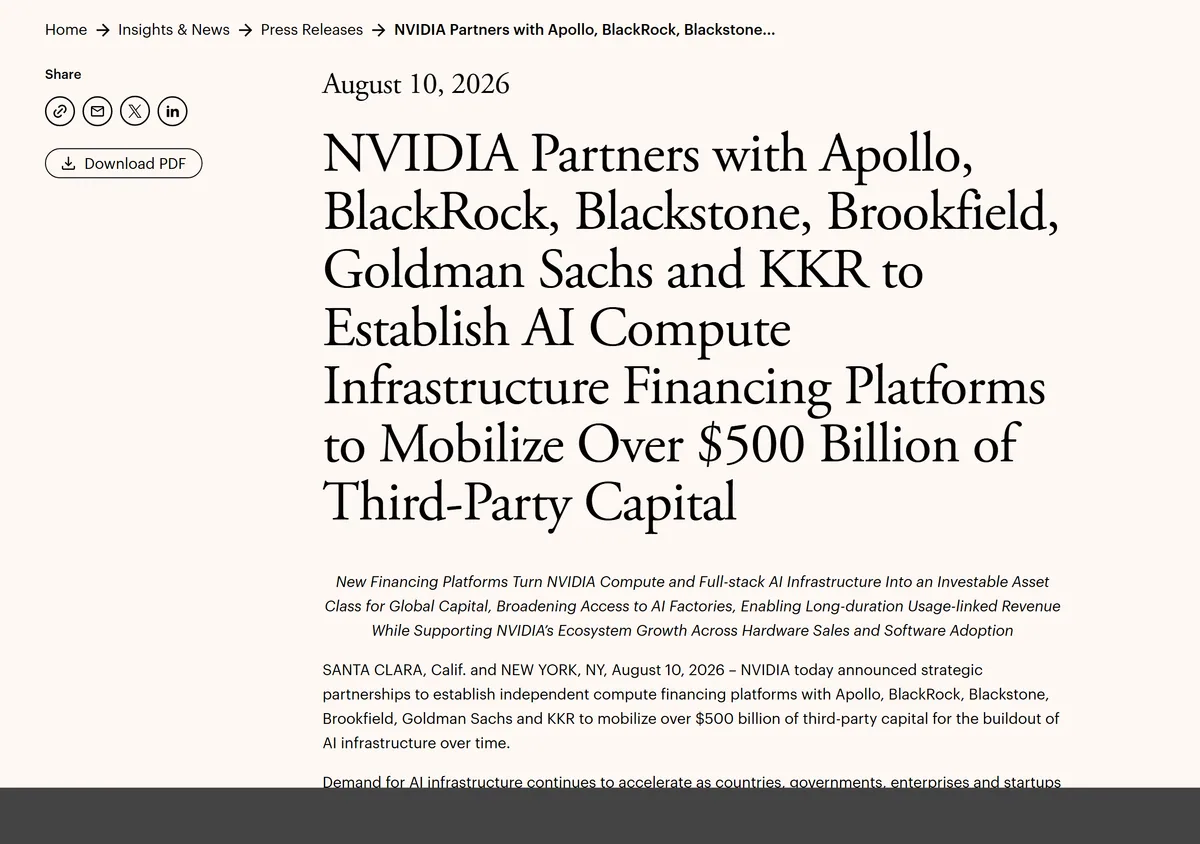 Figure: The press release on NVIDIA’s partnership with six financial firms, 2026-08-10 (source: apollo.com)
The August piece said “the market heard” that NVIDIA had set up a financing platform with Apollo, BlackRock, Blackstone and others. This was no rumor. It was a formal press release on August 10, and there are six partners, including Brookfield, Goldman Sachs and KKR.
The release says NVIDIA has formed strategic partnerships with the six to establish independent compute financing platforms, aiming to mobilize over $500 billion of third-party capital “over time” for the buildout of AI infrastructure. The subhead says the platforms turn NVIDIA compute and full-stack AI infrastructure into an investable asset class for global capital.
Three things to note.
First, $500 billion is a target, not money already in place. Press coverage points out that these are memorandums of understanding, subject to final agreements. How much each firm puts in, where it is invested, on what terms and on what timetable have not been disclosed.
Second, “third-party capital” is the key phrase. The whole point of the design is that the money is not NVIDIA’s. A customer wants GPUs but lacks the funds, the platforms pay, and the customer repays gradually out of future usage fees.
Third, NVIDIA is not entirely free of liability. One commentary notes that NVIDIA may provide residual-value support on individual opportunities, up to 25% of each, assessed case by case. That is, if those GPUs turn out to be worth little in a few years, NVIDIA may have to make up part of the difference.
The August piece described this as NVIDIA moving from “selling shovels” to being a “general contractor”. I now think the more accurate comparison is a carmaker’s finance arm. A carmaker does not only sell cars. It also runs a lending company that finances your purchase. The difference is that NVIDIA has brought in six Wall Street firms to supply the money.
What does the 13F not show?
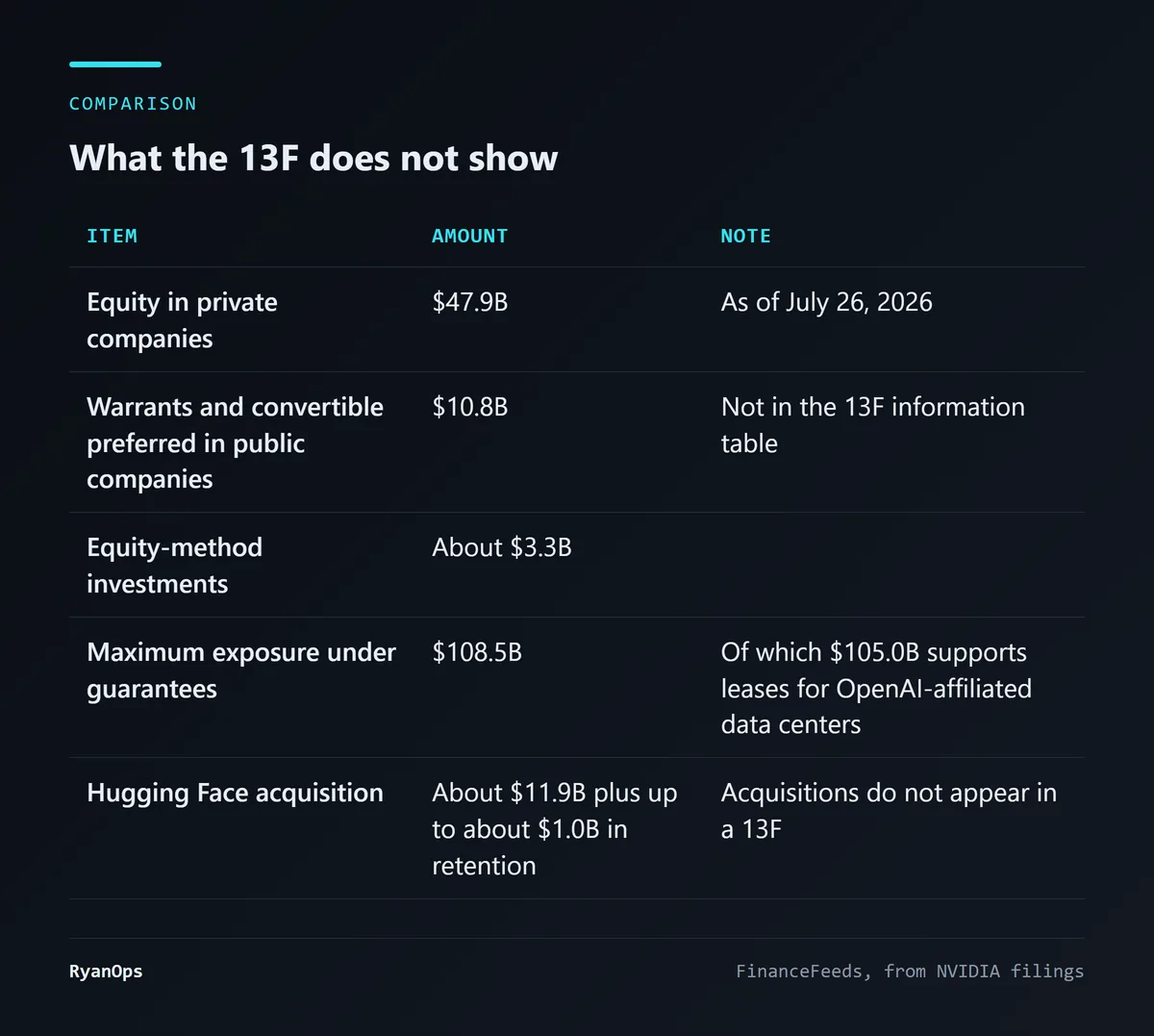 Figure: NVIDIA investments and commitments that do not appear on a 13F (compiled for this article from FinanceFeeds’ reading of NVIDIA’s filings)
A 13F covers only US-listed stocks. Short positions, debt, foreign-listed shares and private companies are all outside it.
So $63.4 billion is only the part of the iceberg above the water.
FinanceFeeds assembled the part below the surface from NVIDIA’s other filings. Equity in private companies comes to $47.9 billion. Warrants and convertible preferred stock in public companies come to $10.8 billion.
The largest number is guarantees: a maximum exposure of $108.5 billion, of which $105.0 billion supports leases for OpenAI-affiliated data centers.
I paused when I first saw that figure. It is not an investment, and NVIDIA has not paid the money out. But if the tenants of those data centers cannot pay the rent, NVIDIA is on the hook. It is larger than all the holdings on the 13F put together.
In addition, NVIDIA announced the acquisition of Hugging Face in September, which I wrote about. Acquisitions do not appear on a 13F either.
How do I see it?
The August piece concluded that NVIDIA had used a 13F to tell the world it would dig the moat around AI infrastructure deeper.
I now think that conclusion misread the document. A 13F is a snapshot of market prices on one day at the end of June. It does not tell you what NVIDIA decided, because in listed stocks it decided nothing this quarter.
What really shows NVIDIA’s strategy is two other things: the $108.5 billion of guarantees and the $500 billion financing platform. They say the same thing. NVIDIA’s customers need more money than they can raise themselves. NVIDIA’s answer is to help them find it and, where necessary, to stand behind it.
That works very well while demand keeps growing. Every dollar of financing becomes a GPU order. The risk runs the other way: if demand for AI compute slows one day, NVIDIA is hurt in three places at once. It sells fewer chips, the customer stocks it holds fall, and the guarantees it gave for customers may be called.
The last column of that holdings table has already offered a small rehearsal. From the end of June to mid-September, two and a half months, the eight holdings together fell 24.2%, about $15.4 billion. Nothing went wrong with AI demand in that period. Share prices merely pulled back.
What would change my view? If NVIDIA starts trimming these customer stocks in later filings, or the guarantee total stops rising, it would mean NVIDIA itself is managing the exposure. So far the direction is the opposite.
For you, if you hold NVIDIA stock or simply follow the AI industry, I suggest watching three numbers, in descending order of importance: the maximum exposure under guarantees, the amount of private equity, and the 13F market value. The 13F is the easiest to look up and the one the news likes best, but it carries the least information of the three.
What this rewrite corrected
- The original gave Intel as 44.23% of the portfolio and SpaceX as 30.94%. Computed from the filed amounts, the correct figures are 47.3% and 33.1%.
- The original said NVIDIA added 21.0659 million Nebius shares, for 6.91%. The filed figure is 1,190,476 shares and 0.5%, with the share count unchanged from the previous quarter.
- The original’s list of the eight holdings left out CoreWeave, the third largest.
- The original said the portfolio “surge” showed NVIDIA putting real money upstream and downstream. Apart from SpaceX being newly reported after its listing, no share counts changed this quarter, and the added value came from prices.
- The original said the financing platform was something “the market heard” and named three partners. It was a formal press release on August 10 with six partners, and $500 billion is a target, not a committed amount.
- The original did not mention the private equity and guarantees outside the 13F, or the decline since the filing. Both are added here.


