Google's Marvell Warrant Is Not a $12.2B Gift
Marvell issued Google a warrant the press valued at $12.2 billion. The 8-K shows that is what Google would pay to exercise it. The terms, worked through.
On August 19, chip company Marvell disclosed that it had issued Google a warrant.
The first sentence of my August piece was: “This time Google is not buying chips with cash. It has been handed a stock option worth $12.2 billion.”
That sentence has two errors. Google still buys the chips with cash, not a dollar less. And the $12.2 billion is not value Google received. It is what Google would have to pay out to exercise the whole warrant.
This time I read the Form 8-K that Marvell filed with the SEC. The document is short and the terms are stated clearly. Worked through from those terms, the deal looks very different from the headlines.
What does the 8-K say?
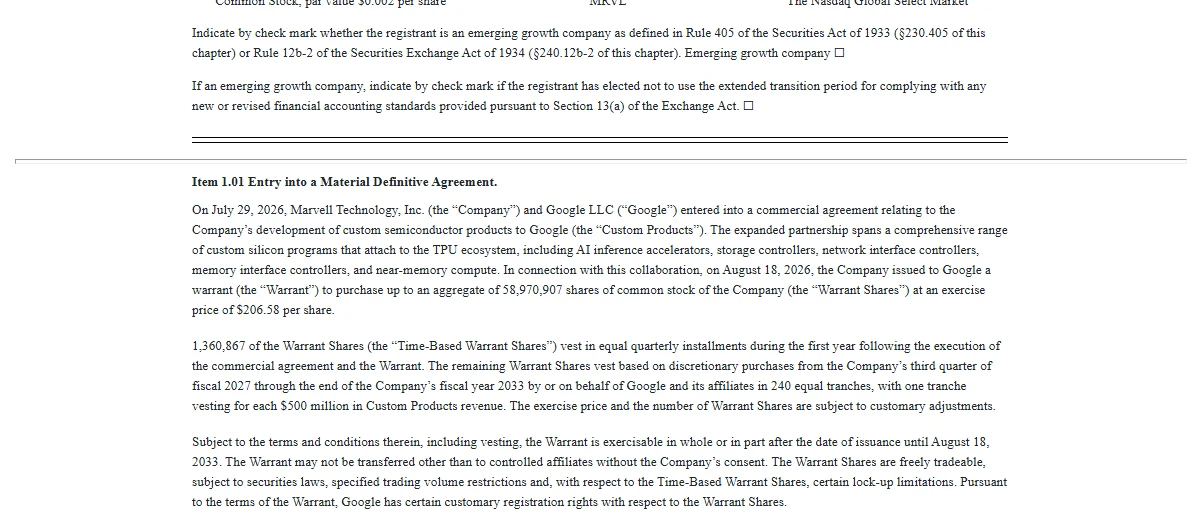 Figure: Item 1.01 of the Form 8-K Marvell filed on August 19, 2026 (source: investor.marvell.com)
An 8-K is what a US-listed company files when something material happens. The substance of this one is Item 1.01, in three paragraphs.
The first covers the collaboration. On July 29, 2026, Marvell and Google signed a commercial agreement under which Marvell develops custom semiconductor products for Google. The filing lists five categories: AI inference accelerators, storage controllers, network interface controllers, memory interface controllers and near-memory compute. All attach to the ecosystem around Google’s own TPU. What a TPU is can be found in the glossary.
The second covers how the warrant vests. It is the most important part of the document and the next sections go through it.
The third covers the term and the restrictions. The warrant can be exercised until August 18, 2033. Without Marvell’s consent it may not be transferred to anyone other than affiliates Google controls.
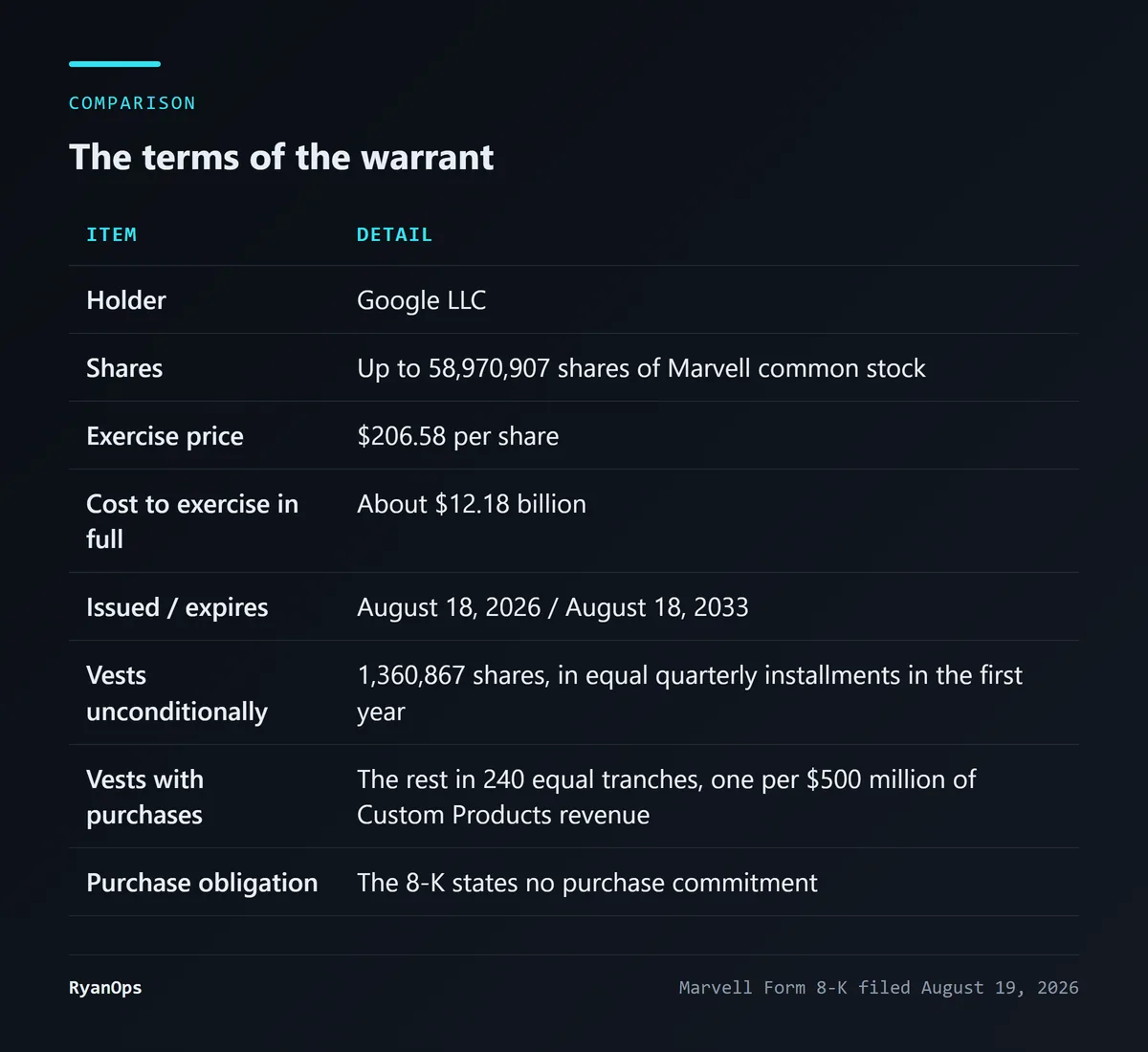 Figure: The main terms of the warrant (compiled for this article from Marvell’s 8-K)
What is a warrant?
The instrument needs explaining first, because this is where my August piece went wrong.
A warrant is a right: to buy a set number of shares from the company, at a price agreed in advance, before a certain date. The agreed price is the exercise price.
What it is worth depends on the share price.
Suppose the exercise price is $206.58. If Marvell’s stock is at $300 by then, Google can buy at $206.58 something immediately worth $300, a gain of $93.42 a share. If the stock is at $200, the right is useless, because buying in the market is cheaper.
So the “$12.2 billion” in the headlines comes from 58.97 million shares times $206.58, or $12.18 billion. That is what Google pays Marvell if it exercises the warrant in full.
It is not a gift Google received. What Google really gains is the share price minus $206.58, times the number of shares. If the stock is not above the exercise price, the gain is zero.
Reuters’ wording was that the warrant is worth $12.18 billion “if fully exercised”. That is not wrong, but it is easily read as Google being handed $12.2 billion. That is how I read it at the time.
Where does the $120 billion come from?
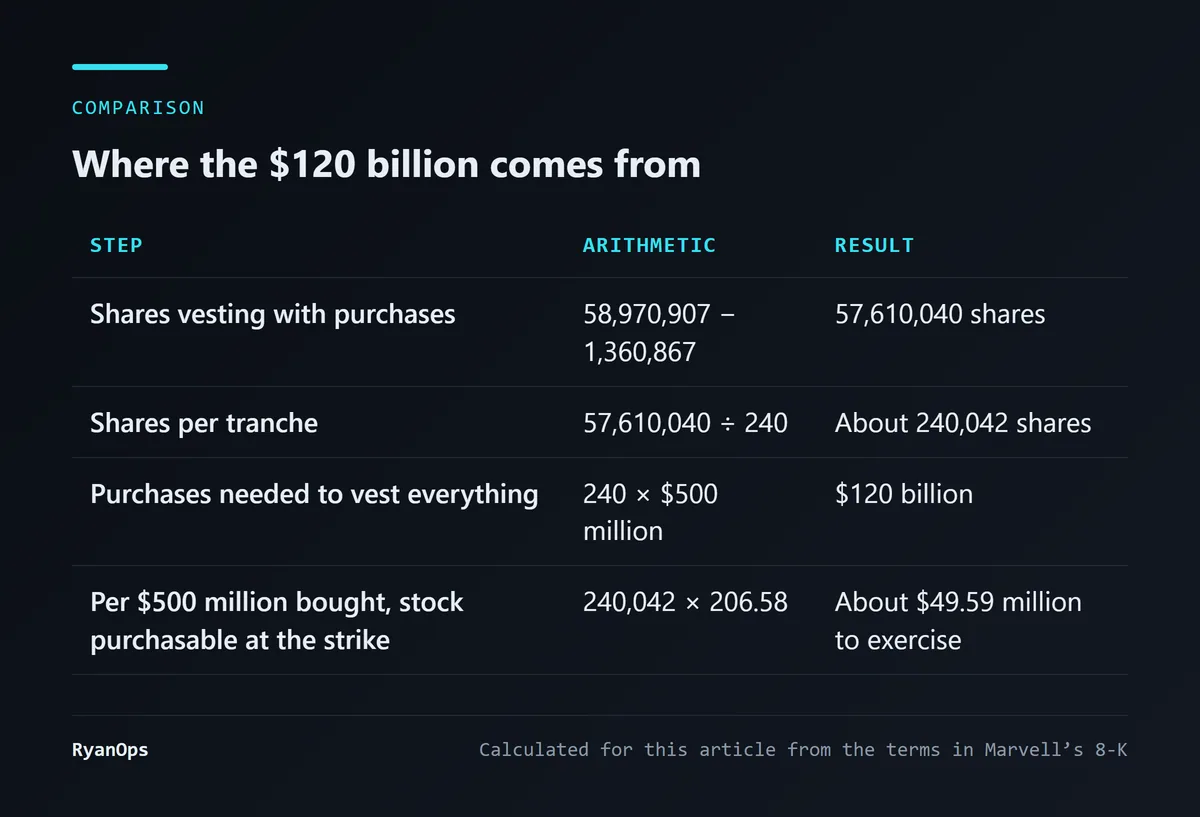 Figure: Deriving the $120 billion from the terms of the 8-K (calculated for this article)
The August piece said: “the deal is estimated to bring Marvell about $120 billion in revenue by fiscal 2033.”
Reuters’ report has the figure but does not say whose estimate it is. Reading the 8-K makes it clear that nobody estimated it. It is arithmetic.
The warrant’s 58.97 million shares fall into two parts.
1.36 million shares are unconditional. They vest a quarter at a time during the first year after signing. Google has to do nothing.
The other 57.61 million have to be earned by purchases. The 8-K says they vest based on Google’s purchases from the third quarter of Marvell’s fiscal 2027 to the end of fiscal 2033, in 240 equal tranches, with one tranche vesting for each $500 million in Custom Products revenue.
240 tranches at $500 million each. 240 times $500 million is $120 billion.
So $120 billion means this: if Google wants the whole warrant to vest, it must buy $120 billion of custom chips from Marvell before the end of fiscal 2033. That is a ceiling, not a forecast.
One word in the 8-K deserves attention. It says vesting is based on “discretionary purchases”. The filing records no purchase commitment. Google can buy $120 billion, $10 billion, or nothing at all. The warrant vests in proportion to what it buys.
The August piece did say the warrant was “tied to purchase targets”, which was the right direction. But writing “estimated to bring $120 billion in revenue” turned a ceiling into an expectation.
What does the warrant amount to as a discount?
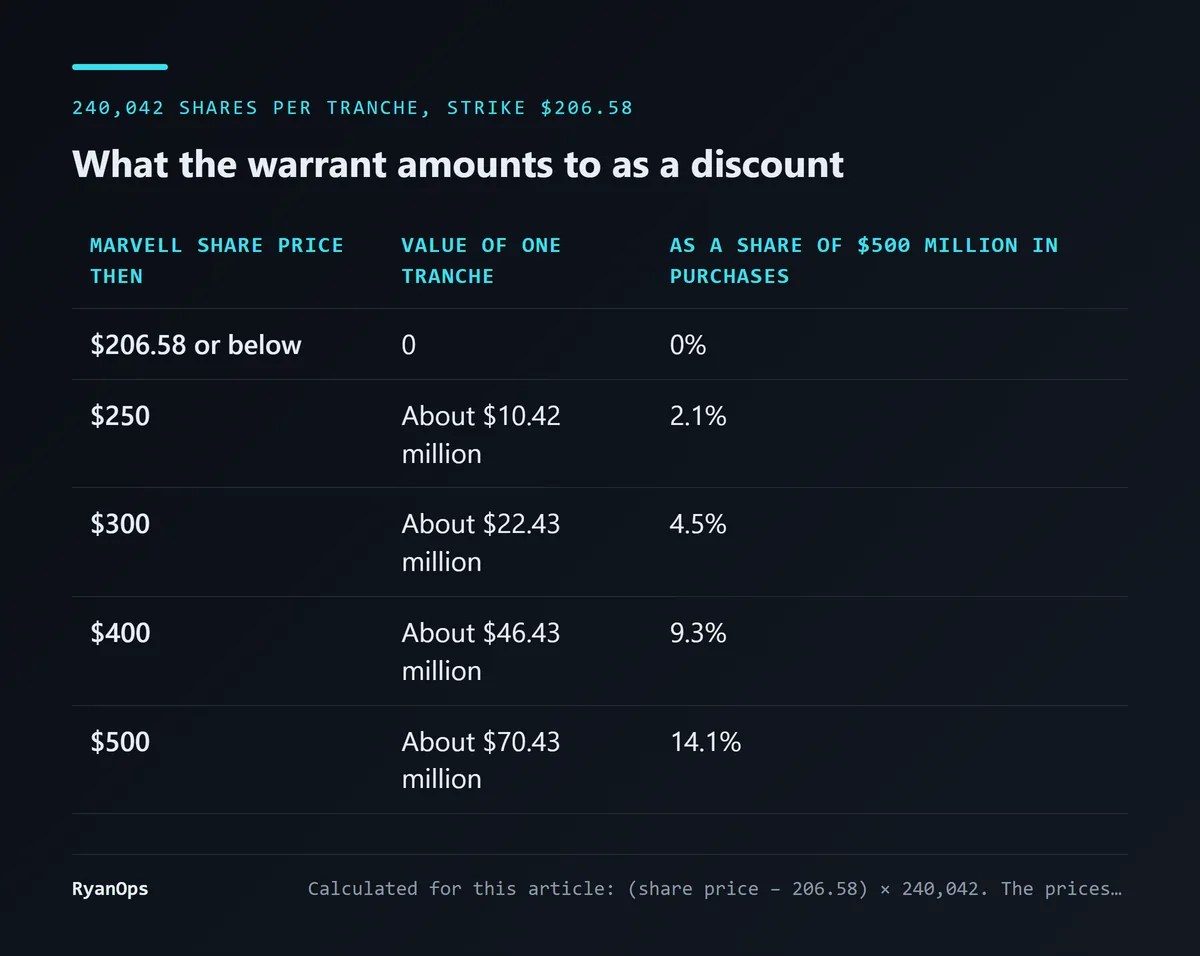 Figure: What one tranche of the warrant is worth as a purchase discount at different share prices (calculated for this article; the prices are assumed scenarios)
This is the calculation I think explains the deal best.
Each tranche is 240,042 shares. For every $500 million of chips Google buys from Marvell, it may buy that many shares at $206.58.
What that right is worth depends on the share price at the time:
- At $250: a gain of $43.42 a share, so a tranche is worth $10.42 million. That is 2.1% of the $500 million in purchases.
- At $300: a tranche is worth $22.43 million, or 4.5%.
- At $400: $46.43 million, or 9.3%.
- At $500: $70.43 million, or 14.1%.
So in essence the warrant is a floating discount. Google pays for its chips as usual, but for each $500 million it receives a rebate coupon tied to Marvell’s share price. The higher Marvell’s stock, the more the coupon is worth.
The design means different things to the two sides.
For Google, its purchases push up Marvell’s revenue, revenue pushes up the stock, and the stock makes the warrant worth more. The more Google buys, the more it gets back.
For Marvell, it is in effect trading future equity for orders. When Google exercises, cash comes in, but Marvell has to issue new shares and existing shareholders are diluted. If Google buys the full amount and exercises everything, Marvell issues 58.97 million more shares.
The share prices in the table are scenarios I set, not forecasts. I did not look up Marvell’s current share price or its total share count, so I cannot work out the dilution. Reuters wrote that full exercise would make Google Marvell’s fifth-largest investor.
Will Broadcom be displaced?
On the day of the news, the share price reactions Reuters recorded were: Marvell up nearly 8%, Broadcom down more than 5%, and Google’s parent Alphabet little changed.
Broadcom fell because it has long been Google’s main partner for custom chips. The market’s first reaction was that its business was being carved up.
Morningstar analyst William Kerwin saw it differently. “This is a big win for Marvell,” he said, but he saw the news “as a growing pie at Google for new sources, rather than a competitive displacement of Broadcom”.
The product categories listed in the 8-K support that view. Only the first of the five is AI inference accelerators. The other four are storage controllers, network interfaces, memory interfaces and near-memory compute, all things that sit beside the accelerator. What Marvell has come in to do looks like the whole ring around the TPU, and not only the TPU itself.
Reuters also gave background: Google’s demand for custom chips is rising because the industry is shifting from NVIDIA’s GPUs toward cheaper alternatives suited to inference.
My reading is that Google is doing two things. One is customizing the surrounding components too, and not only the main chip. The other is having more than one supplier. Neither requires Broadcom to leave. But Broadcom’s bargaining room has indeed shrunk.
Why are deals like this multiplying?
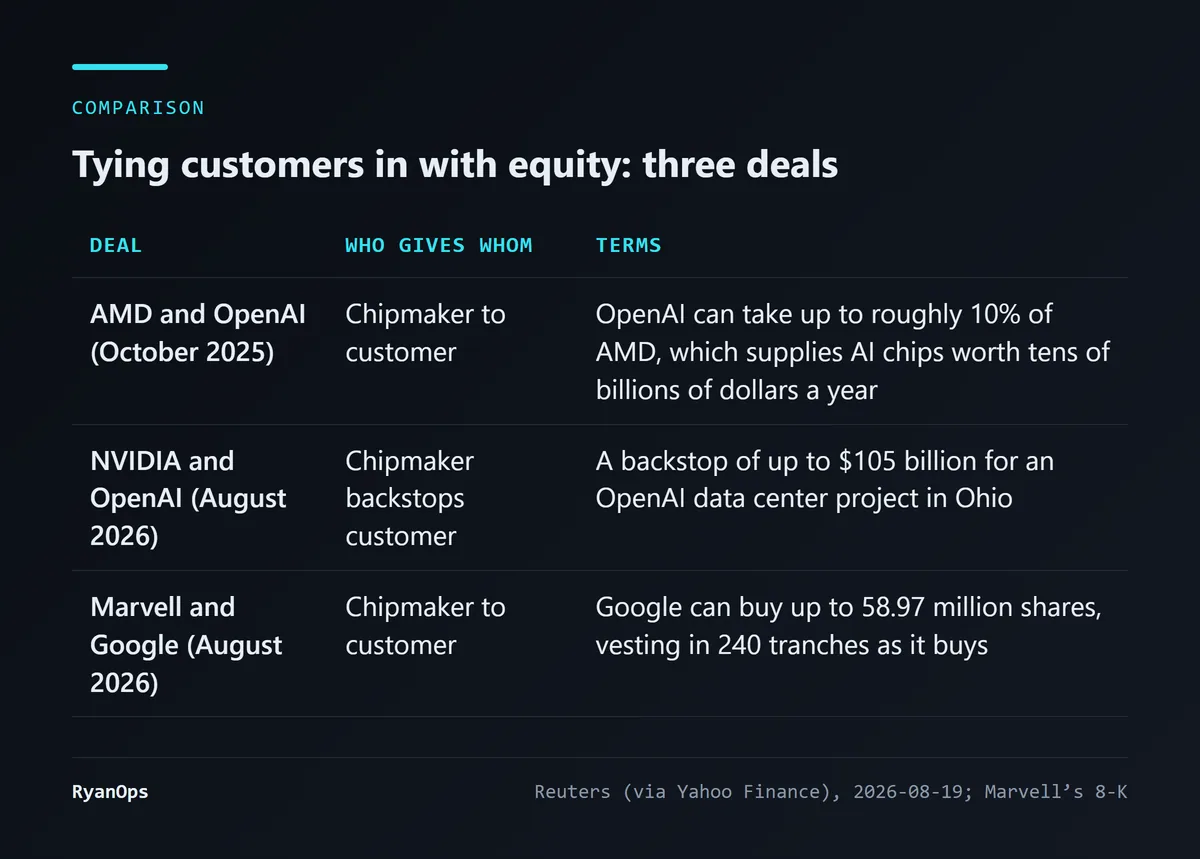 Figure: Three deals in which chipmakers tie customers in with equity or guarantees (compiled for this article from Reuters’ report of 2026-08-19 and Marvell’s 8-K)
Reuters mentioned two similar deals in the same report.
Last October, AMD agreed to supply OpenAI with AI chips worth tens of billions of dollars a year, and OpenAI can take a stake of up to roughly 10% in AMD.
Days before the Marvell deal, NVIDIA agreed to provide a backstop of up to $105 billion for an OpenAI data center project in Ohio.
All three run in the same direction: the chip company gives the customer a benefit in exchange for the customer buying its chips.
One sentence in the August piece had this backwards. It said “cloud giants are choosing to take stakes in key suppliers directly”. On the structure of these three deals, it is the supplier that gives. Chip companies are putting up their own equity or credit so that customers will place larger and longer orders.
I wrote about another version of the same thing in the piece on NVIDIA’s holdings. NVIDIA has guaranteed more than a hundred billion dollars of leases for OpenAI-related data centers and set up financing platforms with six financial firms to help customers borrow to buy GPUs. That piece concluded that customers need more money than they can raise themselves.
Marvell’s case is different. Google is not short of money. Marvell is giving a warrant not because Google cannot afford the chips but because Marvell wants to make sure Google chooses it. This is a smaller supplier negotiating with a very strong buyer.
How do I see it?
I think this is a deal with almost no risk for Google, and one of real significance for Marvell that has been over-read.
For Google the terms are very good. There is no obligation to buy. Buying earns a rebate, and not buying costs nothing. The 1.36 million shares are given unconditionally. At the exercise price that part costs $281 million to exercise, and it is in the money as soon as the stock is above $206.58.
For Marvell the benefit is real. A customer of Google’s standing is willing to hand it five categories of product, on an arrangement running to fiscal 2033. But $120 billion is the ceiling for buying in full, and Google has promised nothing. The 8% rise in the stock reflects the market’s optimism about that ceiling.
What would change my view? Marvell’s coming earnings. If custom product revenue starts to grow markedly, and it reports how many tranches of the warrant have vested, one can work back to how much Google actually bought. Each vested tranche stands for $500 million. That is a rare number that can be checked from outside, because the vesting status of a warrant has to be disclosed.
For you, the next time a headline says “company X receives warrants worth so many billion dollars”, three questions are worth asking.
- Is the amount the exercise price times the shares, or the warrant’s real value? Usually the former.
- Is vesting conditional? Here, 98% of the shares can be had only through purchases.
- Does the party receiving the warrant have any obligation? Here it has none.
My August piece got the answer to none of the three right.
What this rewrite corrected
- The original said Google had been “handed a stock option worth $12.2 billion”. The $12.18 billion is what Google pays on full exercise (shares times exercise price), not the value of the warrant.
- The original said the deal was “estimated to bring Marvell about $120 billion in revenue”. That figure is the purchases required for the warrant to vest in full (240 tranches times $500 million). It is a ceiling and not an estimate, and the 8-K records no purchase commitment.
- The original said “the great majority” of the shares open up only when purchase targets are met. The precise figures are 57,610,040 shares vesting with purchases and 1,360,867 vesting unconditionally by quarter in the first year.
- The original described deals of this kind as “cloud giants taking stakes in key suppliers directly”. The actual structure is the supplier giving equity to the customer, which is the opposite direction.
- The original did not cite the 8-K. This version is based mainly on the 8-K and adds the agreement date, the five product categories, the expiry date and the transfer restriction.


