SpaceX Bought Cursor. Two Weeks Later OpenAI Left
SpaceX closed its $60 billion all-stock purchase of Cursor on August 14. Two weeks later OpenAI ended its partnership. Terms, multiples, models.
On August 14, SpaceX completed its acquisition of Cursor: an all-stock deal valued at $60 billion.
My August piece focused on the size of the deal, the share price reaction and why Musk wanted it. It ended by saying “trading money for time is becoming the standard play”.
Twelve days after that piece went out, there was a sequel. On August 29, OpenAI announced it was ending its partnership with Cursor and proposed to stop supplying models directly after November 12. The reason was stated bluntly: it does not trust the new owner.
That changes what this acquisition means. Cursor’s selling point was neutrality: whichever vendor’s model was best, you could use it there. Whether that position can be held after being bought by one of those vendors is the question this rewrite tries to answer.
What is in the deal?
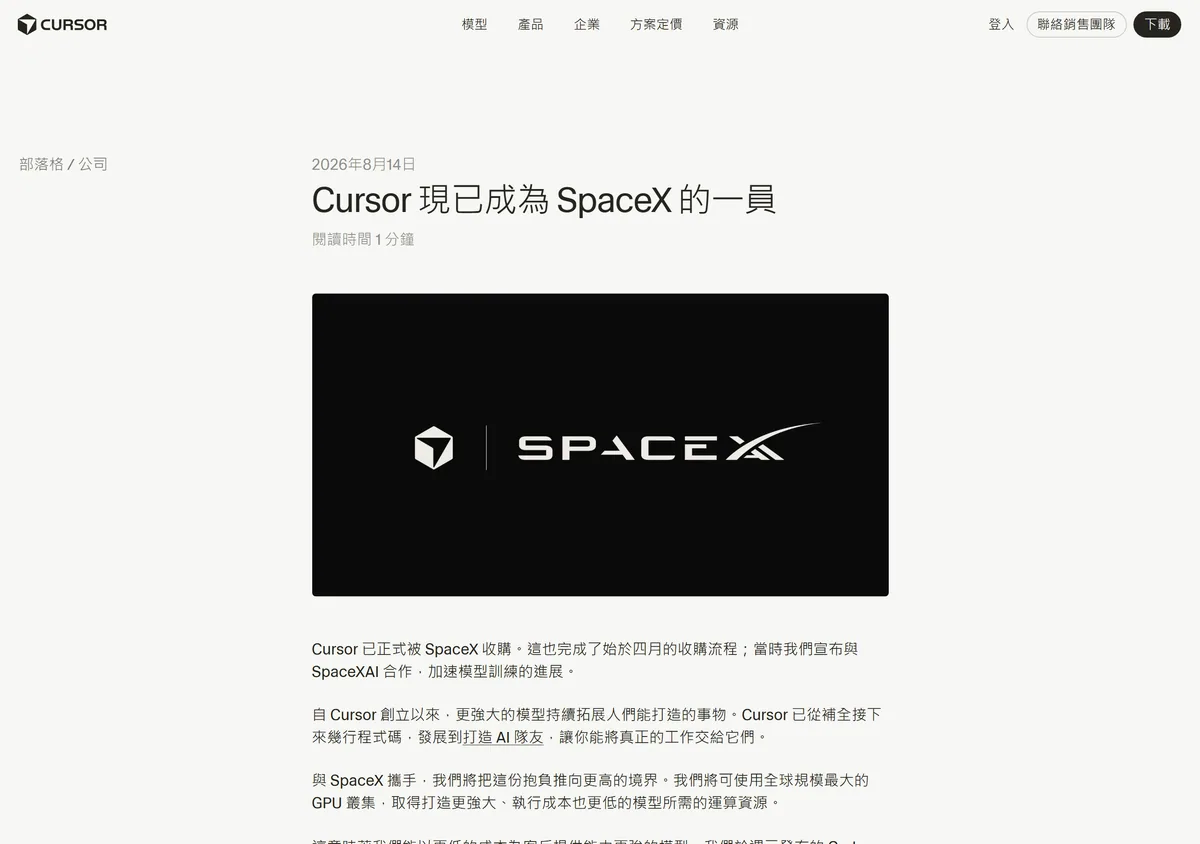 Figure: Cursor’s announcement that it has joined SpaceX, 2026-08-14 (source: cursor.com)
Cursor’s own announcement is short, marked as a one-minute read.
It comes down to a few sentences. Cursor has officially been acquired by SpaceX. It will “have access to the largest fleet of GPUs in the world”, with the aim of building stronger models that are also cheaper to run. Grok 4.6, released two days earlier, is a preview of what the combined company can build.
What the announcement leaves out is longer. Whether prices change: not stated. Any commitment on data and privacy: not stated. Whether the brand stays: not stated. Whether third-party models will continue to be offered: not stated either.
The numbers come from the Form 8-K that SpaceX filed with the SEC. According to Wikipedia and Investing.com:
- What was bought is Cursor’s parent, Anysphere.
- Anysphere’s common and preferred shares converted into 389,289,254 shares of SpaceX Class A common stock.
- That share count corresponds to $60 billion, based on the volume-weighted average price over the seven trading days before closing.
- Vested restricted stock units converted into SpaceX shares. Unvested units and options were assumed by SpaceX and converted into SpaceX equity awards. Including these, Investing.com puts total issuance at about 391 million shares.
- Cursor became a wholly owned subsidiary of SpaceX and is being integrated into the SpaceXAI team.
I did the arithmetic: $60 billion over 389,289,254 shares is about $154 a share. SpaceX’s share price on closing day was $143.45. At that day’s price, the shares Cursor’s holders received were worth about $55.8 billion.
That is the nature of an all-stock deal. The sellers did not get $60 billion. They got 389 million SpaceX shares, and what those are worth later depends on SpaceX’s price. SpaceX listed only in June and its price has swung widely. I traced its fall from $225 to $104 in the piece on NVIDIA’s holdings.
How did the deal come together?
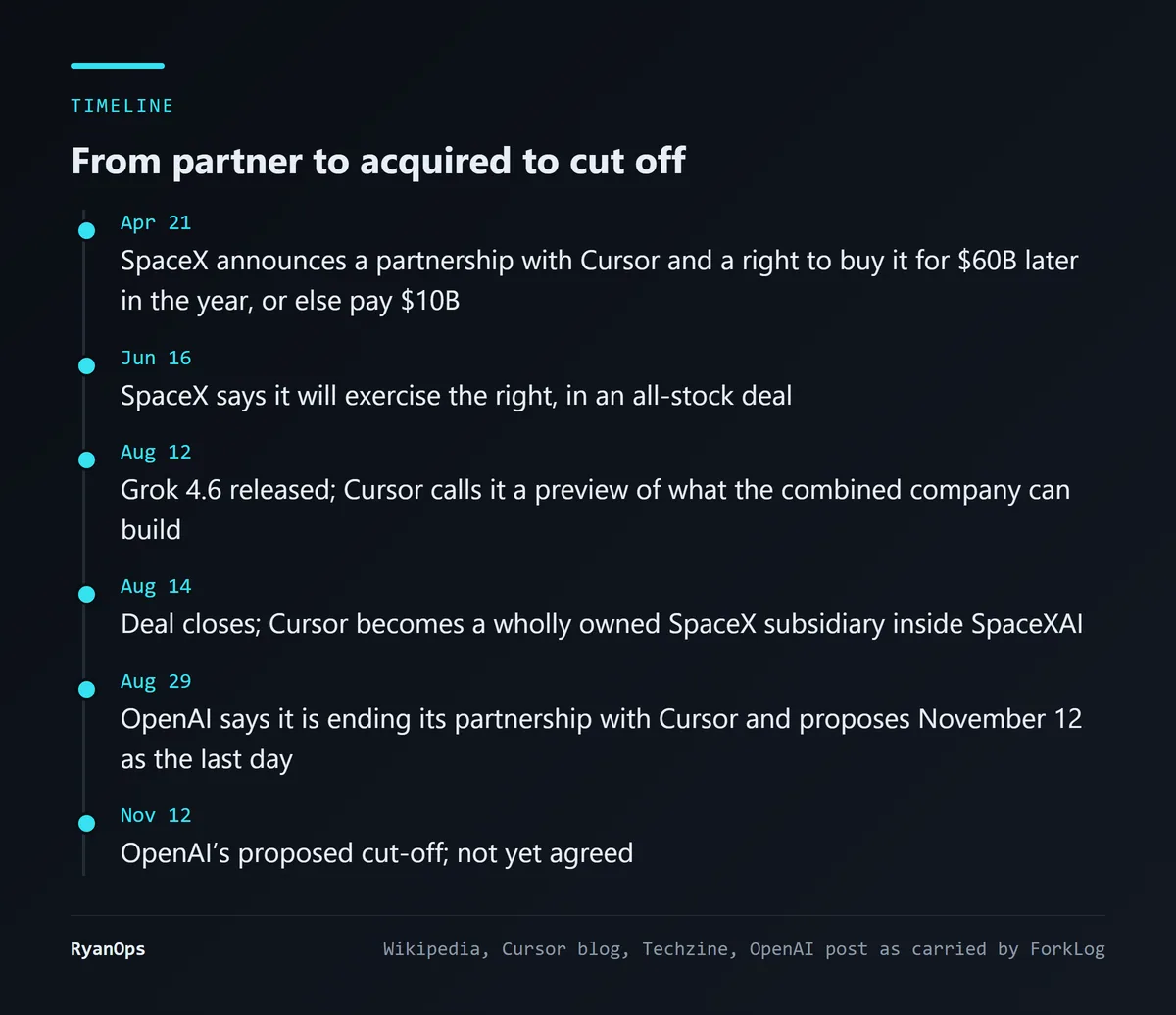 Figure: Timeline of SpaceX’s acquisition of Cursor (compiled for this article from Wikipedia, the Cursor blog, Techzine and ForkLog)
The August piece said “it took only two months from signing in June to closing in August”. The real starting point is earlier, and the structure is unusual.
On April 21, SpaceX announced a partnership with Cursor on model training. At the same time it disclosed an option: SpaceX could buy Cursor later in the year for $60 billion. If it did not, it would pay $10 billion for “our work together”.
In other words, in April Cursor was already sure of at least $10 billion, and the price was already fixed at $60 billion.
On June 16, SpaceX said it would exercise the purchase right. Four days earlier SpaceX had gone public. The sequence is clear: list first, then buy with the listed company’s stock.
On August 14, the deal closed.
So this was a deal whose price was set in April. June to August was only the procedure. The April price lock matters when working out the multiple below.
Is $60 billion expensive?
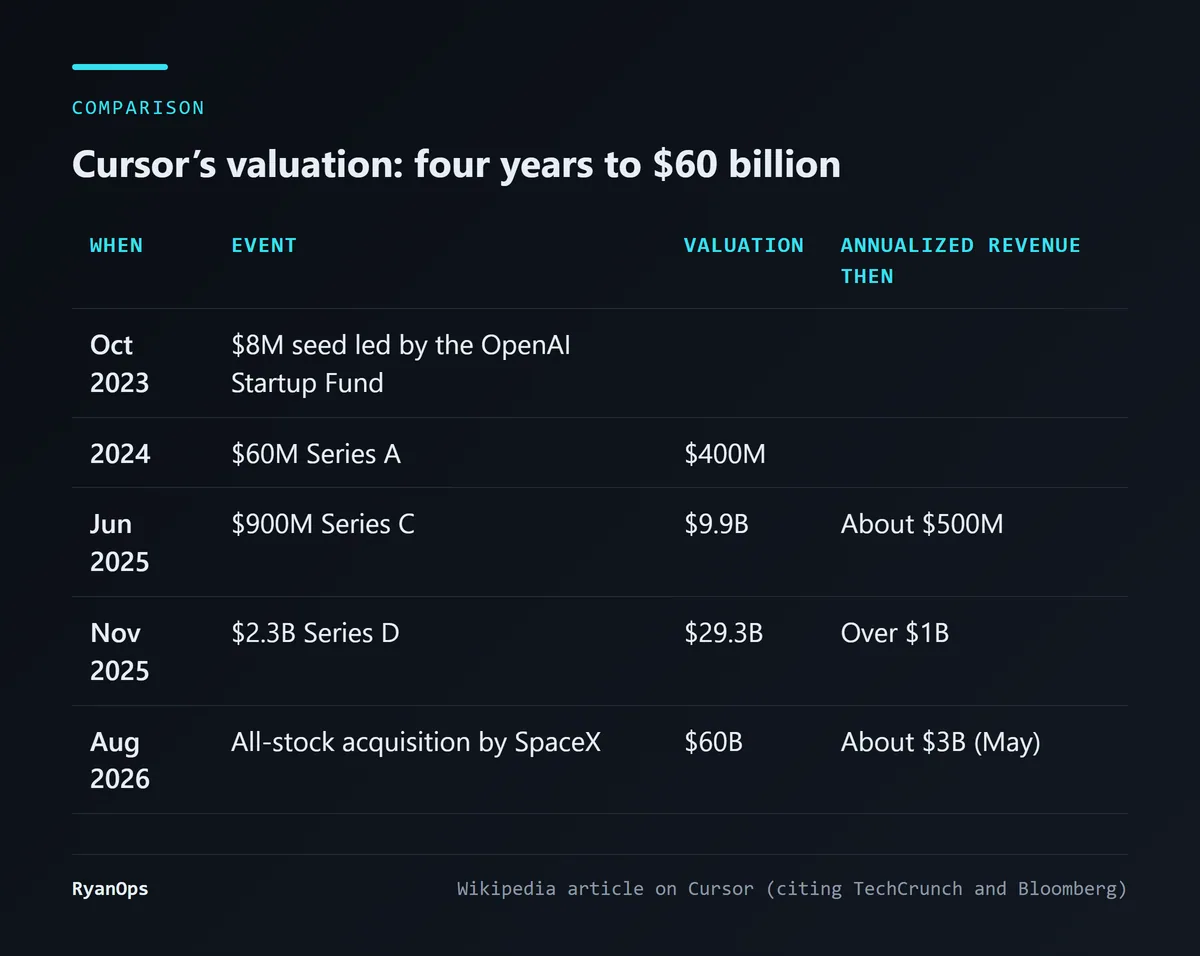 Figure: Cursor’s valuation and revenue (compiled for this article from the Wikipedia article on Cursor, which cites TechCrunch and Bloomberg)
Cursor was founded in 2022 by four MIT students. Its seed round in October 2023 was just $8 million, led by the OpenAI Startup Fund. That detail turns ironic later.
Growth after that went like this:
- January 2025: annualized revenue passes $100 million.
- June 2025: passes $500 million. Series C the same month at $9.9 billion.
- November 2025: passes $1 billion. Series D at $29.3 billion.
- May 2026: about $3 billion, according to Bloomberg.
$60 billion over $3 billion is 20 times.
I worked out the same multiple in the Lovable piece, where it was 27 times. Cursor’s own Series D last November was $29.3 billion on $1 billion, or 29 times.
So by revenue multiple, $60 billion is not expensive, and is even cheaper than Cursor’s previous round. The reason is that the price was fixed in April while Cursor’s revenue kept rising afterwards. Wikipedia notes that in early 2026 Cursor had been in talks for a funding round at a $50 to $60 billion valuation. SpaceX’s price was roughly what it could have got in the private market anyway.
The press calls this “the largest startup acquisition on record”. Investing.com’s exact words are “widely considered”, without saying what it is being compared with. I have not verified the ranking.
The market reaction was small. SpaceX shares rose 1.5% on the news. Morgan Stanley kept its $300 price target and estimated the acquisition could bring SpaceX up to $13 billion in revenue by 2027. That is one bank’s forecast.
Why is OpenAI pulling out?
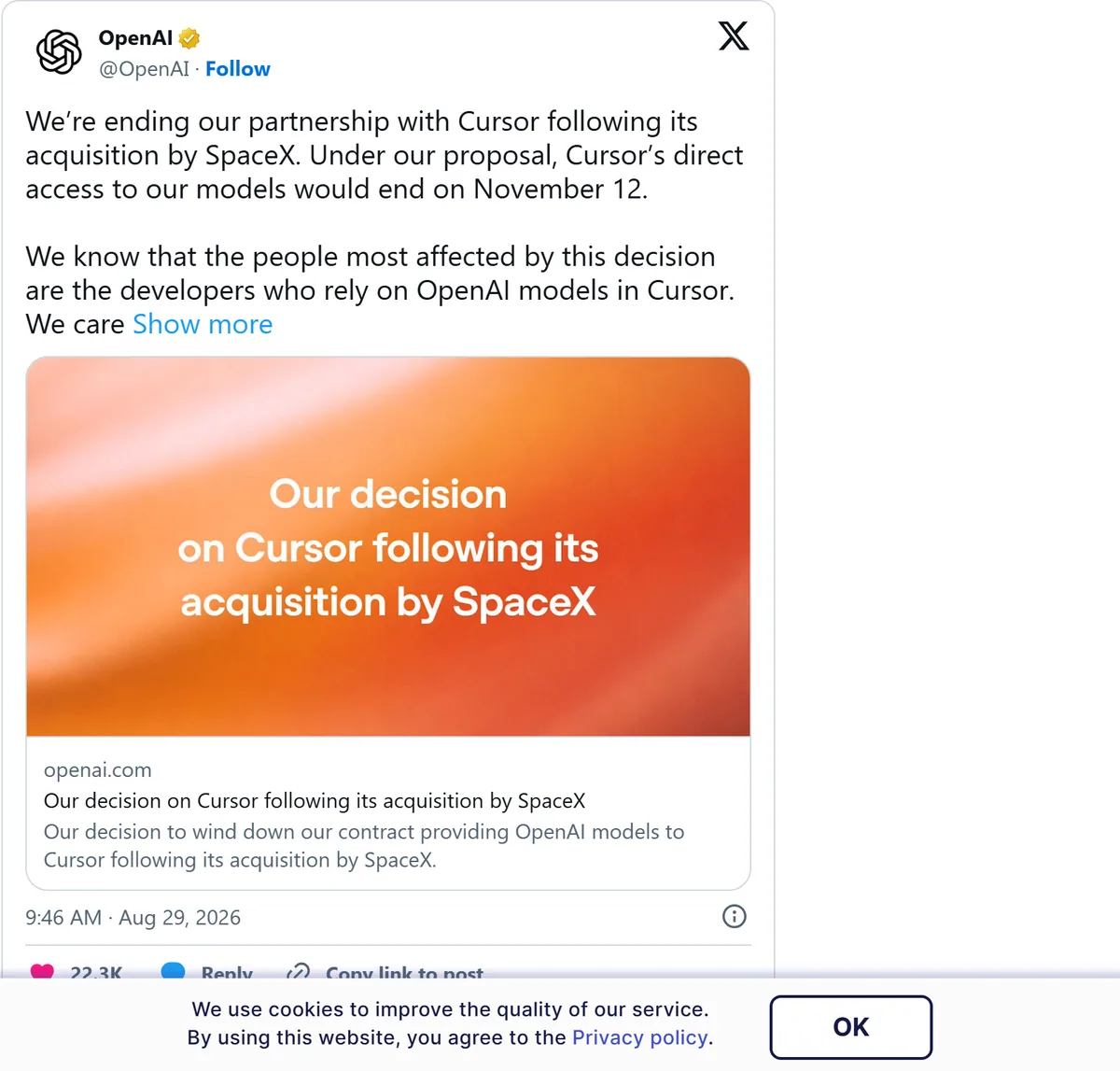 Figure: OpenAI’s post announcing the end of its partnership with Cursor, 2026-08-29 (source: the OpenAI post as embedded by forklog.com)
The first two sentences read: “We’re ending our partnership with Cursor following its acquisition by SpaceX. Under our proposal, Cursor’s direct access to our models would end on November 12.”
According to ForkLog, OpenAI’s reasons come in three layers.
The contract allows it. The contract has a change-of-control clause, giving a window in which it can be terminated after a change of owner. OpenAI says it chose the latest date permitted so that users have time to switch.
It does not trust the new owner. OpenAI is concerned that SpaceX will not comply with its model licensing terms. It cites two things: that after X was acquired in October 2022, that company failed to meet contractual obligations, and that Musk confirmed under oath in 2026 that xAI had deviated from usage terms.
No future models. OpenAI says its upcoming Astra will come with stricter licensing compliance controls and that Cursor will not receive OpenAI’s future models.
The partnership lasted nearly four years. OpenAI led Cursor’s seed round.
Some background is needed here. OpenAI and Musk have years of litigation and public conflict between them, and OpenAI has Codex, a directly competing product. So I have reservations about whether “distrust over licensing compliance” is the only reason. A company not wanting to supply its best models to a product owned by a competitor is a motive that stands without any contract dispute.
On Cursor’s side, CEO Michael Truell says OpenAI’s models account for about 5% of traffic on the platform and that the two companies are still talking. November 12 is OpenAI’s proposal and has not been agreed.
Which models will Cursor still have?
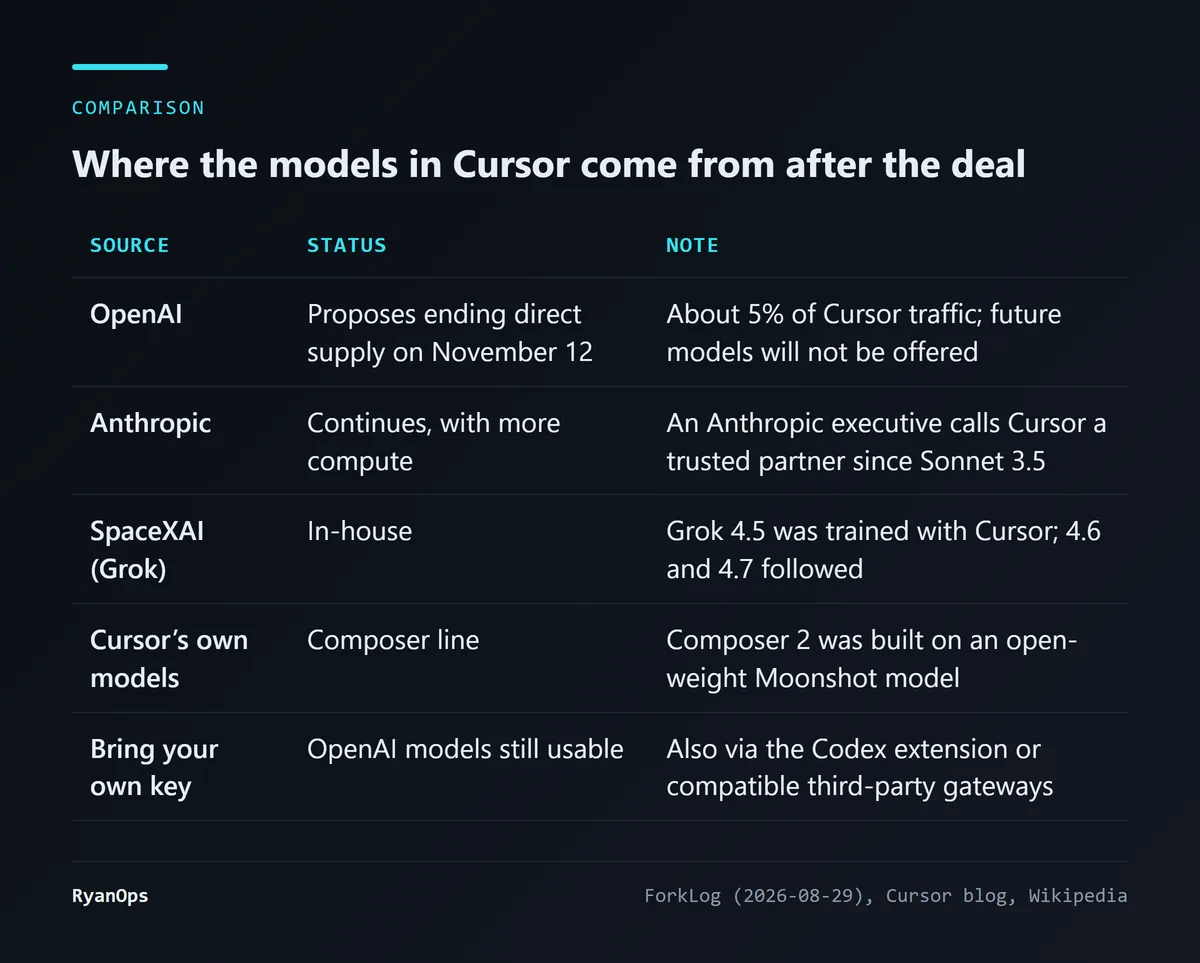 Figure: Where Cursor’s models come from now (compiled for this article from ForkLog’s report of 2026-08-29, the Cursor blog and Wikipedia)
If the 5% figure is right, OpenAI’s exit matters little to most users. The one that really matters is the other vendor.
Tom Brown, Anthropic’s head of compute infrastructure, posted the same day: “Cursor has been a trusted partner of Anthropic since Sonnet 3.5.” He said Anthropic will keep supporting Claude in Cursor and will increase the compute allocated to it.
The two reactions are opposite. OpenAI leaves and Anthropic adds.
My reading is that their positions differ. OpenAI has Codex, and Cursor is a rival. Anthropic has Claude Code too, but Claude sees heavy use inside Cursor, and that is real revenue. With OpenAI gone, part of that 5% of traffic will flow to Claude.
For you, the practical situation is this:
- Until November 12, OpenAI’s models remain available as usual, unless Cursor turns them off earlier itself.
- After that, if you still want OpenAI models in Cursor, you can enter your own API key, use the Codex extension, or go through a compatible third-party gateway.
- Claude is unchanged.
- There will be more and more Grok. ForkLog notes that July’s Grok 4.5 was trained together with Cursor. Then came 4.6 on August 12 and 4.7 on September 21. Cursor’s blog now reposts Grok’s launch announcements directly.
Techzine quotes Cursor’s own benchmark: on CursorBench v3.2, Grok 4.6 scores 69.9% at the High setting and 70.8% at Extra High. This is an exam written by Cursor testing its own parent’s model, so its value as a reference is limited.
Can neutrality hold?
The August piece said “the market widely expects the Cursor brand to be folded into the Grok line eventually”. The source of that sentence is Investing.com’s own speculation, not a statement by either party. So far the Cursor brand is still there and the product is updated as usual. In September it shipped a projects feature and the ability to run cloud agents on machines you manage.
But a few signs deserve your attention.
The footer of Cursor’s website now has two new links: “SpaceXAI Subscription Terms” and “Grok Bot Terms”. The copyright holder is still Anysphere.
In early August Cursor published a post about how its Router chooses a model for each task. When the party choosing the model also owns one of the models, whether that choice still counts as neutral is a fair question. I have no evidence that the Router favors Grok. But the conflict of interest is structural and does not require anyone to do anything on purpose.
Cursor has a record on transparency about model sources. Wikipedia records that when it launched Composer 2 in March 2026, it did not disclose that the base was an open-weight model from Moonshot AI, and users found out themselves. A co-founder later called the omission “a miss”.
How do I see it?
I think this acquisition is good for Cursor users in the short term and a risk to keep watching in the long term.
The short-term benefit is concrete. Cursor’s largest cost is compute, and it now has behind it a company that builds its own data centers. The announcement says models will be stronger and cheaper, and that promise has hardware behind it.
The long-term risk is that a large part of Cursor’s value came from “whichever vendor’s model is best, it is here”. That promise now depends on other model vendors being willing to keep supplying. OpenAI has left. Anthropic stays, but that is a commercial decision, and it can leave too if the sums change. If one day the best option left in Cursor is Grok alone, Cursor turns from a neutral tool into the front end of one vendor’s model.
What would change my view? It could go either way. If OpenAI and Cursor end up agreeing some continuing arrangement, it would mean model vendors still cannot do without this channel, and neutrality holds. Conversely, if Anthropic also starts to restrict supply, or Cursor’s default models quietly all become Grok, that is a different story.
If you or your team depend heavily on Cursor, my suggestions are:
- Write down which models you actually use. If it is mostly Claude or Grok, November 12 does not affect you. If any workflow depends on OpenAI models, start testing alternatives now.
- Do not tie important configuration to one editor. Keep prompts, rule files and agent workflows in formats you can move. Coding agents have changed owners, models and prices very quickly this year.
- Watch for updates to the terms. The announcement says nothing about data and privacy, yet the footer has new terms links. Read them when you have time.
What this rewrite corrected
- The original did not mention the April 21 partnership and purchase option, and described the deal as signed in June and closed in two months. The full timeline is added.
- The original said Cursor was folded into SpaceXAI “instead of continuing as an independent brand”. In fact Cursor became a wholly owned subsidiary, and the brand and product are still there. The idea that Grok will replace the brand was the source article’s speculation.
- The original presented “$13 billion in revenue in 2027” as the market’s estimate. It is the forecast of one bank, Morgan Stanley.
- The original said the combined team could use the Colossus supercomputer. Cursor’s own announcement says “the largest fleet of GPUs in the world” and does not use that name, so this version follows the announcement.
- The original was written before OpenAI announced the end of the partnership. Developments after August 29, and Anthropic’s position, are added.
- The original’s ending mentioned Google launching Gemini 3.7 Flash with a “half-price strategy”. That was a time-limited promotion and not a price cut, and the comparison is removed.


