Seedance 2.5: $7 per 30-Second Clip, 11 Elo Gained
ByteDance's Seedance 2.5 makes 30 seconds of video with sound in one run. The API is now live at $0.231 a second for 720p. The cost and the ranking.
ByteDance released the video generation model Seedance 2.5 on July 31. Its selling point is that one run can produce 30 seconds of video, with sound generated together with the picture.
My August piece spent two sections on what “the company has not made clear”: no resolution published, no price published, and an API said to be coming soon.
Two months on, all three have answers. The API is open, there are prices, and a third-party blind-test leaderboard has added the model. With those numbers, a question that could not be answered in August now can be: what does a 30-second single take cost to make, and is it worth it?
Where can you use it now?
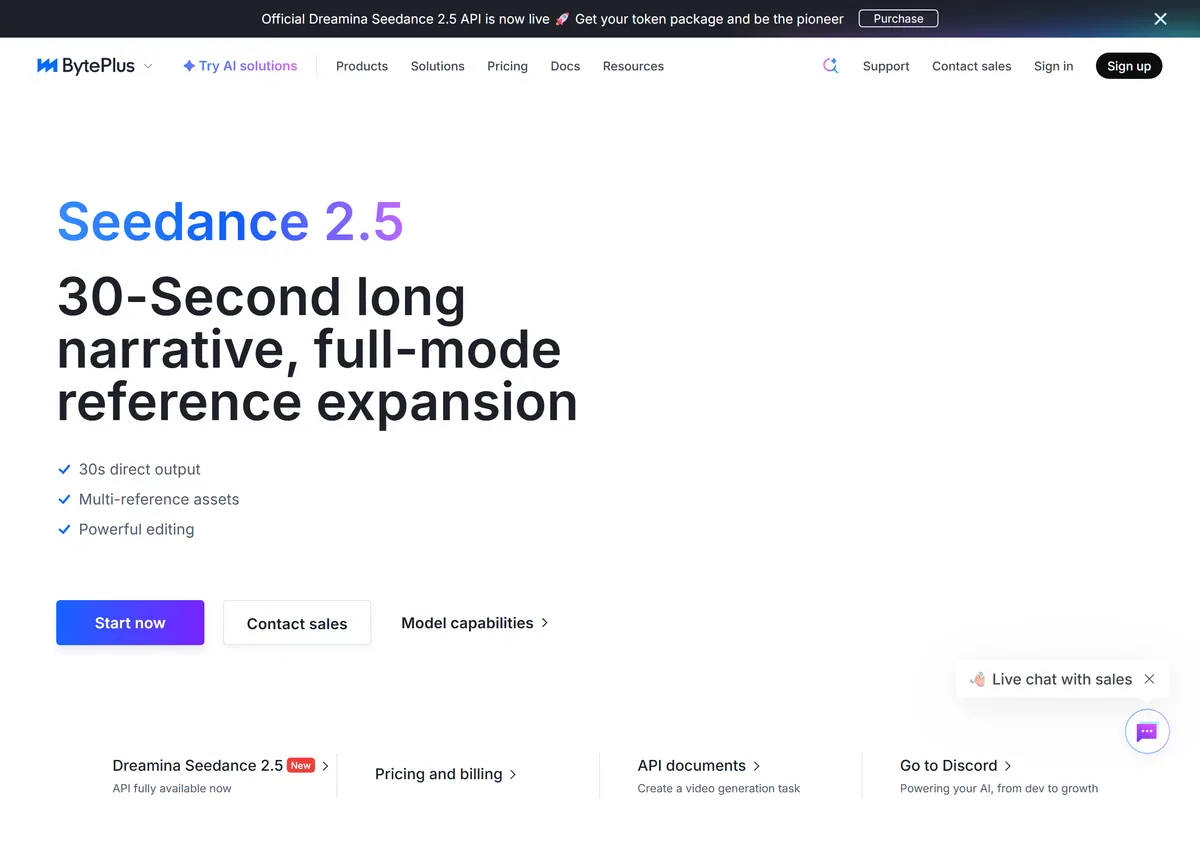 Figure: BytePlus’s product page for Seedance 2.5, captured October 2026 (source: byteplus.com)
There are three routes.
Consumer apps. Jimeng AI and the Pro version of Doubao in China, and Dreamina internationally. TechNode’s report on launch day said it was “rolling out to Jimeng AI and the Pro version of Doubao”.
The official API. BytePlus ModelArk internationally and Volcano Engine’s Ark in China. BytePlus’s product page now says the API is fully available. I did not find the exact opening date. CamClo’s write-up notes that OpenRouter’s Seedance 2.5 page lists a release date of August 7.
Resellers. Many third parties wrap it and sell it, each with its own prices and its own account of the specifications.
One limit is worth knowing up front. CellCog’s write-up points out that BytePlus’s official route is not sold in the United States, Canada, the United Kingdom, Australia or New Zealand, and is open in about 40 markets. Volcano Engine requires Chinese real-name verification and payment in RMB. So where you are decides which route is open to you.
What changed from the previous version?
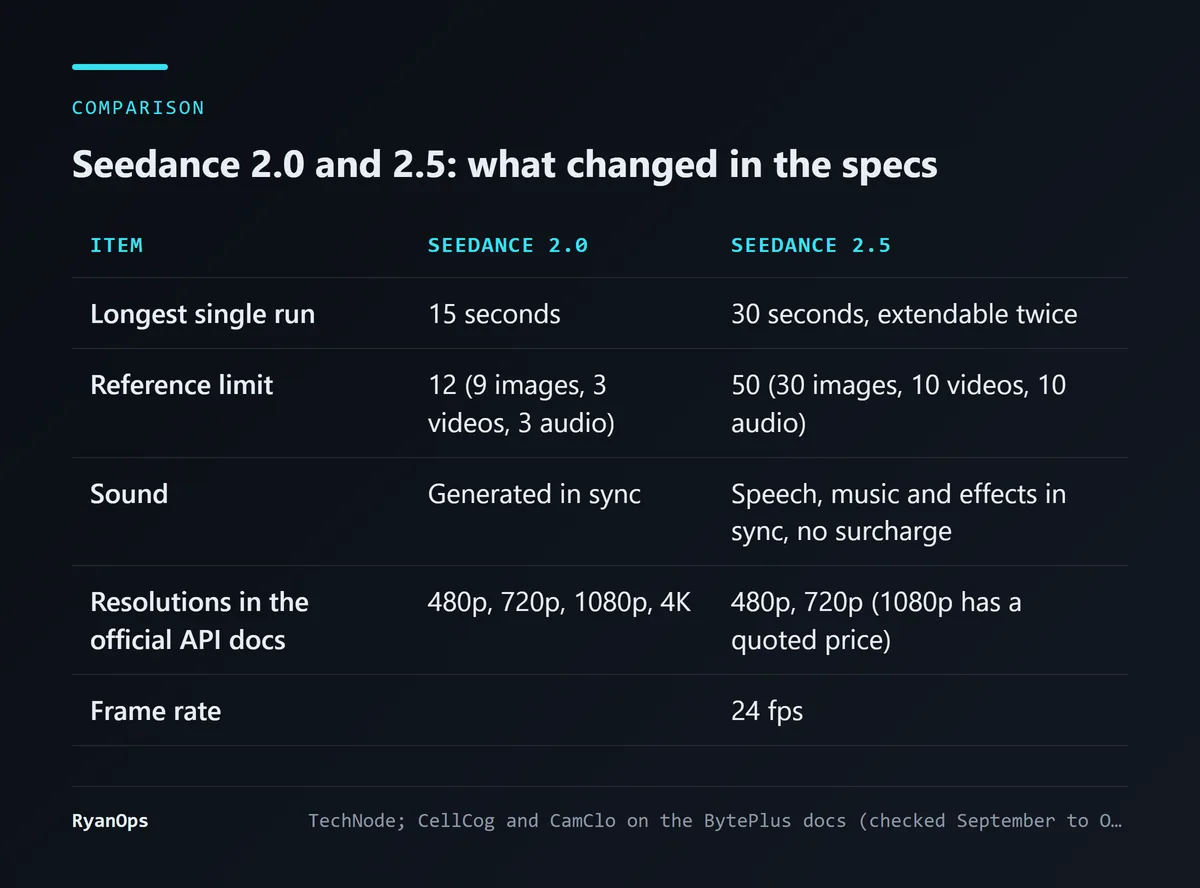 Figure: Specification differences between Seedance 2.0 and 2.5 (compiled for this article from TechNode’s report and CellCog’s and CamClo’s accounts of the BytePlus docs)
Two numbers more than doubled.
Length. 2.0 tops out at 15 seconds per run and 2.5 at 30. TechNode writes that it also supports multi-turn extension, and CamClo’s write-up says a clip can be extended twice.
Anyone who has made short films will understand the difference between 15 and 30 seconds. Fifteen seconds is roughly one shot and one action. Thirty seconds has room for a small arc. Making 30 seconds used to mean generating two clips and joining them, and at the join the character’s face, the lighting and the background often failed to match.
Reference material. 2.0 takes up to 12 items and 2.5 up to 50: 30 images, 10 videos and 10 audio clips. You can use them to tell the model what a character looks like, where the scene is, how the camera moves and what the sound should be like.
Sound. Speech, music and effects are generated in the same run as the picture. CellCog notes specifically that sound is included in the price and that no provider adds a surcharge. My August piece called this the “key technical leap” of 2.5. That is not quite accurate. Synchronized sound was already in 2.0, which sits in the with-audio group on the third-party leaderboard. The progress in 2.5 is in length and in the amount of reference material.
Resolution is where it goes backwards. After checking BytePlus’s documentation, CellCog says 2.5 natively documents only 480p and 720p, at 24 fps. The BytePlus pricing page as compiled by CamClo has a quoted price for 1080p but none for 4K. 2.0 goes all the way to 4K.
The August piece said the “native 4K” circulating online had no official confirmation. That judgment still holds. According to CellCog, the 1440p and 4K seen on resellers are upscaling added by those platforms and not the model’s native output.
The August piece also described local editing, extending a clip forwards or backwards, and joining two clips of different styles. BytePlus’s product page lists “Powerful editing”, but I did not read the official documentation for the details this time, so I leave it there.
What does a second cost?
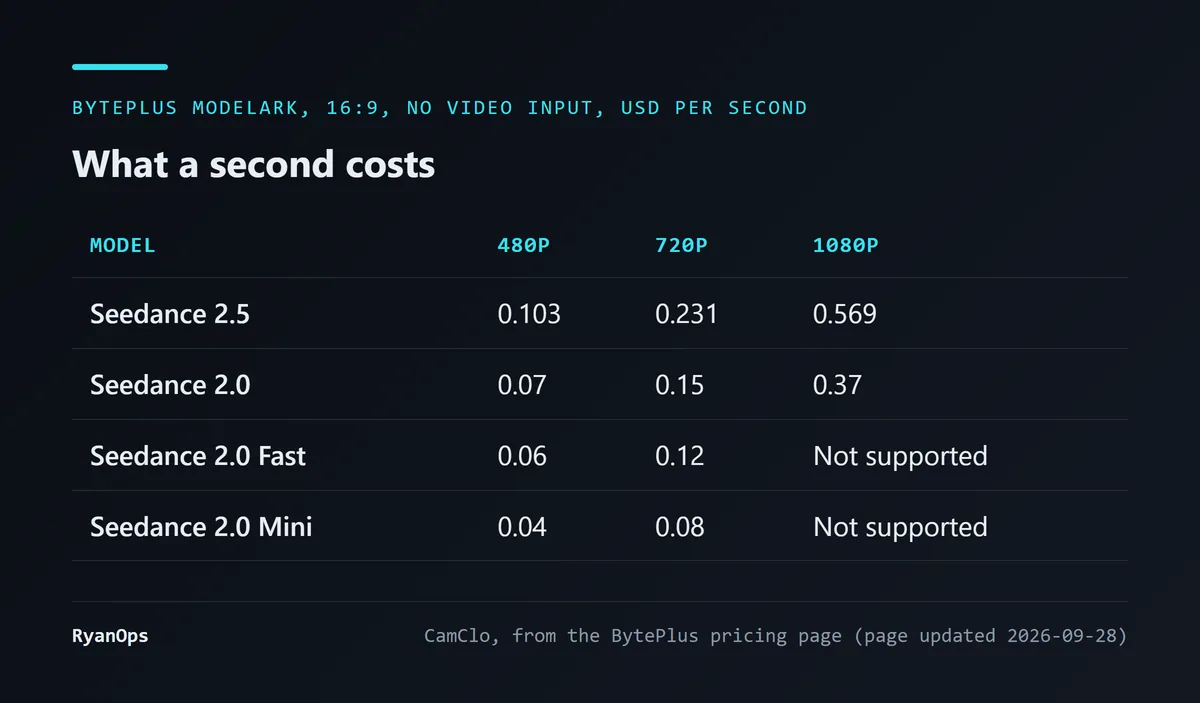 Figure: Per-second prices for Seedance versions on BytePlus (compiled for this article from CamClo’s account of the BytePlus pricing page, updated 2026-09-28)
The official billing unit is the token: $10.70 per million video tokens. On Volcano Engine it is ¥70 per million.
Converted to seconds: $0.231 at 720p, $0.103 at 480p and $0.569 at 1080p.
Against 2.0, every cell is about half again as expensive. 720p went from $0.15 to $0.231, up 54%.
So 2.5 is not only longer. Each second also costs more.
What does a 30-second clip cost?
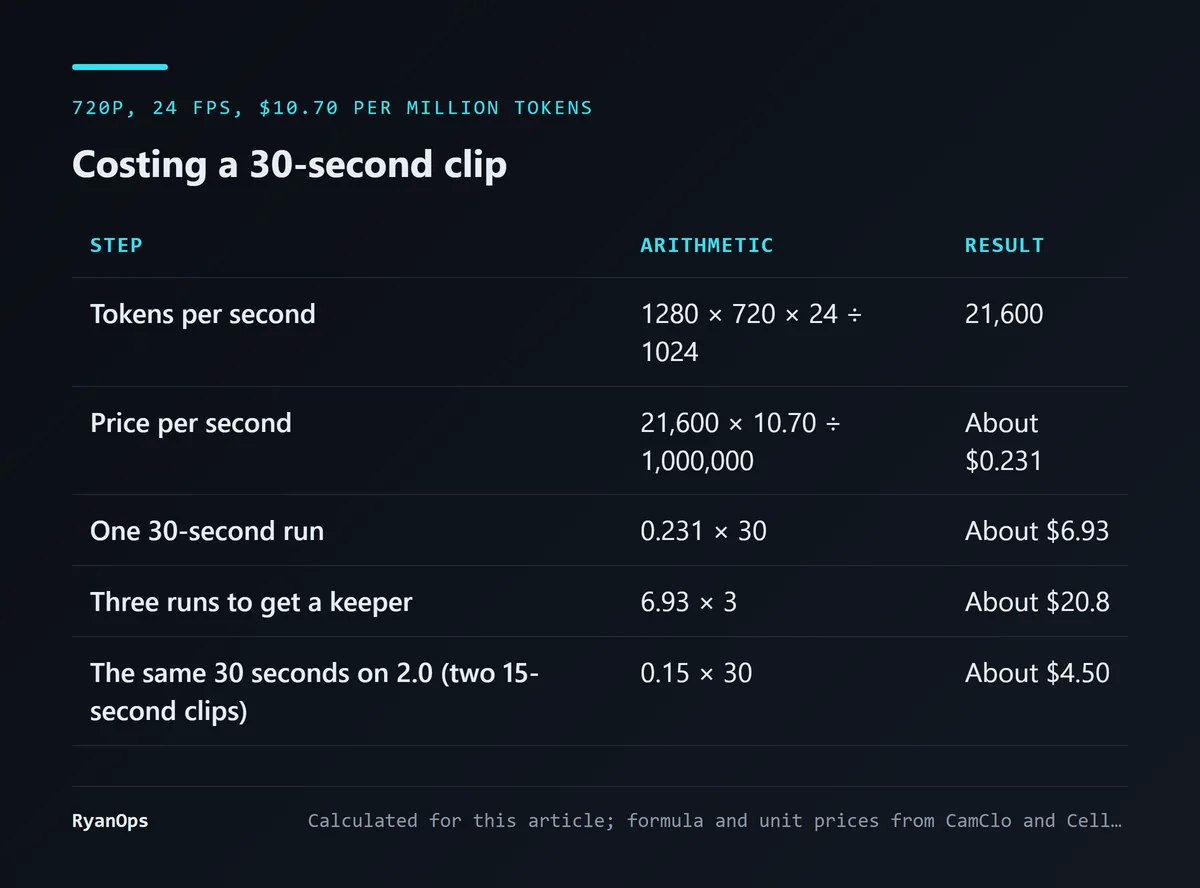 Figure: Cost estimate for a 30-second 720p video (calculated for this article; formula and unit prices from CamClo and CellCog on the BytePlus docs)
I want to lay the arithmetic out, because it shows how video models are priced.
By the BytePlus formula that CamClo cites, the token count is: video seconds × width × height × frame rate ÷ 1024.
720p is 1280 × 720. The frame rate is 24. So one second is 1280 × 720 × 24 ÷ 1024, which is exactly 21,600 tokens.
At $10.70 per million, that is $0.231 a second. It matches the number on the pricing page.
Thirty seconds is $6.93.
The formula tells you two things.
First, price is proportional to pixel count. Double both width and height and you have four times the pixels and four times the price. That is why 1080p costs so much more than 720p.
Second, if you use video as reference material, the seconds of that video are counted too. The formula uses “input video duration plus output video duration”. With video input the unit price drops somewhat (CellCog gives the Volcano Engine rates as ¥42 against ¥70 per million), but the total token count rises.
Then comes the most important point in real use: reruns cost money too.
Video generation rarely satisfies on the first try. CamClo writes that a retry costs the same as the take you keep. BytePlus charges only for successful generations and not for failures such as moderation rejections, but “it succeeded and you just do not like it” is charged.
If a 30-second clip takes three runs to produce one usable result, the cost is a little over $20.
That is the price of generating 30 seconds in one go. Before, when a 15-second clip disappointed, you reran 15 seconds. Now the whole 30 seconds starts over.
If you use the consumer apps, the sums are different. Dreamina works on subscriptions plus credits. CamClo recorded a first-month offer from late September to early October that works out at roughly $0.035 to $0.047 a second at 720p, far cheaper than the API. But Dreamina itself notes that this is not the renewal price, and the consumer plans have no API.
What does the third-party leaderboard say?
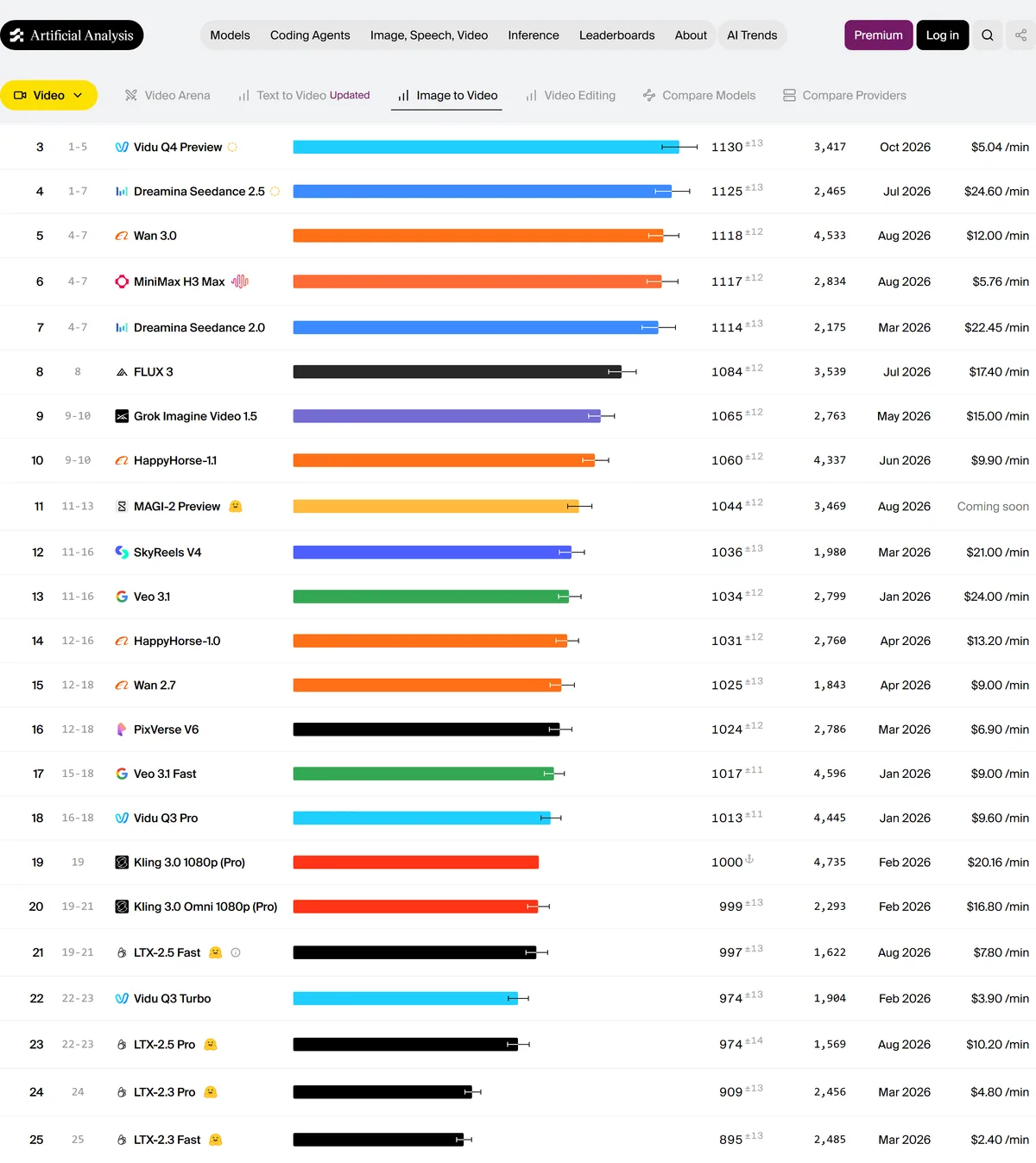 Figure: The Artificial Analysis image-to-video leaderboard (with audio), captured October 2026 (source: artificialanalysis.ai)
Artificial Analysis runs blind tests: users are shown two videos without being told which model made which, and pick the better one. Once enough votes accumulate, an Elo score is computed.
In August 2.5 had not been added. Now it is on the board, in 4th place with 1125 points.
Its predecessor 2.0 is in 7th with 1114.
A gap of 11 points.
Beside each score is a margin of plus or minus 13. In the rank column, 2.5 shows “1-7” and 2.0 shows “4-7”. That means that statistically the true rank of 2.5 could be anywhere from 1st to 7th, overlapping the range for 2.0.
So the blind-test result is that viewers on average find 2.5 slightly better, by a margin too small to be sure of.
This test measures how picture and sound come across. It cannot measure what 2.5 is really selling, which is length and reference material. A continuous 30-second shot and two joined 15-second clips look no different in a one-to-one comparison of short clips. So I would not say 2.5 has made no progress. The more accurate statement is that on picture quality alone it is on the same level as its predecessor, and the progress lies elsewhere.
The score my August piece quoted was 1,225 for 2.0, in third place. The same model is now at 1,114 on the board. The leaderboard version has changed, and old and new scores cannot be compared.
The rightmost column is also worth a look. Artificial Analysis converts each model to a price per minute:
- Seedance 2.5: $24.60
- Seedance 2.0: $22.45
- Wan 3.0: $12.00
- MiniMax H3 Max: $5.76
- Vidu Q4 Preview: $5.04
Vidu Q4, one place above it, scores 5 points higher at one fifth of the price. MiniMax H3 Max, two places below, scores 8 points lower at less than a quarter of the price. All these scores are within one another’s margins.
In other words, on this board Seedance 2.5 is the most expensive of the 3rd to 7th places I captured, and its score does not beat rivals that cost a quarter or a fifth as much. The prices of 1st and 2nd place fall outside the screenshot, and I did not compare them.
How do I see it?
The August piece ended by warning readers not to accept marketing claims wholesale before the company gave clear specifications. That warning can now be replaced with something more concrete.
I think Seedance 2.5 suits one particular need: you want a continuous long take with no join in the middle, and you have a lot of reference material it must respect. For example, one character completing a whole sequence of actions in one scene, with sound that matches. In that case 30 seconds and 50 references are something others cannot offer, and paying more makes sense.
If all you want is good-looking short clips to edit yourself afterwards, the leaderboard has already answered. The same picture quality is available at a quarter to a fifth of the price.
There is also a point about how to count. The cost of video should be reckoned per usable clip, not per generation. A 30-second length doubles the cost of every rerun. I would suggest drafting at 480p first, at $0.103 a second, less than half the 720p rate. Settle composition and movement, then run at high resolution. CamClo also mentions that 2.5 has a 480p draft mode.
What would change my view? If a benchmark specifically compares coherence over long takes, for example whether a character’s face and clothing drift within 30 seconds, and 2.5 clearly beats the joined approach, its premium would have data behind it. So far I have seen specifications and no such measurement. The prices and rankings here are read from documents and the leaderboard. I have not generated any video myself.
For the basics of how vendors charge, see token pricing in the glossary. Video models count tokens by pixels and seconds, which is very different from text models. If running things on your own machine with no API fees interests you, I wrote a walkthrough of a local animated video workflow.
What this rewrite corrected
- The original said the company had not published resolution or pricing and that the API was coming soon. The API is open, and BytePlus’s prices, billing formula and documented resolutions are added here.
- The original described synchronized audio and video as the key leap in 2.5. The previous version, 2.0, could already generate sound in sync. The main changes in 2.5 are length and the number of references.
- The original quoted Seedance 2.0 at 1,225 points and third place on Artificial Analysis, and said 2.5 had not been added. The board now shows 2.5 at 1,125 in 4th and 2.0 at 1,114 in 7th. The leaderboard version has been updated and the old scores no longer apply.
- The original quoted an animation producer describing the industry’s attitude as “don’t ask, don’t tell”. I found no source for it this time and removed it.
- The original described local editing and clip extension in detail. I did not read official documentation for those this time and kept only the item name listed on the product page.


