Meta Settled Its Teen Trial in Eight Days for $17B
States sued Meta over features built to hook teenagers. The trial opened August 18 and settled August 26: about $17 billion over ten years, plus new defaults.
This piece went out on August 20 about a trial that had opened two days earlier in Oakland, California: state attorneys general accusing Meta of designing Facebook and Instagram to addict children. The headline used the most frightening number available, $1.4 trillion.
Its last paragraph said “the trial is expected to take about six weeks, and Zuckerberg is expected to testify in person”.
Six days later the case was over. On August 26, Meta and the states announced a settlement. The trial had reached only the middle of its second week. None of the reports I found says Zuckerberg ever took the stand.
The settlement is for up to about $17 billion, paid over ten years. That is 80 times smaller than the number in the headline.
So the focus of this rewrite has changed. The question then was “how much might Meta pay”. The question now is what it actually agreed to, and whether the result is heavy or light.
What is in the settlement?
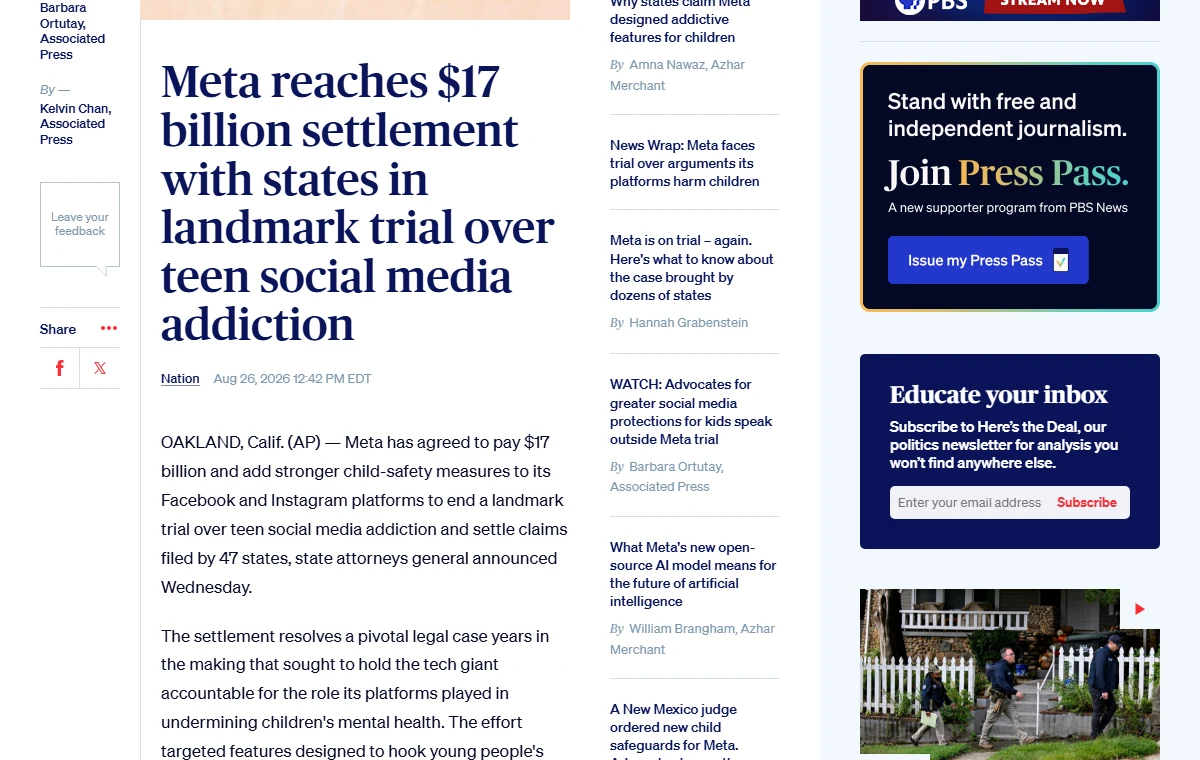 Figure: AP’s report on the settlement, as carried by PBS, 2026-08-26 (source: pbs.org)
AP’s first sentence covers the essentials: Meta has agreed to pay $17 billion and add stronger child-safety measures to its Facebook and Instagram platforms, to end the trial and settle claims filed by 47 states.
The money has several details.
- It is paid annually over ten years, for youth online safety initiatives. NPR’s report says part will go to youth mental health programs, after-school programs and crisis intervention services.
- California Attorney General Rob Bonta said California would receive at least $1.5 billion. Other figures listed by AP: at least $525 million for New Jersey, at least $366 million for Massachusetts, and $353 million for Virginia.
- Part of it is conditional. AP writes that 30%, about $5.3 billion, is released to the states only once YouTube and TikTok adopt similar safety measures and pay the same amount.
There are three versions of the amount. AP says $17 billion, CNBC says a maximum of $16.7 billion, and Meta’s own figure is about $18 billion, with the extra reportedly tied to a separate sum for Texas. There are also three ways of counting the states: 29 originally sued, AP says the settlement covers 47, and NPR quotes the California attorney general’s office as saying it resolves cases and claims in 51 of the consolidated lawsuits. I have not read the settlement document itself, so I give each figure as reported and do not pick one for them.
The court moved fast. NPR writes that Judge Yvonne Gonzalez Rogers approved it within hours of filing.
Where did this case come from?
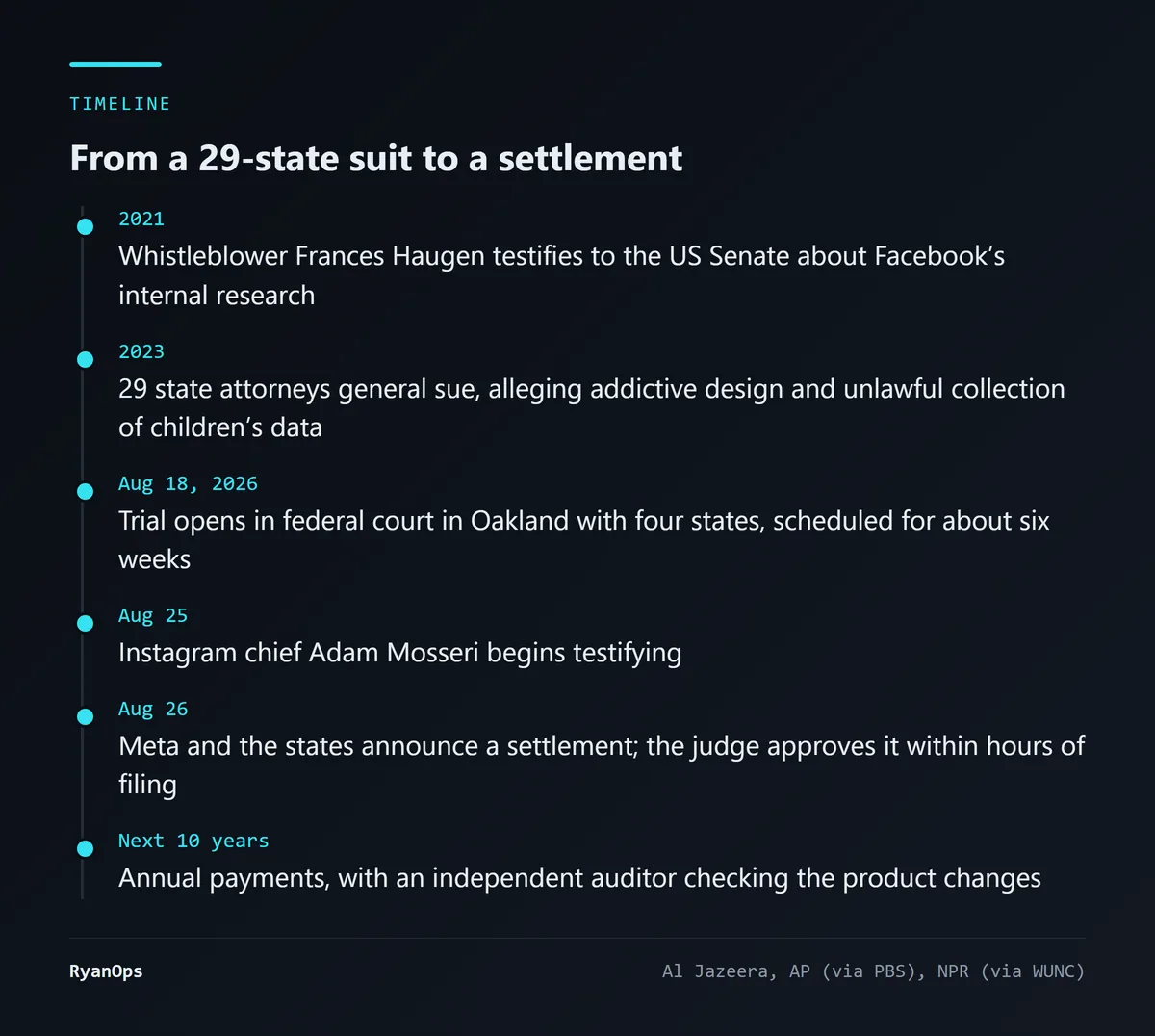 Figure: Timeline of the multistate case against Meta (compiled for this article from reports by Al Jazeera, AP and NPR)
It began in 2021. Frances Haugen, a former Facebook data scientist, testified at a US Senate hearing and laid out the company’s internal research on its products and profits. Al Jazeera’s report calls that hearing the impetus for this case.
In 2023, the attorneys general of 29 states sued together. There were two lines of claim.
The first is design. The states said Meta knew certain features would addict children and harm their mental health, built them anyway, and concealed it.
The second is data. The states said Meta collected data on children under 13 without parental consent, in violation of the federal Children’s Online Privacy Protection Act. Meta’s rules bar registration under 13, but some children enter a false birth date.
On August 18, 2026, four states went first, California, Colorado, Kentucky and New Jersey, with the others to follow. The judge was Rogers. An eight-person jury sat, but only in an advisory role, with the judge deciding in the end.
In opening statements, Megan O’Neill, a deputy California attorney general, put the accusation in one sentence: Meta aims to “hook the users, hold them for as long as they can, harvest their data, and then hide the truth from the public”. She said this worked “especially well for kids”.
Meta’s lawyer, Paul Schmidt, said there was “no dispute” that some users face struggles with social media. But he argued that research showed no clear link between adolescent social media use and a lack of wellbeing.
What happened in court before the settlement?
The trial ran little more than a week, but two important witnesses had already appeared.
Arturo Béjar, a former Meta safety engineer, was the states’ first witness. Al Jazeera writes that he had already testified against Meta in four earlier trials. He said “move fast and break things” was a Meta mantra, and that the company took a “don’t ask, don’t tell” approach to children under 13 being online. NPR adds that he testified that company culture was “obsessed” with growing user numbers, and that internal studies showed young users were exposed to harmful experiences at much higher rates than Meta acknowledged publicly.
Meta had tried to block his testimony on the ground that he deleted Signal messages with former employees. The judge did not accept that.
Adam Mosseri, the head of Instagram, began testifying late on Tuesday, August 25. NPR writes that he was questioned about a feature called “Take a Break”, which nudged children to close the app. The states accused him of touting it publicly when teen uptake was in fact very limited.
The next day the settlement was announced.
It is hard not to connect the timing. A senior executive had just been asked on the stand about things he said in public, and the next person due to testify was the chief executive. A settlement meant none of that had to continue. This is my observation. Neither side has said so.
My August piece quoted the California attorney general as citing Meta’s annual revenue of $200 billion in court as a reference point for fines. I cannot find that passage in the sources this time and have removed it. What Al Jazeera writes is that the coalition of states was seeking about $200 billion.
$1.4 trillion, $200 billion, $17 billion: which is real?
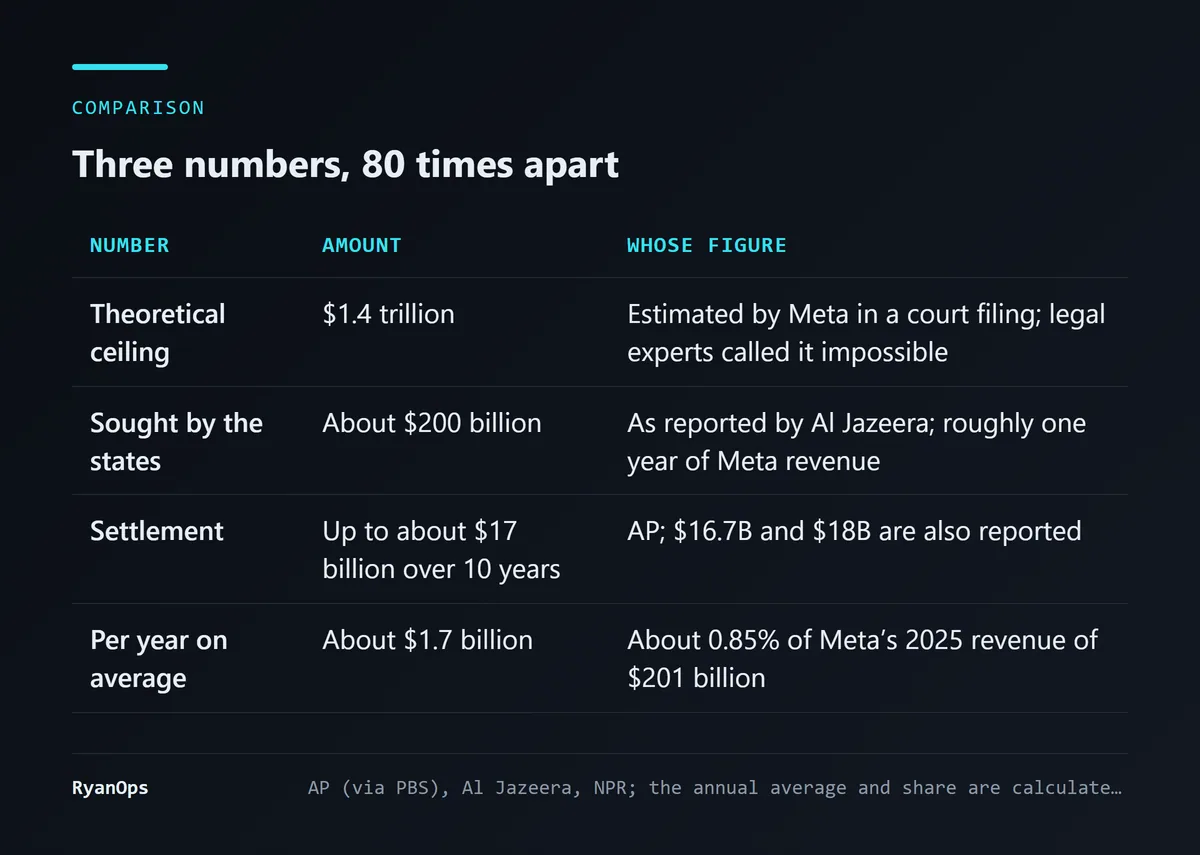 Figure: Three amounts that have appeared in this case (compiled for this article from AP, Al Jazeera and NPR; the annual average and share are calculated for this article)
All three are real. They are simply different in kind.
$1.4 trillion is a theoretical ceiling. Meta computed it itself in a court filing: what each state’s law allows per violation, multiplied by the number of violations alleged. AP writes that legal experts considered the figure unlikely, if not impossible. Meta’s purpose in putting it forward was to show how outlandish the states’ claims were. It is almost equal to Meta’s market value.
$200 billion is what the states wanted. About one year of Meta’s revenue.
$17 billion is what was finally agreed.
I worked out how much that last number weighs.
Over ten years it averages $1.7 billion a year. Meta’s revenue in 2025 was $201 billion. $1.7 billion a year is 0.85% of revenue.
NPR notes that Meta’s net profit last quarter was about $16 billion. In other words, the ten-year total of the settlement is about what it earns in one quarter.
Stanford law professor Nora Freeman Engstrom put it precisely to NPR: the payment is “not exactly pocket change, but it’s hardly a body blow”.
On money alone, Meta won. From $200 billion down to $17 billion, spread over ten years, with 30% of it depending on whether others cooperate.
The August piece put $1.4 trillion in the headline, and a section of the text explained that this was Meta’s own theoretical ceiling and nobody’s actual claim. The text was right, but the headline still chose the biggest number. I have seen this problem again and again in this round of rewrites: the text is more honest than the headline.
Which designs does Meta have to change?
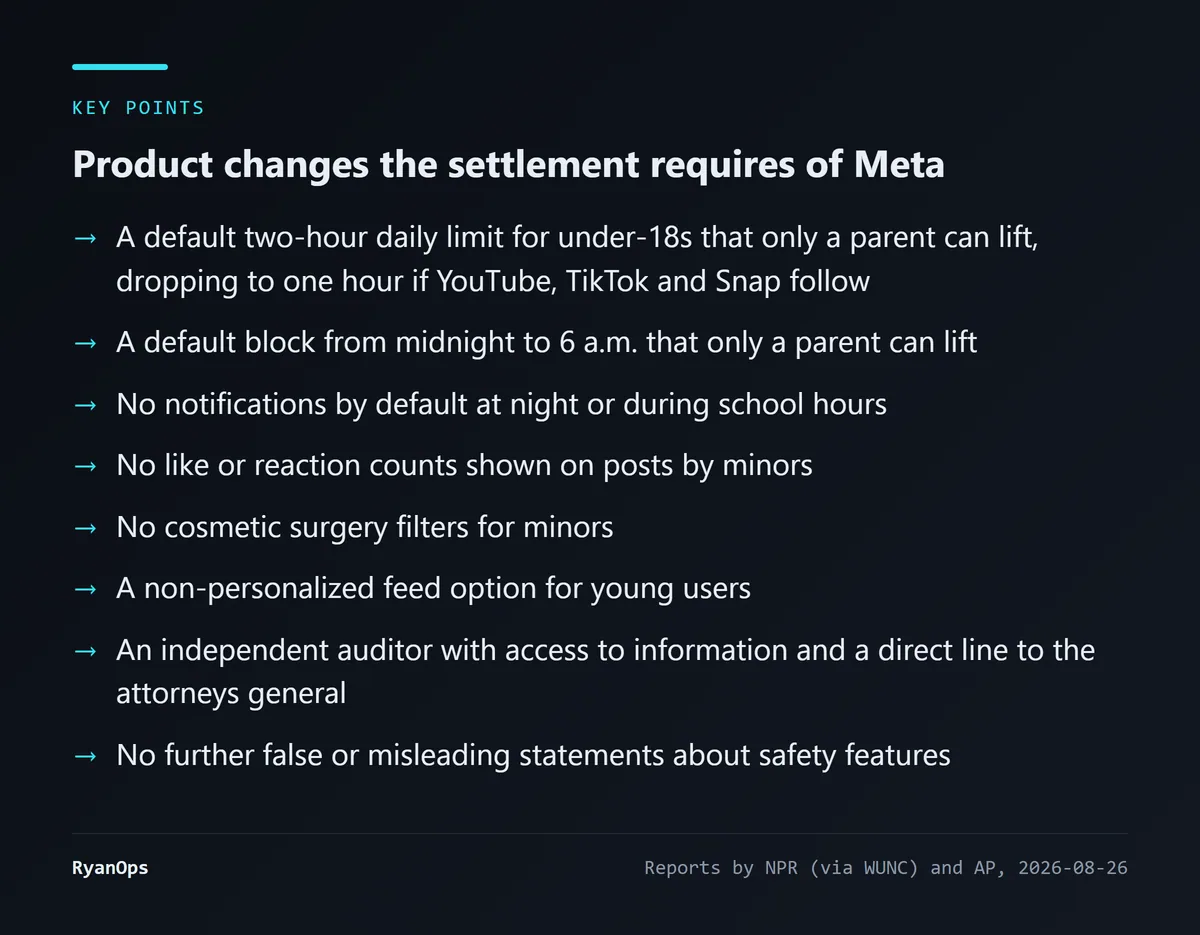 Figure: Product changes the settlement requires of Meta (compiled for this article from reports by NPR and AP, 2026-08-26)
I think this list matters more than the amount.
Money is a one-off cost to Meta. These changes alter the product itself, and every one of them runs against the goal of keeping people on longer.
One by one.
A two-hour daily limit. Users under 18 get two hours a day by default, and only a parent can lift it. If YouTube, TikTok and Snap adopt similar steps, the limit drops to one hour.
A nighttime block. No use by default between midnight and 6 a.m., again liftable only by a parent.
No notifications during school and sleep. Push notifications are the most effective tool for pulling people back into an app.
No like counts. Posts by minors do not show how many likes or reactions they received. This one targets social comparison.
No cosmetic surgery filters. Image filters that simulate cosmetic surgery may not be offered to minors.
The algorithm can be switched off. Young users can choose a feed that is not ordered by a personalization algorithm.
These have one thing in common: they are all defaults.
In product design, a default is more powerful than any feature. Most people never change settings. Meta’s line had always been “we provide tools for parents to manage”, and Take a Break was one of those tools. The states’ rebuttal in court was that almost nobody used them. The settlement turns this around: the limits are on by default, and it takes an action to remove them.
I met the other side of the same thing when writing about Meta’s Muse Code. That product sets “let Meta train on your code” to on by default. The same company understands the power of defaults very well. The difference is that this time it was required to set the default on the side that works against it.
Two further items concern oversight.
An independent auditor. An independent auditor will assess how Meta implements these features and how effective they are. NPR writes that the auditor has expansive access to information and resources and the right to communicate directly with the attorneys general.
No further false statements. Meta is barred from making false, misleading or deceptive statements about its safety features.
What is the conditional 30% about?
This is the most unusual design in the whole settlement.
According to AP, 30% of the amount, about $5.3 billion, is released to the states only when two conditions are met. First, YouTube and TikTok also implement similar safety features, including a one-hour daily limit, a nighttime block and age assurance. Second, those two companies together also pay the same amount.
Meta’s chief legal officer, C.J. Mahoney, said the framework’s success “depends on all other social media platforms following Meta’s lead”. Meta also publicly urged TikTok and YouTube to adopt similar measures.
Looked at another way, Meta has turned a loss into a bargaining chip. It can now say: I have complied, and if I alone am restricted, children will just move to other platforms. That argument is not without merit. And it gives the states a direct financial incentive to put pressure on YouTube and TikTok.
Google and TikTok had not responded when the reports were published.
Is it over?
No.
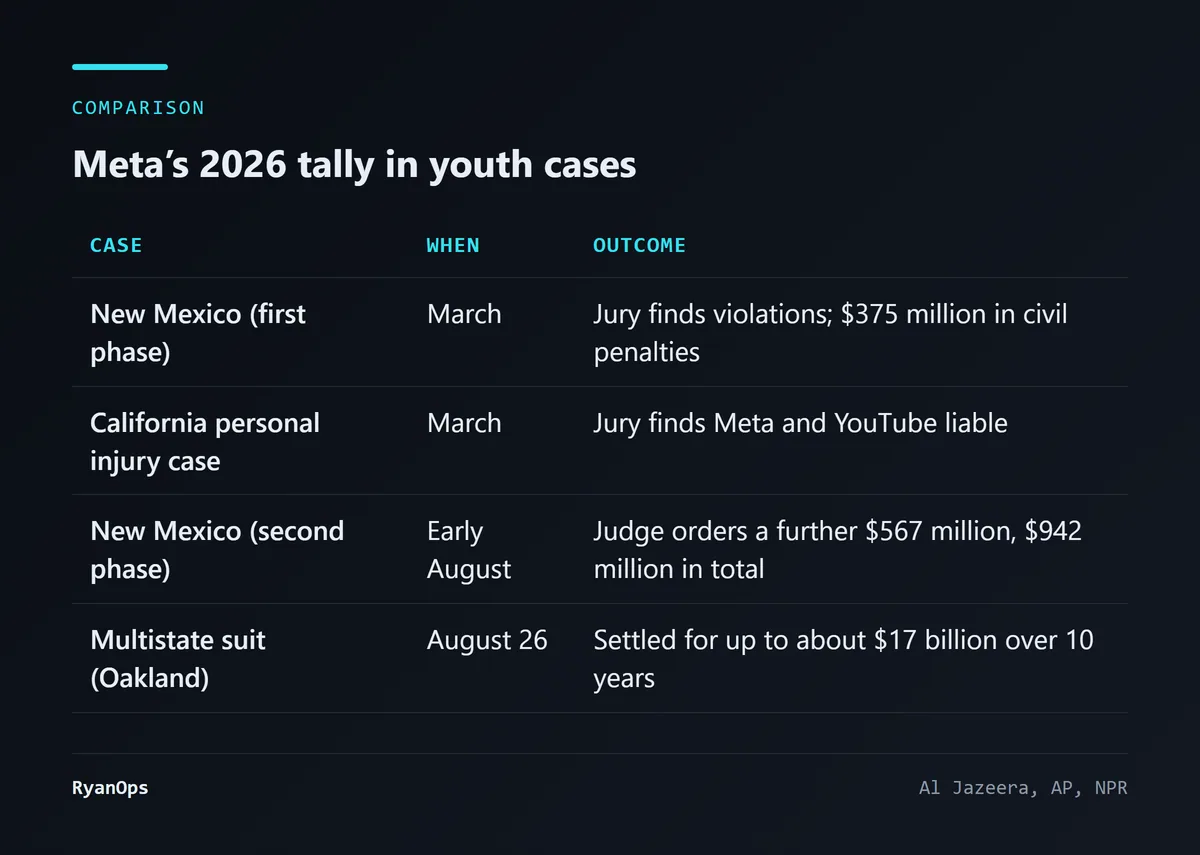 Figure: Outcomes of several youth-related cases against Meta in 2026 (compiled for this article from Al Jazeera, AP and NPR)
This was Meta’s third front this year.
The New Mexico case is separate. In March a jury found Meta in violation and imposed $375 million in civil penalties. In early August a judge ordered a further $567 million. Al Jazeera gives the total as $942 million.
There was also a personal injury case in California in March, in which the jury found both Meta and YouTube liable.
NPR notes that there are thousands of such cases against social media companies, and experts say many will not be affected by this settlement. Nine attorneys general also filed separately in their own states.
The second half of Professor Engstrom’s remark is: “Meta is clearly signaling that it would like this litigation behind it. But this is not game over.” Matthew Bergman, a lawyer representing affected families, called the settlement a “watershed moment” and added that “our work is far from over”.
The August piece gave several details of the New Mexico case, including 75,000 violations found by the jury and 7.5 million items of material awaiting internal review, and a $6 million award in the March personal injury case. Those figures are not in the sources I checked this time, so only the amounts with a source remain.
How do I see it?
I think the money in this settlement is too little and the conditions are more substantial than expected.
The money has been worked out above. A ten-year total equal to one quarter’s profit does not change a company’s behavior.
The conditions are different. A default two-hour limit, a nighttime block and hidden like counts, if actually enforced, will directly reduce the time minors spend on the platforms. Time spent is advertising revenue. That is the real price Meta is paying, and it does not appear in the $17 billion figure.
“If actually enforced” is the key. There are three places I would watch.
The first is age assurance. All these limits apply only to “users under 18”. If a 15-year-old registers as 25, the defaults do not reach them. AP’s list of conditions includes “robust” age-assurance measures, but what counts as robust depends on how the auditor judges it.
The second is whether the auditor’s reports are made public. If only the attorneys general can see them, outsiders have no way to judge.
The third is the clause dropping the limit to one hour. It depends on what competitors do. Until then it is two hours.
What would change my view? If a year from now independent data shows that American minors’ time on Instagram has fallen noticeably, the settlement worked, and the criticism that $17 billion is too little matters less. Conversely, if the data is unchanged, or there is no public data at all, it was only an instalment plan.
If you are a parent, there is one thing you can do now without waiting for the settlement to take effect: check the birthday on your child’s account. These default protections, and the Instagram Teen Accounts Meta launched in 2024, are all triggered by the age registered on the account.
What this rewrite corrected
- The original said the trial was expected to last about six weeks and that Zuckerberg would testify. In fact it settled on August 26, in its second week, and the reports I found do not mention Zuckerberg testifying.
- The original headline led with $1.4 trillion. That was a theoretical ceiling estimated by Meta itself. The settlement is up to about $17 billion over ten years, and the three numbers are now explained side by side.
- The original quoted the California attorney general in court using Meta’s annual revenue as a reference for fines. I could not find this in the sources and removed it. What can be found is that the states sought about $200 billion.
- The original said the New Mexico case found 75,000 violations and that 7.5 million items awaited internal review, and that the California personal injury case awarded $6 million. I found no source for these details this time and took them out.
- The original described the accusations as brought by “four prosecutors”. Four states went to trial, representing the 29 states that sued in 2023.


