PS5 Emulator KytyPS5: How Far It Gets Before GTA 6
What the KytyPS5 PS5 emulator is, how it runs games on PC, where GTA V really stands, how it compares with SharpEmu and EmuFive, and where the legal line is.
The most prominent thing on Rockstar’s GTA VI page right now is a single line: “Coming November 19, 2026.” The platforms listed underneath are PlayStation 5 and Xbox Series X|S. No PC. In four days the game is out, and if all you own is a computer, you get nothing.
That’s why a GitHub project called KytyPS5 keeps coming up. It says it can run PS5 games on Windows, Linux and macOS, it already gets the PS5 version of GTA V into gameplay, and someone in its discussion forum has even opened a thread called “Road to GTA VI.”
I went through KytyPS5’s documentation, its compatibility list, the GTA V report issue and two similar projects, and used the GitHub API to count how active each has been over the past 30 days. The short version: the PS5 version of GTA V gets in-game on KytyPS5’s main branch, but it’s laggy and crashes after a while. On a fork dedicated to GTA, one user reports 70 to 120 fps in Performance mode, but that’s a single report, and Fidelity mode on that build only manages the teens. Playing GTA 6 on PC through an emulator on launch day isn’t realistic, and there’s a legal stretch you can’t route around.
This piece covers how the software works and the legal side only. It does not explain how to obtain any games, firmware or circumvention tools.
What is KytyPS5? A project abandoned for two years, picked up and rebuilt
KytyPS5 grew out of Kyty, written by Vladimir M. (GitHub account InoriRus) under the MIT license. Kyty’s README called it a “PS4 & PS5 emulator,” but it was modest about it: on PS4 it could run “some simple games,” on PS5 only homebrew, and audio, MP4 video and networking weren’t implemented. I checked the GitHub API: the repository’s last push was on May 13, 2024, and it hasn’t moved since.
The KytyPS5 repository was only created on June 9, 2026. Its README says it is “based on a heavily modified version of Kyty.” The license changed from MIT to GPL-2.0, with Kyty’s original MIT notice kept in the LICENSES folder. When I checked on November 14 it had 11,202 stars and 1,415 forks.
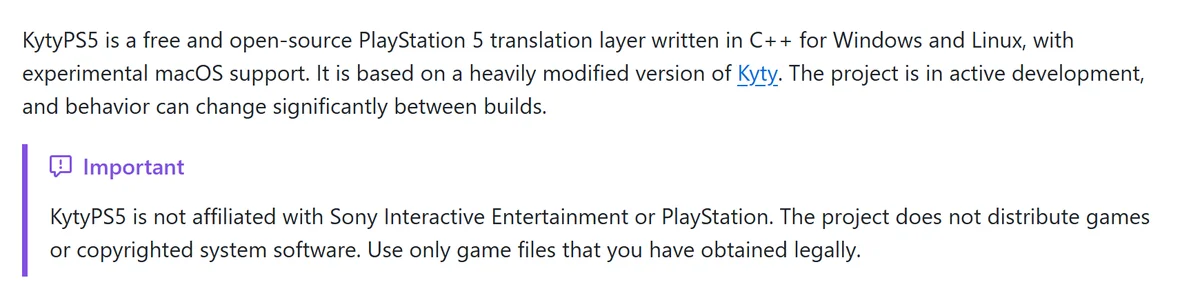 Figure: the top of KytyPS5’s README. Note that it calls itself a “translation layer,” not an emulator; the notice below it comes up again in the legal section (captured 2026-11-15, source: GitHub)
It has moved fast. Notebookcheck’s July 14 report said KytyPS5 0.0.3 could only take GTA V as far as its menus and settings. By the end of September the team was posting weekly progress updates in GitHub Discussions, and a single week would see several games marked as reaching gameplay.
Two project rules say a lot about its character. First, the README states that pull requests that don’t address a concrete problem in a specific game are closed automatically, and that includes general fixes, architectural changes and refactoring. So this project advances one game at a time: whichever game is stuck, that’s what gets fixed. Second, contributors may use AI tools for research, reverse engineering and development, but pull requests must disclose how much AI was involved, and communication in issues and pull requests must come from the human contributor rather than an autonomous AI agent.
It doesn’t actually emulate the CPU: what does “translation layer” mean?
You may have noticed that KytyPS5 introduces itself not as an “emulator” but as a “PlayStation 5 translation layer.” That wording isn’t modesty. It describes how the thing works.
The PS5’s CPU is an AMD Zen 2 x86-64 processor and its GPU is AMD RDNA 2; KytyPS5’s developer notes say outright that the PS5 graphics architecture is “based on AMD RDNA 2.” If your computer has an Intel or AMD x86-64 CPU, it speaks the same machine language as the PS5, so KytyPS5 has no need to emulate the PS5’s CPU instruction by instruction. The author of EmuFive put it most plainly when explaining why KytyPS5 needed modifying: “KytyPS5 does not emulate the PS5’s CPU: it runs the game’s own x86-64 code directly.” The game’s own code runs straight on your CPU.
The way I read it, this is closer to Wine or Proton on Linux: the Windows game’s code runs as-is, and Wine swaps its calls to Windows for things Linux can do. KytyPS5 has a few pieces to swap:
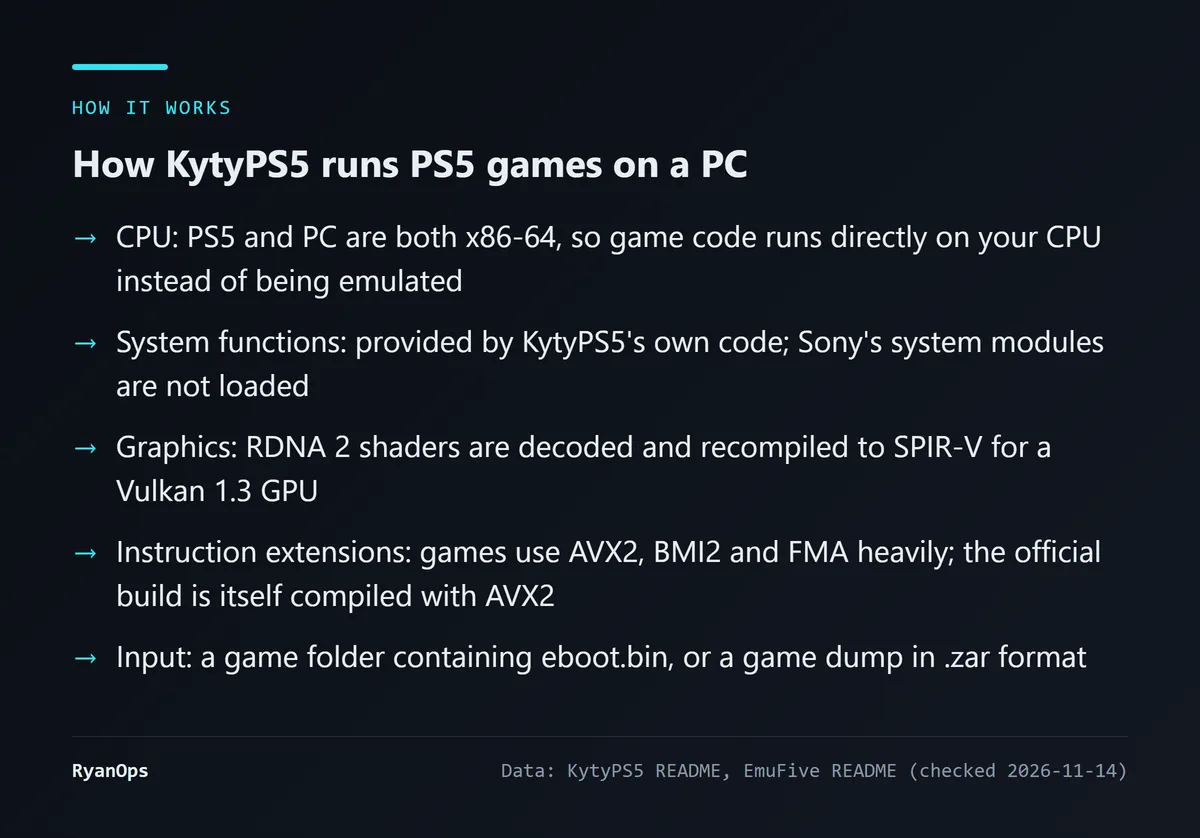 Figure: how KytyPS5 works (data: the KytyPS5 and EmuFive READMEs)
- System functions: PS5 games call Sony’s system libraries for files, sound, video and controllers, and KytyPS5 has to provide that functionality with its own code. The README specifically says “External low-level emulation modules are neither required nor planned,” meaning it neither needs nor plans to load Sony’s system modules. That matters legally, and I’ll come back to it.
- Graphics: this is the hardest part. The game’s shaders are compiled to RDNA 2 instructions, and KytyPS5’s shader recompiler has to decode them, turn them into an intermediate representation, and emit SPIR-V for Vulkan to hand to your graphics card, which is why it requires Vulkan 1.3. GTA V’s weekly updates include entries like “added the missing DS_WRITE_B8_D16_HI instruction” and “added PS5 BVH ray intersections.” That’s the work happening here.
- CPU instruction extensions: both are x86-64, but PS5 games use instructions such as AVX2, BMI2 and FMA heavily. EmuFive’s documentation notes that the official KytyPS5 build is itself compiled with AVX2 and stops with “Illegal instruction” on the PS4’s CPU. By the same logic, an older PC CPU without AVX2 presumably can’t run the official build either.
KytyPS5 lists these minimum requirements: Windows 10 version 1803, or a current Linux distribution, a 64-bit x86 processor, and a Vulkan 1.3-capable graphics card with current drivers. macOS is still experimental: it runs the x86-64 build under Rosetta 2 with Vulkan provided by MoltenVK, and only a small number of games have been verified in-game on Apple Silicon.
The game format it takes is a game folder containing eboot.bin, or a game dump in ZArchive (.zar) format. “Dump” is the legally loaded word in this whole story. Keep it in mind.
How does GTA V run on KytyPS5? I pieced the timeline together
There are plenty of claims online, from “runs at 60 fps” to “already playable.” I lined up the project’s own records in order:
- July 14: Notebookcheck reported that KytyPS5 0.0.3 could boot the PS5 version of GTA V as far as its “menus and settings,” and stressed that this covered only the loading process, the menu screen and the settings interface.
- September 21–27: the first official weekly update added a missing GPU instruction for GTA V, and also said “Prologue crashes are still being reported.”
- September 24: user DenizSAHIN570 opened issue #810, consolidating the scattered earlier GTA V reports into one. The test used PPSA04264 (game version 01.005.000), emulator build 2026-09-24-2aaf0c9, on Linux.
- September 28–October 4: the weekly update said “GTA V reaches gameplay in both Performance and Performance RT modes.”
- October 7: the most recent test date for GTA V on the compatibility list. Windows and Linux are currently marked in-game and macOS doesn’t boot, with one report per operating system.
Issue #810 is the most useful of these to me, because it tests GTA V’s three graphics modes separately and states exactly which builds were used:
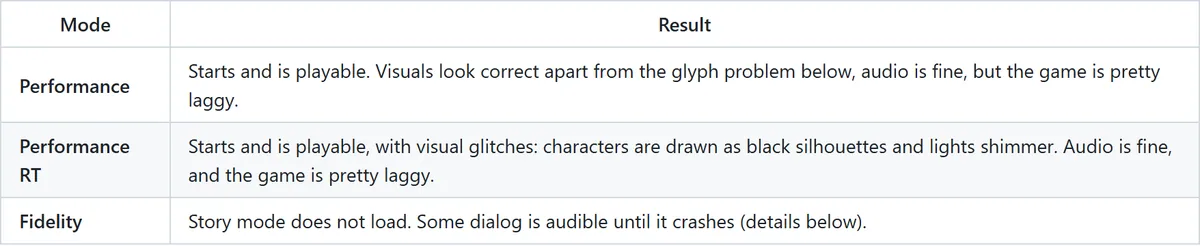 Figure: test results for the three graphics modes in issue #810 (captured 2026-11-15, source: GitHub issue #810)
In short: Performance mode starts and is playable, the picture looks broadly right apart from some glyphs that don’t render, the audio is fine, but it’s “pretty laggy.” Performance RT is also playable, but characters are drawn as black silhouettes and lights shimmer. Fidelity mode won’t even load story mode; you hear some dialogue and then it crashes. The maintainers had said in another pull request that Fidelity mode uses ray tracing, which KytyPS5 didn’t support at the time.
On September 29, contributor TheCruZ then posted three pull requests addressing the missing glyphs, a depth texture upload error, and a second Fidelity mode crash. None of the three was merged: #927 was closed on October 5, and the other two were closed on October 19 together with #1258, titled “run GTA V’s ray tracing dispatches.” TheCruZ carried on in a personal fork, TheCruZ/KytyPS5-GTA. It was created on September 28, describes itself as focused on making GTA run smoothly and finding bugs to push back to the main repo, and had reached v23 by November 13.
So for GTA V reports from October on, you have to tell the main branch and this fork apart:
- Main branch, October 22 (issue #1835): build 2026-10-22-f5f4e7d, Ryzen 9800X3D with an RTX 5080. Cutscenes at 60 fps with some tiny freezes, gameplay averaging around 25 fps (between 20 and 60), and a crash after about 10 minutes roaming the city; starting without a save file, it still crashes just before the prologue.
- Fork v17, November 1 (issue #2053): Ryzen 5 5600 with an RX 7900 XT. The reporter calls it “fully playable,” with 70 to 120 fps in Performance mode, 20 to 40 fps in Performance RT during the day, and around 10 to 20 fps in Fidelity.
- Fork v23, November 13 (a comment on issue #829): a user who is also on an AMD graphics card reports that Fidelity mode still runs at 9 to 10 fps, and that this build now crashes shortly after launch.
All three are single users on their own hardware, so none of them is a general rule. But the overall picture is clear: the main branch isn’t stable yet, the smoother build depends on a fork maintained by one person, and Fidelity mode’s last recorded result on the main branch is a crash, with only around 10 to 20 fps on the fork.
There’s another set of frame rates going around online, from discussion #1937, posted on October 27. It’s titled “Road to GTA VI,” and its author, Ekt0re, lists games they think an emulator needs to run well first, as milestones on the way to GTA VI. The GTA 5 entry says “in game,” with frame rates of “min 45, max 60, avg 56 on RTX 5060; min 63, max 112, avg 75 on 4090 Ti,” and says the main branch “struggles from time to time” while TheCruZ’s fork runs it well in both Performance and Fidelity modes.
I’d discount those numbers heavily. The author’s own post says it is “all imagination and speculation” and calls the frame rates, taken from users’ public tests, a “very approximate figure.” It gives no CPU and no emulator build. And NVIDIA never officially released an RTX 4090 Ti; PC Gamer reported back in 2023 that the card had reportedly been cancelled. That alone makes the source of those numbers questionable.
Ekt0re closes with a line I think is fair: “this is less of a roadmap toward GTA VI and more of a roadmap toward the emulator’s stability and functionality.”
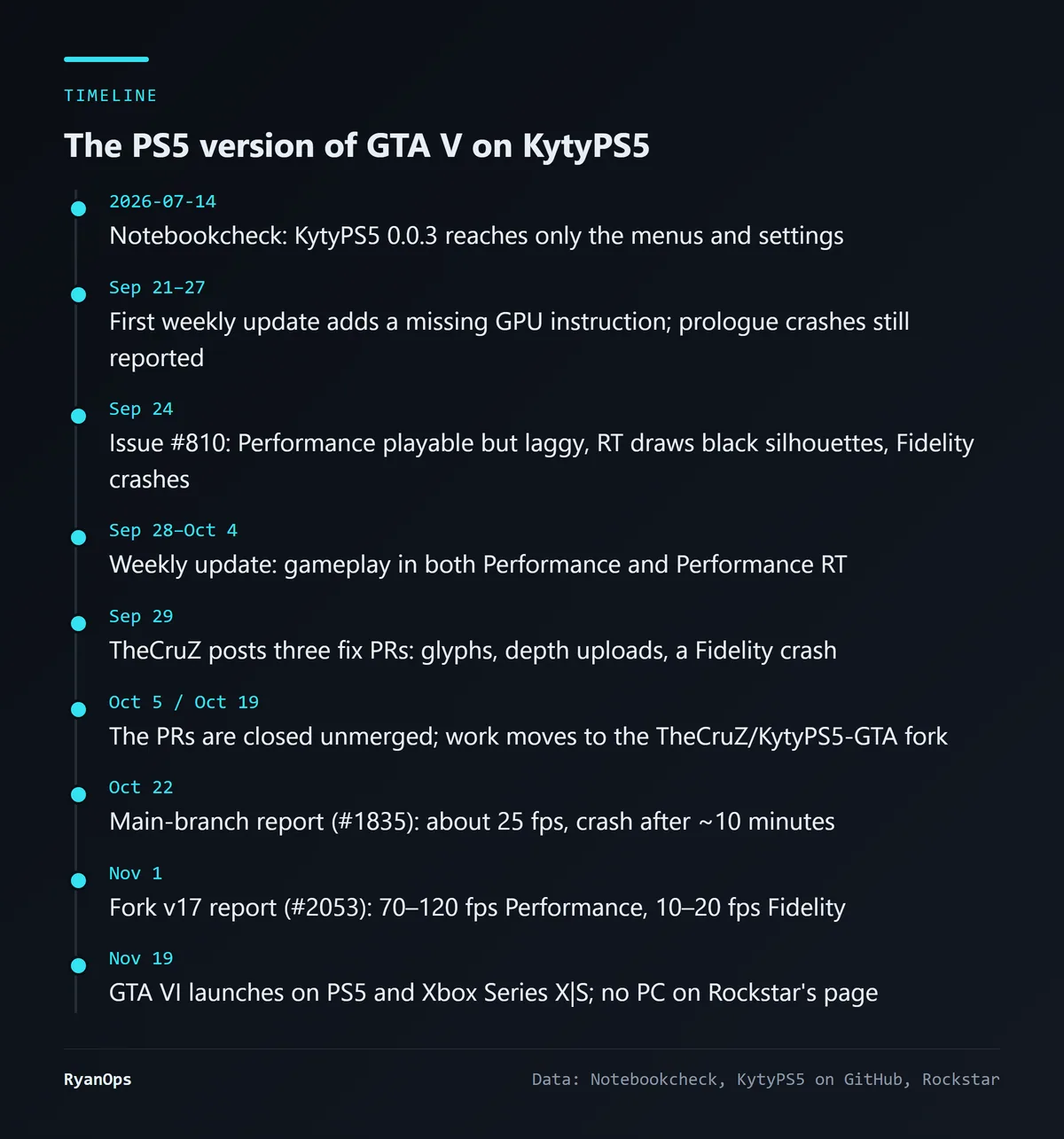 Figure: GTA V’s progress on KytyPS5 (data: Notebookcheck, KytyPS5 weekly updates, issues #810, #1835 and #2053, TheCruZ’s pull requests and fork, Rockstar’s website)
One more thing that’s easy to miss: the highest tier on KytyPS5’s compatibility list is “in-game.” There is no “playable” tier. I pulled the list’s raw data and counted: as of November 15 it covers 463 games, with 278 in-game, 68 at the main menu, 64 at the logo and 53 that don’t boot. In-game means “reaches the game screen,” not “can be played start to finish.”
KytyPS5, SharpEmu and EmuFive compared
I also looked at the two other projects it usually gets compared with. These are the numbers I got from the GitHub API, for October 15 to November 14, 2026, counting only commits on the default branch, so they may differ slightly from figures you see elsewhere.
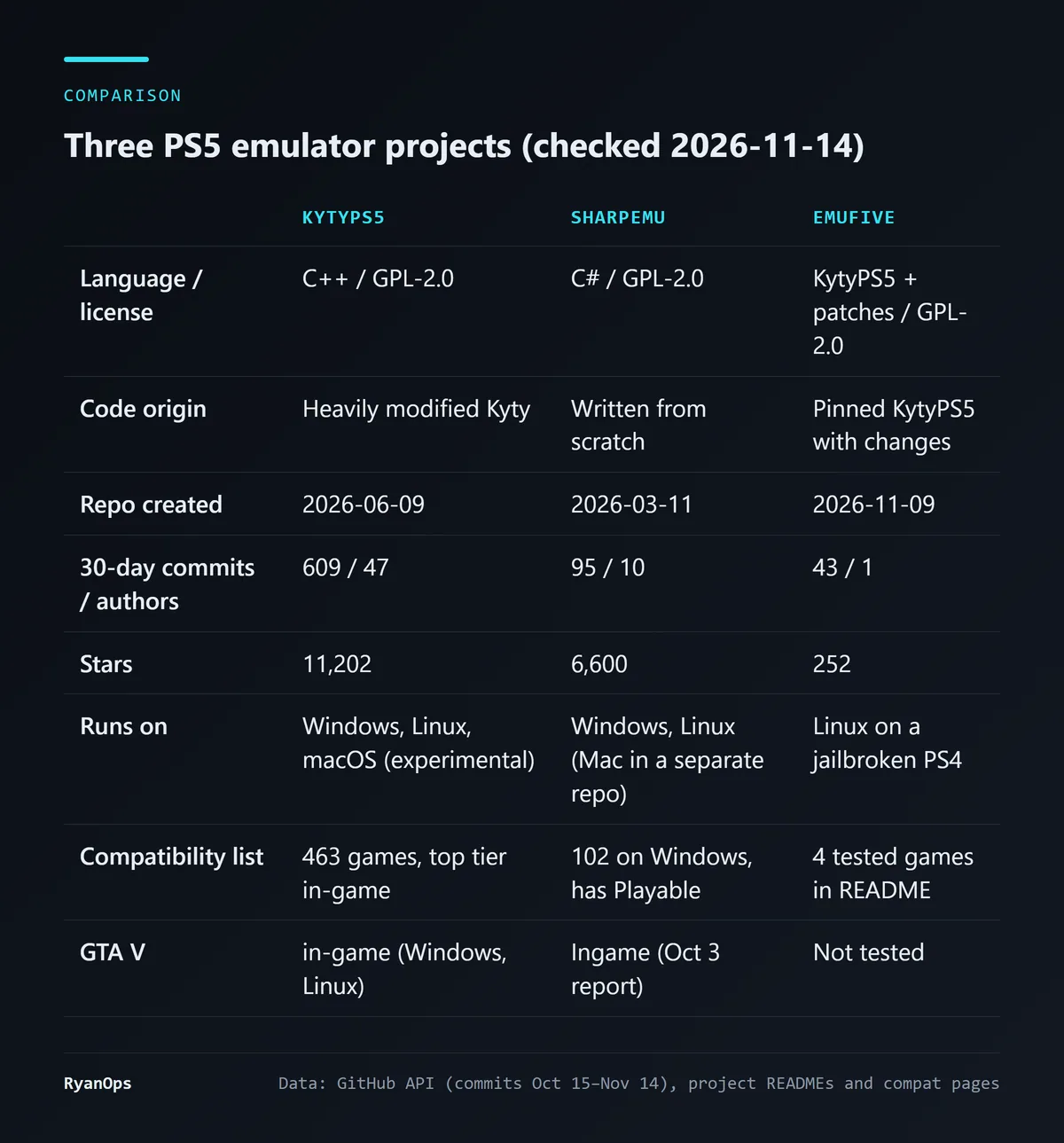 Figure: three PS5 emulator projects compared (data: GitHub API, commits from 2026-10-15 to 11-14; each project’s README and compatibility page)
KytyPS5: 609 commits from 47 distinct authors in 30 days, about 20 a day. C++, GPL-2.0.
SharpEmu: 95 commits from 10 authors in 30 days. It’s written from scratch in C#, and its repository was created on March 11, 2026, earlier than KytyPS5’s. Its README points in almost the opposite direction: “The current focus is on accuracy and infrastructure setup rather than game-specific compatibility.” It also has an experimental PS4 backward compatibility mode, with screenshots of Bloodborne and Uncharted: The Nathan Drake Collection in the README. It supports Windows and Linux, with the macOS version kept in a separate sharpemu-mac repository.
SharpEmu’s compatibility database does have a “Playable” tier. The numbers I saw were 102 games tested on Windows: 46 Playable, 26 Ingame, 6 Menus, 13 Boots and 11 Nothing. GTA V is on it too: the October 3 report says Ingame, with the note “Reach in game, some minor graphical artifacts. Performance heavy.”
The two sets of compatibility numbers can’t be compared directly. SharpEmu has tested 102 games and KytyPS5 lists 463, the tiers are defined differently, and both rely on user reports, with people testing whatever games they care about. What you can say is that KytyPS5 has far more games tested, while SharpEmu has an extra, stricter Playable tier.
EmuFive is the one where the common impression needs correcting. It isn’t a third independent PS5 emulator; it’s KytyPS5 with modifications. Its author, blue0x1, pins KytyPS5 at a specific commit, applies their own patches, recompiles it for the PS4’s AMD Jaguar CPU, and packages it as a Linux system that boots on a jailbroken PS4. Jaguar lacks AVX2, FMA and BMI2, so its key patch, number 0004, rewrites those instructions into equivalent SSE4.2, AVX and BMI1 code when a game module loads. The author reports finding 287 instruction forms in God of War Sons of Sparta and compared the registers, flags and memory results for every one.
The results are better than I expected: on a PS4 Pro, Sons of Sparta runs at about 40 FPS and more, Hollow Knight: Silksong at 50 to 60 FPS, and Plants vs. Zombies: Replanted at a locked 60; on a PS4 Slim, Vampire Survivors holds a stable 60. These are all fairly light games, though. EmuFive’s repository was only created on November 9, and its 43 commits in the 30-day window are really all from the last week, every one by the author.
So if you count only PS5 emulators that run on a computer and have their own codebase, there are two of any size right now: KytyPS5 and SharpEmu. Most of the rest are KytyPS5 forks, such as Cosmo/KytyPS5, named in the README, which ports it to the Xbox Series X with a Direct3D 12 renderer, and the TheCruZ version mentioned in #1937.
The legal side: case law backs emulators, until decryption comes in
The conclusion first: writing an emulator is, in itself, something US case law has sided with developers on. But if the emulator has its own built-in way of breaking encryption, or the game files come from somewhere questionable, the risk is entirely different. What follows is my summary after reading the statutes and the ruling. It isn’t legal advice.
The emulator itself: the case cited most often is Sony v. Connectix, decided by the US Court of Appeals for the Ninth Circuit on February 10, 2000. Connectix made software called Virtual Game Station that let Macs play original PlayStation games. During development they extracted Sony’s BIOS from a console chip and copied it into memory repeatedly for reverse engineering, and Sony sued for infringement. The court held that this intermediate copying during reverse engineering “were protected fair use” and reversed the injunction. The key was that the finished product contained no Sony BIOS.
KytyPS5 and SharpEmu both stay carefully on that side of the line. KytyPS5 states that it “does not distribute games or copyrighted system software,” and as mentioned it doesn’t need Sony’s system modules. SharpEmu’s contribution guide explicitly bans submitting “Sony proprietary code, firmware, keys, decrypted assets,” and requires reverse engineering to be based on public information, clean-room techniques or one’s own research.
The game files are the problem: both projects require users to use legally obtained games. SharpEmu says the games it uses for development and testing are all “dumped from consoles that we personally own.” The catch is that turning a PS5 game you legally bought into an eboot.bin folder KytyPS5 can load requires, as I understand it, a jailbroken PS5. Decrypt reported on September 29 on a public jailbreak called Relapse that supports system software 7.00 through 13.60, one of whose uses is running “game backups”; consoles updated to 14.00 on or after September 16 can’t use it. Separately, in an August court filing in a class action brought this June, Sony pointed to the line in its license terms saying the software is “licensed to you, not sold.”
What does Taiwanese law say? I read the Copyright Act on Taiwan’s national laws and regulations database:
- Article 80-2, paragraph 1: technological protection measures a copyright holder uses may not be cracked, damaged or circumvented without lawful authorization. A violation carries civil liability for damages under Article 90-3.
- Article 80-2, paragraph 2: equipment, devices, components, technology or information for cracking, damaging or circumventing those measures may not be manufactured, imported, offered for public use or offered as a service to the public without lawful authorization. Violating this paragraph is a criminal matter: Article 96-1 provides for up to one year in prison, detention, or a fine of NT$20,000 to NT$250,000, or both.
- Article 80-2, paragraph 3 lists ten exceptions, including “encryption research” and “reverse engineering.” But the specifics of each are set separately by the competent authority, and I didn’t read those guidelines, so I can’t tell you whether “jailbreaking your own console and dumping your own game to play on a PC” counts as an exception. My own view is that it would be hard to fit.
In other words, in Taiwan, cracking your own console is mainly a civil risk, while making or distributing circumvention tools is where criminal liability comes in. Downloading a game someone else dumped is reproducing someone else’s work, and that’s no longer an emulator question at all.
US precedent: Yuzu and Ryujinx. In early 2024 Nintendo sued Tropic Haze, the developer of the Switch emulator Yuzu, alleging violations of the DMCA’s anti-circumvention and anti-trafficking provisions, on the grounds that without Yuzu’s decryption of Nintendo’s encryption, pirated games couldn’t run on PCs. One of Nintendo’s allegations in the complaint was that The Legend of Zelda: Tears of the Kingdom leaked before its official release, that pirated copies were downloaded more than a million times, and that they were playable on Yuzu. Tropic Haze settled in March 2024, paying $2.4 million, stopping development and surrendering its domain. Around October 1 the same year, another Switch emulator, Ryujinx, went offline after Nintendo contacted its lead developer, gdkchan; reports describe that as an agreement between the two sides rather than a DMCA takedown.
There’s a difference here that matters for KytyPS5: Nintendo’s case against Yuzu targeted the fact that Yuzu itself decrypted Nintendo’s encryption. Going by its README, KytyPS5 doesn’t distribute games or copyrighted system software and takes game dumps the user has prepared. That keeps it further from “distributing circumvention tools,” but it also hands the cracking step to the user.
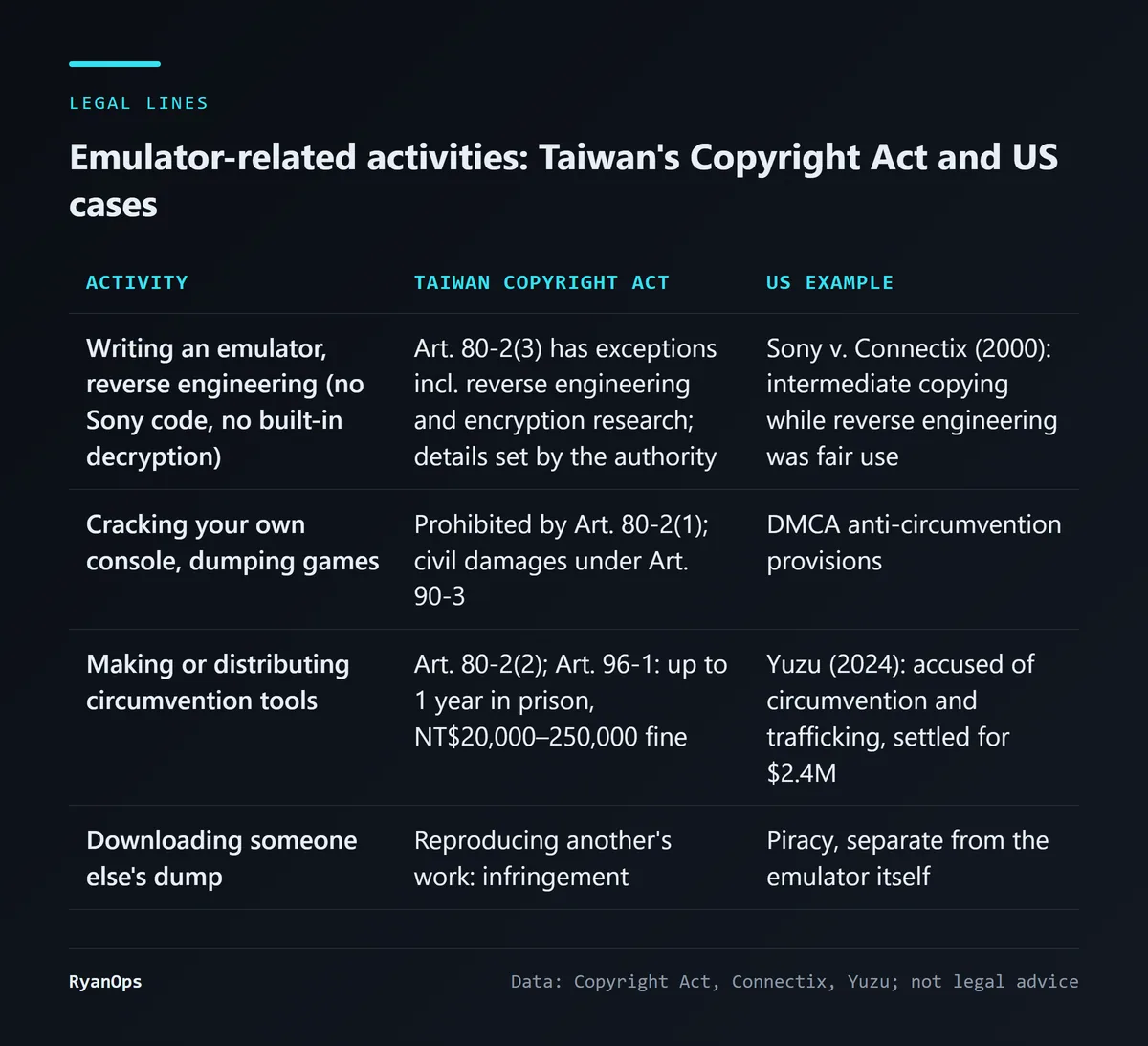 Figure: where the legal lines fall for emulator-related activities (data: Taiwan’s Copyright Act from the national laws database, the Sony v. Connectix ruling, reporting on the Yuzu settlement; not legal advice)
What I see in common between the two cases is that the risk spikes when an emulator becomes the way to play a hot new release around launch, and when the project is making money. The figure cited in Nintendo’s complaint was that Yuzu’s Patreon was bringing in about $30,000 a month at the time. The GTA 6 launch is exactly that kind of moment, and the only reply under #1937 says “prepare for the takedowns,” so the community knows it too. For what it’s worth, KytyPS5’s README has no donation link, while SharpEmu accepts GitHub Sponsors and cryptocurrency.
Can you play GTA 6 on PC through an emulator on launch day?
Not realistically. Technically, the PS5 version of GTA V is a port of a game that’s several years old, and on KytyPS5’s main branch the October 22 report still had it averaging about 25 fps and crashing after roughly ten minutes of roaming. The GTA-focused fork has a report of smooth Performance mode, but Fidelity mode there only gets 10 to 20 fps, and one user says the latest build crashes right after launch. GTA 6 has only been announced for PS5 and Xbox Series X|S, and my guess is that it will lean on GPU features even more heavily than GTA V. That’s a guess, though, and we won’t know until someone actually tests it.
Then there’s getting the game. To run GTA 6 in an emulator you first need a dump of it. As covered above, turning a copy you legally bought into a dump takes a jailbroken PS5 still sitting on old system software. Unfortunately, on October 3 Notebookcheck cited a leak from a datamining account saying the GTA 6 release build requires system software 14.10, released on October 1, while Relapse stopped working from 14.00. That’s a leak, and neither Sony nor Rockstar has confirmed it. The only route left is piracy, and that’s not academic research anymore.
Final thoughts: buy a console or wait for the PC version
PS5 emulators like these have always lived on the legal edge. Yuzu’s fate shows that once an emulator is tied to revenue and to hot new releases, it can easily be sued out of existence, so these projects are almost never going to be commercial. Without that, there’s no full-time team and no testing budget, and the quality has a hard time reaching the stability of a real product: KytyPS5’s compatibility list tops out at “in-game,” GTA V still crashes on the main branch, and the smoother build depends on a fork maintained by one person.
That also decides who uses it. Mostly it’s developers and players who can compile code, read a log and dump their own games, researching and playing for themselves. From an academic point of view it’s well worth following: you get to watch a group of volunteers translate RDNA 2 shaders into Vulkan and push games forward one at a time until they run. But if you just want to play GTA 6 on November 19, the answer is simple: buy a PS5 or an Xbox Series X|S, or wait for Rockstar to announce a PC version.


